
Can You Play Mahjong with 5 People? Rules & Alternatives
Last updated: Nov 23, 2026
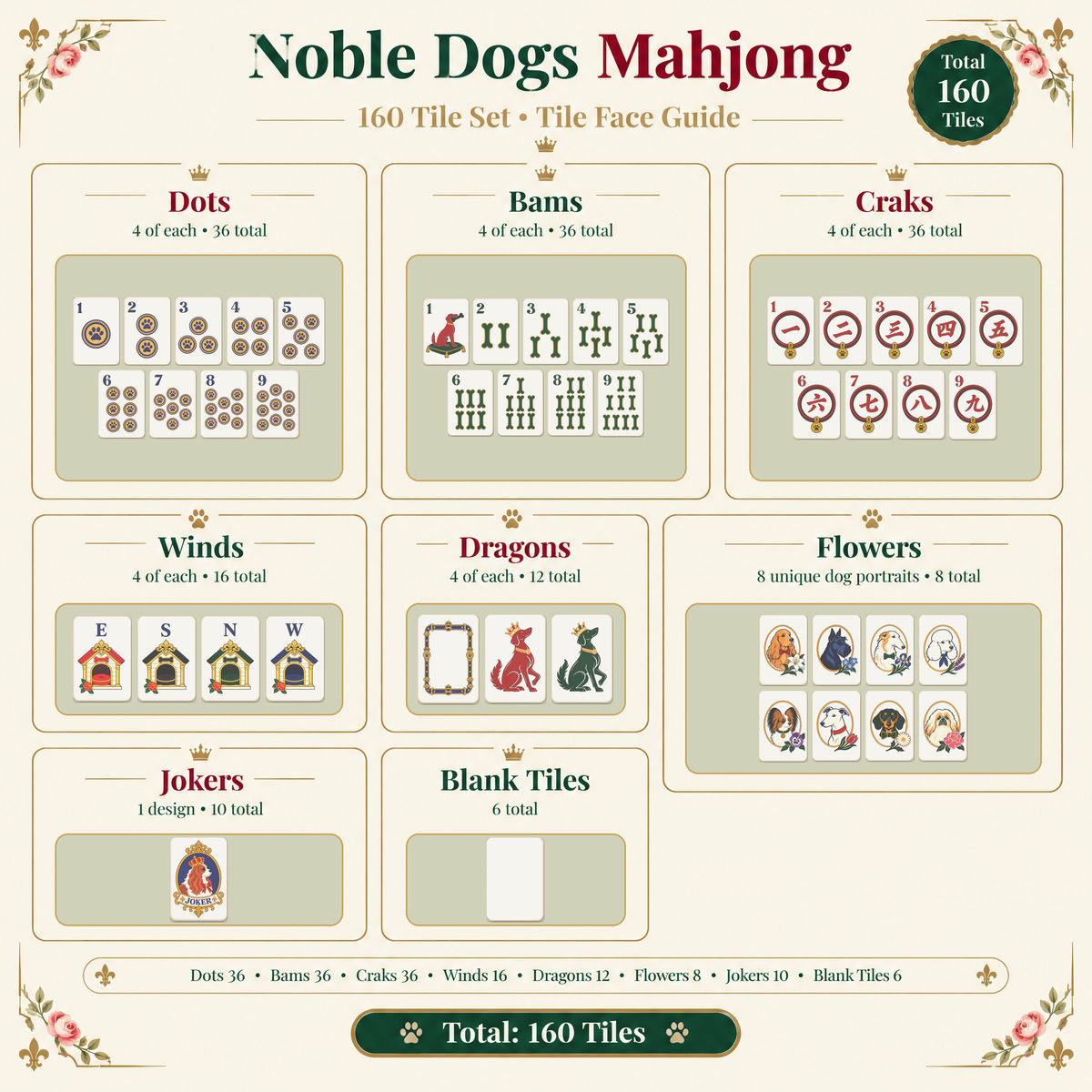
No—American mahjong is strictly a four-player game. The game mechanics, tile distribution, Charleston ritual, and scoring all depend on exactly four players. If you have five, you have three honest options: rotate one person out each hand (most common), play a regional 5-player variant (Hong Kong or Taiwanese mahjong use different tiles and structures), or invite a spectator to learn while sitting out. Some groups invent house rules to squeeze in a fifth, but this breaks the core math—wind assignments, wall draw sequences, and hand validity all depend on the four-player model. The cleanest solution: play with four, keep a fifth as scorekeeper or next-round player, and swap every 10 minutes. That's how we manage it at our table.
Why does American mahjong require exactly four players?
American mahjong allocates tiles, winds, and drawing order by the four cardinal positions—East, South, West, North. With 152 tiles split four ways, each player draws 13, and the discard wall serves 4 directions. Adding a fifth breaks wind assignment, wall geometry, and the dealer rotation. The hand validation (checked against the current year's National Mah Jongg League card) assumes four distinct hands competing. Removing or adding a player means re-drafting the Charleston and re-calculating who discards when—it cascades into chaos. We've tried it; someone always gets stuck without a clear draw order or winds collide.

What's the most practical way to include a fifth player?
Rotation method: Play four-player games in 12–15 minute rounds. After each hand, the fifth player rotates in (usually taking the position of whoever had the worst score or volunteering). Keep a running score sheet across multiple rounds. This is how most casual groups handle Thanksgiving or family game nights. The advantage: no rules to invent, everyone plays equally, and the game stays legitimate. The downside: someone sits out each hand, which feels like a penalty if they're competitive. To offset this, some groups give the sitting player the role of scorekeeper, wall supervisor, or "flavor commentator"—it keeps them engaged and invested.
Can you play a legitimate 5-player mahjong variant instead?
Yes. Hong Kong mahjong and Taiwanese mahjong both have 5-player formats and are played worldwide. They use different tile counts, hand-building rules, and scoring. For example, Hong Kong 5-player uses 144 tiles (or variants with 152+) and redistributes seats to accommodate five. Riichi mahjong (Japanese) is played 3–4 players, not five. If your group is interested in variants, you'll need a different ruleset, tiles designed for that game, and everyone learning new hand patterns. This is a full commitment—not a casual swap. We recommend learning how to play American mahjong first, then exploring variants later if the group wants a second skill.
🀄 Shop best-selling mahjong sets →
What happens if you break the four-player rule and play anyway?
Chaos. We tested it years ago at an experimental game night. With five players, the wind rotation becomes asymmetrical—someone is always in a position where the dealer or draw order doesn't make sense. Hands stop validating against the card. The Charleston (the pre-game tile exchange) requires exactly four people passing in sequence; a fifth person either passes twice or sits out the exchange, creating unequal tile access. Scoring breaks because payment flows assume four players, not five. One person inevitably feels wronged. Most importantly: you're no longer playing American mahjong—you're playing a house variant no one else recognizes. If that's your goal, great, but be honest about it and write down the rules so the next group knows what they're signing up for.
Should a fifth person sit out as a spectator or scorekeeper?
Absolutely. This is underrated. A scorekeeper role transforms downtime into active participation. They track points, call out invalid hands early, remind players of the hand pattern, and manage the hand change ritual. We've found that a sharp scorekeeper actually improves game quality—fewer disputes, faster play, and a learning opportunity for newcomers. A spectator who's studying the game but not yet ready to play is also valid. They can watch three full hands, ask questions in real time, and join the next round. If your fifth person is a beginner, this is ideal: they observe the Charleston, see how the card works, and notice what beginners commonly mistake. By the time they sit in, they've got baseline confidence.
✨ Find your Mahstead set — free US shipping →
How do you keep score across rotating players fairly?
Use a cumulative scoresheet. Track each player's running total across all rounds, not per hand. If a player sits out for two consecutive hands, they start the third hand with the same score they left off with. Document who played which hands so you can audit scores later. We use a simple table on a notepad:
Player | Hand 1 | Hand 2 | Hand 3 | Hand 4 | Hand 5 | Total |
Alice | 20 | — | 15 | 25 | 30 | 90 |
Bob | — | 10 | 20 | — | 25 | 55 |
Carol | 30 | 25 | — | 20 | — | 75 |
Dave | 15 | 20 | 25 | 30 | 20 | 110 |
Ellen | 10 | 30 | — | — | 15 | 55 |
The dashes indicate who sat out. At the end of five hands (or however many you play), the highest cumulative score wins. This method is fair, transparent, and works equally well if someone joins late or leaves early.
What equipment do you need for a rotating-player format?
For four-player games with a fifth sitting out, you need the standard 152-tile American mahjong set. A fourth player's set is unnecessary. What does matter: a clear playing surface (mat keeps tiles organized and reduces noise), individual racks with pushers so tiles don't spill during rotations, and a clean scoresheet visible to all players. A travel bag or case ensures your set survives the shuffle between hands and players. If your group is meeting regularly, consider engraved sets with house titles—they add personality and make it clear whose set is whose during the rotation.
🎁 See our most-loved mahjong sets & accessories →
What to check before you buy a set for a rotating-group setup
Tile clarity: Choose a set with clear, crisp engravings or printing so all five people can read tiles from across the table (matters when someone's sitting off to the side).
Rack durability: If your fifth player will be handling tiles frequently as they rotate in and out, racks take the abuse. Check that pushers slide smoothly.
Scorekeeping space: If you're tracking a running total, ensure you have paper or a whiteboard visible to the scorer. Some mats have built-in scoring panels.
Set completeness: Verify the set includes 8 jokers and all 152 tiles. A 160-tile set from Mahstead gives you spares so you're never caught short if a tile cracks.
Storage for the scoresheet: Keep your rotating-player rules and score template in the bag or case so new players see them immediately.
Key takeaway
American mahjong is a four-player game—adding a fifth without changing rules breaks the mechanics. The best solution is to rotate a fifth player in and out each hand, keeping one person as scorekeeper or spectator. If your group is committed to five-player mahjong, learn a regional variant like Hong Kong mahjong instead. For casual groups, stick with the rotation method: it's fair, easy to explain, and keeps everyone engaged. Start with a best-selling set, set up a scoresheet, and swap players every 12–15 minutes. That's how we do it, and it works.

FAQ
Can you play American mahjong with more or fewer than four players?
American mahjong is strictly four players. Fewer than four: read our guide on 2- and 3-player mahjong rules for legitimate variants. More than four: rotate players out, or switch to a regional variant like Hong Kong or Taiwanese mahjong that supports five or six.
If I rotate a fifth player, do I need two sets or just one?
One set is enough. Only four people play each hand. The fifth person sits out, and no additional tiles are needed. A single 160-tile set with spare tiles ensures you're never short during rotations.
How often should I swap the fifth player in?
After each complete hand (about 12–15 minutes). This keeps the game moving and ensures everyone plays roughly equally over the course of an evening. If someone is learning, let them sit out 1–2 hands to observe first.
Does the Charleston work with a fifth player sitting out?
No—the Charleston requires exactly four players passing tiles in sequence. The fifth person waits for the exchange to complete, then joins for the draw. This is why the rotation method works: the fourth-player mechanics stay intact.
What if I want to play five-player mahjong legitimately?
Switch to Hong Kong, Taiwanese, or another regional variant. They have 5-player rules, different tile counts, and distinct hand patterns. You'll need a new ruleset and tiles designed for that game—it's a full commitment, not a casual house rule.
Is there a house rule that lets five people play American mahjong?
Technically yes—you can invent one. But it will break wind assignment, hand validation, and scoring. We don't recommend it unless everyone agrees upfront that you're playing a custom game, not American mahjong. The rotation method is cleaner.


View More
View More
View More
