
British Mahjong Rules: How It Differs from American Play
Last updated: Nov 23, 2026
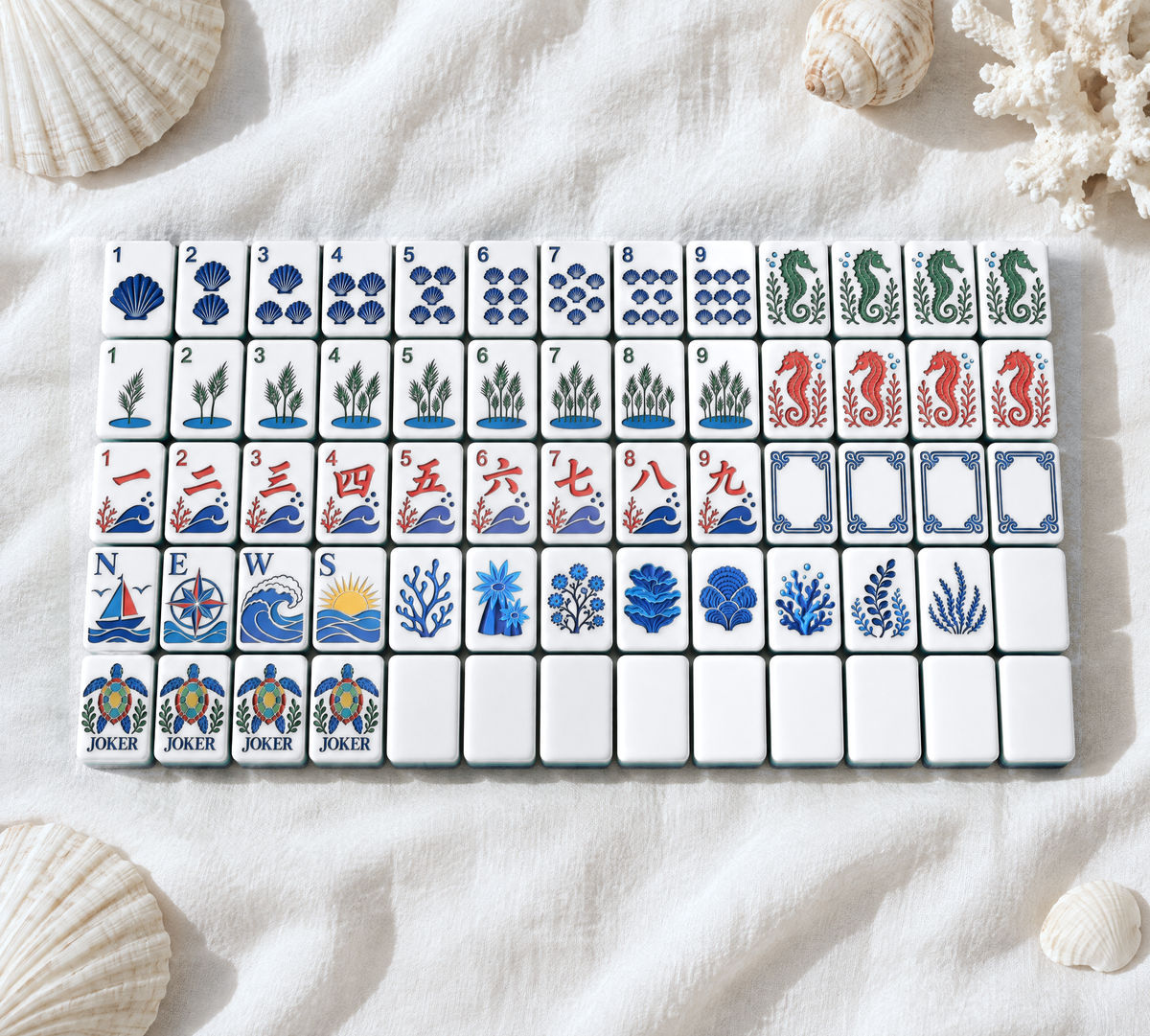
British mahjong uses 152 tiles (same count as American) but differs in core mechanics: there is no Charleston; players draw tiles one by one in rotation before forming hands; the card system lists patterns to complete, but not from an annual league deck; jokers exist but work differently than in American play; and scoring reflects longer walls and faster elimination. Games typically last 8–12 rounds per session. The ruleset evolved from Hong Kong mahjong in the 1960s and remains popular in UK clubs, particularly among players who prefer less ritual before dealing and more classical hand structures. No official NMJL card exists; groups often use printed or digital hand guides. If you're transitioning from American play, expect simpler tile-passing rules but steeper hand memorization. Mahstead's best-selling mahjong sets work for British play—152-tile counts are standard—though you'll need to source or print your own hand reference card.
What are the core tile differences between British and American mahjong?
Both games use exactly 152 tiles: three suits (Bams, Craks, Dots) numbered 1–9 with four copies each, plus 16 winds, 12 dragons, and 8 flowers. British and American tile counts are identical. The key difference lies in how they're used: American mahjong allows only exposed pungs, kongs, quints, and sextets (plus joker substitutions), while British play permits exposing single tiles and pairs earlier in rounds, and joker rules are more permissive. Both games use standard ivory or bone acrylic tile faces, so a single 160-tile acrylic set works for either variant—just follow the ruleset of your group.

How does British play work without a Charleston?
In British mahjong, there is no pre-game Charleston tile exchange. Instead, one player (East/the dealer) begins with 14 tiles; the other three start with 13. Players draw one tile per turn from the wall in strict order—East draws first. Crucially, you may call loose tiles (unattached tiles) from previous discards if they complete your hand, not just the last discard, making the game faster-paced and less positional than American play where only the player to the discarder's right can call. This flattens the advantage of sitting order. British rounds typically run 12–20 minutes; American rounds 20–40 minutes due to Charleston overhead and hand-card lookup delays. Both are social paces; neither is speed mahjong.
What hand structures does British mahjong follow?
British mahjong hands are based on a printed or digital hand card showing valid combinations—similar to American pattern recognition, but not from the National Mah Jongg League. Cards typically list sections (e.g., "All Pungs," "Consecutive Sets," "Mixed Honors") and may be reissued annually by UK mahjong associations or regional clubs. Hands favor classical shapes: all single suit, mixed dragons and winds, consecutive number runs. American play restricts runs (chows) to non-exposed tiles only; British play is more flexible, allowing runs to be called and exposed more freely. Hand cards do circulate among players at the table, and consulting one during play is standard courtesy, unlike American play where card-checking happens between turns. This reduces friction and speeds play significantly.
How does British scoring differ from American mahjong?
British mahjong scoring is simplified compared to American's complex doubling system. Most British groups use a flat base: completing a hand earns a fixed point value (often 1 point per tile in hand, or a round score of 4 per player). There are no "limit hands," "all kongs," or "all honors" multipliers—just a basic clean vs. concealed bonus (hand won without any called tiles scores higher than one with exposed sets). American scoring rewards rare hand patterns with 2× to 8× doubling; British scoring treats all completed hands equivalently, making it accessible to newer players. Games conclude when one player reaches a threshold (often 100–150 points) or after a fixed round count (often 4 or 8 rounds per session). Scoring sheets are simpler: a pad with player names and running tallies suffices, no need for the American-style reference tables.
What should transition players from American to British know?
If you've played American mahjong and move to British, expect: (1) faster setup—no Charleston means games start in minutes; (2) looser discards—calling earlier discards shifts strategy away from seat-based advantage; (3) card-sharing—the hand guide is open on the table, not private; (4) shorter rounds and simpler scoring—math is mental arithmetic, not reference tables. Common mistakes: assuming American hand cards work (they don't—the patterns differ), forgetting loose-tile calling rules and missing scoring opportunities, or mixing joker substitution rules (British is more permissive; check your group's house rules). British clubs often post rule summaries; ask before your first session. Most players pick up the rhythm in 2–3 games. The tile set itself—our best-selling mahjong sets—transfers seamlessly; only the rulebook and hand card change.
Aspect | American Mahjong | British Mahjong | Who Wins? |
Tile count | 152 + 8 jokers | 152 + jokers (variable) | Tie |
Pre-game exchange | Charleston (3 passes) | None; draw-in-turn | British (faster start) |
Loose tile calls | Last discard only | Any previous discard | British (more flexible) |
Exposed sets | Pungs, kongs, quints, sextets; no runs | Runs allowed; more permissive | British (easier patterns) |
Hand reference | Annual NMJL card | Group-printed or digital card | American (standardized) |
Rounds per session | 4–8 | 4–8 (faster play time) | Tie |
Scoring | Multiplied (2×–8× for rare hands) | Flat base + simple bonuses | American (strategic depth) |
Game duration | 2.5–4 hours | 1.5–3 hours | British (quicker finish) |
🀄 Shop best-selling mahjong sets →

Is British mahjong played in clubs, or mainly at home?
British mahjong thrives in both settings. Official clubs exist in London, Manchester, Birmingham, and other UK cities, usually affiliated with regional associations that publish hand cards and tournament rules annually. Home games are equally common; many groups meet weekly, using either printed or app-based hand guides. If you're in the US and curious about British play, some East Coast clubs (particularly in areas with UK expat populations) offer sessions—check community centers, libraries, and Meetup boards in your region for "mahjong" or "tile games." Online British mahjong communities also coordinate regular play via video. Starting a British mahjong group at home is straightforward: source a 152-tile set (our acrylic sets work perfectly), download or print a hand card from a UK association, and teach your friends the relaxed, loose-tile calling rules. You'll have a full game in one evening.
What equipment do you need to play British mahjong at home?
You need: a 152-tile set (acrylic or bone), mahjong mats or a smooth table, racks with pushers to organize hand tiles, a printed or digital hand-card guide, and a simple scoring pad. Optional: a wind indicator (a small token or marker to show East, South, West, North) and mahjong bags for portable storage. Our acrylic sets come with standard tiles and suit any variant—British, American, or classical. Mats keep tiles stable during loose-tile calling; racks prevent fumbling. Hand cards can be printed at home or on a tablet; check UK Mahjong Association websites for downloadable PDFs. Total setup cost is modest; the largest investment is the tile set itself. Scoring uses pencil and paper—no special equipment needed.
🎁 See our most-loved mahjong sets & accessories →
Can you mix American and British players at one table?
Not advisably. The ruleset differences—particularly loose-tile calling, hand card structure, joker substitution, and scoring—create real conflicts mid-game. A player trained in American calling etiquette may miss opportunities under British rules or miscalculate scoring. Worse, hand cards differ; an American player reads a pattern that doesn't exist on the British card. If you must accommodate both groups, pick one ruleset, print that card on the table, and agree on rules beforehand. Most mixed groups choose American for consistency (more standardized via the NMJL card) or British for speed if all players are amenable. Separately: British and American tiles look identical to an outsider, so a borrowed set works for either game—the rulebook determines the variant, not the tiles. That's one reason our best-selling mahjong sets are so versatile.
✨ Find your Mahstead set — free US shipping →
What to check before you buy a set for British mahjong
Tile count: Confirm 152 tiles. Avoid sets sold as 144 (too few) or 166 (excessive spares; play uses only 152).
Tile size and clarity: Our acrylic tiles are ¾-inch with deep engravings—readable across a table during fast play.
Set completeness: Verify all four copies of each number and wind exist before opening. Count wind tiles (should be 16: four each of N, E, W, S).
Rack compatibility: If you buy racks separately, check they fit your tile depth. Our racks are sized for standard-thickness tiles.
Hand card source: Confirm your group uses an accessible hand-card format (printed PDF, laminated sheet, or app). Don't assume—ask before your first game.
Joker rules clarity: Confirm how many jokers your group permits and whether they substitute for single tiles, pairs, or both. British rules vary by region.

FAQ
Can I use an American mahjong set for British play?
Yes. Tile count and faces are identical (152 tiles). Only the ruleset changes. You'll need a British hand card and must learn loose-tile calling rules, but the physical set transfers seamlessly.
Is there an official British mahjong rulebook?
Not globally unified. UK Mahjong Association and regional clubs publish guidelines and hand cards. Rules vary slightly by group; always ask your host for house rules before sitting down.
How long does a British mahjong game take?
Typically 1.5–3 hours for a full session (4–8 rounds), faster than American play because there's no Charleston and rounds move quicker with loose-tile calling.
Do British mahjong sets come with a hand card?
Rarely. Sets include tiles and racks; you source the hand card separately from your club or print one from a UK association website.
What's the biggest mistake new British players make?
Forgetting loose-tile calling—assuming only the last discard can be claimed, which wastes scoring chances. Practice calling earlier discards in your first few games.
Can I play British mahjong online?
Yes. Several UK online mahjong communities host regular games via video or dedicated platforms. Check community boards or ask your local club for links.


View More
View More
View More
