
Siamese Mahjong Tips: Rules, Strategy & Setup
Last updated: Nov 23, 2026
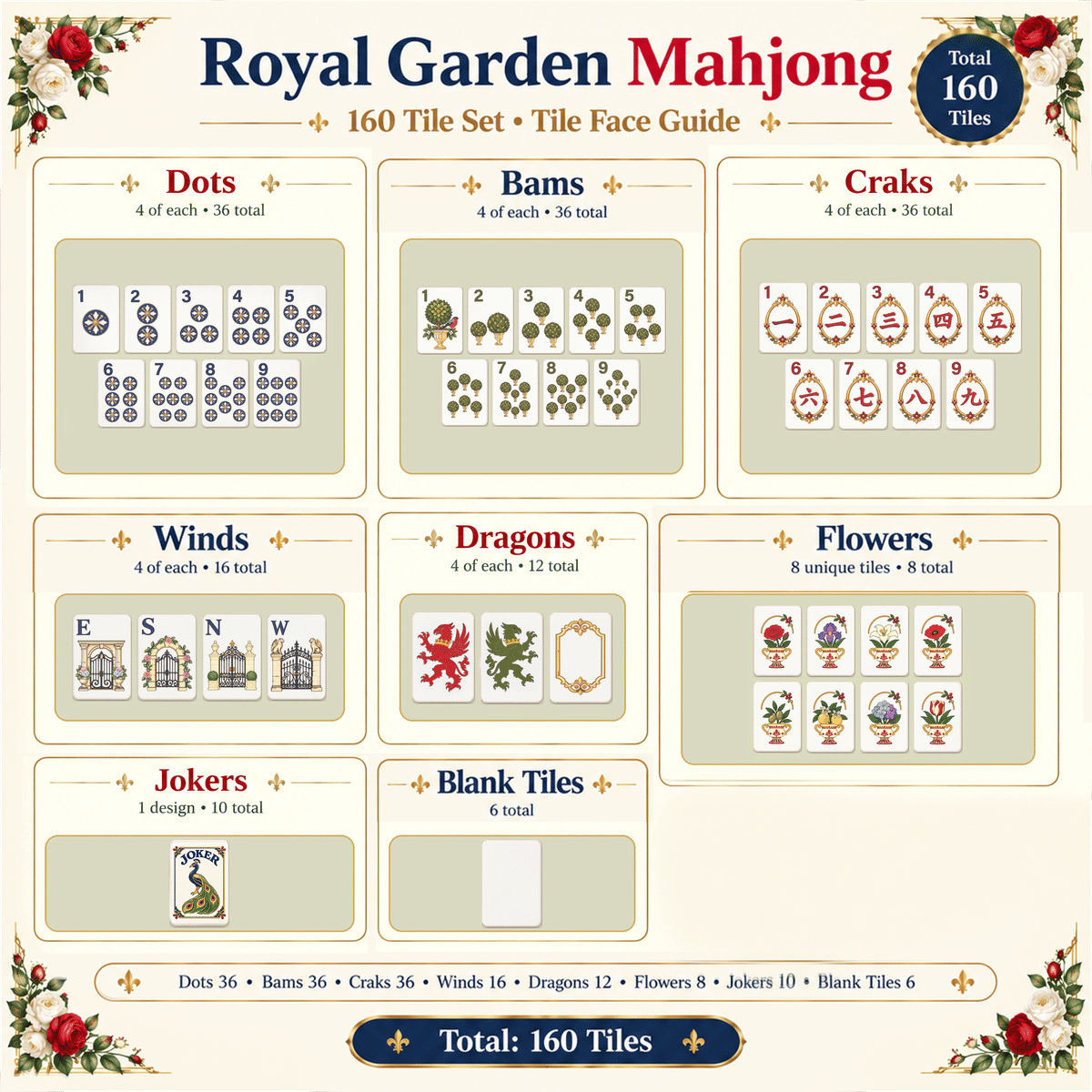
Siamese mahjong is a four-player variant played with a 144-tile set (36 tiles per suit in Bams, Craks, and Dots; 16 winds; 12 dragons; 8 flowers; 8 jokers) using hand-drawn or engraved Thai cultural motifs on acrylic or bamboo tiles. The game runs like Chinese Classical mahjong: players draw and discard in turn, building chows (runs like 4-5-6 Bams) and pungs (three identical tiles) rather than matching the American League card. Hands win when you complete a melds-only pattern (no eyes as bonus) plus a winning pair. Jokers substitute for any tile in any meld except the final winning pair. Games typically last 20–45 minutes per round. The score is calculated by speed, meld type, and special yaku (scoring patterns), not by point tables. Siamese sets emphasize ornate tile art; many players invest in quality acrylic or bone-and-bamboo sets with traditional Thai iconography. If you're coming from American mahjong, the biggest shift is learning to spot chows and adapting your strategy from fixed hands to open-ended melds.
Siamese mahjong sits at the intersection of Thai heritage and classical Asian tile play. It's faster than American mahjong, riskier in hand-building, and deeply rewarding once you understand the rhythm. We've hosted weekly Siamese games for years, and we've learned what separates players who get stuck from those who build winning hands consistently.
What's the core difference between Siamese and American mahjong?
American mahjong fixes hands from the year's National Mah Jongg League card; Siamese mahjong has no card. Instead, all valid hands are melds only: three or more of the same tile (pung), three tiles in sequence (chow), and a winning pair. Chows are always three tiles in rank order within a suit—never a pair or single. Because you can call and expose chows, the game feels more interactive; you can read what opponents need and block them mid-hand. American players often over-discard early because they expect a fixed pattern; Siamese players must track open melds and infer hand direction from tile discards.

How do you build a winning hand in Siamese mahjong?
Start by deciding whether you're aiming for a high-value meld (all kongs, all chows, all pungs, or mixed) or a quick hand (fewer melds, faster exit). In Siamese play, you peek at your 14 starting tiles and immediately spot pairs and potential melds. Never discard from a pair unless you've already found another pair candidate. Prioritize calling chows early—they lock in points and give you visibility. Once you've exposed one or two melds, you signal hand direction; savvy opponents will then avoid discarding tiles that help you. The mistake we see most: players hoard honor tiles (winds and dragons) too long, hoping for a pung or kong when they could have built chows in the suited tiles and won faster. Speed in Siamese play is leverage; a quick hand prevents opponents from organizing.
What tiles are hardest to use in Siamese mahjong?
Terminal tiles (1 and 9 Bams, Craks, Dots) and honor tiles (winds, dragons) are the trickiest because they appear in fewer chow combinations. A 1 Bam can only chow as 1-2-3; a 9 Dot can only chow as 7-8-9. If you draw three 1 Bams early, you commit to a pung; if you draw only two, you're stuck holding a dead tile. Winds (North, East, West, South) and dragons (Red, Green, White) can only form pungs or kongs—never chows. This means honor tiles are high-value when they're part of your melds but fatal dead weight if they're orphaned. The pro move: when the discard pile shows two or three 1 Bams, stop waiting for the third and shift to middle-rank suited tiles (4, 5, 6) that chow easily. Many beginners collect honor tiles thinking "I'll get lucky"; experienced players see a dead-end and pivot within one or two turns.
How does the joker (wild) rule change your strategy in Siamese play?
Siamese mahjong typically allows one or two jokers per hand (check your local ruleset). A joker can substitute for any tile in any meld except the final winning pair—that pair must be live tiles. This flexibility means you can afford to build chows with partial information. If you have 4-5 Bams and a joker, you can call a 3 Bam discard as a chow (3-4-5 with joker as 5), leaving the real 5 to surface later or letting you draw it fresh. The risk: if you overuse jokers in one hand, you waste a precious wild, and if the hand stalls, you're left with no backup. Our table rule: jokers are most valuable in the fifth or sixth meld—early melds use real tiles only. This forces players to play tighter early and rewards patience.
What's the real advantage of acrylic vs. bone-and-bamboo tiles for Siamese play?
Tile Type | Weight & Feel | Thai Art Quality | Durability | Setup Time | Best For |
Acrylic (modern) | Light, stackable | Sharp, engraved designs | Decades of weekly play | 30 seconds | Weekly casual games, travel |
Bone-and-bamboo (traditional) | Heavy, authentic click | Hand-painted, ornate | 10+ years with care | 2–3 minutes (manual sorting) | Collectors, ceremonial play |
Both play identically in rules. Acrylic tiles move faster—they stack neatly, reset quicker between rounds, and ship safely. Bone-and-bamboo tiles feel ceremonial; the weight in your hand and the clack when you draw create an immersive experience that many long-time Siamese players prefer. If you're hosting weekly games, acrylic is honest: it saves 10 minutes per session, and over 50 games a year, that's 8+ hours reclaimed. If you play once a month or you're building a heritage set for display, bone-and-bamboo rewards the ritual. Our best-selling acrylic mahjong sets include clean Thai cultural designs and are packed to survive shipping.
🀄 Shop best-selling mahjong sets →

How do you stay safe from a premature win declaration?
In Siamese mahjong, the moment you announce "win," your hand is locked for scoring. If a flaw is found (a meld is incomplete, you declared too early, your pair is a joker), you're penalized—often out of that round entirely. Before you announce, ask yourself: Do I have exactly four melds and one pair? Is every meld complete (3 or 4 of the same tile, or 3 in sequence)? Is my pair two identical non-joker tiles? Count on your fingers if you must. We've seen players rush after six minutes of play, call "win" on a three-tile pung, and lose their score. The rule is unanimous at every table: no backsies. Slow down. Verify. Then declare.
What's your step-by-step opening strategy?
Sort your 14 starting tiles by suit, then by rank. Separate honors (winds, dragons, flowers) to the right.
Scan for pairs immediately. Two identical tiles are your lifeline; most hands need one pair to win.
Mark potential chows. If you have 4-5 Bams, you're one tile from a chow. Highlight it mentally.
Look for pung seeds. Two 7 Dots mean you need one more; it's a priority draw.
Discard your deadest tile first—something that doesn't connect to any pair or meld seed and that you haven't seen in the discard pile yet.
Track opponent discards. If North player throws 2 Craks, East throws 3 Craks, you now know 2-3 Craks are gone—the 1-2-3 chow is riskier.
Call melds aggressively once you've seen 6+ discards. Information breeds confidence.
🎁 See our most-loved mahjong sets & accessories →
How do you adapt if you've been playing American mahjong and want to switch?
The hardest mental shift is abandoning the League card. In American play, you hunt a specific hand pattern; in Siamese play, you pivot constantly based on draws and discards. Here's a practical framework:
Stop thinking "this is my hand." Every turn, reassess. A hand that looked like all-chows may suddenly pivot to all-pungs if two opponent melds block your chow strategy.
Learn to spot chows under pressure. American players see "1-2-3" as exotic; in Siamese play, it's your bread-and-butter meld. Drill recognizing runs in each suit until it's automatic.
Embrace the discard pile as your guide. American players ignore early discards; Siamese players read the pile like a map. Two 5s gone? Don't build 4-5-6 chows.
Expect hand conflicts. In American play, hands rarely overlap; in Siamese play, two players often target the same suit or honor tile. Accept it. Call melds when they help you, and don't wait for the perfect sequence.
Play 5–10 casual rounds with experienced Siamese players who'll narrate their thinking. The rules feel foreign for one session, then intuitive by round three.
What common setup mistakes slow down a Siamese game?
Mixing old and new tiles. If your set is missing a 6 Bam from years of wear and you substitute a blank or a tile from another set, the game stalls when players can't find that tile. Before each game, verify your set is complete.
Not pre-sorting the wall. Some groups shuffle and deal blind; others pre-sort tiles into the wall frame beforehand. Agree on a method so you don't waste five minutes per game debating the wall setup.
Ignoring the flower rule. Some Siamese rulesets award immediate replacements for flowers drawn; others don't. Clarify before the first draw. A misunderstanding here derails scoring.
Using worn tiles without clear icons. Thai cultural motifs are gorgeous but sometimes subtle. If a tile is worn and unclear, rename it at the start of play so no one disputes it mid-hand.
To avoid these: lay out all 144 tiles face-up for 30 seconds at the start of the session, count them, and confirm no duplicates or blanks are mixed in. It sounds pedantic, but it eliminates 90% of mid-game disputes.
✨ Find your Mahstead set — free US shipping →
What to check before you buy a Siamese mahjong set
Tile count: 144 tiles exactly for Siamese play. Some sets market 152 or 160; confirm the 144-tile base is included.
Thai design clarity: Can you distinguish 1 Bam (bird), 2 Dot, 5 Crak at a glance? If tile icons are too ornate or faded, gameplay slows.
Weight and stackability: Lighter acrylic tiles let you shuffle faster and build taller melds on the rack. Bone tiles are heavier and clack louder—a plus if you love the sound, a minus if you have a small table.
Joker count: Confirm you have exactly 8 jokers (or however many your ruleset requires). Extra jokers cause confusion mid-game.
Packaging and spares: Quality sets ship in a divided case and include a spare joker or two in case of damage in transit.
Mat and accessories included: Some sets bundle a play mat, wind indicators, or racks. Confirm what's in the box before purchase.
Our sets ship acrylic mahjong tiles in protective compartments to prevent tile-to-tile chipping. Free shipping across the US means you can order with confidence that it'll arrive player-ready.

FAQ
Can I play Siamese mahjong with an American mahjong set?
Technically yes, but not well. American sets have 152 tiles and 8 jokers; Siamese play uses 144 tiles. The extra tiles confuse the game, and American sets often include duplicates or specialized designs that break Siamese hand rules. Use a set designed for the variant you're playing.
How long does a typical Siamese mahjong game last?
One round (one winning hand) takes 15–30 minutes depending on player experience and luck. A full session of four rounds is 60–120 minutes. American mahjong rounds typically run 20–40 minutes, so Siamese is slightly faster overall.
What's the difference between Siamese and Thai mahjong?
Siamese and Thai mahjong are the same game; the terms are interchangeable. "Siamese" is the historical name (Siam was Thailand's former name), while "Thai mahjong" is the modern term. Rules, tile counts, and scoring are identical.
Do I need a mahjong mat to play Siamese?
No, but it's helpful. A mat organizes your melds, protects tiles from spills, and gives you clear zones for discard piles and melds. If you're playing casually on a dining table, a mat keeps tiles from sliding. Choosing the right mat depends on your table size and play frequency.
Are Siamese mahjong hands harder to spot than American hands?
Yes and no. American hands are fixed (you're matching a printed card), so spotting is a card-reading drill. Siamese hands are open-ended (any four melds + one pair wins), so there are infinite valid hands—but each individual hand is easier to build because you're not locked into a single pattern. Most players find Siamese hands easier to construct but require more strategic thinking about which hand to pursue.
What happens if two players want to call the same discard?
In most Siamese rulesets, the player closest to the discarder (going counterclockwise) has priority. If both claim the same tile simultaneously, house rules break the tie—often "first claim wins" or "the discarder decides." Agree on your table rule before the first game to avoid disputes.
Can I use jokers in the winning pair?
No. Your final pair must be two identical tiles without jokers. Jokers can substitute for any other tile in any other meld, but the pair is always live tile + live tile.
How do I know if my Siamese set is authentic?
Authentic sets have Thai cultural motifs engraved or hand-painted on each tile, 144 tiles total, 8 jokers, and often come in a divided wooden or plastic case. Look for clear iconography: the 1 Bam should show a bird, flowers should be recognizable, and dragons should be distinct. If the set looks generic or has Western symbols, it's likely a hybrid set designed for casual Western play rather than traditional Siamese rules.


View More
View More
View More
