
Best Mahjong Racks: Choosing Pushers for Your Weekly Game
Last updated: Nov 23, 2026
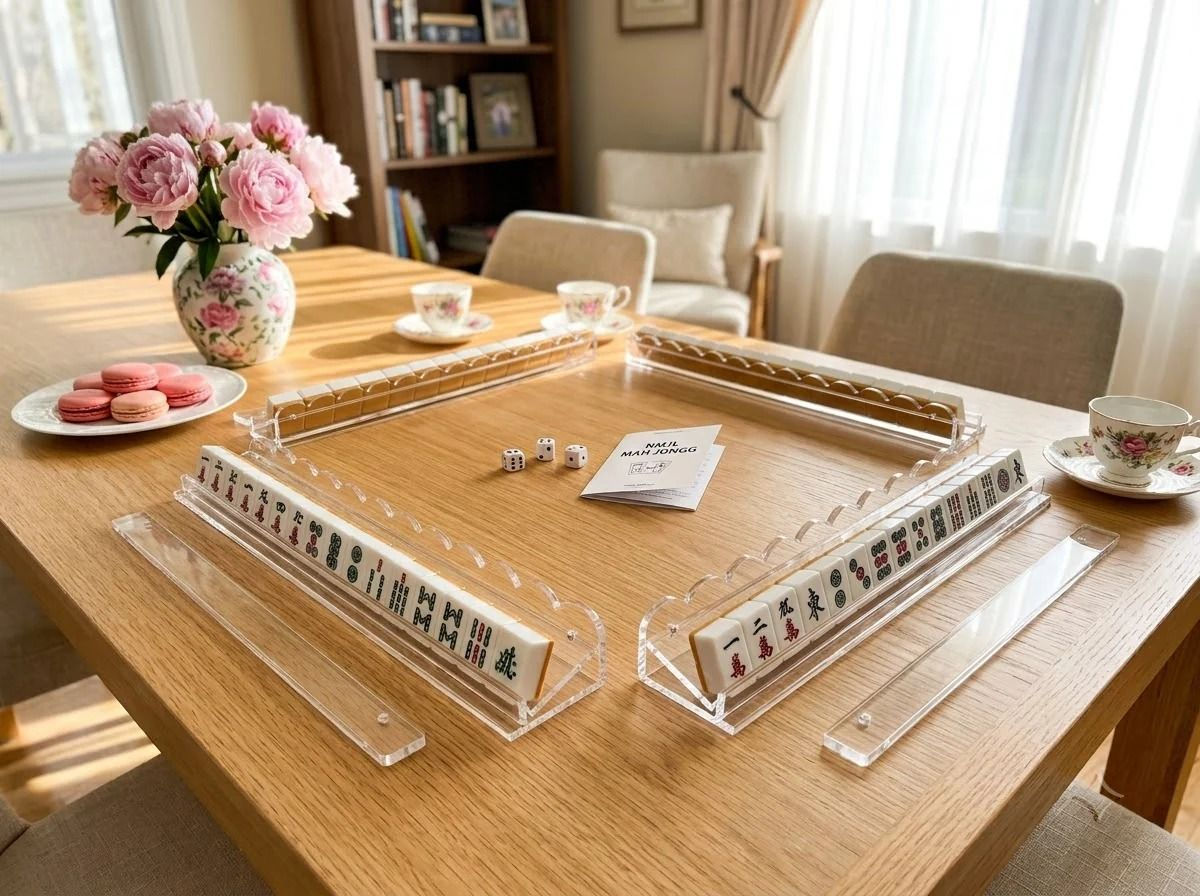
Mahjong racks are acrylic stands that hold your 13 or 14 tiles upright during play, paired with a pusher stick to slide tiles forward as you draw. We use them in nearly every game because they hide your hand from opponents and let you organize tiles faster. Racks come in several heights (typically 2–3 inches tall) and widths; standard acrylic models suit most home players, while bamboo or custom-engraved versions add personality. A four-piece set of racks with pushers costs less than a set of individual racks and works for both casual and regular weekly groups. The key decision is choosing between basic clear acrylic (affordable, no-fuss) or a branded, engraved design that matches your set. Check tile depth tolerance and pusher fit before ordering to avoid tiles tipping sideways.
A rack with pusher transforms how you hold and play your hand. We've been hosting weekly games for years, and the difference between using nothing and using a proper rack—better hand organization, faster plays, no accidental tile flips—is night and day. If you're upgrading from playing with tiles fanned in your lap or on a mat, a rack is a small investment with a big payoff.
What makes a mahjong rack different from a tile holder?
Mahjong racks are specifically designed for American play: they must hold 13–14 tiles upright at a slight angle, have a slot or lip for a matching pusher, and be shallow enough not to block your view across the table. A generic tile holder or pencil caddy won't do the job—the tiles will slide, pushers won't fit properly, and you'll spend more time adjusting than playing. A proper mahjong rack's width typically spans 7–9 inches to accommodate a full hand, and the back lip should be just tall enough to keep tiles from falling backward when you lean toward the center. Our racks with pushers are engineered for American tile thickness and shuffle speed, so every pusher glides without snags.
Should you buy individual racks or a set of four?
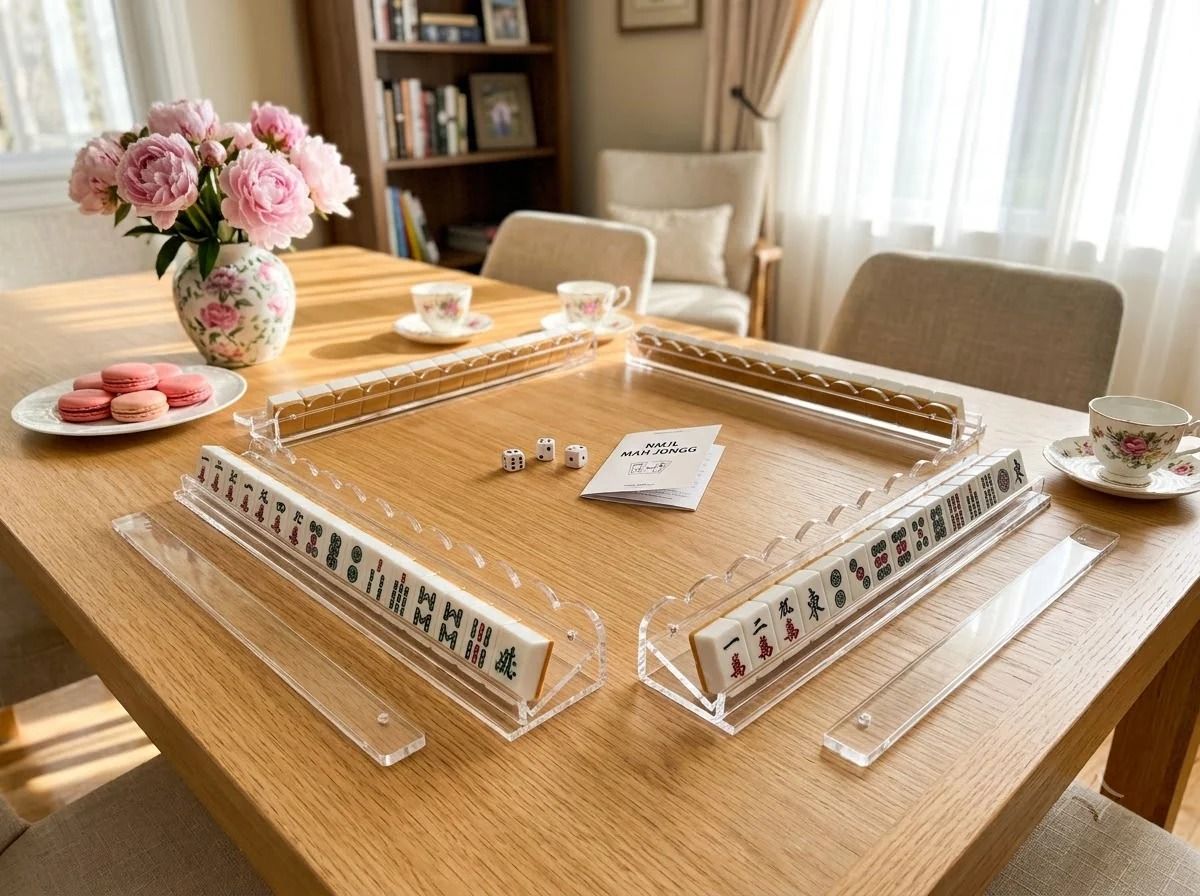
If you're hosting, four matched racks look cleaner and feel more intentional—your table feels like a real game space, not a hodgepodge. Individual racks let you replace one if it cracks, but you'll often end up buying four anyway by the time someone wants a second set. A four-piece set from Mahstead ships together and costs less per rack than buying separately; you also know all four pushers will glide identically. If you're a traveling player or an occasional guest, one or two individual racks are fine. If you host weekly, buy the set.
Clear acrylic vs. engraved racks: what's the real difference?
Feature | Clear Acrylic | Engraved / Custom Design ---|---|--- Cost | Entry-level; see current price on product page | Premium; see current price on product page Durability | Excellent; same material either way | Excellent; engraving doesn't weaken acrylic Look | Minimal, functional | Branded, matches themed sets or shows personality Pusher fit | Standard; all manufacturers use similar depth | Standard; designed to fit Mahstead pusher specs Best for | Casual play, small budgets, matching any set | Weekly regulars, gift sets, themed tables
Engraved racks aren't harder to use—the groove for the pusher is identical. The choice is aesthetic and practical: if you own one of our engraved American mahjong sets, matching racks complete the look. If you have multiple sets or play casually, clear acrylic works everywhere without feeling out of place.
How do you know if a rack will fit your tiles and pusher?
Before ordering, measure your tile thickness at the widest point (American mahjong tiles are typically around ⅜ inch thick when set in the groove). Check whether the product page specifies acrylic thickness and pusher slot width—a slot that's too tight will bind; too loose and the pusher wobbles. The depth of the rack (front to back) matters too: if it's very shallow, larger hands will push tiles off the back when you're sliding them forward. Read the dimensions carefully; if you're unsure, email support through the Mahstead site or check the FAQ below. We've tested our racks with standard American tiles and pushers from our own sets, so compatibility is guaranteed if you buy from the same maker.
What mistakes do first-time rack buyers make?
Many new players buy a single rack thinking they'll share it—then discover that passing one rack around the table slows play and frustrates everyone. Another common error: assuming any acrylic stand will work. Cheaply made racks have rough grooves that catch pushers, scratches that make tiles stick, and warped bases that tip. We've seen players store racks in hot cars or direct sunlight and watch them crack or discolor. Store racks flat or upright in a cool space; never leave them on a sunny windowsill. Also, don't force a pusher into a too-tight slot—apply steady, even pressure until it seats. If a pusher is stuck, run warm water over the joint (don't submerge), wait a minute, and try again gently. Never use a hammer or heat gun to force it.
🀄 Shop best-selling mahjong sets →
Why do you need a pusher if you have a rack?
The pusher is the second half of the rack system. Without it, you'd still be picking tiles out by hand and disrupting your hand's order. The pusher lets you draw from the left end, advance your tiles to the right as new tiles land in the rack, and reveal only one tile at a time to the table. It's small ergonomic genius: your hand stays on the pusher, your eyes stay on your tiles, and opponents can't see what you've drawn until you commit. A pusher that fits your rack perfectly will slide in one smooth motion; a poor fit makes every draw feel sticky. We pair our pushers with our racks so there's no guesswork.
What's the difference between hosting a game with racks vs. without them?
Without racks, tiles live face-down on the mat in front of each player or in laps—messy, slow, and prone to accidents. Someone bumps the table, tiles scatter. You lean in to see your hand, opponents catch a glimpse. Shuffling the discard pile during play is chaotic. With four matched racks and pushers, the game feels organized and fair: each player's hand is secure and private, draws are deliberate, and the table stays clean for the entire session. We've noticed that games move faster (fewer "where did that tile go?" interruptions) and people relax more because their hand won't slide into a neighbor's space. If you play weekly, racks are worth it not just for speed but for morale.
🎁 See our most-loved mahjong sets & accessories →
What to check before you buy
Tile depth tolerance: Verify the groove width matches your tiles (typically ⅜ inch for American mahjong).
Pusher length: The pusher should reach from the front of the rack to near the back without binding or rattling.
Base stability: The rack's base should sit flat on a table without rocking; place it on a level surface to test.
Acrylic clarity: Look for cracks, cloudiness, or rough edges in photos or in person.
Quantity: If you host, commit to a full set of four; one or two racks isolates players and slows the game.
Shipping condition: Acrylic can shift during transit. Open your box immediately, inspect each rack, and report damage within a few days to the seller.
If you're buying a full American mahjong set for the first time, pair it with a four-piece rack and pusher set—they turn a collection of tiles into a real game. Match the aesthetic if you like (engraved racks with branded sets), or go simple and functional. Either way, you'll wonder why you ever played without them.
✨ Find your Mahstead set — free US shipping →
FAQ
Can I use one rack for all four players and swap it between draws?
No. Passing one rack around defeats the purpose and ruins play flow. Each player needs their own rack so hands stay organized throughout the round. Buy a set of four.
Do bamboo racks work as well as acrylic?
Bamboo racks are durable and beautiful, but they wear differently. The groove can splinter over time, and pushers may not glide as smoothly. Acrylic is the modern standard for weekly play.
What if my pusher gets stuck in the rack groove?
Don't force it. Run warm water over the joint, wait a moment, then gently work it free. If it's truly stuck, soak the groove area in warm water for 30 seconds and try again. Never use heat guns or harsh tools.
Should I buy extra racks in case one breaks?
A quality acrylic rack is durable if stored properly. If you host regularly, keeping one spare is smart. Otherwise, buy a replacement only if needed.
Can I use the same rack with different mahjong variants (American, Chinese, Hong Kong)?
American tiles are thicker than Chinese or Hong Kong tiles, so American racks won't work well with those variants. Stick to racks sized for the game you play. If you switch variants, get appropriate racks for each.


View More
View More
View More
