
American Mahjong vs. Wright-Patterson: Which Game Is Right for You?
Last updated: Nov 23, 2026
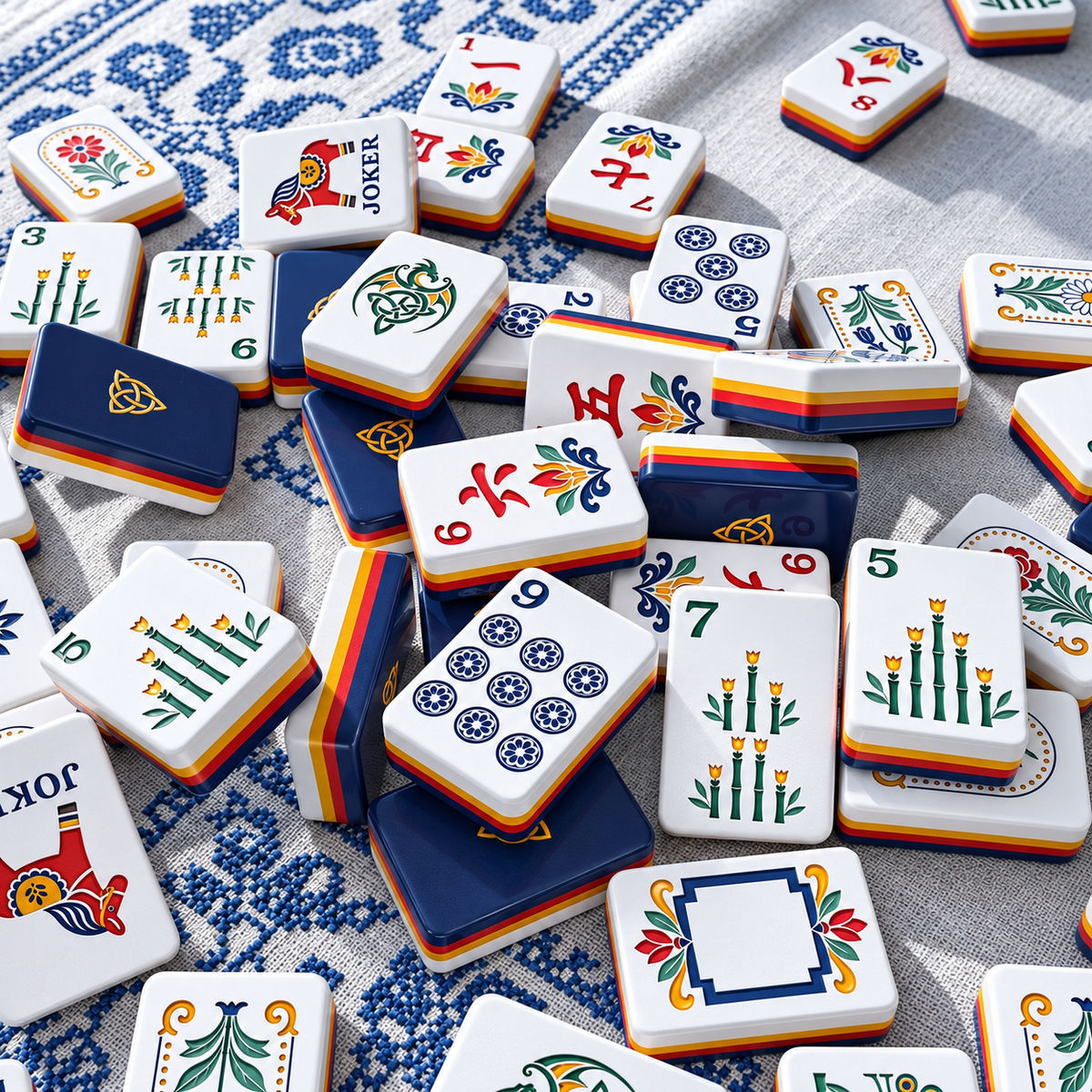
American mahjong uses 152 tiles (108 numbered suits, 16 winds, 12 dragons, 8 flowers, 8 jokers) and hands are drawn only from the current year's National Mah Jongg League card—a published list that changes every spring. Wright-Patterson mahjong, a variant played mainly in military and government circles (named after Wright-Patterson Air Force Base in Ohio), follows similar tile composition but uses a closed, memorized hand set rather than a published card; hands are also fixed but known through tradition rather than annual publication. American mahjong forbids chows (sequences like 1-2-3); Wright-Patterson allows them in many positions. Jokers in American mahjong can never represent a single tile or form a pair; in Wright-Patterson they are often more freely used. American games always play with exactly 152 tiles and 8 jokers—no blanks are added to play. Both are four-player games, but scoring, exposure rules, and the rhythm of play differ markedly. Wright-Patterson is less widely available as a standard ruleset outside specific circles, while American mahjong dominates recreational play across the U.S.
What is the core rule difference between the two variants?
American mahjong hands come from a printed card released every spring by the National Mah Jongg League. Players memorize or reference specific patterns (like "2468 Like a Suit," "Consecutive Pungs," or "Like Numbers"). Wright-Patterson hands are also fixed—but they are learned through oral tradition and club memoranda rather than a single authoritative published list. In American play, you cannot call or expose a chow (1-2-3 in sequence); you can only expose pungs (3 identical), kongs (4 identical), quints (5), and sextets (6). Wright-Patterson typically permits chows in certain hand configurations, making it more flexible in the middle stages of play.

Why does the published card matter so much in American mahjong?
The card is your rulebook. Every legal American hand—every pung, kong, quint, sextet, all-joker, and mixed configuration—appears on the current year's card. If a hand is not on the card, it cannot win in American play. This creates consistency: everyone at the table (and across the country, if you play in tournaments) uses the same hands. The card forces players to think strategically about which hands to pursue early, which tiles to discard, and when to pivot to a backup hand. Wright-Patterson players rely on club consensus and passed-down patterns; there is no universal reference—a hand legal in one Wright-Patterson circle may not be recognized in another. The American system means you can play in a game in Texas or New York and know exactly which hands count.
How do joker rules differ, and why does it matter?
In American mahjong, a joker can never stand alone as a single tile, can never form a pair, and can substitute for any tile in an exposure (pung, kong, quint, or sextet) except in the pair position. This constraint forces a strategy: you must count jokers carefully and sometimes choose between using one to complete an exposure or saving it for a critical tile later. Wright-Patterson typically allows jokers more freedom—they may substitute in more contexts, and some Wright-Patterson circles permit a joker to form a pair, especially in the opening draws. This makes Wright-Patterson games faster and sometimes more forgiving for newer players; American play rewards tile counting and joker discipline. If you play American weekly, joker management becomes instinctive; switching to Wright-Patterson without relearning joker logic can lead to called hands that violate the opponent's house rules.
Can you move between American and Wright-Patterson without relearning?
Not smoothly. The core tile set and four-player structure are the same, but the hand library, calling rules, and joker behavior are different enough that a player comfortable with American mahjong will make costly mistakes in Wright-Patterson play—exposing a chow when it is illegal, or using a joker in a position not allowed. Conversely, a Wright-Patterson player joining an American game may try hands that do not appear on the card and face a "not on the card" challenge. The good news: the tile-reading, wind-and-dragon logic, and four-player etiquette transfer instantly. You already know how to track discards, count remaining tiles, and spot an open hand. The difference is in the hand patterns and restrictions, not in the fundamental game flow. Many players who travel or relocate learn both; some prefer one over the other and seek groups that play their variant.

Which variant should your group choose?
Factor | American Mahjong | Wright-Patterson Mahjong |
Hand Reference | Published annual card (National Mah Jongg League) | Memorized or club-specific list |
Chows Allowed | No; exposure only (pung, kong, quint, sextet) | Yes, in many hand types |
Joker in Pair | Never | Often permitted |
Difficulty for Beginners | Moderate (card to reference) | High (hands must be memorized) |
Availability of Players | Widespread in US clubs, synagogues, community centers | Limited; mostly military/government circles, Ohio region |
Consistency Across Groups | Uniform nationwide | Varies by club or region |
Best For | Casual home games, tournaments, mixed skill levels | Close-knit groups, military tradition, experienced players |
We recommend American mahjong for groups building a regular game from scratch. The card eliminates ambiguity, newcomers can join mid-year and catch up, and you can find tutorials, scoring guides, and strategy articles easily. Wright-Patterson is ideal if your group already plays it and you are joining an established circle—or if you want a challenge and are willing to invest in memorization. For a first set and accessories, our best-selling mahjong sets work equally well for both variants; the tiles are the same, and the difference is rules, not equipment.
🀄 Shop best-selling mahjong sets →
How do you learn Wright-Patterson if your local community plays it?
Ask the group for their hand list or "house card." Many Wright-Patterson circles maintain a typed or handwritten reference that documents their standard hands. Attend a few games as an observer, note the hands that appear, and ask players to explain the logic behind each hand—why 2-4-6-8 All Pungs matters, or how a hand with two dragons and two winds differs from one with three of the same wind. Ask your mentor whether chows are allowed in their hands (they vary by region), and whether there are special rules for quints or sextets. Read any club by-laws or minutes that may exist. The learning curve is steeper than American (no central card), but the hands tend to be more memorable because they recur every game. If you play Wright-Patterson regularly for a few months, the hands become intuitive. If you drift back to American mahjong later, you may remember Wright-Patterson hands for years—they seem simpler and more pattern-based than the card's dense catalog.
What to check before you buy a set for either variant
Confirm your group's variant. Ask "American" or "Wright-Patterson" and listen carefully. If anyone says "Hong Kong" or "Chinese," that is a separate game altogether.
Check tile clarity. Both variants require you to read Bams, Craks, and Dots at a glance; glare or worn tiles slow play.
Verify joker and flower count. A standard American or Wright-Patterson set has 8 jokers and 8 flowers (4 pairs). Some vintage sets may vary.
Test the rack fit. If you order racks, ensure they hold your tiles comfortably; a crowded rack leads to accidental discards and disputes.
Plan for a mat or cover. Both variants benefit from a padded surface to muffle tile noise and protect your table—especially important if you play weekly.
🎁 See our most-loved mahjong sets & accessories →
Where do American and Wright-Patterson communities overlap?
Most U.S. mahjong clubs and meetups teach American mahjong first; it is the default for suburban and urban recreational play. Wright-Patterson remains strong in Ohio (particularly around the base and surrounding military communities), and pockets exist in other regions where military families or expatriate groups maintain the tradition. Some hybrid groups teach both and let players choose which variant to play in a given round. Online mahjong communities (forums, social media groups, meetup boards) almost always specify "American" in their group description; if you see only "mahjong" without a label, ask before attending. In the rare case where a group plays Wright-Patterson, it is almost always stated explicitly. If you want to find an American mahjong game nearby, check community centers, libraries, synagogues, and country clubs in your area—or search online meetup boards for "American mahjong." For Wright-Patterson, contact military base recreation departments or Ohio-based mahjong clubs directly.
✨ Find your Mahstead set — free US shipping →
If you are outfitting a table for the first time, consider whether you want engraved American mahjong sets with titles or humor (useful for American play, where the card reference is central to the experience), a padded mat to protect your table and dampen noise during long games, and racks with pushers if your players prefer a neat, organized hand. All Mahstead sets contain the same 152 playing tiles plus spares and work for both American and Wright-Patterson play; the variant you choose depends only on your group's rules and local tradition.

FAQ
Can I use the same tiles to play American mahjong one night and Wright-Patterson another?
Yes. The tile set is identical; only the hand list and calling rules change. You would just reference a different hand list or rulebook.
Is Wright-Patterson easier than American mahjong?
Not necessarily. Wright-Patterson hands are often more logic-based and repeated, so memorization becomes easier over time. American play requires referencing the card but is more forgiving for newcomers who can look up hands on the spot.
Do I need a special Wright-Patterson set or American mahjong set?
No. Any standard 152-tile mahjong set works for both variants. The tiles are the same; the rules and hands differ, not the equipment.
Where can I find a Wright-Patterson mahjong group?
Contact military base recreation centers, local government employee clubs in Ohio, and ask longtime mahjong players in your area. Wright-Patterson communities are smaller and more tightly knit than American mahjong clubs.
What if I learn American mahjong and then move to a Wright-Patterson community?
You will need to learn the Wright-Patterson hand list, but your tile-reading, wind-and-dragon knowledge, and game sense will transfer instantly. The learning curve is steep but not insurmountable.
Can Wright-Patterson hands appear on the American Mah Jongg League card?
Rarely. Some Wright-Patterson hands (like all-pung hands or all-one-suit hands) are simple enough that they appear on the card, but most Wright-Patterson hands are specific to that variant and not officially recognized in American play.


View More
View More
View More
