
American Mahjong Tile Counting: Rules, Math & Table Practice
Last updated: Nov 23, 2026
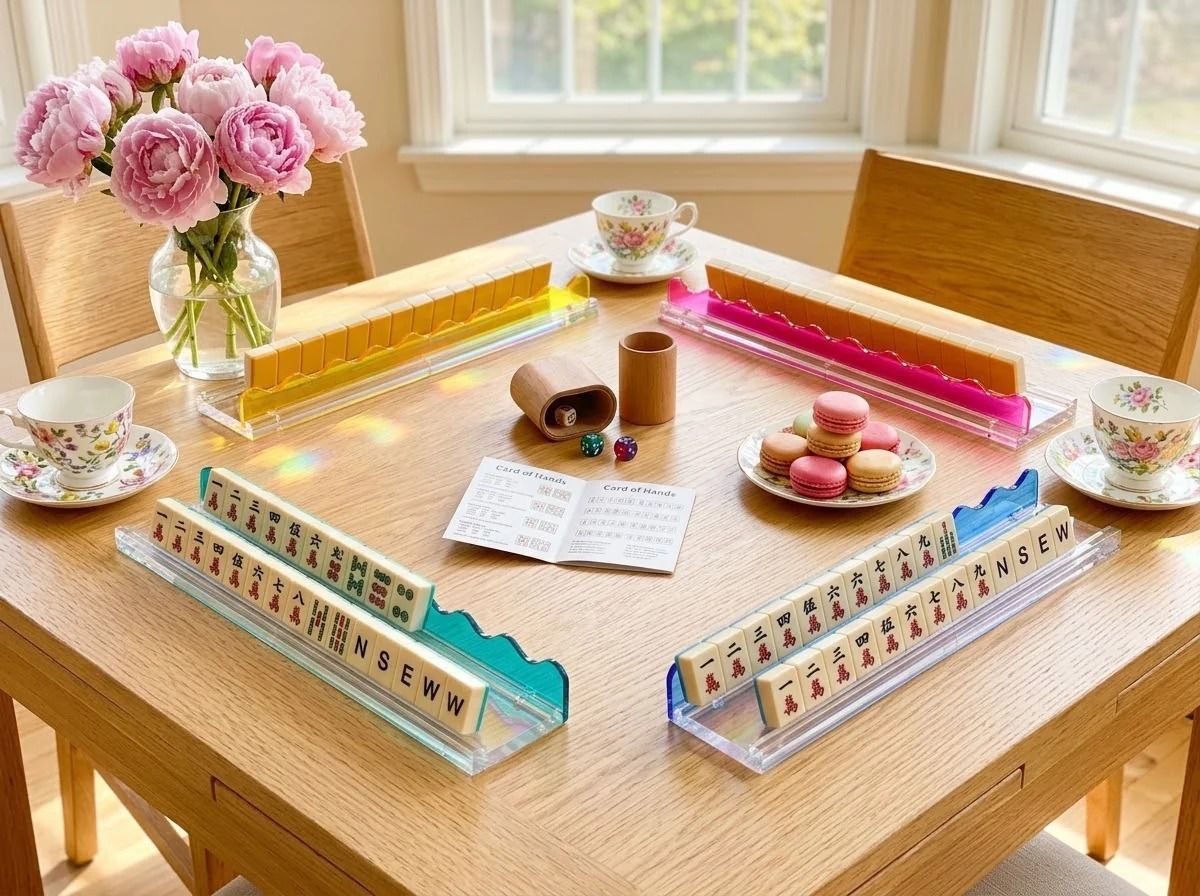
American mahjong always begins with exactly 152 playing tiles plus 8 jokers. Each of the three suits (Bams, Craks, Dots) contains four copies of numbers 1–9 (36 tiles per suit, 108 total); add 16 winds (4 each: North, East, West, South), 12 dragons (4 Red, 4 Green, 4 White), 8 flowers, and 8 jokers. Your opening hand holds 13 tiles; each player draws and discards one per turn. At game end, the winning hand contains exactly 14 tiles (the 13 plus the drawn winning tile). Counting happens continuously: verify your wall has 108 after the Charleston, monitor the discard pile for duplicates or missing suits, and confirm the final count before announcing Mah Jongg. Mahstead's acrylic sets ship complete; the spare tiles (included in 160-tile sets) never enter play—they sit aside as backups if a tile cracks or is misplaced mid-game.
What does "tile counting" actually mean in American mahjong?
Tile counting is the running tally of where every tile is at every moment—your hand, the wall, the discard pile, other players' melds, and uncalled exposed sets. It prevents duplicates being drawn twice, catches missing tiles, and confirms the game's math adds up. Most players count passively (just noticing), but skilled players verify actively: checking that no suit is missing, that jokers aren't overused, and that the final hand matches the card.
The core principle is simple: 152 + 8 jokers always live somewhere. Before the first discard, 52 tiles are in player hands (13 each × 4); 108 remain in the wall. As draws and discards flow, tiles move but never vanish.

How many tiles should each player have at each stage?
Opening hand: 13 tiles per player (52 total). After the Charleston, the East player draws the wall tile to begin with 14; all others hold 13 until their first turn. After the first discard: East discards, back to 13. Each subsequent turn: draw one, discard one, so you stay at 13 until you draw the winning tile (then 14). On mah jongg: the winning hand is always 14 tiles—either as a pair plus four melds of three or four tiles each, or the special patterns on the current year's card.
Mid-game verification: Count exposed melds per player. A pung uses 3 identical tiles; a kong uses 4; a quint uses 5; a sextet uses 6. Sum these plus the concealed tiles in each player's hand. The total should always equal 13 per player (or 14 if that player just drew and hasn't yet discarded). If one hand totals 12 and another totals 14, a tile went missing or was miscounted.
Discard pile total: Not fixed, but it grows by 1 per turn until mah jongg. After 40 turns, the discard pile holds 40 tiles (if no one called a set from it). Use this as a rough checkpoint: if after 20 turns you count fewer than 15 discards, check for tiles stuck in the wall or misplaced in someone's hand.
What's the "before and after" rule for the wall and Charleston?
Before the Charleston begins, all 152 tiles are shuffled into a single combined pile. Players then build a wall: East starts and places tiles face-down in pairs until each of the four positions has a wall segment. Most American games stack a wall 2 tiles high × 18 tiles wide per player (72 tiles per wall), but wall-building mechanics vary—what matters for counting is this: after wall-building is complete, exactly 108 tiles lie in the wall, face-down.
After the Charleston (the tile-passing ritual), verify the wall still has 108 tiles before the first draw. Count is easiest if your wall is organized in pairs: 2 high × 18 wide = 36 pairs = 72 tiles per side × 4 sides = 288 positions, but only tiles within the wall count. A common mistake: miscounting during Charleston if a tile lands outside the wall boundary or if someone holds a Charleston tile too long and forgets to pass it.
Post-Charleston checkpoint: Player hands (52 tiles) + wall (108 tiles) = 160 tiles (including jokers in hand). If the count is 161, a tile has duplicated; if 159, one is missing—stop and recount before discarding.
How do jokers fit into tile counting?
Jokers are always counted separately in your running tally because they're never part of a pair and can only substitute for tiles within an exposed meld (pung, kong, quint, or sextet). The 8 jokers live somewhere on the table at all times.
Joker locations:
In concealed hand: counts toward your 13–14 total.
In an exposed meld: counts as part of that meld's size (e.g., 2 real Craks + 1 joker = a pung).
In the wall: face-down, counted as 1 of the 108.
Discarded: never—jokers can't be thrown. If a player tries to discard a joker, it's an error; the meld it was standing in collapses or the hand is invalid.
Counting rule: At any moment, jokers used = (jokers in hands) + (jokers in melds). This total must be ≤ 8. If you count 9 joker appearances, an extra tile was mistaken for a joker, or a joker was double-counted.
Pro tip: Track joker use on a notepad—one tally mark per joker seen. This catches the error where two players both think they hold the last joker.
When should you recount, and what's a hard stop?
Recount before the Charleston ends: after all three passes, verify 52 tiles in hands and 108 in the wall.
Recount before East's first discard: This is the final checkpoint. If counts don't match, the Charleston had an error. You must agree on who holds the missing or extra tile before play starts.
Recount during play if a discard is challenged: If a player claims a tile can't be in the discard pile (e.g., "That's the third 5 Dot, but we already called one"), stop and count all discards plus all exposed tiles. Verify no suit has more than four copies on the table.
Recount before announcing mah jongg: Don't announce until you've counted your 14 tiles against the card. Verify the suit distribution, pung/kong combinations, and joker positions match the pattern. A miscounted hand that doesn't actually match the card is a dead hand.
Hard stop: missing or duplicate tile during play. If one suit is provably missing a tile (e.g., only three copies of a 7 Crak exist, and you see all four on the table plus discards), stop immediately. Either a tile was miscounted during Charleston, or a tile was damaged before play. Agree with all players on the outcome: replay the hand, deal new tiles, or if a tile is broken, use a spare from your set. This is rare but serious—handle it calmly with group consensus.

Step-by-Step Tile Audit Checklist
Stage | Action | Count | Expected Total |
Shuffle | Mix all 152 tiles + 8 jokers | 160 loose tiles | 160 |
Wall build | Stack 108 in wall; hold 52 | 52 in hands, 108 in wall | 160 ✓ |
After Charleston | Verify hand counts | 13 per player × 4 = 52; wall = 108 | 160 ✓ |
Before East discards | Final pre-game count | Hands + wall + any jokers | 160 ✓ |
Turn 10 (mid-game) | Discard pile + hands + wall | ~10 discards; 52 in hands; 98 in wall | 160 ✓ |
Before mah jongg call | Winning hand check | 14 tiles match card pattern | Valid ✓ |
🀄 Shop best-selling mahjong sets →
How to avoid tile-counting errors at your table
Error 1: Losing a tile during the Charleston. A tile falls on the floor or gets knocked under the table. Fix: Keep the table clear of clutter. Use a mahjong mat with raised edges to contain tiles and make dropped ones visible. Count tiles immediately after the Charleston so missing ones are found while memories are fresh.
Error 2: Duplicate joker or suit tile. Two tiles of the same number and suit are both in play—impossible if you started with a valid 152-tile set. Fix: If you've bought a damaged or counterfeit set, stop play and verify your set is complete. Mahstead's 160-tile acrylic sets are checked before shipment; if you ever suspect a duplicate or missing tile, compare against what's in a complete American mahjong set.
Error 3: Losing count mid-game. After 15 turns, no one remembers how many tiles are in the wall. Fix: Before each turn, a designated "scorekeeper" glances at the wall height and mentally notes it. More practically: mahjong racks with pushers help. Racks organize your concealed hand so you can't accidentally miscount what you're holding. Some players keep a running tally on paper: "Turn 1: 107 left in wall. Turn 2: 106. Turn 3: 105…" It sounds tedious, but it prevents the "where did that tile go?" crisis.
Error 4: Miscounting an exposed meld. A player lays down a quint (5 tiles: 3 real + 2 jokers) but you count only 4. Fix: When a meld is exposed, state its size aloud: "Three 5 Dots and two jokers—that's a quint." Everyone nods. This vocal confirmation catches miscounts in real time.
Error 5: Playing with an incomplete set. A joker is cracked or a Bam is missing from the start. Fix: Before your first game with a new set, lay out the 152 tiles by suit and hand-count each group. Most sets come complete, but our best-selling designs are acrylic and durable precisely to survive years of play without loss.
What's the math if someone runs out of wall tiles?
In standard American mahjong, if the wall runs dry before anyone declares mah jongg, the hand is a draw. This happens rarely—only if the game goes 16+ full rounds with no one calling a set and no one drawing the winning tile.
How to count down to this: Each turn removes 1 tile from the wall (the draw). After ~50 turns, roughly 58 tiles remain in the wall. You're approaching the limit. The absolute last tile that can be drawn is tile 108 from the wall; after that draw, the wall is empty and the hand ends. Count by twos (wall pairs) to stay organized: "18 pairs in the wall right now" = 36 tiles = maybe 18–20 more turns before it empties, roughly.
In practice, someone usually wins before the wall empties. If it does empty, check your discard pile to confirm no one missed a winning tile, then tally: all four players' hands + all discarded tiles + all exposed melds should total exactly 152 (no jokers left uncalled). If they do, it's an honest draw and you begin a new hand.
🎁 See our most-loved mahjong sets & accessories →
What to check before you buy a new set
Before play begins with a new set:
Physically count: Sort all 152 tiles (plus spare jokers and blanks if included) by suit and number. Verify you have 4 of each number 1–9 in Bams, Craks, and Dots; 4 each of N/E/W/S; 4 each of Red, Green, and White dragons; and 8 flowers and 8 jokers. Use the checklist in our guide to what's in an American mahjong set.
Check for damage: Look for chips, cracks, or faded characters—especially on high-wear tiles like the 1 Bam and the White dragon.
Verify acrylic quality: Tiles should not feel brittle or cloudy. Mahstead sets use durable acrylic that resists warping and cracking through years of play.
Test jokers and blanks: Spare tiles (included in 160-tile sets) should be the same weight and texture as playing tiles so they're indistinguishable if they accidentally enter the wall.
Keep documentation: If you buy an engraved set with titles or jokes, store the invoice; it proves completeness if a tile goes missing later.
✨ Find your Mahstead set — free US shipping →

FAQ
Can I recount tiles after the game has started?
Yes. If any player suspects a missing or duplicate tile, stop play immediately, count all tiles on the table and in hands, and compare to 160. Resolve the discrepancy before continuing. This is rare but fair.
What if one joker is cracked and I can't use it?
Stop using that joker and rely on the spare jokers included in your 160-tile set. Never play with fewer than 8 jokers in rotation—the game's math depends on exactly 8. If you run out of spares, don't play until the set is replaced or repaired.
How do I count tiles quickly during a fast game?
Use a simple mental method: Each turn, subtract 1 from your running wall count. After 20 turns, you've drawn 20; subtract from 108 to get 88. Use mahjong racks to organize your hand so you always know exactly 13 tiles are yours and can count other players' exposed sets at a glance.
What if the discard pile has more than one of the same tile discarded?
That's legal. A player can discard a 5 Crak, then later another player discards a different 5 Crak. The discard pile can hold multiple copies of the same tile as long as no more than four copies of any tile live on the entire table (hands + melds + discards + wall combined). Count them all; if you see a fifth, an error occurred.
Does counting tiles differently in Chinese mahjong or Riichi mahjong?
Yes, fundamentally. Chinese mahjong uses 144 tiles (not 152) and no jokers; Riichi uses 136 tiles. This article covers only American mahjong. If you play other variants, ask your group's house rules for their starting and ending tile counts—they differ from American, so don't mix them.


View More
View More
View More
