
American Mahjong Terms and Glossary: Essential Vocabulary
Last updated: Nov 23, 2026
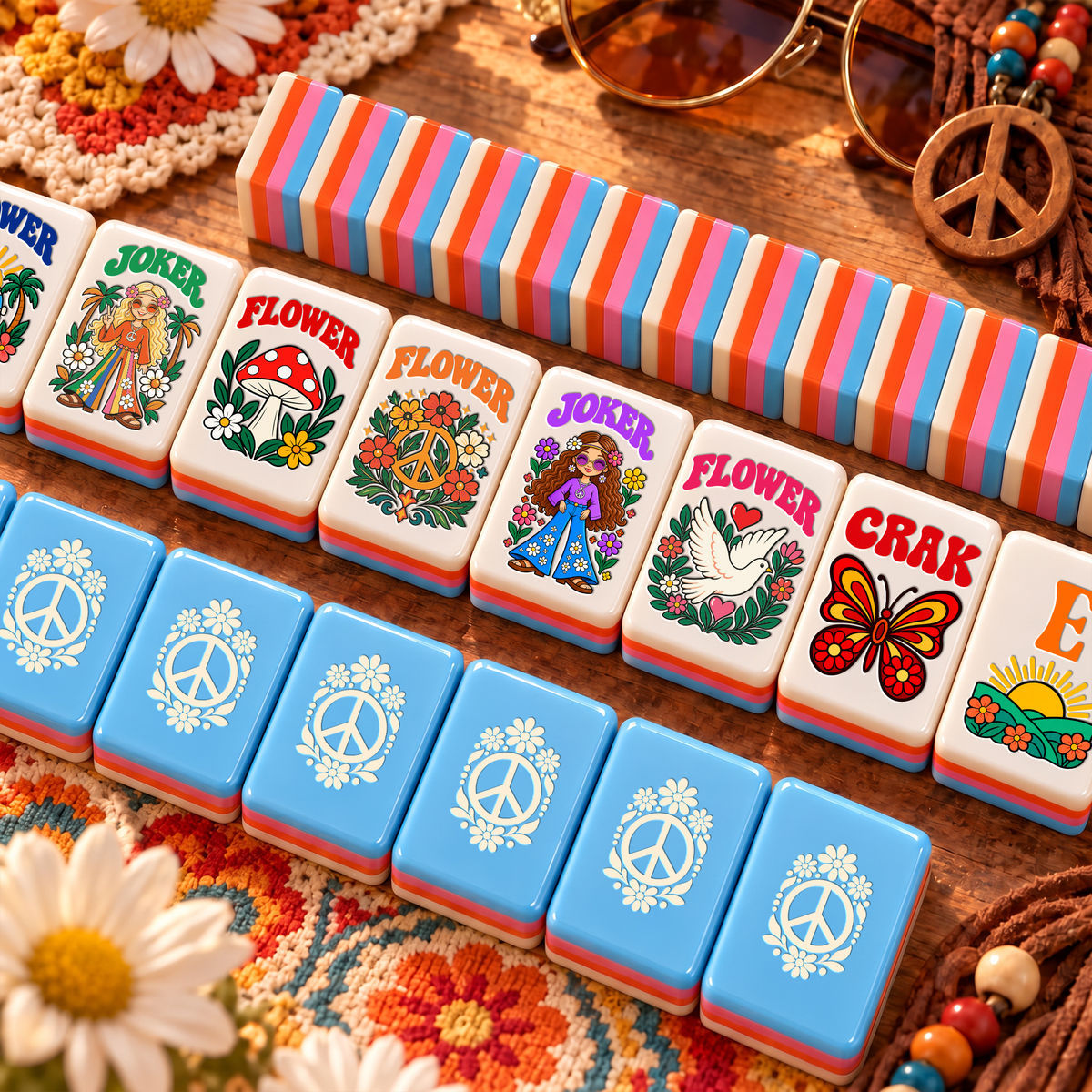
American mahjong uses specialized vocabulary that describes tiles, hands, and actions during play. Pung = three identical tiles (e.g., three 5 Dots); kong = four identical; quint = five; sextet = six. Chow (a 1-2-3 sequence) does not exist in American mahjong—only identical sets are exposed. Joker acts as a wild tile and can appear only in melds (never as a single or pair). Charleston is the tile-passing ritual before the game begins. The card = the current-year National Mah Jongg League hand reference, issued each spring. Exposure means laying a completed meld face-up on the table. Winning hand matches one pattern exactly from the card using 14 tiles (13 + 1 drawn). Our best-selling mahjong sets come with full tile identifiers so you learn the names as you play. Most games last 2–4 hours; fluency with terms comes after 3–5 sessions. 🀄 Shop best-selling mahjong sets →
What are the four suits and winds in American mahjong?
American mahjong has three numbered suits: Bam (1–9, marked with sticks or a bird on 1), Crak (1–9, marked with lines or a character), and Dot (1–9, shown as circles, with White "Soap" as zero). Winds are four tiles: North, East, West, and South. Each appears in sets of four. You'll see the Chinese character for each wind on the tile face. These seven categories (three suits + four winds) form the backbone of every hand pattern on the card.

How do melds differ: pung, kong, quint, and sextet?
A pung is exactly three identical tiles—same suit, same number. A kong is four identical. A quint is five identical (four tiles plus one joker substituting for the fifth). A sextet is six identical (four tiles plus two jokers). In American mahjong, you cannot expose a chow (the 1-2-3 sequence common in Chinese variants). Once you lay a meld on the table, it's locked—you cannot draw it back. If you meld a Joker in a pung, that Joker is "spent" and cannot be moved or swapped later.
What does the National Mah Jongg League card tell you?
The card, issued each spring, displays all legal winning hands for that year in American mahjong. Hands are organized by pattern type: simples, honors, all-simples, all-winds, all-dragons, and more. Each hand shows the tile composition (e.g., "three Pungs of Bams, one Kong of Craks, one pair of Dragons"). You must match your 14 tiles exactly to one pattern on the current card—no substitutions. When you think you've won, you call "Mahjong" and everyone verifies your tiles against the card. The card changes yearly; old cards are never valid.
What is the Charleston and why does it matter?
The Charleston is a ritual three-round tile exchange that happens before any hand is drawn or played. In round one, each player passes three tiles face-down to the player on their right. In round two, pass three to the player opposite. In round three, pass three to the left. Some groups add an optional fourth round (the "over-pass") where you swap tiles with the player on your right again. The Charleston shuffles the tile distribution so no one has predictable holdings. Beginners often pass weak tiles too early; veteran players hold one or two discards to control their strategy mid-Charleston.
How do jokers work and what are their limits?
Jokers are wild tiles that substitute for any tile you need—any Bam, Crak, Dot, wind, or dragon. A hand may contain up to two jokers if the pattern on the card allows it; some patterns require zero jokers, others allow one or two. Jokers can never appear alone as a single tile in a pair position. Once a joker is exposed in a meld, it is locked—you cannot swap it for another tile or reposition it. If you draw a joker, you may add it to an exposed meld by swapping it for the tile it replaces, but only if the meld is already on the table and you have the tile that joker was standing in for in your hand.

How do winds, dragons, and honors fit into hands?
Winds and dragons are called honors (as opposed to the numbered suits). A hand may contain all honors (no numbered tiles), or a mix of honors and numbers. Red dragons appear with Craks, green dragons with Bams, and white dragons (also called "Soap") with Dots. When you see a blank or empty-looking tile, that's Soap. Honor-heavy hands like "two pungs of winds, one kong of dragons, simples" are common patterns on the card. You need the card in front of you to spot which honor combinations form legal hands.
Comparison: Common American Mahjong Hand Types
Hand Type | Uses | Jokers Allowed | Example from Play | Skill Level |
All simples | Only tiles 2–8, no 1/9, honors | Typically 1–2 | Three pungs of Dots, one pung of Bams, simples | Beginner |
All honors | Only winds & dragons, no numbers | Varies by year | Two pungs of winds, one kong of dragons | Intermediate |
Like/quint combos | Multiples of one suit or honor | 0–2 (per card) | Five Bam, quint plus two Dragon pungs | Advanced |
All terminals | Only 1 and 9 of each suit, plus honors | 0–1 (rare) | Pungs of 1 Bam, 9 Dot, 1 Crak | Advanced |
Essential Terms Every Player Must Know
Exposure – laying a completed meld face-up on your rack after your turn so everyone sees it.
Wall – the face-down stack of undrawn tiles in the center of the table (152 tiles total, played with 8 jokers).
Dead wall – the last 16 tiles set aside before play starts; used for replacement draws after kongs.
Blind draw – drawing a tile without looking, usually from the far end of the wall.
Discard – placing a tile face-up next to your rack after drawing; opens it for others to use if they call it.
Called tile – a discard taken by another player to complete an exposure.
Self-drawn – winning with a tile you drew yourself rather than a discard.
Winning hand – 14 tiles that match exactly one pattern on the current card.
Ready hand (or "one away") – a 13-tile hand needing only one tile to win.
Pair – two identical tiles (the only meld that does not need to be identical across suits in some contexts; always identical in American mahjong).
Joker as wild – when a Joker stands in for a tile it physically isn't.
Spent Joker – a Joker locked in an exposure that cannot be moved or swapped.
Over-pass – an optional fourth Charleston round; not played in all groups.
Goulash – a variant hand deal using undealt tiles from a previous game (uncommon in formal American play).
Limit hand – a hand worth the maximum points for the year (scored under the NMJL system).
Non-limit hand – any hand worth fewer points than the year's limit.
What to Check Before You Play
Before sitting down at a new table, confirm:
What year is the card? Ask outright. Never use last year's card.
How many jokers? Some groups play with the standard eight; others house-rule differently. Verify before the Charleston.
House rules on the over-pass? Not all groups allow a fourth Charleston round.
Is self-drawn valued differently? Some play where drawing your own winning tile scores more.
What discard protocol? Do discards stay in the center, or go to a discard pile? Some groups require calling a discard aloud.
Time limit? Friendly games often have none; tournaments enforce strict turn times.
🎁 See our most-loved mahjong sets & accessories →
Building Your Vocabulary Through Play
The fastest way to learn terms is to join a regular game and have someone at the table who names each action aloud. When you see a pung laid down, the player should say "pung" and show the three identical tiles. When a joker substitutes, someone should point it out. After 4–5 games, you'll recognize all 40+ core terms automatically.
If you're buying a set to host your own group, pick one with engraved American mahjong sets so tiles are easy to read. Adding a mat with printed rules or a quick reference helps newcomers follow along without feeling lost. Many players also keep a printed glossary at the table during their first month of hosting—no shame in it.
Hand-Signal Shorthand at the Table
Experienced players often use shorthand when calling melds:
"Pung" – three identical tiles coming down.
"Kong" – four identical; usually you announce "kong" and draw a replacement from the dead wall.
"Quint" or "quintet" – five tiles, including one joker.
"Sextet" – six tiles, including two jokers.
"Mah!" or "Mahjong!" – you've won; call this loudly so everyone stops.
"Pair" – two identical tiles (though usually only named during winning verification, not during play).
A Worked Example: Reading a Winning Hand
Imagine you draw your 14th tile and lay out:
Three 4 Bams (a pung)
One 4 Bams, one 5 Bams, one 6 Bams (a simples run? No — this is NOT a chow in American mahjong; this is illegal)
Four 5 Craks (a kong)
Three South winds (a pung)
Two White dragons (a pair)
You check the card and find no match. Why? Because you tried to use a run, which American mahjong does not allow. You go back in and draw again. Next turn, you draw a second White dragon to complete a pair, and now your melds are four identical or Joker-substituted multiples only. You find the pattern on the card and call Mahjong.
✨ Find your Mahstead set — free US shipping →
Glossary Quick Reference (Alphabetical)
All-honors: Hand using only winds and dragons, no numbered suits.
All-simples: Hand using only numbered tiles 2–8, no 1, 9, or honors.
Called tile: A discard taken from another player's hand to complete an exposure.
Charleston: The three-round tile-exchange ritual before play begins.
Chow: A 1-2-3 sequence; not allowed in American mahjong (exists in Chinese and Riichi variants).
Crak: One of three numbered suits (1–9); marked with lines or a character.
Dead wall: The 16 tiles set aside before play; used for replacement draws after kongs.
Discard: Placing a tile face-up after drawing; opens it for others to call.
Dot: One of three numbered suits (1–9); shown as circles; White tile (zero) is Soap.
Exposure: A meld laid face-up on the table; locked once exposed.
Joker: A wild tile that substitutes for any other; limited to two per hand in most years.
Kong: Four identical tiles; you draw a replacement from the dead wall.
Limit hand: A hand worth the year's maximum point value.
Non-limit hand: Any hand worth fewer points than the year's limit.
Over-pass: An optional fourth Charleston round; not universal.
Pair: Two identical tiles (required in every winning hand as the final 2 of the 14).
Pung: Three identical tiles.
Quint/Quintet: Five identical tiles (four tiles plus one joker).
Ready hand: A 13-tile hand needing only one more tile to win.
Self-drawn: Winning with a tile you drew yourself, not a discard.
Sextet: Six identical tiles (four tiles plus two jokers).
Soap: The White dragon; serves as both dragon and zero Dot.
Wall: The central stack of undrawn tiles.
Wind: One of four honor tiles: North, East, West, South.
Winning hand: Exactly 14 tiles matching one pattern on the current year's card.

FAQ
Can I use a chow (1-2-3 sequence) in American mahjong?
No. American mahjong allows only identical melds: pungs (three), kongs (four), quints (five), and sextets (six). Chows are not legal in American mahjong. Chinese and Riichi variants do allow sequences; verify which game your group plays before buying a set.
What does "the card" mean and why do I need it?
"The card" is the National Mah Jongg League's annual hand reference, issued each spring. It lists every legal winning hand for that year. You must match your 14 tiles exactly to one pattern on the current card—no old cards, no house variants. Without the card, you cannot verify a win. Every player at the table needs access to a copy.
If I expose a pung with a joker in it, can I swap the joker for the real tile later?
No. Once a joker is locked in an exposure, it cannot be moved, swapped, or replaced. Plan carefully before laying melds. If you realize mid-game the joker would be better elsewhere, you cannot undo the exposure.
What is the dead wall and when do I draw from it?
The dead wall is 16 tiles set aside before play starts. You draw from it only after you declare a kong. When you lay a kong, you draw a replacement tile from the end of the dead wall closest to you to maintain 14 tiles in hand. Once the dead wall is empty, no more replacements are available.
Why do some groups call an optional "over-pass" in the Charleston?
The over-pass is a fourth round of Charleston where players exchange tiles one more time, usually passing right again. It's optional and not universal. Some groups believe it balances the tile distribution further; others skip it to speed up play. Ask your table before the first Charleston which rule you're following.
How many jokers are in a standard American mahjong game?
A standard game plays with eight jokers. They are part of the 160-tile set composition and are never added or removed mid-game. If your set came with extra jokers, those are spares and stay in the box during play.
What's the difference between self-drawn and a called discard for winning?
Self-drawn means you drew your 14th winning tile yourself from the wall. Called means you took a discard from another player's hand to complete your win. In American mahjong, both are valid. Some scoring systems award more points for self-drawn (varies by local rules and year's card).
Can a joker ever appear alone, or as one of a pair?
No. A joker can never stand alone as a single tile or form a pair by itself. Jokers only work within melds (pung, kong, quint, sextet) as substitutes for one of the identical tiles. The pair in a winning hand must always be two identical real tiles, never jokers.


View More
View More
View More
