
8 Dot Tile in Chinese Mahjong: Meaning, Value & Play
Last updated: Nov 23, 2026
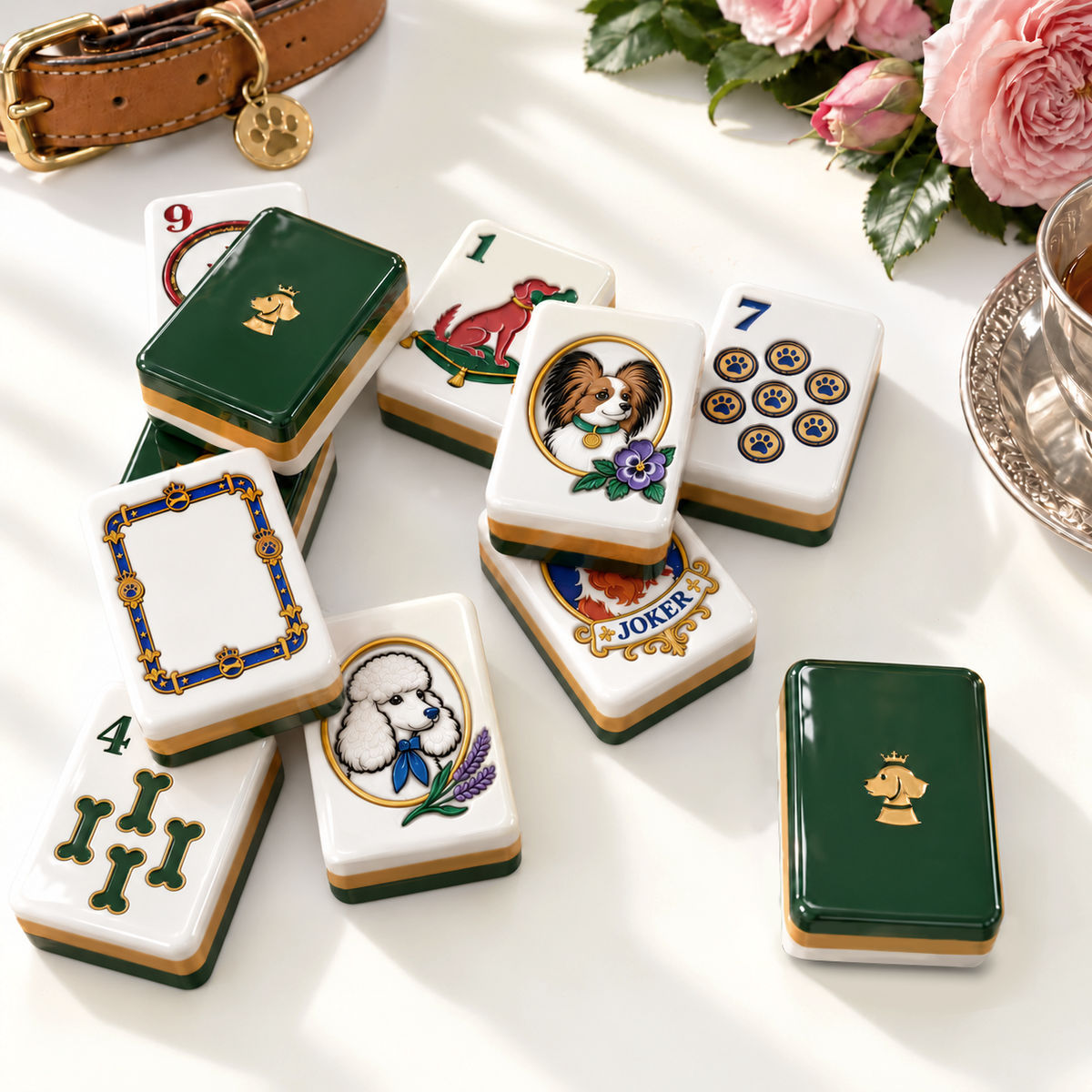
In Chinese mahjong, the 8 Dot is the second-to-highest number tile in the Dot suit (1–9) and belongs to the "simple" or "minor" tiles rather than honor class. The Dot suit traditionally represents coins or pearls; the 8 Dot shows eight dots arranged in a pattern. In Chinese variants (Cantonese, Mandarin, Shanghai), the 8 Dot is used to form sequences (chows: 6-7-8, 7-8-9, 8-9-1) and pungs (three or four identical 8 Dots), both of which score points. In American mahjong, the 8 Dot tile exists identically in the standard 152-tile set but is never used in sequences—only in exposed pungs, kongs, or within joker-dependent hands shown on the current National Mah Jongg League card. American players building sets from our best-selling mahjong collection will find the 8 Dot in every standard deck, with four copies present for gameplay.
The 8 Dot is a mid-range honor tile in Chinese mahjong representing the number eight in the Dot suit (1–9) and belongs to the "simple" or "minor" tiles rather than honor class. The Dot suit traditionally represents coins or pearls; the 8 Dot shows eight dots arranged in a pattern. In Chinese variants (Cantonese, Mandarin, Shanghai), the 8 Dot is used to form sequences (chows: 6-7-8, 7-8-9, 8-9-1) and pungs (three or four identical 8 Dots), both of which score points. In American mahjong, the 8 Dot tile exists identically in the standard 152-tile set but is never used in sequences—only in exposed pungs, kongs, or within joker-dependent hands shown on the current National Mah Jongg League card. American players building sets will find the 8 Dot in every standard deck, with four copies present for gameplay.
What does the 8 Dot tile look like?
The 8 Dot shows the numeral 8 or eight small circles (pips) arranged symmetrically on a square face, usually centered. Traditional Chinese sets display pips in two neat columns of four dots. Modern acrylic American sets use printed Arabic numerals for speed and clarity. The tile is typically smaller than honor tiles and made from bamboo, bone, plastic, or acrylic depending on the set's age and cost. Color is always uniform—the suit design distinguishes it from Bam and Crak tiles.

How does the 8 Dot rank in Chinese mahjong hands?
In Chinese mahjong, the 8 Dot ranks as a "terminal" number tile (higher than 1–7, lower than 9). It combines freely with 6-7 (forming 6-7-8 chow) and 9-1 (forming 8-9-1 chow). As a pung or kong, three or four 8 Dots score base points; no bonus applies unless the hand includes special conditions like "all terminals" or "honor tiles only." Value depends entirely on hand type and local scoring rules—a pung of 8 Dots in a mixed honor hand scores less than the same pung in an all-simples hand. Scoring varies by region, so always confirm house rules before play.
Why doesn't American mahjong use chows with the 8 Dot?
American mahjong forbids exposed sequences (chows) entirely—whether 6-7-8, 8-9-1, or any other combination. The National Mah Jongg League card dictates which hands are legal; hands are built from the current year's card and must match exactly one listed pattern. The 8 Dot cannot be melded publicly in a sequence; it appears only in pungs, kongs, quints, or sextets of four identical tiles, or hidden in your hand. This rule keeps the game faster and removes ambiguity about which sequences are valid. American mahjong differs sharply from Chinese and Hong Kong variants—American is card-driven, sequence-free, and plays with jokers.
🀄 Shop best-selling mahjong sets →
How many 8 Dot tiles are in a standard set?
Every legal American mahjong set contains exactly four 8 Dot tiles, as part of 36 total Dot tiles (1–9 in fours). The 152-tile American deck also holds four each of Bam and Crak numbered 8s, totaling twelve numbered 8 tiles in play. Chinese and Hong Kong standard sets (usually 144 tiles) also include four 8 Dots. When you open a new acrylic set, count the Dots: you should find four each of 1 through 9. If a tile is missing, contact the seller immediately—the set is incomplete.

When would you draw or hold the 8 Dot in a real game?
During the Charleston (the tile-passing ritual before American mahjong begins), you might receive 8 Dot tiles and choose to pass them forward, backward, or across depending on your emerging hand strategy. Once play starts, you draw tiles one at a time from the wall and discard to keep exactly thirteen tiles in hand (fourteen when you declare a win). An 8 Dot in your hand is useful if the current National Mah Jongg League card shows a pung or joker-wild group containing 8 Dots. If the card does not call for 8 Dots, you discard it early to avoid being forced to keep dead weight. Skilled players study the year's card before the game to know which tiles will complete hands.
Scenario | American Mahjong | Chinese Mahjong | Why It Differs |
8 Dot in hand | Match to pung or joker hand on card only | Use in 6-7-8 or 8-9-1 chow, pung, or honor mix | American forbids chows; Chinese allows sequences |
Four 8 Dots in set | Yes, always four copies | Yes, standard four copies | Both start with 36 Dot tiles (1–9 × 4) |
Exposed melds | Pung, kong, quint, sextet (never sequence) | Pung, kong, chow (sequence) | American rule: no open sequences |
Scoring for 8 Dot pung | Depends on hand pattern on card | Fixed points ± bonuses for hand type | American uses card; Chinese uses fixed scoring |
🎁 See our most-loved mahjong sets & accessories →
Building a set: What to check before you buy
When shopping for your first American mahjong set, confirm it contains exactly 152 playable tiles plus spares. A complete deck lists four each of Dots 1–9, Bams 1–9, Craks 1–9 (twelve more 8s total), four winds, twelve dragons, and eight flowers, plus eight jokers. Acrylic sets from Mahstead's engraved collection print numbers clearly so beginners spot the 8 Dot instantly. Traditional bone or bamboo sets use pips (small dots), which require practice to count quickly under game pressure. If you play primarily Chinese or Hong Kong mahjong, a 144-tile set works; if you want flexibility across variants, stick to American 152-tile sets. Check that tiles feel smooth, not sticky or warped—acrylic lasts through hundreds of games without chipping.
Our pillar guide to what's in an American mahjong set covers the full tile roster, roles, and why each tile matters.
Why American and Chinese mahjong treat the 8 Dot so differently
American mahjong is card-driven and sequence-free. Every hand originates on the National Mah Jongg League card released each spring; the card shows which tile combinations win. The 8 Dot can only appear as part of a pung, kong, or a joker-extended pattern—never as one third of a sequence. Chinese mahjong is rule-based and sequence-rich. The 8 Dot combines with 6-7 or 9-1 to form chows (melds of three consecutive tiles), which are fully legal and scored heavily. This fundamental rule shift means learning American mahjong first does not teach Chinese sequences; players switching variants must unlearn the prohibition on chows. How to play American mahjong explains the full card system.
✨ Find your Mahstead set — free US shipping →

FAQ
Is the 8 Dot tile the same in American, Chinese, and Hong Kong mahjong?
The tile face is identical—eight pips or the numeral 8. The rules differ: American forbids chows, so the 8 Dot only forms pungs or joker hands. Chinese and Hong Kong allow the 8 Dot in sequences (6-7-8, 8-9-1), which score heavily. All variants use exactly four 8 Dots per set.
Can you win with only 8 Dot tiles as your hand in American mahjong?
No. Your hand must match a pattern on the current National Mah Jongg League card exactly. Some patterns call for a pung (three 8 Dots) or a joker-filled group with 8 Dots, but no hand requires eight Dots alone—American mahjong requires thirteen or fourteen tiles forming a complete card pattern.
How many 8 Dot tiles should I see when counting a new American mahjong set?
You should see exactly four 8 Dot tiles, plus four 8 Bam tiles and four 8 Crak tiles (twelve numbered 8s total). If any are missing, contact the seller immediately—the set is incomplete and unplayable for a four-player game.
Why does American mahjong eliminate chows but keep the 8 Dot?
The 8 Dot exists for two reasons: it fills bonus and honor-mixed hands on the card, and it maintains a complete Dot suit (1–9) for hand variety. Removing it would simplify the game but limit the range of legal hands and strategies.
If I learned Chinese mahjong first, how do I unlearn the 6-7-8 chow rule for American play?
Study the current National Mah Jongg League card before your first American game. Mark or highlight pungs on the card so your eye learns to recognize them instead of sequences. Most new American players make this mistake once—after the first discard penalty, the rule sticks. Play a few practice rounds online or with patient friends to build muscle memory.
Does the 8 Dot score higher or lower than other number tiles in Chinese mahjong?
The 8 Dot is a mid-rank tile with no inherent bonus. Scoring depends entirely on the hand type (all simples, mixed honor, all honor, etc.) and local rules. A pung of 8 Dots scores the same points as a pung of any other simple number tile unless the hand includes special bonuses.


View More
View More
View More
