
Wuhan Mahjong Strategy: Tiles, Tactics & Position Play
Last updated: Nov 23, 2026
Wuhan mahjong strategy centers on three pillars: rapid hand assembly through open melding (exposure of pungs, kongs, and quints), defensive discard reading to block opponents' winning tiles, and strategic seat advantage—East begins with the strongest information. Unlike American mahjong, which uses a fixed annual card, Wuhan play allows players to form hands more freely from any combination of melded sets and pairs. Winning hands typically score higher when declared early; tile pressure increases as the live wall depletes. Success depends on reading discard order, calculating remaining tiles in the wall, spotting orphaned suits, and adjusting your hand assembly pace based on table tempo and opponent patience. New players often overbuild exposed sets too early, telegraphing their intentions; experienced Wuhan players hold flexibility in their construction, keeping multiple winning paths open until the last safe moment. A strong grasp of suit abandonment (which suits no opponent seems to need) and hand speed calculations gives you a decisive edge over position-reactive play alone.
Wuhan mahjong—rooted in central China and played across the Yangtze River region—prioritizes speed, openness, and positional awareness in ways that diverge sharply from American mahjong rules. If you've only played the American variant with its fixed card and rigid hand templates, Wuhan's strategic landscape will feel more fluid and more pressured. We host weekly Wuhan games and have learned that the moment you stop thinking "hand first" and start thinking "table state first," your win rate climbs.
🀄 Shop best-selling mahjong sets →
How does hand speed affect Wuhan positioning?
In Wuhan, declaring your hand early—often by the 12th or 14th draw—signals strength and forces opponents into reactive mode. Slower builds telegraph weakness; your opponents will then hoard dangerous tiles or accelerate their own melds. The player who assembles a winning hand fastest typically controls the table's pace, meaning you should aim to complete one of two or three viable paths by mid-game rather than locking into a single dream hand. East seat inherently moves first after the discard, giving you the information advantage and the option to declare or pass based on live-tile visibility. South and West must commit to their builds with less data, so position conditioning—adjusting your hand speed relative to the seat order—is non-negotiable. When you sit East, speed costs you little; when you sit West, patience and flexibility cost less than racing a faster East. The table's mood (aggressive drawing vs. cautious hoarding) also tells you whether to rush or wait.

What discard patterns reveal your opponents' winning conditions?
Reading discards is the beating heart of Wuhan defense. An opponent who discards 1 and 9 Bams early but hoards middle Bams is building a pung or kong in that suit; one who flushes a whole suit within five turns has likely abandoned it entirely. Count how many of each number each player has thrown: if West has discarded two 5 Dots and no other Dots after ten turns, the remaining 5 Dots are probably live and dangerous. The most predictive discard pattern is the honor tile dump—a player who tosses three winds or dragons consecutively is signaling they have no honor pairs and are pursuing a pure suit hand or a mixed hand weighted heavily toward Bams, Craks, or Dots. Once you spot that signal, you can adjust: hold honor tiles a turn or two longer, or push them out earlier if you're threatened. Conversely, a player discarding only middle-number tiles (4–6) while holding high and low hints they're building a narrow winning condition and are vulnerable to extreme numbers. Wuhan players who master discard archaeology—reconstructing each opponent's likely tiles from the discards on the table—win consistently because they know which tiles are truly safe to play.
When should you meld openly versus building in hand?
This decision separates casual from competitive Wuhan play. Melding visibly (exposing pungs, kongs, quints) accelerates your declaration and shows your strength, but it narrows your hand's versatility; once a pung is exposed, you cannot reroute those tiles into a different set. Building in hand keeps all options live: that pung-in-progress can become a pair if you pivot strategies mid-hand. The core tactic is controlled exposure: expose one or two open sets early to signal progress and pace, but keep your pair, your wildcards (if playing with jokers or a variant that allows them), and your most flexible set-in-progress concealed until you're within two or three tiles of declaring. This forces opponents to decide whether to block your visible melds or defend against your hidden ones—a cognitive strain that often leads to mistakes. East seat can afford more aggression because you move first after each opponent's discard, so opponents react to you rather than you reacting to them. If you sit West, delay exposure by one or two rounds to see how the hand unfolds; the extra data often saves you from committing to a losing path. When a hand feels tight (few tiles remain in the wall, multiple players are active), restraint pays: one exposed pung and a visible pace is enough to win a race without overcommitting.
How does wall depletion change your strategy?
Wuhan hands finish faster than American mahjong rounds, and the live wall shrinks visibly over 15–18 turns. As fewer tiles remain, the probability that your needed tile exists drops sharply—and so does the probability that an opponent will discard it safely. In the early game (turns 1–6), hold flexible hands and meld cautiously; you have time to pivot. In the mid-game (turns 7–12), you should have one clear winning path open and one backup; start melding that path aggressively if no opponent has declared yet. In the endgame (turns 13+), the player with the fastest, most obvious hand often wins because discarding becomes a minefield: every tile you throw might complete someone's hand. Experienced Wuhan players calculate tile math at this stage: if you need a 5 Crak and you've seen three of the four copies discarded, you know the draw odds are one-in-many; time to abandon that path and pivot to your backup. The wall also signals dead tile zones—numbers no opponent has touched—meaning those tiles are probably already in finished hands or hidden meldings. Playing dead tiles is safe and fast late-game; touching live tiles is the highest-risk move. When the wall is down to 15 tiles, only the player closest to winning should meld anything new; others should defend by discarding unpaired, mid-range honors or extreme numbers that seem already abandoned by the table.

What makes seat positioning a strategic advantage?
Wuhan is more position-sensitive than American mahjong because hand speed and discard sequencing compound with seat order. East always moves first and sees the discard before deciding; South sees East's response before committing; West sees the maximum information but also faces maximum time pressure because South and East already know the table state. North (in some variants) has the information advantage between rounds but moves last during a round, creating a mixed strategic profile. The dominant seat is East in aggressive games (where speed matters) and West in defensive games (where information density matters). A weak East player often loses to a strong West because the extra data outweighs the move order. Conversely, a fast, aggressive East can dominate a cautious West in a loose table. Your seat determines your tactical priorities: East prioritizes pace; South balances speed and information; West prioritizes reading and adaptation; North plays a supporting role, often focusing on blocking the presumed winner. Most winning sessions at our tables involve one player exploiting their seat's natural advantage—usually East pushing the pace or West reading discards and adapting—while others play their seat reactively. When you rotate seats, mentally shift your target: if you move to West, slow down and read the table harder; if you move to East, decide whether to race or control from the first draw.
Seat | Information Timing | Natural Pace | Winning Edge |
East | First after opponent discards | Fast (move advantage) | Speed + early advantage |
South | After East's response | Moderate | Adaptability + info balance |
West | After East & South signal | Slow (late move) | Reading + discard archaeology |
North | Information-rich between rounds | Moderate-slow | Blocking + defensive set play |
East wins most often in loose, fast tables; West wins in tight, competitive tables where reads matter more than pace.
What tiles should you prioritize holding versus discarding early?
Hand composition theory in Wuhan centers on tile flexibility—each tile's potential role in multiple set types. A 5 Dot can anchor a pung, serve as middle in a pure-number progression, or partner in a mixed hand; it is high-value early because it keeps options open. Extreme numbers (1, 9 in each suit) are lower-value early unless you're already building a terminal-heavy hand because they lock you into fewer set types. Honor tiles (winds, dragons) are dual-purpose: they form pure-honor pungs or serve as filler in mixed hands, so a single 5 honors have reasonable hold-value. Early in your hand, discard your most restrictive tiles first—duplicates of extreme numbers you don't plan to meld into, honors that don't fit your emerging pattern, suits you've decided to abandon. This pruning buys you flexibility. By mid-game, discard based on table pressure: if East is moving fast, throw defense-first (unpaired honors, dead tiles); if no one is close to winning, throw cards that keep your options open. Late-game discard is pure math: every tile out of your hand is a tile that cannot be stolen or needed. Predicting which suits opponents have abandoned lets you discard safely from those suits while holding live-suit cards longer—a simple read that saves you multiple turns of anxiety.
🎁 See our most-loved mahjong sets & accessories →
What's the difference between Wuhan strategy and American mahjong tactics?
American mahjong forces all hands to match the current year's National Mah Jongg League card, meaning you build toward one of hundreds of legal templates. Strategy revolves around reading the card, counting the jokers in play, and executing that template. Wuhan mahjong allows freestyle hand formation—any combination of sets and a pair—so your strategic space is vastly larger but less structured. American tactics emphasize template efficiency (knowing which card patterns leave the fewest dead tiles); Wuhan tactics emphasize table state reading (knowing what tiles are live, dead, or orphaned based on discards alone). American games reward careful study of the card and long-term pattern recognition; Wuhan games reward real-time calculation, seat awareness, and rapid decision-making under uncertainty. If you're transitioning from American to Wuhan, expect to shift from "Which card hand should I build?" to "What pace is the table setting, and what is my opponent's hand likely to need?" The psychology also differs: American mahjong can feel methodical and card-focused; Wuhan mahjong feels dynamic and opponent-focused. Both are skill games, but Wuhan punishes inattention and poor discard reading far more immediately than American does.
If you regularly host Wuhan games, you'll want a quality set and a mat that supports fluid melding and discard visibility. Our best-selling mahjong sets include acrylic designs built for fast play and clear tile reading—crucial when you're tracking four suits, honor tiles, and discard archaeology across 15+ turns. A sturdy mahjong mat with defined zones for melds, your hand, and the discards keeps the table organized as hands speed up and stress increases. Racks with pushers are especially useful in Wuhan play because tile movement happens constantly; pushers let you adjust your hand silently without telegraphing which tiles you're holding or reconsidering.
✨ Find your Mahstead set — free US shipping →
What common mistakes tank a Wuhan player's win rate?
The most expensive mistake is overcommitting to a single hand path too early. Many newer players decide on a full-suit build in turn three, meld it visibly by turn six, and then find the fourth copy of their key tile in the discard pile by turn eleven—too late to pivot, too committed to escape. Build flexibility; keep two viable paths until turn twelve. The second mistake is ignoring seat position. Playing East and West with the same aggression level is a tactical error; East can race, West must read. The third is poor dead-tile recognition. If no player has discarded Bams for five turns, you do not throw Bam pairs, even if you've already committed to them; you're likely discarding into an opponent's winning hand. Fourth: discarding from your currently-building suit. If you're one tile away from a pung of 5 Craks, do not throw a 3 Crak late-game; you might need that discard to stay safe if an opponent wins. Fifth: moving too slowly when East. East's advantage evaporates if you take eight turns to build what West builds in six; East is fast or East is dead. Most casual players also violate table awareness: they focus so hard on their own hand they miss an opponent's visible pace shift, which signals either sudden weakness (they gave up and are now defending) or sudden strength (they pivoted to a faster hand and are about to declare).
What to check before you buy a Wuhan mahjong set:
Tile size: 1.2–1.5 inches is ideal for counting, reading suit markers, and rapid movement.
Visibility: white backgrounds or high contrast print matter when reading discards across a crowded table.
Jokers/blanks: confirm your regional rules on joker counts; Wuhan variants differ on wildcard flexibility.
Racks: if included, ensure pushers move smoothly; sticky pushers slow your hand rearrangement and signal hesitation to sharp opponents.
Case or mat: Wuhan sessions often run 5–10 rounds; a durable travel bag or mat protects your set across multiple weekly games.

FAQ
Is Wuhan mahjong played with the same 152 tiles as American mahjong?
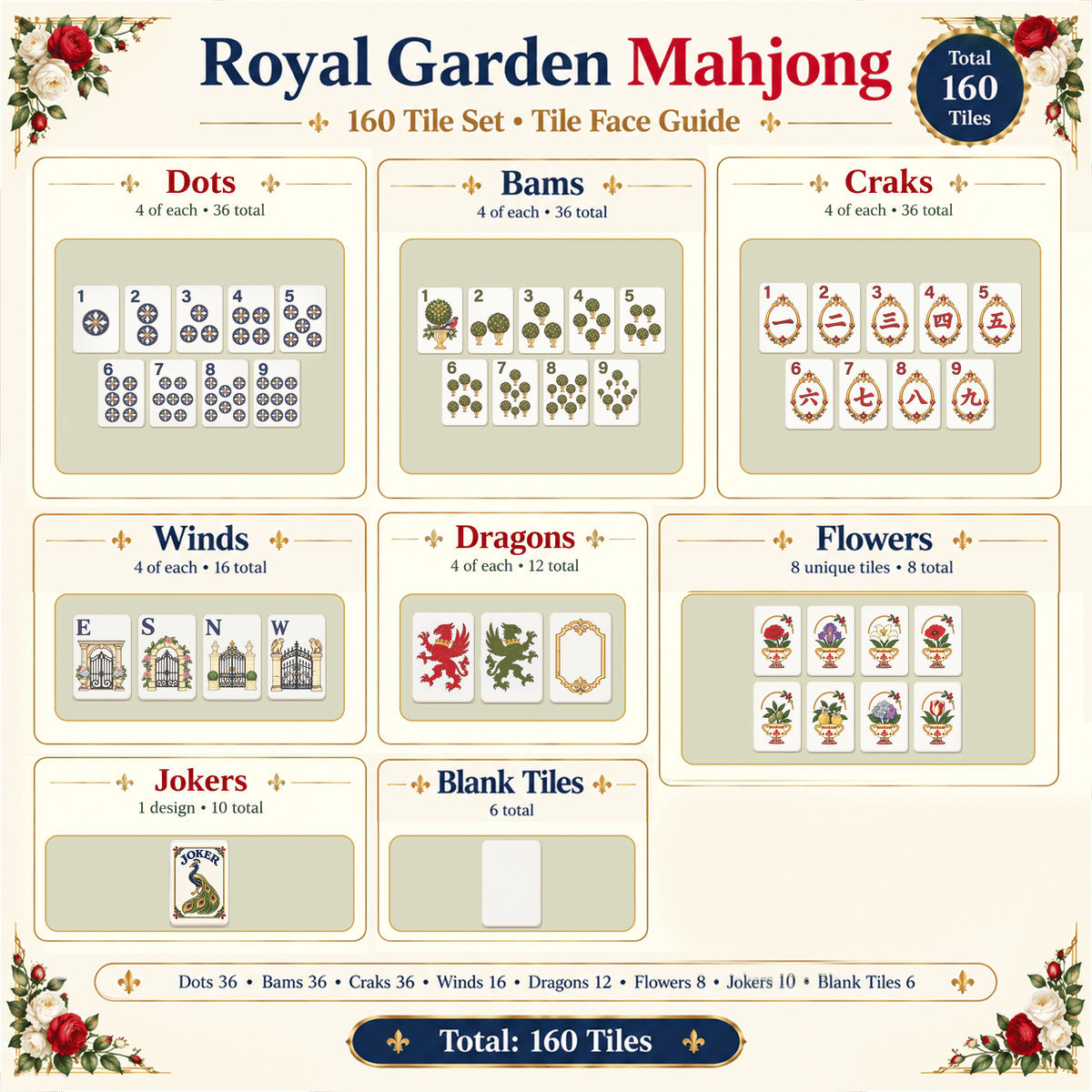
No. Wuhan uses a standard Chinese set—108 suited tiles (Bams, Craks, Dots in 1–9, four copies each), 16 winds, 12 dragons, plus flowers and jokers (counts vary by regional rule). American mahjong uses exactly 152 tiles per National Mah Jongg League standard. The tile compositions and hand-building rules are fundamentally different.
Can I use an American mahjong set to play Wuhan?
Mostly yes, if you strip out the extra jokers and ignore the American hand card. You'll have the suits and honors needed. However, American sets are optimized for the American tile distribution and card layout; a Chinese set is clearer for reading traditional hand patterns and may include design elements (flower markers, simplified characters) that speed Wuhan play.
How many jokers does a typical Wuhan hand use?
Wuhan variants differ widely. Some use no jokers (pure tile play); others use 1–2 per hand. Check your group's house rules before buying a set. Our best-selling acrylic sets include extras so you can adapt to any variant.
What's the fastest way to improve my Wuhan win rate?
Study discard patterns obsessively. Keep a mental log of which suits each player abandons, which numbers they hoard, and which discards signal pivots. The player who reads the table best wins; hand speed and seat tactics are secondary to discard archaeology.
Does my mat choice affect my Wuhan strategy?
Yes. A mat with clear meld zones and a defined discard row lets you and your opponents read the table state instantly, reducing misreads and speeding play. A cluttered mat hidden under stacks of tiles slows decision-making and invites mistakes. A quality mahjong mat is a strategic tool, not just décor.
Is Wuhan mahjong easier or harder than American mahjong for a beginner?
Harder, initially. Wuhan requires real-time tile calculation and opponent reading; American mahjong lets you study the card in advance. But once you grasp discard archaeology and seat positioning, Wuhan becomes faster and more intuitive because the hand rules are simpler—no card, just sets and a pair.


View More
View More
View More
