
Wright-Patterson Mahjong with 2 Players: Rules & Setup
Last updated: Nov 23, 2026
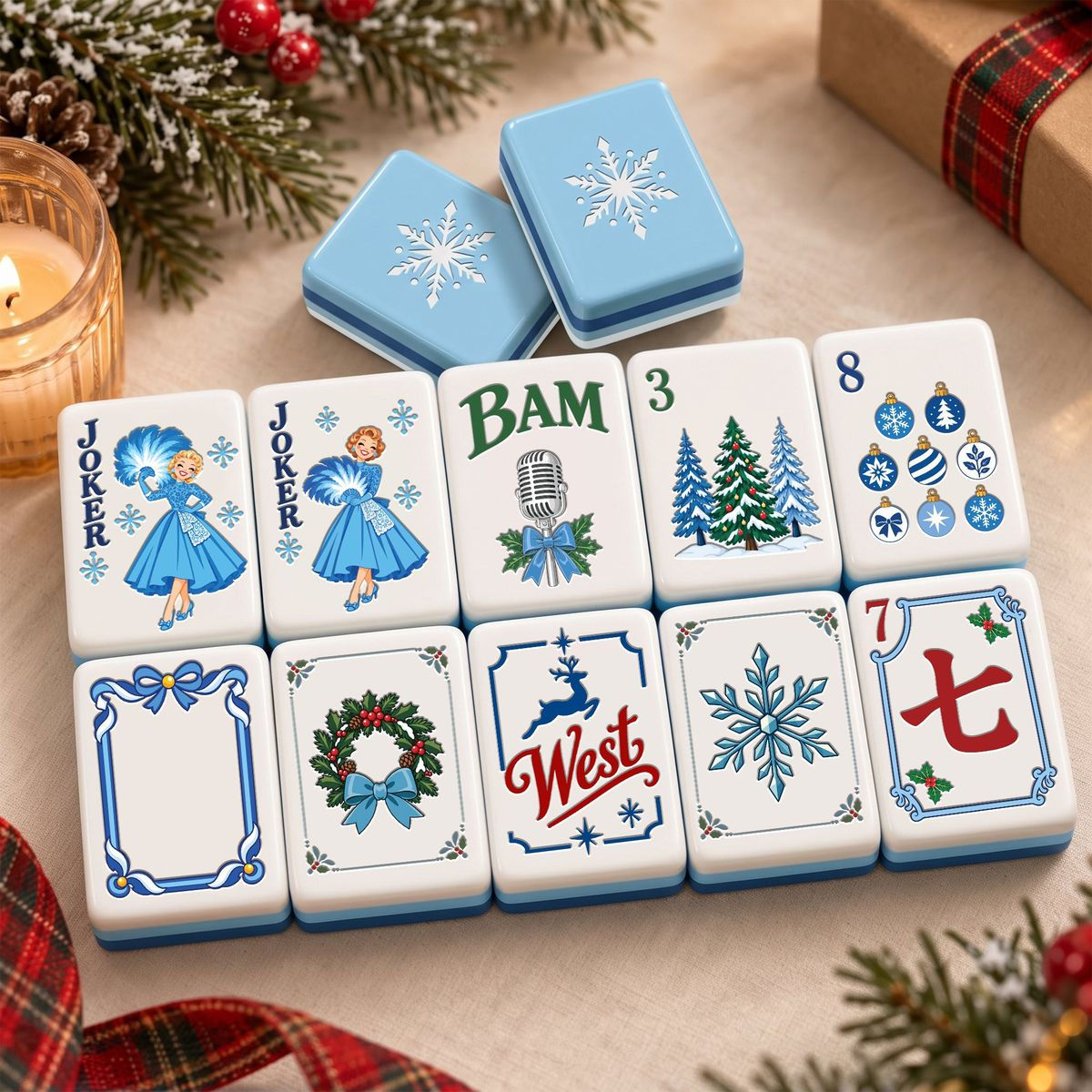
Wright-Patterson mahjong is a legitimate two-player American variant where each human player controls two compass positions (typically East and West, or North and South). All 152 tiles and 8 jokers remain in play; you set aside dummy hands for the positions you don't occupy, draw and discard for both your positions in turn, and play from the current year's National Mah Jongg League card exactly as in four-player American mahjong. The dummy hands sit exposed so both players see which tiles are held; players take turns claiming discards (dead or live) just as normal, and winning hands follow standard American scoring. Most players complete a game in 1–1.5 hours. You'll need one 152-tile American mahjong set and the current year's card. The challenge is discipline: you must play both your positions fairly, never favoring one over the other, and many groups use a scorepad to track liability separately for each position.
🀄 Shop best-selling mahjong sets →
How Do You Deal and Set Up the Wall?
Shuffle all 152 tiles face-down and build a wall exactly as in four-player: 34 pairs per side (typically 19 inches long for standard tiles). Player 1 draws from wall positions 1–13 as East and West; Player 2 draws as North and South. The loose tile (the "dead" tile beneath the kong box on the wall) remains reserved for any kong bonus. Dummy hands are placed upright in open racks so both players see all tiles at all times. This transparency is crucial: if a dummy hand hides tiles, disputes arise immediately.

When Do Players Take Turns and Who Discards?
Player 1 draws one tile for their East position (or draws from the loose tile if East has just made a kong), then discards one tile from East face-up into the center. Player 2 then draws one tile for their North position, and discards. This turn sequence continues: East draws → East discards → North draws → North discards → West draws → West discards → South draws → South discards, then back to East. If a discard is claimed for a pung, kong, or quint by any position, the claimer's turn is skipped; the player holding that position plays out of order when claim resolution ends. Both players must announce which position they are playing for before drawing, so no confusion occurs mid-turn.
Can You Claim a Discard for Your Dummy Positions?
Yes. If Player 1's West position (a dummy) needs a tile that Player 2 just discarded, Player 1 claims it aloud (e.g., "West takes it for a pung"). Player 2 confirms they saw the discard tile and which player took it. Because dummy hands are open, everyone sees the claim is legal. Jokers cannot be used in a single tile, pair, or any "dead" position (blank space in a hand). Once a dummy hand completes a hand, it is dead for that round—no further claims, no further draws. The other human-controlled position continues play alone, drawing and discarding, until it also completes or the wall exhausts. This speeds play and keeps momentum high.
How Do You Track Scoring and Liability?
In four-player American mahjong, each player owes or receives payment based on one winning hand per player. In Wright-Patterson, each position is scored separately, so East, West, North, and South each accumulate individual scores. The simplest method: keep a scorepad with four columns (East, West, North, South) or two columns per player (Player 1 = East + West; Player 2 = North + South). When East wins, credits go to East's column and debits come from the other three positions' columns. At the end of a session, Player 1 calculates their net (East column + West column), and Player 2 calculates theirs (North column + South column); the difference settles between them. Some groups sum payments immediately (so each round is cashed out separately), while others tally a final session number. Decide your method before the first hand to avoid confusion.
🎁 See our most-loved mahjong sets & accessories →
What Are Common Mistakes That Slow Down or Derail a Game?
Mistake | Why It Breaks | How to Avoid |
Playing one position "loose" to help the other win | Ruins fairness; both players should have equal odds. | Treat dummy positions as unbiased; play each hand as if a stranger owned it. |
Hiding or tilting dummy racks so tiles are obscured | Other player cannot verify claims; disputes spiral. | Use clear open racks; keep all dummy tiles fully visible at all times. |
Mixing up whose turn it is or skipping a draw | Wall empties unevenly; some positions run out before others. | Call out position name before each draw; use a simple turn sheet or app. |
Forgetting the National Mah Jongg League card is the only valid guide | Players invent hands; scoring becomes arbitrary. | Lay the current year's card flat between you; reference it before every win. |
Claiming a discard for a dead hand or joker in a pair | Illegal in American mahjong; must reverse play and restart. | Know the rules: no jokers in pairs, singles, or dead spots; check before claiming. |

Which Variant Is Closest to Standard American Play?
Wright-Patterson is the purest two-player adaptation because it keeps all 152 tiles in play, uses the official National Mah Jongg League card, and changes only which positions are controlled by humans—not the rules themselves. Other two-player variants (like simplified "heads-up" games that reduce the tile count or invent house rules) are not American mahjong anymore; they're fun experiments, but they won't help you play in a club or tournament.
If you're training for four-player games, Wright-Patterson is ideal: you learn position strategy, rotation, discarding discipline, and card reading at full complexity. You can also play hybrid Wright-Patterson where one round is two players controlling all four positions, then a third and fourth friend join mid-session—no re-dealing, just the newcomers take over the dummy positions. This is a popular warm-up or starter method at clubs.
✨ Find your Mahstead set — free US shipping →
What Equipment Do You Need to Play Smoothly?
A single 152-tile American mahjong set is all that's required. However, because two humans control four positions, an open-rack setup is critical: you need four racks with pushers—one per position—so every player can see every tile at every moment. Without visible racks, you forfeit the transparency that makes two-player mahjong fair and quick.
A mahjong mat gives you a clear, marked discard zone and wall section, making it hard to misplace tiles or claim discards by accident. For scoring and turn order, a simple notepad works; some players prefer a dice cup and dice to randomize the initial wall draw. If you travel with your set to a friend's house, a durable bag or case keeps all 152 tiles, racks, and mat together and safe.
Item | Why It Helps | Nice-to-Have or Essential |
152-tile American mahjong set | Required; contains all tiles, dragons, flowers, winds, jokers. | Essential |
4 open racks with pushers | Keeps dummy hands visible; prevents "hidden" tiles. | Essential for fair play |
Mahjong mat (felt or vinyl) | Clear discard zone, wall outline, wall corner markers. | Nice-to-have; clarifies physical space |
Current year's National Mah Jongg League card | Only valid hand guide for American mahjong. | Essential |
Scorepad or tracking app | Records position scores separately; settles fairly. | Nice-to-have; prevents disputes |
Dice (1–2 pairs) | Randomizes wall break, initial dealer; adds chance element. | Nice-to-have; optional house rule |
Bag or case | Portable, protected storage; keeps set in one place. | Nice-to-have; essential if traveling |
Before You Buy a Set, Check These Points
Tile size and readability. Standard American tiles are roughly 1″ × 1.5″. If you or your partner has vision trouble, hold a sample tile at arm's length to confirm symbols are clear. Engraved tiles (rather than printed) wear better over hundreds of games and stay legible longer.
Rack height and pusher reach. Racks must be tall enough to hide tile faces from across the table, but not so tall that you strain to see your own hand. Pushers must slide smoothly without jamming. Test a rack before buying if possible; a sluggish pusher slows every turn.
Joker count and spare tiles. A 160-tile set includes spare tiles beyond the standard 152; they're useful if a tile cracks or is lost, but never added to play itself. Check that your set includes enough jokers (8 used in every game) so you're never short mid-round.
Mat durability and size. If you play weekly, a vinyl mat outlasts felt. Measure your table: a standard mat fits an 4–5 foot table comfortably. Portable mats fold; permanent mats stay flat longer.
Set storage. If racks, mat, and bag fit inside the carrying case with the tile set, you're ready to travel. Loose pieces left behind are the most common way players lose tiles.
What Sets You Up for Success?
Start with Mahstead's best-selling American mahjong sets, which come with all 152 tiles, 8 jokers, and spare pieces, ready to play. Pair your set with four open racks and a felt or vinyl mat so dummy positions stay visible and discards don't scatter. Before each hand, lay out the current year's National Mah Jongg League card and a scorepad: one position per column. Agree on your turn sequence aloud before the first draw (East → West → North → South), then play each position fairly, as if a stranger controlled it. After 12–18 hands (roughly 1.5 hours), you'll have a full game. Most two-player groups run a session weekly and track cumulative scores over a month; after four weeks, settle the net difference and start fresh. Wright-Patterson works best when both players respect the rules and each dummy position equally—no favoring, no shortcuts, no house rules that undercut the National Mah Jongg League card. If one player feels a position is being played unfairly, call it out immediately; trust is everything in two-player games.

FAQ
Can I play Wright-Patterson with fewer than 152 tiles or with a smaller set?
No. American mahjong requires exactly 152 tiles (three suits × 1–9 × 4 copies each, plus 16 winds, 12 dragons, 8 flowers, 8 jokers) to generate fair, balanced hands from the National Mah Jongg League card. Fewer tiles break hand probability and invalidate the card. Always use a full 152-tile set.
What happens if one of my dummy hands completes before the other?
The completed dummy hand stops playing immediately; it is dead for that round. The other human-controlled position continues alone, drawing and discarding, until it also wins or the wall runs out. This keeps the game moving and is called a dead hand rule.
Do I have to announce which position I'm playing for before I draw?
Yes. Say aloud (e.g., "East draws" or "West plays") so the other player hears and confirms. This prevents disputes: if you draw silently, the other player may think you're drawing for a different position, and claims can collide or go unchecked.
How do I score if both of my positions win in the same hand?
Only one position wins per hand in American mahjong; the other three positions pay. If you control two positions and one wins, only that position scores. The other positions (yours and your opponent's) all pay out to the winner, each with its own liability column.
Is Wright-Patterson played in clubs or tournaments, or is it just a casual variant?
Wright-Patterson is a casual home variant; it is not part of the National Mah Jongg League tournament structure, which requires four players. It's popular for training, date nights, or when a third or fourth player is unavailable. Use it to sharpen card reading and position strategy before four-player games.
Can I switch partners or add a third player mid-session without re-dealing?
Yes. If a third friend arrives, they can take over one of your dummy positions immediately; you drop that position and play as a single position (East or West) from that hand onward. The new player draws and discards in turn. This is called a hybrid hand and is a fun way to extend a session.
What if I make a rule error and we don't notice until several tiles later?
Stop play, review the National Mah Jongg League card, and correct the error (reverse the claim, return tiles, restart the turn). If you can't agree, replay that hand from the last undisputed state. Accuracy is better than speed; one bad hand ruins trust for the entire session.
Do I need a separate scorecard for each player, or can I track all four positions on one sheet?
Either works. One sheet with four columns (East, West, North, South) is clearest; at the end of each hand, record the winner's position and mark debits for the other three. Then sum Player 1's columns (East + West) and Player 2's (North + South) at session end.


View More
View More
View More
