
How to Read the 2027 Mahjong Card: Step-by-Step
Last updated: Nov 23, 2026
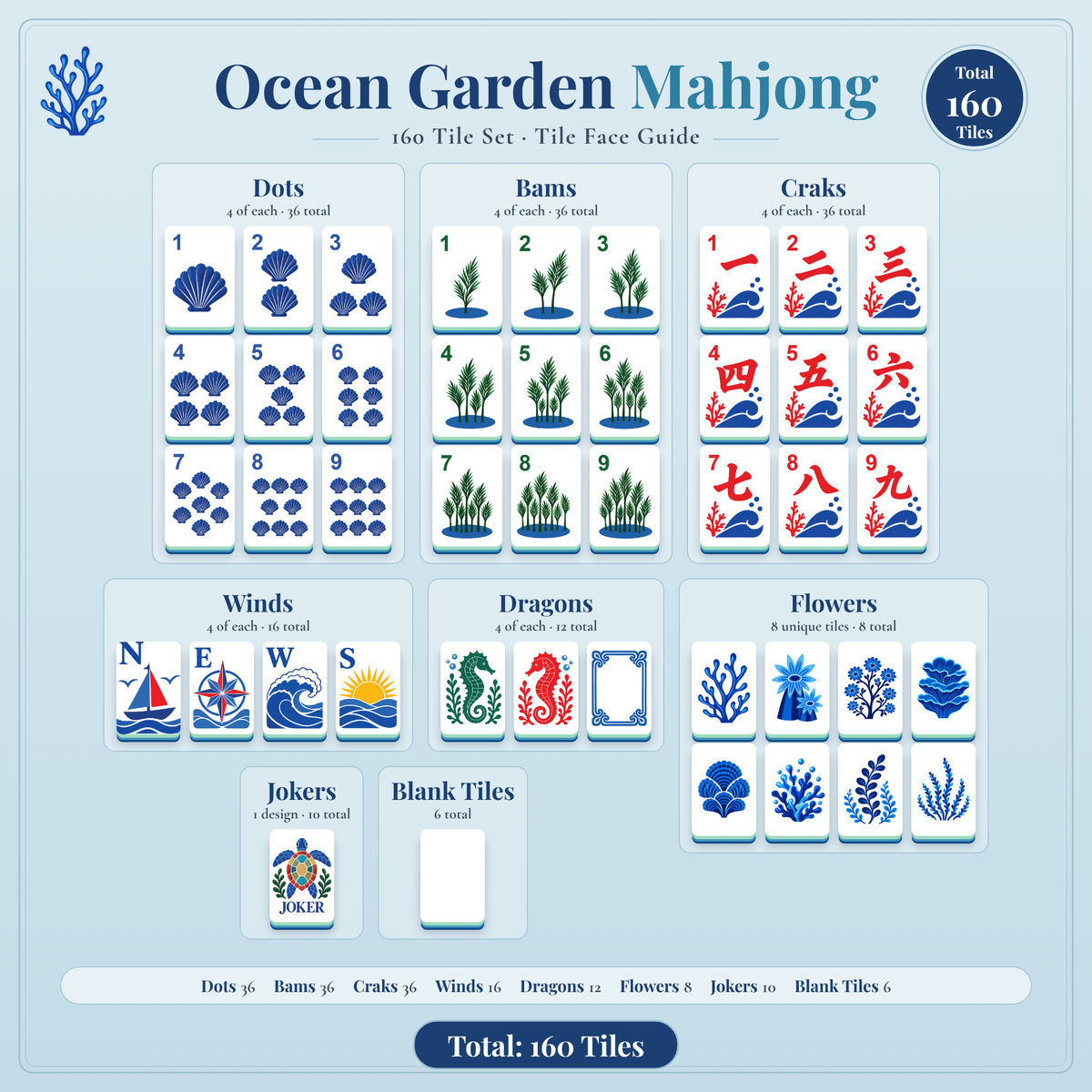
The 2027 National Mah Jongg League card is a single-page reference issued every spring listing all legal winning hands for American mahjong that year. It's organized by hand type (pungs, kongs, quints, sextets, pairs) and shows each hand as a numbered row with a symbolic pattern using dots, numbers, letters, and joker symbols. You read left to right: identify your tiles, find a row that matches your pattern exactly, verify the hand number hasn't already been claimed this round, call "Mahjong," and expose your tiles. The card is mandatory—hands off the card cannot win. New players should study the card's sections before the game, learn to spot common patterns (like "all Bams" or "like numbers across suits"), and never assume a hand is legal without finding it on the card first.
🀄 Shop best-selling mahjong sets →
The 2027 National Mah Jongg League card is not a guide—it's the law. Every legal winning hand lives on that card and nowhere else. Unlike Chinese or Riichi mahjong, which have written rules, American mahjong exists entirely within the card's rows. Without it, you have no game. Players at every skill level keep a card visible at the table, and learning to read it fast is the difference between confident play and hesitation that costs you the round.
What does each section of the card represent?
The card divides hands into broad categories: Pung hands (three identical tiles repeated), Kong hands (four identical tiles), Quint hands (five identical tiles), Sextet hands (six identical tiles), and mixed combinations. Each category contains rows numbered sequentially, typically starting around hand 1 and extending past 100 depending on year and variant. The layout uses tiles (shown as symbols), suits (Bam, Crak, Dot), numbers (1–9), winds, dragons, and flowers, plus a joker symbol (usually a star or asterisk) to show where jokers can substitute. A single row might look like: P:111 P:222 P:333 D:444 J (read as "three Bam ones, three Bam twos, three Bam threes, three Dot fours, and one joker"—a valid pung hand). Rows are printed in columns with the hand number in the far left. Scan the card methodically: find the hand type that matches your exposure pattern, then verify tile-by-tile that your hand matches that row exactly.

How do you match your tiles to a row on the card?
Start by identifying what you hold: Count your exposed tiles (pungs, kongs, quints, sextets) and your pair. Write them down in order if it helps: "5 Crak, 5 Crak, 5 Crak; 2 Dot, 2 Dot, 2 Dot; White dragon, White dragon, White dragon; 7 Bam; 7 Bam" (three exposures plus a pair). Now look at the card for rows with the same structure—three exposures and a pair. Scan the relevant section and find the row where the tiles match exactly in the order shown. Jokers make this tricky: a row might show P:555 P:222 P:333 D:77 J, meaning the pair can be any tile (the joker symbol after "77" tells you one of the pair can be a joker substitute). If you hold 5 Crak, 5 Crak, 5 Crak; 2 Dot, 2 Dot, 2 Dot; 3 Dot, 3 Dot, 3 Dot; 7 Bam; 7 Bam, this hand matches that row. Hand found—call "Mahjong."
What you hold | How to scan | Common mistake |
Three identical tiles (pung) | Look under Pung section, left side | Confusing "like numbers" (1-2-3) with identical tiles—don't; American mahjong has NO sequences |
Four identical tiles (kong) | Scan Kong rows, mid-card | Forgetting jokers can substitute—check where the card shows a joker symbol |
Five identical tiles (quint) | Find Quint section, usually middle | Missing that a quint must be five of the exact tile, not mixed numbers |
Mixed (e.g., pung + kong + pair) | Look for multi-type rows | Assuming hand is legal because it "looks right"—verify on the card or it doesn't win |
What role do jokers play in reading the card?
Jokers are wildcards shown as a special symbol on the card (often a star or the word "J"). When a row displays a joker symbol, it means you can substitute a joker for that tile position—but you don't have to. If the card shows P:888 P:666 P:444 C:11 J, the joker can replace any one tile listed (one of the 8 Bams, 6 Bams, 4 Bams, or 1 Crak), or replace the pair with any tile. In practice, jokers fill gaps in your hand. If you drew 4 Bams, 4 Bams, 4 Bams; 6 Bams, 6 Bams, 6 Bams; 8 Bams, 8 Bams, 8 Bams; 1 Crak; and a joker, that joker can become the second 1 Crak and you've completed the hand. Never use a joker for a single tile or a pair—American mahjong rules forbid this. The card will never show a joker standing alone or representing both tiles in a pair. Study your card's joker placement closely; rows with many joker symbols give you more flexibility, but you must still match the tile list precisely.
How do you avoid reading errors that cost you the win?
The most common mistake is misreading hand structure. You expose a pung (three identical), then a kong (four identical), then a pair, and you scan a row with two pungs and a pair—close, but wrong. Scan slowly: count the exposures on the card, count yours, and ensure they match in number and type. Second pitfall: confusing "like numbers" (1-2-3 of the same suit) with sequences. American mahjong has no chows or sequences; you cannot call or expose a 1-2-3 run. If the card shows C:123, it means 1 Crak, 2 Crak, 3 Crak as three separate tiles, not a sequence. Never assume. Third: forgetting that wind and dragon tiles are single suits. Four North winds are identical for matching purposes, but a North wind is not the same as a South, East, or West wind. A pung of Norths must be three North winds, not three winds of mixed direction. Finally, double-check hand numbers: in a given round, each hand number can only be called once. If another player already claimed hand 42, you cannot also call hand 42—move to the next matching row on the card.

What's the fastest way to learn the card as a new player?
Before game time, study the card's overall structure for 10–15 minutes. Identify where Pung hands start and end, where Kong hands begin, where mixed hands live. Recognize that hands typically progress from simpler patterns (all of one type) to complex ones (mixed tiles, multiple suits, many jokers). During your first few games, read aloud when you find a match: say the hand number and the tile list out loud so other players confirm you're reading correctly. Keep a pencil handy to mark hand numbers you've already called, reducing confusion in later rounds. Ask experienced players to show you their hands and how they found them on the card. Most importantly, never rush: if you think you have a hand, take five seconds to find it on the card before you call. Hesitation is fine; an illegal call forfeits the hand. Our best-selling sets come with engraved tiles or printed reference guides that some players find helpful during early learning, though an official card is always required to play.
🎁 See our most-loved mahjong sets & accessories →
How does reading the 2027 card differ from past years?
The National Mah Jongg League issues a new card every spring, and each year's card may include new hands, remove outdated ones, or adjust hand numbers to balance gameplay. The 2027 card is the current legal reference; any hand from a 2026 or earlier card is no longer valid in tournament or league play. Changes are usually subtle—a handful of hands added or removed—but they matter. If you learned on an old card, some numbers and rows you memorized may not exist in 2027. Before sitting down at the table, confirm all players are using the same year's card; playing with mismatched years causes disputes and invalid calls. The best practice is to buy or download the current year's card from the National Mah Jongg League directly each spring and keep it visible at the table. Online play platforms and organized clubs auto-update to the new card on the official date, so you're always compliant. If you're hosting regular games, print or display the 2027 card prominently and ask players to bring their own copy as backup.
✨ Find your Mahstead set — free US shipping →
What to check before you buy a set with a card included
Many mahjong sets include a printed reference card, but verify it's the 2027 card—older sets sometimes include 2025 or 2026 versions. Check the production date or listing details before purchase. If the card is laminated or printed on sturdy stock, it'll last through multiple games without fading. Some players prefer a separate official card from the National Mah Jongg League website so they can reference it on a phone or tablet during play. If you're a beginner, a set with a printed card is convenient for learning, but don't treat it as a substitute for hands-on study. Our best-selling acrylic sets are designed for serious players who already know the card and want beautiful, durable tiles. If you're shopping for a gift for a new player, pair a set with a current year's card and a note suggesting they study the card structure before the first game.

FAQ
Can I play American mahjong without the official card?
No. The card is the only source of legal hands. Hands not on the card cannot win. Always have the current year's card visible at the table.
What if two players call the same hand number in one round?
Only the first player to call wins that hand. The second player's call is invalid, and they must continue playing. Each hand number is claimed only once per round.
Do I need to memorize the entire 2027 card?
No. Most players learn common patterns (all one suit, all one number, mixed patterns) and scan the card during play. Regular play builds recognition over time.
Can I use a phone or tablet to read the card at the table?
Yes, many players use digital copies. Confirm your group allows it before the game. Official league play and tournaments usually require a physical card.
What happens if I call a hand that doesn't match the card exactly?
Your call is invalid. You must expose your tiles, and play continues. This is why reading slowly and carefully matters—an invalid call ends your chance to win that round.
How do I know if a hand uses jokers or not?
The card shows joker symbols (usually stars or "J") next to tiles that can be replaced by jokers. If no symbol appears, that tile must be a real tile, not a joker.


View More
View More
View More
