
Winds & Dragons Section of the Mahjong Card Explained
Last updated: Nov 23, 2026
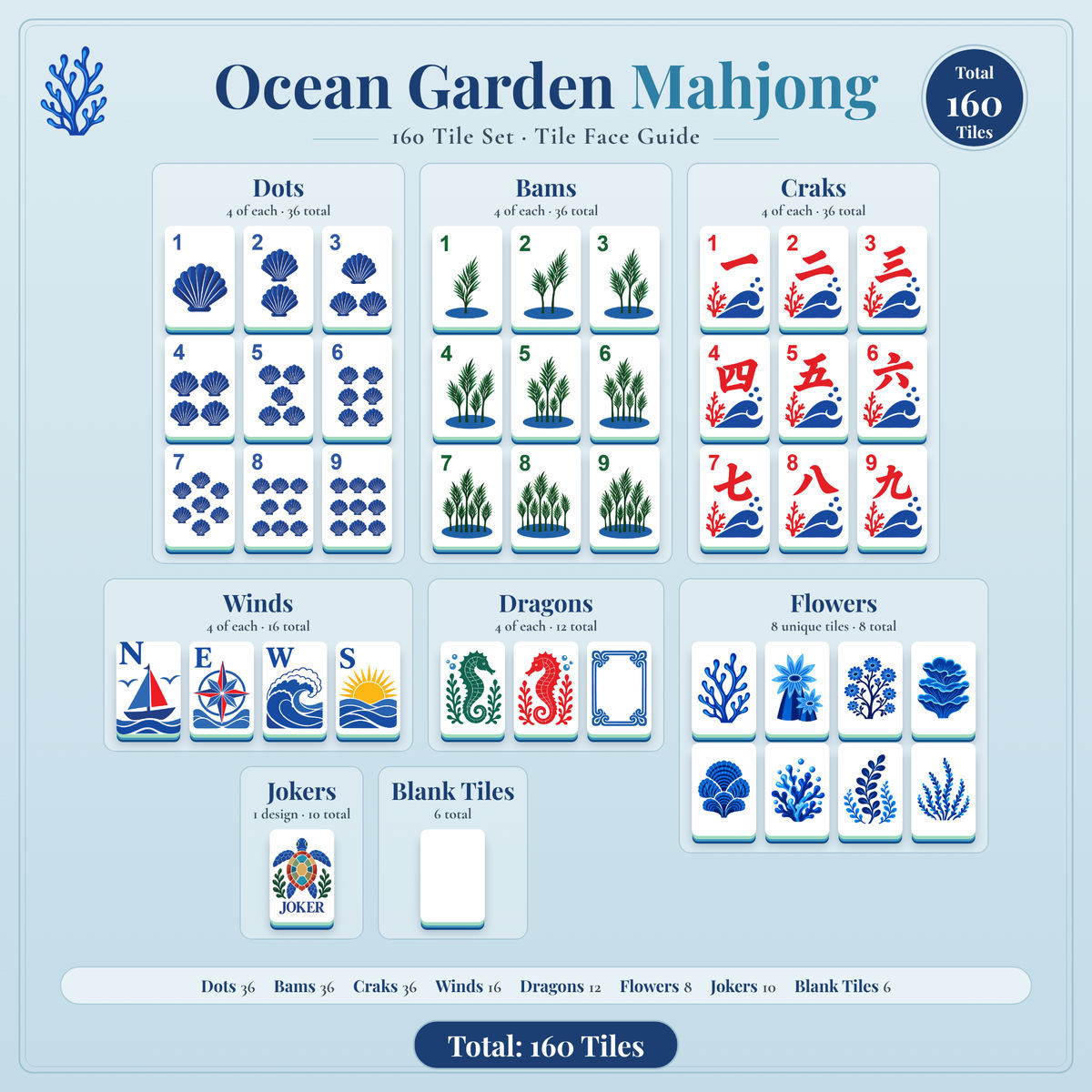
The winds and dragons section of the mahjong card displays all valid patterns built from the four wind tiles (North, East, West, South) and three dragon tiles (Red, Green, White). This section occupies roughly one-quarter of the card and is organized by year and hand number, just like every other section. Wind and dragon hands typically require three identical tiles (a pung), four identical tiles (a kong), or combinations with jokers. The Red dragon pairs with Craks, Green pairs with Bams, and White ("Soap") pairs with Dots and doubles as zero. Unlike bam, crak, and dot suits, winds and dragons cannot form sequences—only groups of identical tiles count as legal. When reading the card, you'll see notation like "FFFF" for four Flowers or "NNNN" for four Norths, and the card tells you exactly which joker count makes each hand playable. Mahstead's engraved mahjong sets clearly mark dragons and winds in distinct colors, making it faster to spot patterns during rapid play.
Where do winds and dragons appear on the card?
The winds and dragons section sits alongside or separate from number-based suits on your League card. Unlike the bam, crak, and dot sections, which run from 1–9 in repeating patterns, winds and dragons are fixed symbols. You'll find them listed in their own dedicated columns or boxes, organized by hand number. Most card layouts group all wind and dragon combinations together so you can scan quickly without flipping back and forth. The card is issued every spring by the National Mah Jongg League, and the 2026 card includes every playable wind and dragon hand for that year only.

Which tiles are winds and which are dragons?
Winds: North (N), East (E), West (W), South (S)—four identical tiles each, 16 total. Dragons: Red, Green, White—four identical tiles each, 12 total. The White dragon (also called Soap) is special: it pairs with Dots and also serves as zero in number sequences. Red dragons belong with the Crak suit; Green dragons belong with the Bam suit. This suit pairing matters because some hands mix a dragon with numbered tiles—knowing which dragon aligns with which suit helps you build those hands faster.
How do wind and dragon hands differ from number hands?
Wind and dragon hands contain only identical tiles—no sequences (chows) are ever legal in American mahjong, but this is doubly true for winds and dragons. You can only expose or call a pung (3), kong (4), quint (5), or sextet (6) of winds or dragons. A hand like "three North winds and a white dragon" is not playable because North and White are different tiles; a hand like "four North winds and four East winds" is playable because each group is identical. Jokers work freely in wind and dragon groups (except they can never fill a pair or single tile). When you read a hand like "NNNN EEEE YYYY" on the card, all identical symbols within each bracket count as one group.
How do you spot and call a wind or dragon hand mid-game?
Pull your hand face-up in front of you after the Charleston and before play starts. Scan your tiles: count how many of each symbol you hold. If you see four North winds and four East winds already in your hand, mark that hand number on your card immediately—you're one step away from winning (you need only one more tile to complete). As play continues, wait for that completing tile to be discarded or drawn. Because winds and dragons cannot be "picked" from your closed hand mid-round (the rule applies to any hand), you must draw or receive the final tile from another player's discard. Many players miss wind-heavy hands early; glance at your winds and dragons first during the initial sort, before you count numbered suits.
🀄 Shop best-selling mahjong sets →
What's the difference between wind and dragon hands and mixed hands?
Some hands combine winds or dragons with numbered tiles—for example, "three East winds, three 2 Bams, a pair of Red dragons"—and those are called mixed hands. Pure wind or dragon hands use only winds, only dragons, or only winds and dragons together. Mixed hands often score higher because they're harder to build. On the card, pure wind and dragon sections are usually grouped in their own area, separate from the numbered-suit sections. Mixed hands may appear in a dedicated "All Kinds" or "Like Numbers" section depending on the year's card layout. If you're unsure whether a hand mixes suits or stays pure, look at the hand number on the card first; the surrounding hands will follow the same pattern.
What common mistakes do new players make with winds and dragons?
Mistake 1: Forgetting that White dragons = zero. If you're building a number hand that ends with "0 0 0," you need three White dragons, not a White dragon plus numbered tiles. Mistake 2: Mixing a Red dragon with Bams or a Green dragon with Craks when you should use pure dragons. Check the card again: pure dragon hands never include numbered tiles. Mistake 3: Calling a hand too early because you see four Norths but didn't notice the card requires four Norths plus a specific second group (like four Reds and a pair of Greens). Always read the entire hand on the card, not just the first group. Mistake 4: Assuming a wind tile discarded by someone else can't help you. If you're one tile short of four Easts, and East is thrown, don't hesitate—call immediately. Many slow players cost themselves winning opportunities by second-guessing wind and dragon calls.

How do jokers work in wind and dragon hands?
Jokers substitute for any tile except a pair or single tile. In a wind or dragon hand, if the card reads "NNNN EEEE GGGG 11" (four Norths, four Easts, four Greens, and a pair of 1s), you can use jokers for Norths, Easts, or Greens, but never for the pair of 1s. If the card reads "NNNN EEEE GGGG XX" (where XX is a pair of some tile), you can use one joker per group of four but zero in the pair. This limitation is absolute in American mahjong. Some houses allow "American joker" rules where one joker per hand behaves differently; confirm your house rules before play begins.
Comparison: Wind & Dragon Hand Patterns
Pattern Type | Legal in American Mahjong? | Example from Card | Joker Rule |
Four identical winds + four identical winds + four identical dragons + pair | Yes | NNNN EEEE RRRR WW | Jokers in each group of 4; none in pair |
Three winds + three dragons + mixed numbered tiles | Yes (if on card) | NNN RRR 2B 4B 6B | Jokers substitute per hand rules |
Wind + wind + wind as a sequence (1-2-3) | No, never | — | Illegal; winds have no order |
Two different dragons in same group | No | (e.g., RRG) | Illegal; groups must be identical |
Pure dragon hand | Yes | RRRR GGGG WWWW XX | Jokers in groups only |
Common Wind and Dragon Hands at a Glance
When you pick up your tiles, look for these patterns first:
All Winds: Four of each (N, E, W, S) + a pair of any tile. High-value hand if you complete it early.
All Dragons: Four of each (Red, Green, White) + a pair. Same principle; rare and valuable.
Wind + Dragon Mix: For example, three Norths, three Easts, three Greens, and a pair of Red dragons. Build step-by-step and don't discard from the groups you're working toward.
One Wind or Dragon Group + Numbered Tiles: The easiest mixed hand; focus on completing the wind or dragon first, then build the numbered suit.
🎁 See our most-loved mahjong sets & accessories →
What to Check Before You Read the Card
Confirm the year. You can only play hands from the current year's card (2026 in this cycle).
Locate the winds and dragons section. It's usually labeled separately from number suits on the card layout.
Count jokers in your hand. Know how many you hold before you start; it affects which hands are possible.
Verify suit pairing. Red = Crak, Green = Bam, White = Dot (when used as zero or paired with Dots).
Read the full hand. Don't stop after spotting one group; the card shows the entire hand required to win.
Reading the Card Like a Pro: Quick Checklist
[ ] Mark all wind and dragon hands you might build in your starting hand.
[ ] Watch for the completing tile throughout the round.
[ ] If you see four identical winds or dragons, look at the rest of the hand immediately—don't assume it's unplayable.
[ ] Never substitute a joker in a pair or single tile.
[ ] Discard from suits and tiles outside your target hand groups.
[ ] Call as soon as the completing tile arrives—hesitation costs rounds.
To learn how winds and dragons fit into the broader card structure, see our guide to reading a mahjong card.
What You'll Need
A clear, well-organized mahjong set makes spotting winds and dragons effortless. Our best-selling mahjong sets feature high-contrast colors and crisp engravings on each tile, so winds (labeled N, E, W, S) and dragons (marked in distinct shades) stand out instantly during play. Many of our designs also include engraved mahjong sets with personalized titles, perfect if you host regular games and want every player's tile set clearly identifiable. For faster play and less strain, pair your set with a mahjong mat to organize your hand and racks with pushers to keep tiles upright and grouped by suit—both tools help you see winds and dragons at a glance.
✨ Find your Mahstead set — free US shipping →

FAQ
Can a wind tile and a dragon tile be in the same group?
No. Each group must contain identical tiles. A pung of North winds cannot include any East winds or any dragon tiles. Wind and dragon hands mix different groups, not different tiles within one group.
Is the White dragon always worth zero?
The White dragon (Soap) serves as zero when used in a number sequence or when paired with Dots. In a pure dragon hand—four Reds, four Greens, four Whites—the White dragon is just a dragon tile, not a zero. The card layout tells you how White is used in each hand.
How many wind tiles are in a standard mahjong set?
Sixteen: four identical North tiles, four East, four West, and four South. All American mahjong sets contain exactly these 16 wind tiles as part of the standard 152-tile count.
If I draw a wind tile that completes a hand, can I keep it hidden until my next turn?
No. You must expose your hand (call "Mahjong") immediately when the completing tile arrives. Delaying a win is not allowed and may result in penalties depending on house rules.
Can I use a joker to fill a pair of winds?
No. Jokers can never substitute for a pair or single tile in any American mahjong hand. If the card shows "NNNN EEEE GGGG WW," the pair of Wests must be real White tiles, never jokers.


View More
View More
View More
