
Why Is Mahjong So Popular Right Now in 2026
Last updated: Nov 23, 2026
Mahjong's current popularity stems from four converging forces: Gen Z discovery via TikTok and streaming (making the game visible to millions who'd never encountered it), the mental-health appeal of deliberate, screen-free play, renewed interest in cultural heritage among diaspora communities, and the social-media amplification of aesthetics—colorful tiles, engraved sets, and stylish mats are now gifts and home décor. Unlike the 1980s mahj boom, today's revival is durable because it spans age groups and cultures simultaneously. You'll find complete introductory guides at mahjong for beginners, and when you're ready to play, best-selling mahjong sets range from simple practice tiles to heirloom-quality acrylic designs. Most newcomers start with a 160-tile American mahjong set and learn the hand structure from the current year's National Mah Jongg League card in their first session.
Mahjong has moved from niche hobby to mainstream phenomenon in 2024–2026, driven by social media, accessibility, and a hunger for analog connection. If you're curious about why everyone's suddenly talking about tiles, here's what's actually happening.
Is mahjong trending because of social media?
Yes—TikTok and Instagram have made mahjong visual and accessible in ways books never could. A 15-second video of colorful tiles clicking into place, or a close-up of an engraved set with witty text, reaches millions who would never walk into a mahj bar or community center. The aesthetics are shareable, the game looks meditative, and creators often position it as a "rich grandma hobby" or mindful escape—all genuinely true, and all algorithmically rewarding. Mahjong content now functions as both hobby tutorial and lifestyle aspiration.

Why are younger players suddenly interested in a game their grandparents played?
The appeal works on three levels for Gen Z and millennials: cultural reconnection (especially in diaspora families where mahj was a tradition), novelty (it's genuinely different from digital games), and mental health (a 2–3 hour game demands presence, conversation, and zero screens). Many younger players describe mahjong as intentional socializing—you can't multitask, you can't check your phone, and the game's built-in pacing (draw, discard, pass, wait) creates a rhythm that feels rare and valuable. For non-Asian players, it's discovery of a game they'd never encountered, with lower barriers to entry than many assume: the rules are learnable in one sitting, and you don't need prior experience to host a weekly game.
What makes American mahjong easier to learn than other variants?
American mahjong differs fundamentally from Chinese, Hong Kong, or Riichi versions: it uses a standardized hand card (updated every spring by the National Mah Jongg League), the hand structure is simpler, and there are no chows or sequences you must announce—you can only expose pungs (3 identical tiles), kongs (4 identical), quints (5 identical), and sextets (6 identical). This constraint actually reduces decision paralysis for beginners. You buy a 160-tile set, learn the tile names and suits (Bams, Craks, Dots), spend 15 minutes on the Charleston (the tile-passing ritual), then reference the hand card for your first game. Most players pick up the core strategy in three to five sessions. By contrast, Chinese mahjong allows open sequences and has regional rule variations that can take months to master. If you're starting from zero, American is the fastest entry point.

How has the aesthetic of mahjong sets changed the perception of the game?
Sets are no longer purely functional—they're now status objects and gifts. Engraved tiles with custom text, acrylic designs in jewel tones, and branded mats transform mahjong from a purely recreational activity into a visual identity. Someone who plays mahj once a week now has a "mahjong aesthetic" they can photograph, gift, or display. This shift has created a secondary market: people buy sets for the design, and that purchase often leads to learning the game. You can find everything from minimalist modern designs to colorful resin sets to engraved American mahjong sets with personal jokes or initials. The professionalization and aestheticization of the equipment has made the game itself feel more intentional and premium.
🀄 Shop best-selling mahjong sets →
Is mahjong actually easier to sustain as a hobby than it was 20–30 years ago?
In the 1980s mahj boom, the game relied on geographic proximity and tight social circles—you needed a mahj bar nearby, or a friend group willing to meet weekly. Today, you can find players online, learn rules from video, buy a set without hunting through import shops, and join hybrid communities (in-person plus Discord). The supply chain is also more transparent: a 160-tile set with a quality mat and pushers is accessible at multiple price points and ships nationwide. More importantly, the game now co-exists with other leisure activities instead of competing against them. Mahj doesn't have to be your only hobby; it's a weekly anchor that attracts people specifically because it's not the default (which would be streaming or gaming). The cultural permission to play mahj—especially for younger women, for non-Asians, and for people outside traditional diaspora networks—is genuinely new.
What you'll need to host a weekly game
If you're thinking about starting, here's a minimal checklist:
A 160-tile American mahjong set with clear engraving and sturdy tiles (acrylic is most durable for weekly play).
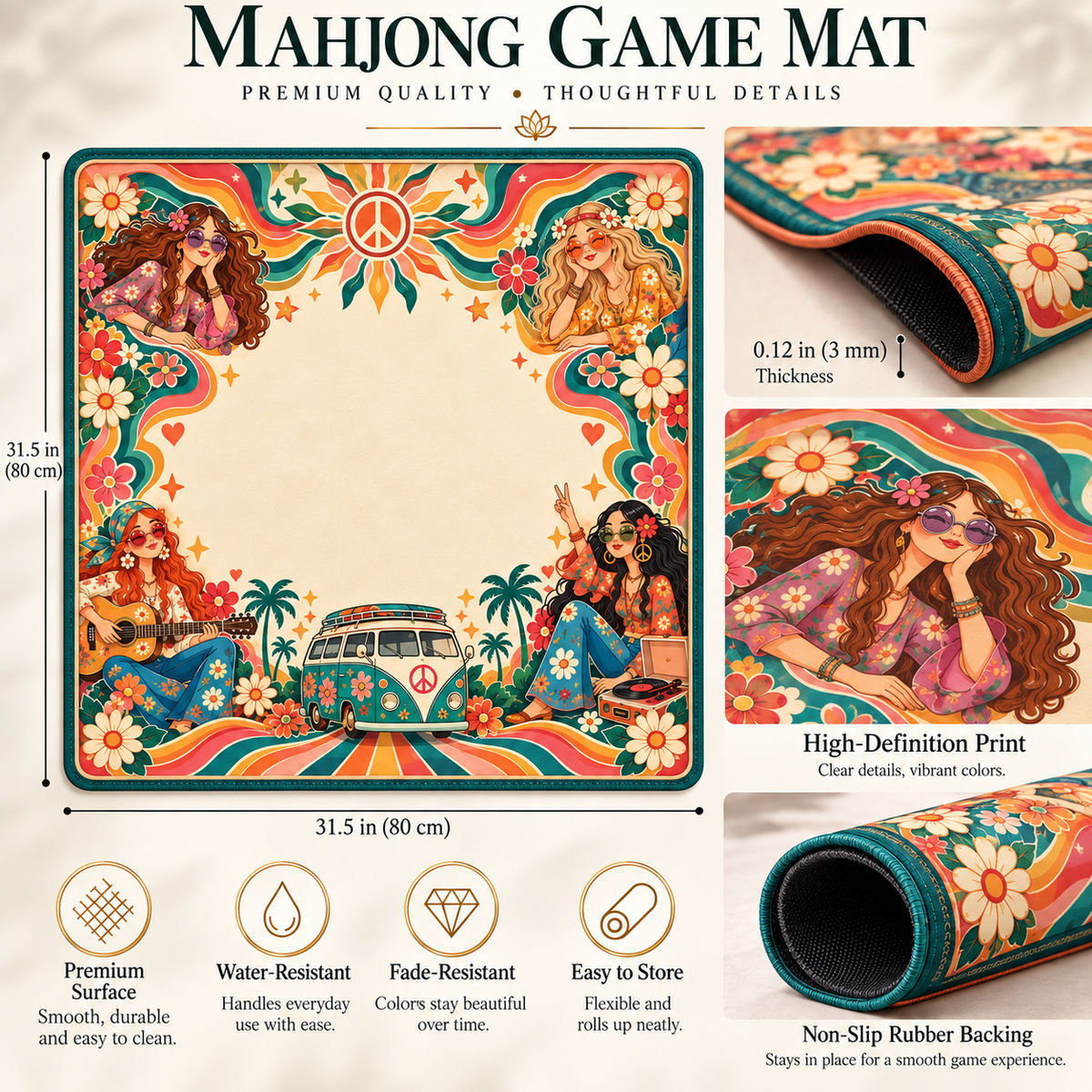
A mat (helps organize tiles, protects the table, and speeds up the game—especially if you're playing at a dining table rather than a mahj table).
Racks with pushers (optional but invaluable; they hold your hand vertically so others can't see your tiles, and pushers let you manage the wall efficiently).
A current-year National Mah Jongg League hand card (the game is unplayable without it; you reference it constantly).
Four players, 2–3 hours, and snacks.
Most new players underestimate the mat. A quality mat keeps tiles from sliding, provides built-in score-tracking areas, and makes the game feel intentional rather than thrown-together. If you're buying your first set, pair it with a mahjong mat that matches your space. You can add racks with pushers later as your group settles into a routine.
Setup level | Who it's for | Why it works |
Tiles only | One-time casual players, learning in a group | Lowest friction; you can borrow. |
Tiles + mat | Weekly regular players, home hosting | Organized, protects furniture, speeds play. |
Tiles + mat + racks + pushers | Serious weekly hosts, mixed-skill groups | Hides hands, pro feel, reduces disputes. |
Tiles + mat + racks + case | Travel or storage, hosting guests overnight | Portability and longevity. |
🎁 See our most-loved mahjong sets & accessories →
Where does mahjong fit in the broader "analog games" trend?
Mahjong is riding a wave that also includes board games, card games, and vinyl. People are explicitly choosing activities that require presence and conversation. Unlike Wordle or chess.com, mahj is inherently social—you cannot play it alone, and the game is ephemeral (each hand takes 10–20 minutes, then it's over). This built-in structure appeals to people exhausted by endless digital options. Mahjong also has a longer session length (2–3 hours), which creates a commitment that many find psychologically valuable: you're protecting that time from interruption. The analog nature is not a bug—it's the entire appeal.
What to check before you buy
Tile durability: Acrylic tiles hold up to weekly or twice-weekly play for years. Bamboo-composite tiles are lighter but can warp if stored near heat. Check the material.
Tile visibility: Engraving must be deep and clear, especially if players wear glasses or are older. Poor engraving leads to disputes and frustration.
Set completeness: A proper 160-tile American set includes 152 playing tiles (152 = the game) plus spares. Confirm the count before buying.
Mat quality: A thin fabric mat will bunch up; you want a mat with a backing or rubberized base that grips the table.
Storage: If you're buying a set, plan for a travel bag or case—tiles get lost or damaged rolling around a closet.
✨ Find your Mahstead set — free US shipping →

FAQ
Can I play mahjong with fewer than four players?
Yes. Two-player and three-player variants exist and have adjusted hand structures and scoring. However, the standard American game is designed for four players, and the social rhythm is different. Most newcomers learn four-player first.
Do I need to be Asian to play or enjoy mahjong?
No. Mahjong is a skill game with no cultural gatekeeping. Today's players include all backgrounds and ages. Your first friend group might include people from different families and traditions, which often enriches the game.
How much does it cost to start playing?
See current price on product pages. A beginner-friendly set with a mat and hand card is an affordable investment for something you'll use 50+ times a year if it becomes a regular hobby.
Is there a big learning curve?
Not as steep as many assume. The tile names and suits take 10 minutes to memorize. The hand card is your reference tool—you're not memorizing 81 hands, you're learning to recognize patterns. Most players feel competent by their third game.
Why does the game feel different every week if the hand card is the same?
The tile distribution, wall order, and discard sequence are different each game, which creates different strategic opportunities even when the available hands are fixed. You're not memorizing hands so much as learning when to pursue them, when to pivot, and when to give up and play defensively.
What's the best way to find players in my area?
Community centers, libraries, synagogues, and country clubs often host or post notices about mahjong groups. Meetup boards and local Facebook groups are reliable. If you're in a city, searching "[your city] mahjong club" or "[your city] mahjong group" usually surfaces options. Many groups welcome newcomers.


View More
View More
View More
