
What Set Do You Need for Siamese Mahjong
Last updated: Nov 23, 2026
Siamese mahjong uses the same 160-tile set as American mahjong—152 playing tiles plus spares—but with modified hand patterns and calling conventions. The key difference: Siamese rules allow sequences (chows) to be called and exposed, which American mahjong forbids entirely. Many Siamese players use best-selling American sets because the tile composition (three suits, winds, dragons, flowers, jokers) works for both variants; you simply follow Siamese hand charts instead of the National Mah Jongg League card. Verify with your group whether they follow strict Siamese hand lists or a hybrid ruleset before buying, since sets are universal but scoring and melds vary regionally. Most home groups transition smoothly between American and Siamese using the same tiles. 🀄 Shop best-selling mahjong sets →
How does Siamese mahjong differ from American mahjong?
American mahjong forbids sequences (chows) entirely—you can only expose pungs (three identical), kongs (four identical), quints (five), and sextets (six). Siamese mahjong allows players to call and expose chows (three tiles in sequence within a suit, like 3-4-5 Dots), and pungs remain valid. Siamese also tends to use fewer jokers per hand and applies different scoring multipliers. The tile inventory stays identical: 108 suited tiles (Bams, Craks, Dots in 1–9), 16 winds, 12 dragons, 8 flowers, and 8 jokers in a standard 160-tile set. The critical takeaway: equipment doesn't change, but hand validation and calling rules do.
🎁 See our most-loved mahjong sets & accessories →

Do you need a special Siamese mahjong set?
No. Siamese mahjong plays with the exact same 160-tile American mahjong set that any home player would use. The tiles themselves—face markings, colors, numerals—are standard. What changes is the hand reference card you play from: you use Siamese hand charts or a hybrid rule list rather than the annual National Mah Jongg League card. Some regional groups hand-print or laminate custom reference sheets; others play from memory after years of experience. A few vendors sell sets with printed Siamese hands on the tile racks or mats, but these are uncommon. For most Siamese players, buying engraved or custom American mahjong sets works perfectly—you just reference the correct hand list on your phone, mat, or printed guide.
What size and tile count should you buy?
Siamese mahjong, like American, is designed for exactly four players and uses all 152 playing tiles plus 8 jokers at once—a single 160-tile set per game. If you host weekly games or want spares for replacements, one set is sufficient; if you run simultaneous games, buy multiple sets. Tile size varies: standard acrylic tiles are roughly 1¼ inches (about 3 cm) per side, making them comfortable for middle-aged and older hands. Some best-selling acrylic sets come with matching racks with pushers to hold and organize tiles during play—highly recommended if you have arthritis or prefer not to handle loose tiles. Verify your group's tile-size preference before ordering; a few regional clubs prefer smaller tiles for compact play, but most Western Siamese players use standard American acrylic dimensions.
Which Mahstead set works best for Siamese games?
Any best-selling Mahstead set works for Siamese mahjong because they all contain the same tile inventory and meet American mahjong specs. Choose based on aesthetics and durability: acrylic sets are durable, lightweight, and easy to clean between games. If you want a personalized touch—a family name, a witty phrase, or a lucky symbol engraved on the tiles, racks, or case—browse engraved American mahjong sets. If you play Siamese seasonally or travel with your set, pair it with a quality mahjong bag or case to protect tiles and racks during transport. No set sold by Mahstead is labeled "Siamese"—all are built for the American standard, which is the foundation Siamese rules build on.
Comparison: What to buy for Siamese mahjong at home
Need | Recommendation | Why it works | Durability |
Start Siamese games this month | Covers four players, includes all required tiles | 5+ years with care | |
Weekly host, multiple groups | Two or more sets | Run simultaneous games or keep spares | Each set rated 5+ years |
Ergonomic play, hand comfort | Reduces hand strain, organizes tiles during play | Pushers last entire set life | |
Travel or club play | Tiles stay safe; easy to carry to meetups | Cases withstand years of transport | |
Gift + lasting appeal | Engraved set or custom titles | Personalized, memorable, unique | Engraving permanent; set durability unchanged |
✨ Find your Mahstead set — free US shipping →

What to check before you buy
Before ordering your Siamese mahjong set, verify three things with your game group:
Hand reference source: Ask whether your group uses a printed Siamese hand chart, a digital file, or memory-based play. If a specific chart is required, confirm it aligns with standard Siamese conventions or a local hybrid ruleset. You'll need access to this before your first game, not after.
Tile size preference: Most Siamese players in North America use standard American acrylic tiles (roughly 1¼ inches). Confirm your group hasn't adopted a regional compact or oversized standard.
Joker and blank count: A 160-tile set includes 8 jokers and a reserve of spare tiles. Siamese hands typically use fewer jokers per meld than American hands do, but confirm your ruleset before assuming the standard joker cap.
Once confirmed, order from our best-selling collection—all sets ship free across the US and include a full tile inventory ready to play. If you want a mat to track discards or organize tiles during play with racks, add those in the same order for convenience.
Does a mat or table cover help Siamese play?
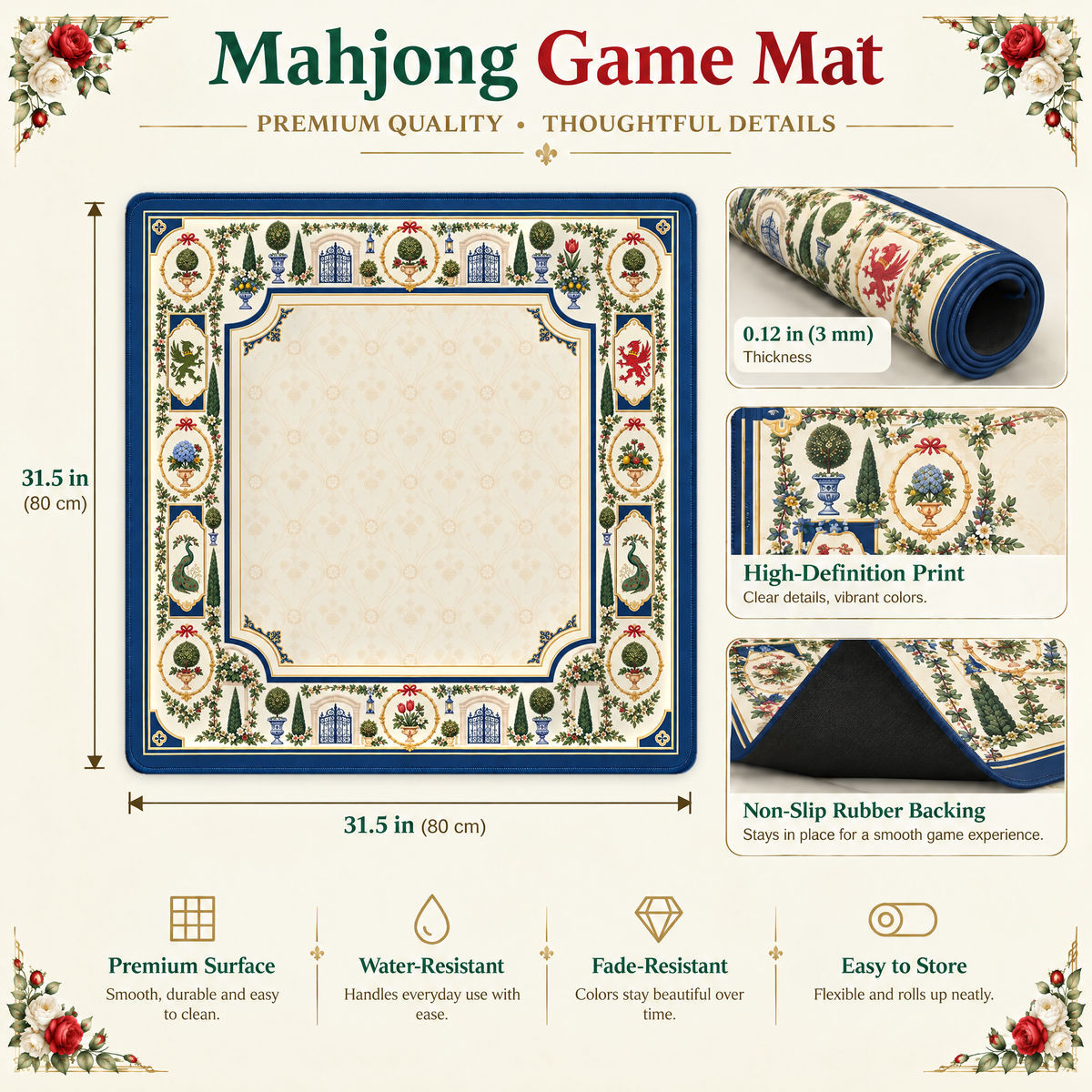
Yes. A dedicated mahjong mat provides four zones for tile placement, a discard center, and a scoreboard area—all helpful whether you play American, Siamese, or any variant. Mats reduce tile noise, protect your table surface, and standardize where each player sits relative to melds and the wall. For Siamese play specifically, a mat's clear layout helps players unfamiliar with Siamese hand patterns orient themselves quickly. If you host mixed American–Siamese games on the same table, a mat is nearly essential to keep groups organized and prevent mid-game confusion. Mats are optional if your group plays informally on a carpeted surface, but we recommend them for weekly or tournament-style Siamese games.
How to host your first Siamese mahjong night
Order your set: Buy one 160-tile acrylic set at least two weeks before your first game (free US shipping).
Get a hand reference: Download or print your group's Siamese hand chart; laminate it or keep it on your phone for quick lookup.
Set up: Shuffle all 152 tiles facedown on a mahjong mat or table. Designate a dealer (East wind).
Skip the Charleston or follow tradition: American mahjong always includes a Charleston (tile-passing ritual); confirm whether your Siamese group does.
Begin: Dealer draws 14 tiles; other players draw 13 each. Play proceeds by standard Siamese rules—calling chows, pungs, and kongs as allowed.
Settle scoring: After someone wins or the wall exhausts, score according to your Siamese hand list multipliers.
Rotate dealer: Pass East wind clockwise after each hand.
For your second and third games, ask experienced players to coach or clarify borderline melds—Siamese hand interpretations can be nuanced regionally.

FAQ
Can I play Siamese mahjong with an American mahjong set from any brand?
Yes. Any 160-tile set with the standard American composition (108 suited tiles, 16 winds, 12 dragons, 8 flowers, 8 jokers) works, regardless of manufacturer. What matters is the hand reference your group uses, not the set brand.
Does Siamese mahjong use the same number of tiles as American mahjong?
Yes—exactly 152 playing tiles plus 8 jokers, totaling 160. Game play uses all 152 tiles once per hand, so you need only one set for four players.
Is the Charleston required in Siamese mahjong?
It depends on your group's ruleset. Some Siamese variants include the Charleston; others skip it. Confirm with your players before your first game.
Can I use racks with pushers for Siamese play?
Absolutely. Racks and pushers work with any mahjong variant—American, Siamese, Chinese, or hybrid. They improve ergonomics and tile organization regardless of calling rules.
Should I buy an engraved set for Siamese, or is a plain set fine?
Both work equally well. Engraved sets add personality and make great gifts; plain sets are purely functional. Choose based on your budget and whether you want a keepsake or a casual game tool.
Where do I find Siamese hand charts online?
Siamese hand lists vary by region and club. Ask your game group directly, or search mahjong forums and regional meetup boards for "Siamese mahjong hands" or "Thai mahjong rules." Print or bookmark the chart your group endorses.


View More
View More
View More
