
What Is Fan in Mahjong? Complete Guide to Scoring Multipliers
Last updated: Nov 23, 2026
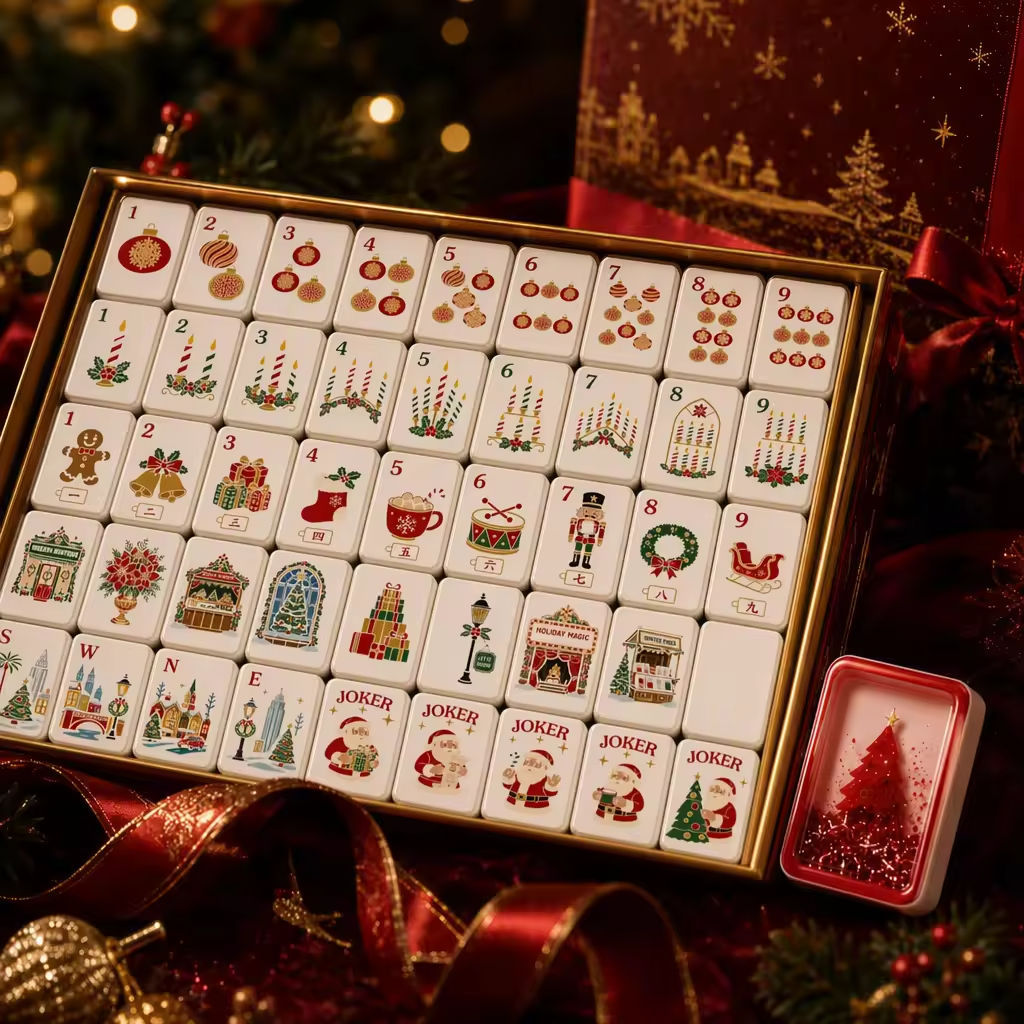
Fan in American mahjong is the multiplier assigned to each hand pattern on the National Mah Jongg League card. It ranges from 1 to 8 (or sometimes higher in special cases) and determines how many base points your completed hand is worth. If a hand is marked "1 fan," you win the base point value once; a "2 fan" hand doubles that payout. Fan values reflect hand difficulty: simpler patterns (all Pungs, few jokers) score 1–2 fan; complex patterns (mixed suits, consecutive numbers, minimal joker use, or rare tile combinations) score 5–8 fan. The card, updated every spring by the National Mah Jongg League, lists only legal hands and their fan values; no other hands win in American mahjong. Our best-selling acrylic sets come with the current year's card so you're never guessing at the table.
Fan is the multiplier assigned to each hand pattern on the National Mah Jongg League card. It ranges from 1 to 8 (or sometimes higher in special cases) and determines how many base points your completed hand is worth. If a hand is marked "1 fan," you win the base point value once; a "2 fan" hand doubles that payout. Fan values reflect hand difficulty: simpler patterns (all Pungs, few jokers) score 1–2 fan; complex patterns (mixed suits, consecutive numbers, minimal joker use, or rare tile combinations) score 5–8 fan. The card, updated every spring by the National Mah Jongg League, lists only legal hands and their fan values; no other hands win in American mahjong. Our best-selling acrylic sets come with the current year's card so you're never guessing at the table.
How does fan differ from points?
Fan and points are not the same. Points are the base numerical value (often 20, 30, or 40 depending on house rules and wind position). Fan then multiplies that base: a 3-fan hand at 30 points becomes 90 points total. The National Mah Jongg League card lists only the hand pattern and its fan value; actual payout depends on your group's agreed point system and whether you're East (dealer) or another position. Always confirm your group's point scale before the game starts—it varies by region and club.

What fan values appear on the card?
The National Mah Jongg League card organizes hands by complexity and assigns fan from 1 to 8 in most sections. Common examples include: 1–2 fan for Pung-heavy hands (three of the same tile, repeated); 2–3 fan for mixed-suit combinations; 4–6 fan for hands requiring exact sequences without jokers (called "clean" hands); 7–8 fan for rare or extremely constrained patterns (often called "limit hands" in some rule sets). The card also includes bonus sections marked "Bonus" or special categories—fan there varies and is clearly labeled. You cannot score a hand that isn't on the current card, even if a previous year's card showed it.
Why do high-fan hands score more?
High-fan hands score more because they are harder to complete. A 1-fan hand (e.g., all Pungs, any suits) requires fewer constraints—you're just matching three identical tiles repeatedly. A 7-fan hand might demand all tiles from the same suit, no jokers, with a very specific sequence pattern. The fewer jokers you're allowed to use and the more exact the tile combination, the rarer the win, so the higher the fan reward. This system keeps the game balanced: lucky draws pay off with simple hands; skilled play and patience yield rare, high-scoring hands. Over a full game, both strategies have equal mathematical weight.
How does fan affect your session winnings?
Your session winnings depend directly on fan accumulation over time. If you win four hands at 1 fan, two hands at 3 fan, and one hand at 5 fan (all at 30 base points), your total is (4 × 30) + (2 × 90) + (1 × 150) = 120 + 180 + 150 = 450 points. The player who chases high-fan hands does not necessarily win more if they complete fewer hands overall; the player who wins more 2–3 fan hands steadily often scores higher. Competitive American mahjong rewards consistency and card literacy over "lucky" big hands. Always track fan as you play so you understand your score in real time.
Hand Type | Typical Fan | Complexity | Joker Limit | Why Harder |
All Pungs, mixed suits | 1–2 | Simple | Many allowed | Straightforward matching |
Mixed sequence, standard | 2–3 | Moderate | 2–4 typically | Requires exact number order |
Single suit, no sequences | 3–4 | Moderate-High | 1–3 typically | Color lock reduces tile pool |
Limit/rare pattern | 7–8 | Extremely high | 0–1 or none | Extreme rarity; expert-level constraint |

How do you read fan on the card and avoid mistakes?
When you look at the National Mah Jongg League card, each hand is printed with a fan value in a small box or margin—usually a single numeral like "2" or "5." Before declaring mahjong, always cross-check your actual tiles against the card's exact description (suit, number, pung vs. kong, joker count) and confirm the fan number. A common mistake is misreading a 2-fan hand as 1 fan or vice versa, which costs you money at settlement. Take a breath: read the hand name, count your tiles aloud, trace the card with your finger. Ask another player to verify before you call. Once you declare, the hand is locked—no corrections. Many groups print or laminate the card in large type to reduce squinting and error at the table.
What to check before you buy a mahjong set
Card legibility: Does the set include a legible, full-size card from the current year? Tiny or outdated cards cause scoring disputes.
Tile readability: Can you quickly identify suits (Bam, Crak, Dot) and numbers in good light? Engraved or silk-screened tiles should have clear contrast.
Set completeness: American play uses 152 tiles + 8 jokers. Never assume a "160-tile" set has extra jokers; verify the tile manifest when you order.
Storage clarity: If your set includes a mat or bag, ensure the card stays flat and protected. Bent or faded cards lead to confusion mid-game.
🀄 Shop best-selling mahjong sets →
Our engraved mahjong sets come with the current-year card, printed in legible font. We also offer mahjong racks with pushers so you can organize and conceal your tiles clearly—no accidental reveals, no misread fan when your hand is sorted. A proper rack saves disputes and keeps the game moving.
Are there variants where fan works differently?
Chinese, Hong Kong, and Riichi (Japanese) mahjong use scoring systems very different from American. Chinese mahjong typically uses "points" (not fan) and has no centralized league card; hands are defined by local rule books. Hong Kong mahjong uses "fan" and a separate "point" multiplier, with 13 fan as a limit hand and extremely high payouts. Riichi mahjong uses "fu" (base points) and "han" (similar to fan) to calculate scores via a fixed table. If you play American mahjong, stick to the National Mah Jongg League card and fan system—mixing systems mid-game ruins scores and trust. Each variant has its own integrity; respect the one your group plays.
🎁 See our most-loved mahjong sets & accessories →
We focus on American mahjong equipment, so our cards, sets, and mahjong mats are designed for National Mah Jongg League rules and fan scoring. If your group plays a different variant, confirm the scoring system and rule book before game night—switching mid-session is chaos.
Common fan-scoring mistakes and how to avoid them
Mistake 1: Calling a hand not on the card. You matched six Dots in a pretty pattern, but it's not listed on the current card. No win, no points. Fix: Always check the card first, not your pattern sense.
Mistake 2: Misreading fan at settlement. You thought the hand was 2 fan; another player says it was 3. Fix: Have the card reader announce fan before you pay. Write it down.
Mistake 3: Forgetting wind bonuses. Some groups add extra points if East (dealer) wins. Fan does not include this—it is separate. Fix: Confirm all scoring rules (base points, wind bonuses, feng shui bonuses if any) before the Charleston begins.
Mistake 4: Assuming a set is legal without the card. You borrow a vintage set with no current card. You guess at fan. Fix: Always bring a current card, printed legibly. Set it in a holder or mat so it's visible to all four players.
Mistake 5: Playing with an outdated card. Last year's card has different fan values than this year's. Fix: The National Mah Jongg League releases a new card every spring. Check the date on your card; if it is from 2025 or earlier, order the current year's edition with your set.
✨ Find your Mahstead set — free US shipping →

FAQ
Can I use an older mahjong card, or does fan change every year?
Fan values can and do shift slightly year to year as the National Mah Jongg League updates the card. Using an outdated card means you may score hands that no longer exist or miss new ones. Always play with the current year's card, issued in spring. Mahstead sets include the current card so you're never in doubt.
If I win two hands in a row, do I add the fan together or keep them separate?
Each hand scores independently. You do not add fan from hand to hand. If you win a 2-fan hand, you score that payout. Then the game resets for the next hand, and you score a new 3-fan hand separately. Your session total is the sum of all individual hands, but each hand's fan multiplier applies only to itself.
What if my group plays with a house rule where all hands are worth 1 fan?
That is not American mahjong as defined by the National Mah Jongg League. You are simplifying for casual play, which is fine—but understand that you are not using the fan system at all; you are playing a flat-point variant. If you ever want to enter a league game or play with other groups, switch back to the standard card and fan values to avoid confusion.
How do I explain fan to a complete beginner?
Tell them: "Fan is a multiplier, like a bonus multiplier in a video game. A simple hand is worth 1 fan—you win the base points once. A harder hand is worth 3 fan—you win the base points three times over. The card tells you which hands are legal and how much each one is worth." Once they see the card, it clicks fast.
Does fan affect the difficulty of playing East (dealer) position?
No. Fan is determined by the hand pattern on the card, not by position. However, East position often comes with higher base-point payouts or bonuses in some rule systems. Ask your group if they add extra points for East wins. Fan and wind bonuses are calculated separately—both apply to your total.


View More
View More
View More
