
What Does the 6 Bam Tile Look Like in Mahjong?
Last updated: Nov 23, 2026
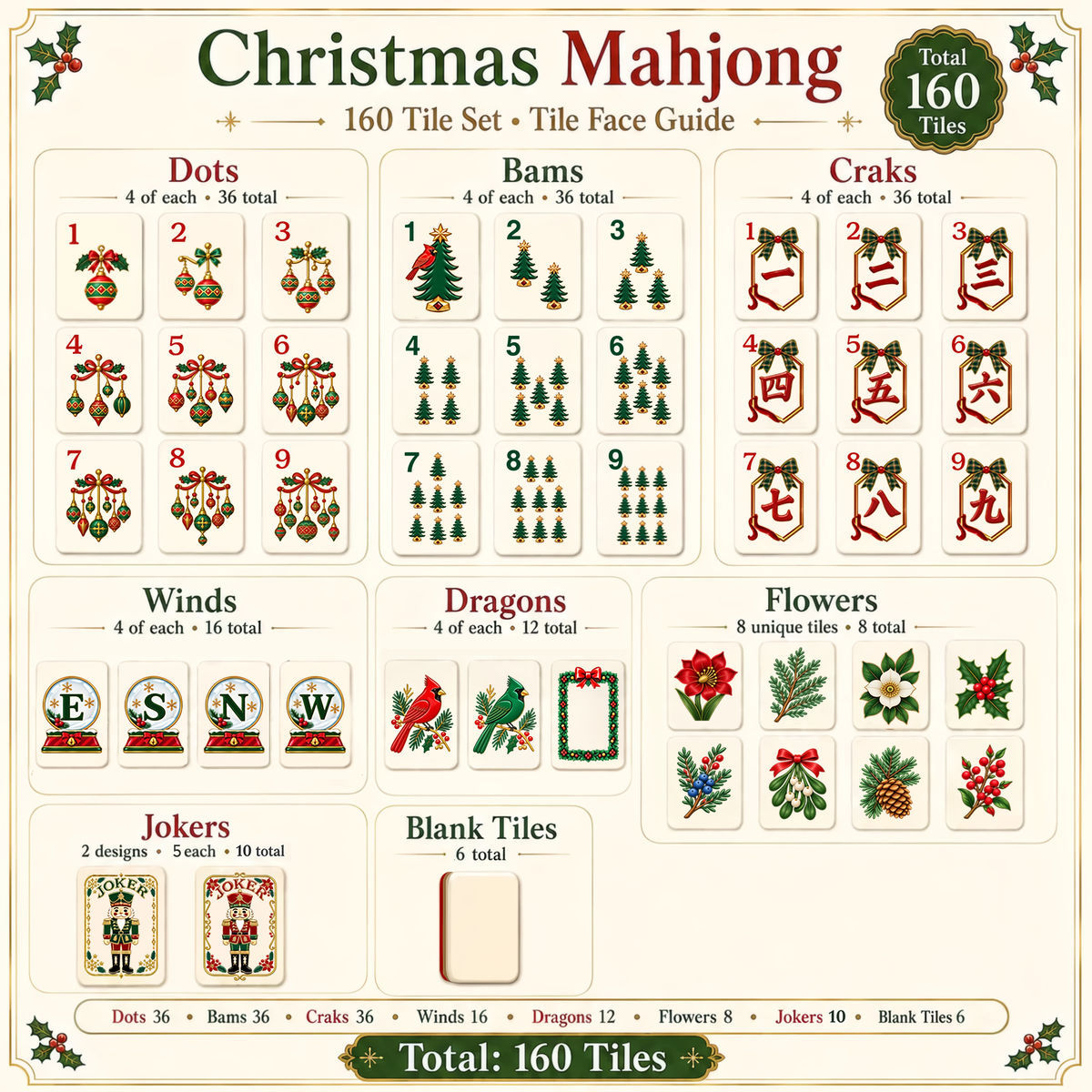
The 6 Bam tile shows six bamboo stalks—usually rendered as vertical or slightly angled sticks—organized in two neat columns of three on most American mahjong sets. The bamboo design appears centered on the tile face, with the numeral "6" printed in one or both corners, depending on the set's engraving style. In acrylic sets, the Bam suit is typically green or teal to distinguish it from the red Crak suit and white or ivory Dot suit. The tile is identical to the other three 6 Bams in a standard 152-tile set; you'll use all four copies together when building winning hands. Unlike the 1 Bam (which often features a bird perched on the stalk), the 6 Bam is purely symbolic—no character or decoration beyond the stalks themselves. Recognizing suit colors and stalk patterns at a glance helps you call tiles faster and read your rack efficiently during play.
Where does the 6 Bam fit in the complete tile set?
A standard American mahjong set contains 152 playing tiles: three suits (Bams, Craks, Dots) with numbers 1–9, four of each tile. The Bam suit represents bamboo; Craks (sometimes spelled "Crags") show Chinese characters with a decorative border; Dots are circles. All three 6 tiles (6 Bam, 6 Crak, 6 Dot) look similar in structure—six symbols arranged in the same pattern—but differ in color, suit symbol, and historical meaning. Explore what's in an American mahjong set to see the full tile breakdown and suit functions in winning hands.

How do you recognize a 6 Bam at the table?
Speed matters at mahjong. Look for these quick identifiers:
Color: Bam suit is almost always green, teal, or seafoam in acrylic sets.
Stalk pattern: Six vertical or angled bamboo sticks, never circles or characters.
Numeral: Corner marking "6" (single or double corner, depending on set design).
Symmetry: Stalks arranged in two columns—never scattered or overlapping.
When tiles are face-down on the table, you'll know them only by back design. Once exposed in a pung (three identical tiles) or kong (four identical), the color and bamboo pattern jump out. Beginners often confuse the 6 Bam with 6 Crak (red, with character strokes) or 6 Dot (white, with circles); naming them aloud as you organize your rack—"6 Bam, 6 Bam, 6 Bam"—reinforces the visual memory. Our best-selling mahjong sets use crisp acrylic with high contrast between suits, making tile recognition instant.
🀄 Shop best-selling mahjong sets →
Why does the 6 Bam design matter for gameplay?
Clear tile design directly affects play speed and enjoyment. If numbers and suit colors blur together under table lighting, you'll hesitate before discarding or calling—slowing the game and frustrating players. The 6 Bam's stalk pattern is distinct enough that even squinting across the table, you can identify it. In sets with dim or poorly printed numbers, newer players misread a 6 Bam as a 5 or 7, leading to missed opportunities or illegal plays. Sets with thick, beveled edges and engraved numbers (not painted) resist wear; after hundreds of games, your 6 Bam tile still reads clearly. Poor-quality sets lose contrast after a year of regular play, forcing players to turn tiles face-up to confirm, which breaks rhythm. Engraved American mahjong sets with customized titles or designs maintain crisp detail longer because the engravings are cut into acrylic rather than surface-printed.

What's different between the 6 Bam and other number tiles in the Bam suit?
Each Bam tile 1–9 has the same green color and bamboo theme, but stalk count is the only variable:
Tile | Stalks | Use Case | Visual Cue |
1 Bam | 1 stalk + bird | Rare, high-value hands | Single stalk; bird silhouette |
2 Bam | 2 stalks | Common in runs (sequences only in other variants) | Paired stalks vertically |
3 Bam | 3 stalks | Frequent discard | Three vertical stalks |
4 Bam | 4 stalks | Mid-value hands | Four stalks, two columns |
5 Bam | 5 stalks | Joker substitute in many hands | Five stalks, offset pattern |
6 Bam | 6 stalks | Standard hand component | Six stalks, two columns of three |
7 Bam | 7 stalks | Less common than 6 or 5 | Seven stalks, taller arrangement |
8 Bam | 8 stalks | Mid-discard rank | Eight stalks, denser pattern |
9 Bam | 9 stalks | High-value, terminal tile | Nine stalks, fullest stalk count |
In American mahjong, you can't make a sequence (chow) with 4–5–6 Bams like you might in Chinese variants. Instead, you build pungs (three identical 6 Bams) or kongs (four identical 6 Bams), then match them to other groups on the current year's National Mah Jongg League card. The 6 Bam appears in many hand types because six is neither too rare nor too common—a "sweet spot" for hand construction. If you're learning, focus on remembering the stalk count for each Bam; once you can glance and count, the rest follows.
🎁 See our most-loved mahjong sets & accessories →
How do tile materials and printing affect 6 Bam visibility?
Acrylic tiles (the standard for American mahjong) offer excellent durability and color clarity. The 6 Bam's green Bam suit shows boldly against acrylic's smooth finish, especially under typical game-room lighting. Bamboo stalks are either engraved (cut into the tile surface) or printed (applied on top). Engraved designs last decades; printed designs fade after heavy shuffling and stacking. When shopping for a set, tilt a sample tile toward a light source: if you see the design sharply and the number 6 is legible from two feet away, the print quality is strong. Tile thickness matters too—thinner tiles (under 15mm) warp or chip if stacked carelessly; thicker acrylic tiles feel substantial and stay flat on the table. Some sets include mahjong racks with pushers that hold tiles at a slight angle, letting you see all four 6 Bams in your hand without rotating them constantly—a game-changer for players with vision challenges or arthritis.
What to check before you buy a mahjong set
Before ordering, verify these points:
Suit colors are distinct: Green Bams, red Craks, white Dots. No murky or washed-out tones.
Numerals are in all four corners or clearly marked: You read tiles from any angle without rotating them.
Tile thickness and weight: At least 15mm thick acrylic, substantial enough to feel balanced when shuffled.
Engraving or high-quality print: Run your thumb over the 6 Bam design; you should feel texture (engraved) or see sharp ink lines (printed). Blurry or raised paint is a sign of lower-grade production.
All four 6 Bams present: Count by suit. Every number 1–9 should appear exactly four times (one per tile, four tiles total per number per suit = 36 Bam tiles).
Complete joker set: American mahjong uses exactly eight jokers in play; your set should include spares for replacement.
Sets sold with mahjong mats or bags and cases often include protective storage that keeps tiles dust-free and organized—a practical choice for weekly players.
✨ Find your Mahstead set — free US shipping →

FAQ
Why is the 6 Bam green instead of another color?
Traditional Chinese bamboo is depicted in green across all mahjong variants. Mahstead uses green for the Bam suit to match centuries of mahjong convention, making the 6 Bam instantly recognizable to any player worldwide.
Can I use a 6 Bam in a sequence with a 5 Bam and 7 Bam in American mahjong?
No. American mahjong does not allow chows (sequences). You can only expose pungs (three identical 6 Bams) or kongs (four identical 6 Bams). Sequences are unique to Chinese, Hong Kong, and Riichi variants.
How many 6 Bam tiles are in a complete American set?
Exactly four. A standard 152-tile set contains four copies of every number-suited tile. All four 6 Bams may appear in your hand simultaneously if you're building a hand that includes multiple 6 Bam groups.
What if my 6 Bam tile cracks or fades?
Acrylic tiles rarely crack under normal play, but if a tile breaks, you can purchase a replacement tile set or individual replacement tiles from many mahjong suppliers. Fading occurs only with lower-quality surface printing; Mahstead sets use engraving or high-grade ink that resists fading for years.
Is the 6 Bam lucky or unlucky in mahjong?
No. In American mahjong, tile numbers have no luck value—only gameplay function. The 6 Bam is used strategically based on the current year's hand card, the same way you'd use any other tile. Cultural superstitions about numbers may apply in Chinese variants, not American.
How do beginners learn to spot the 6 Bam faster?
Practice counting stalks out loud as you organize your rack. Call "six" as you place each 6 Bam in a row. After one or two games, stalk recognition becomes automatic. Pairing a mahjong rack with pushers helps because tiles are displayed at an angle, and you see all numbers clearly without rotating tiles constantly.


View More
View More
View More
