
What Do the Numbers on the Mahjong Card Mean?
Last updated: Nov 23, 2026
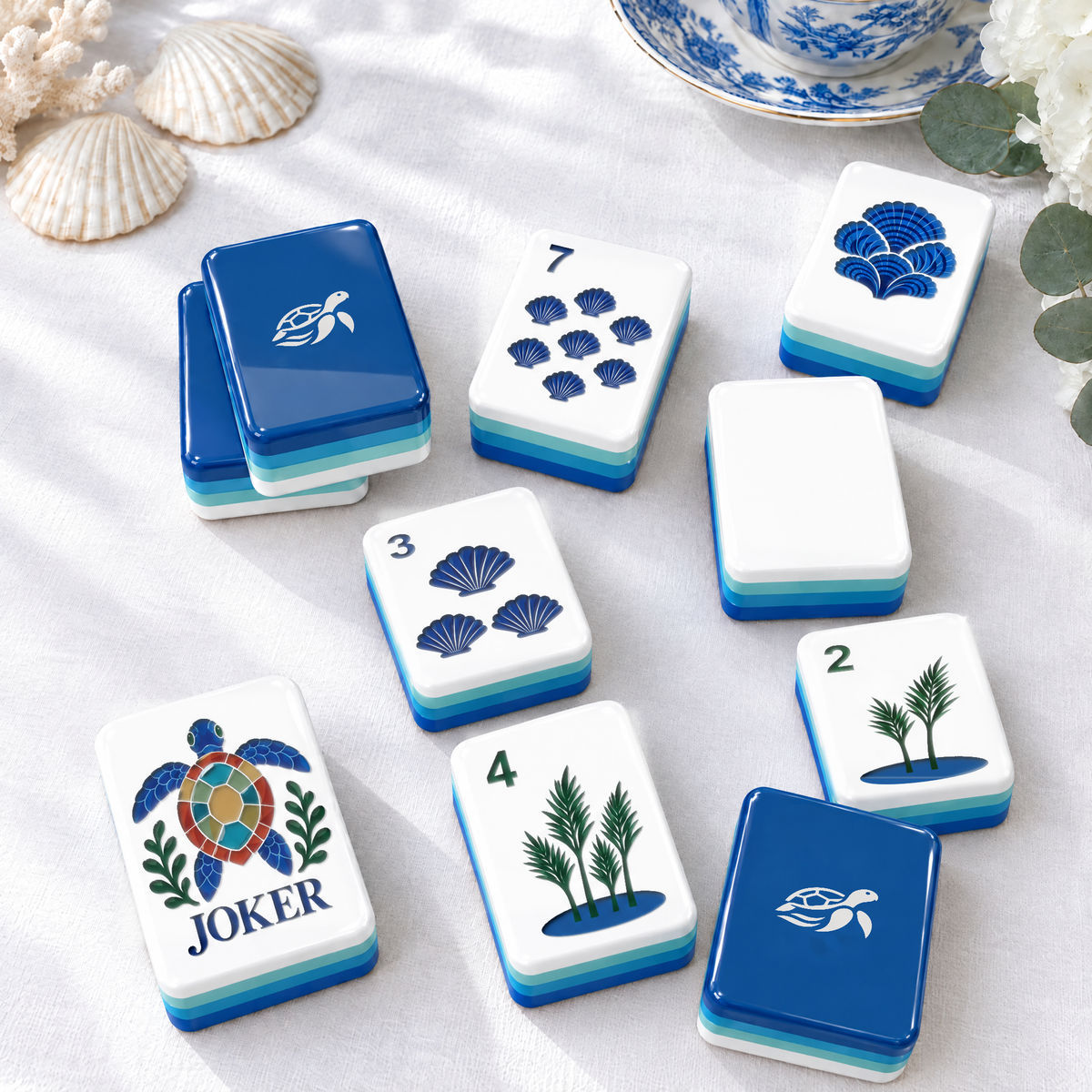
The numbers on the National Mah Jongg League card are a shorthand cipher for building hands. Since we host weekly games, we've watched countless new players stare at that card with confusion—but once the code clicks, the entire game opens up. Let's break it down step-by-step so you're not guessing during your next game.
How Are Suits Coded on the Card?
American mahjong uses three number suits: Bams (1–9, often shown with a bamboo symbol), Craks (1–9, shown with a circle), and Dots (1–9, shown with a dot). The card uses abbreviated notation: a tile like "2 Bam" appears as "2B" or just "2" in a Bam column. When you see a hand pattern that reads "1B 1B 1B 2B 2B 2B 3B 3B 3B," you're looking at three complete pungs (sets of three identical tiles) in the Bam suit. Each number refers to the denomination printed on the face of the tile—higher numbers are worth more points in some hands, but the card itself only cares that you match the exact pattern. Understanding suit abbreviations saves you from calling the wrong hand or mixing suits accidentally during play.

What Do the Grouped Numbers Actually Mean?
When numbers are clustered together on the card, they describe a single group of identical tiles. Here's the critical rule: "111" means three 1's of the same suit (a pung), never three different suits. "1111" means four 1's (a kong). "11111" means five 1's (a quint, unique to American mahjong). A hand might list "1B 1B 1B 2B 2B 2B 3B 3B 3B 4C 4C 4C 5D 5D" where the pattern uses pungs across suits—but the card shows this pattern only once in a specific row, and you must match it exactly. One common mistake: assuming "123" (a sequence like 1 Bam, 2 Bam, 3 Bam) counts as a legal group. It doesn't—American mahjong has no chows or sequences. Every exposed group must be a pung, kong, quint, or sextet of identical tiles.
🀄 Shop best-selling mahjong sets →
Why Does the Card Show Joker Counts Separately?
The National Mah Jongg League card lists joker allowances within each hand pattern, usually as a number on the right margin or in parentheses. For instance, a hand might say "0 J" (zero jokers allowed) or "2 J" (up to two jokers permitted in that hand). Jokers can substitute for any tile except a single tile or a pair—meaning you cannot build an entire hand of jokers or use them as one of your final two tiles. The card enforces this limit because certain patterns are meant to be harder (and thus worth more points). If a hand says "1 J," you may substitute a joker for one tile in any group, but no more. This separation prevents players from forcing hands that should be impossible. We've seen new groups assume jokers work like wildcards in poker—they don't. The card is your contract.
How Do Numbers Indicate Hand Complexity and Point Value?
Though the card doesn't explicitly show point totals (that's managed by the score sheet), the placement and structure of numbers on the card hint at difficulty. Hands requiring five or six identical tiles (quints or sextets) are rarer and thus higher-scoring. Hands using all three suits or mixing winds and dragons are more complex than hands in a single suit. The card is organized so simpler hands (usually single-suit, all identical denominations) appear in the upper sections, and elaborate patterns appear lower. This visual hierarchy helps experienced players gauge which hands are worth chasing when you have a partial pattern in your rack. New players should focus on understanding the layout of the card before worrying about points; learning which hands are "easy" versus "hard" comes naturally after your first dozen games.

What Symbols Appear Alongside Numbers?
In addition to numbers, the card includes small pictographs for winds (North, East, West, South), dragons (Red, Green, White/Soap), and flowers. These symbols are not numbers but represent the actual tile symbols on your set. A hand labeled "EEWW" means East Wind, East Wind, West Wind, West Wind (two pungs of winds). The card might show "1D 1D 1D R R R" meaning three 1 Dots paired with three Red Dragons—the number "1" represents the Dot suit denomination, and the "R" is a symbol. Confusion arises when players conflate symbols with numbers; the Winds and Dragons do not have numeric codes on the card itself, only symbolic ones. When in doubt, match the symbols on the card to the symbols on your tiles—this takes the guesswork out of reading the card correctly.
Hand Pattern Type | What Numbers Show | Jokers Allowed | Common Mistake |
All Pungs, one suit (e.g., "1B 1B 1B 2B 2B 2B 3B 3B 3B 4B 4B") | Each number is the Bam denomination; grouping shows three or four identical tiles. | Usually 0–2 (per card) | Assuming "1 2 3" counts as a group; it doesn't in American mahjong. |
Mixed suits with Dragons | Numbers for Bams/Craks/Dots; symbols for Dragons (R/G/W). | Varies by hand | Forgetting that Winds and Dragons are named, not numbered. |
Quints or Sextets | "11111" or "111111" signals five or six of the same tile. | Often 0 (quints/sextets are rare and strict). | Thinking you can substitute jokers in these high-difficulty hands. |
All Honors (Winds & Dragons) | Only symbols appear; no numbers for suit. | Usually 0–1 | Treating Wind/Dragon hands as having "numeric" values. |
🎁 See our most-loved mahjong sets & accessories →
A Practical Checklist: Reading the Card in Real Play
Locate the year at the top of the card—you must use the current year's card only.
Find your hand in the grid by scanning for a pattern that matches what's in your rack or on your table.
Count the tiles in each group: is it "111" (pung) or "11111" (quint)?
Check the suit letters (B, C, D) and match them to the suits on your tiles.
Verify joker allowance in the margin—if it says "0 J," your hand must have no jokers substituted.
Confirm your pair at the end—the last two tiles in a hand must match and cannot contain jokers.
Call "Mahjong" only after you've double-checked every tile against the card.
We keep a laminated or printed copy of the card at the table so anyone can verify a hand before the draw moves to the next player.
What to Check Before You Buy a Set or Card
Year of the card: The National Mah Jongg League card updates every spring. Using last year's card invalidates your hands.
Tile legibility: Ensure your set's numbers and suit symbols are large and clear enough to read across the table without squinting.
Card format: Choose between a full-size poster (easier to read) or pocket-sized card (portable). Some groups laminate their own; others use engraved sets with themed designs that spark joy during setup.
Card storage: A bent or torn card is harder to read. Keep yours in a protective sleeve or mahjong case.
✨ Find your Mahstead set — free US shipping →
Why Understanding the Card Code Matters for Hosting
Once you grasp the notation, you'll host games with confidence. New players won't feel embarrassed asking you to explain a pattern; you'll know exactly what the card is saying without fumbling. The card is not a mystery—it's a system, and systems are teachable. When someone at your table learns that "555C 666D 777D 1B 1B 2B 2B" is a valid hand (three pungs in two suits plus a pair in a third), they stop seeing the card as random and start seeing it as logic. This shift transforms them from a confused beginner into an engaged player who wants to return next week.

FAQ
Can I use a mahjong card from last year?
No. The National Mah Jongg League updates its card every spring with new hands. Using an outdated card means you might call hands that are no longer legal or miss hands that are now valid. Always confirm the current year's card is at your table.
Do the numbers on the card tell me how many points a hand is worth?
No. The card shows which hands are legal and how many jokers each hand allows. Point totals are tracked separately on a score sheet or by house rules. Some groups assign higher points to rare patterns (like quints or all-honor hands), but the card itself doesn't display points.
What does "0 J" mean next to a hand pattern?
It means that hand cannot contain any jokers as substitutes—all tiles must come directly from the wall or from your original draw. You must build it with natural tiles only.
Why are there no sequences like "1 2 3" on the mahjong card?
American mahjong does not allow sequences (chows). Only identical-tile groups—pungs (3), kongs (4), quints (5), and sextets (6)—are exposed or called. This is a core rule that sets American mahjong apart from Chinese or Riichi variants.
How do I know which numbers represent which suit when I'm reading the card?
Look at the card's column headers or legend. Bams are marked with a bamboo symbol and labeled "B," Craks with a circle labeled "C," and Dots with a dot labeled "D." Match the symbol on the card to the symbol on your tiles.
Can I substitute a joker for a pair at the end of my hand?
No. Your final pair (the two tiles you lay down last) must be natural tiles only—never jokers. Jokers can only substitute within the first few groups.


View More
View More
View More
