
Vietnamese Mahjong: Rules, Tiles & How It Differs from American
Last updated: Nov 23, 2026
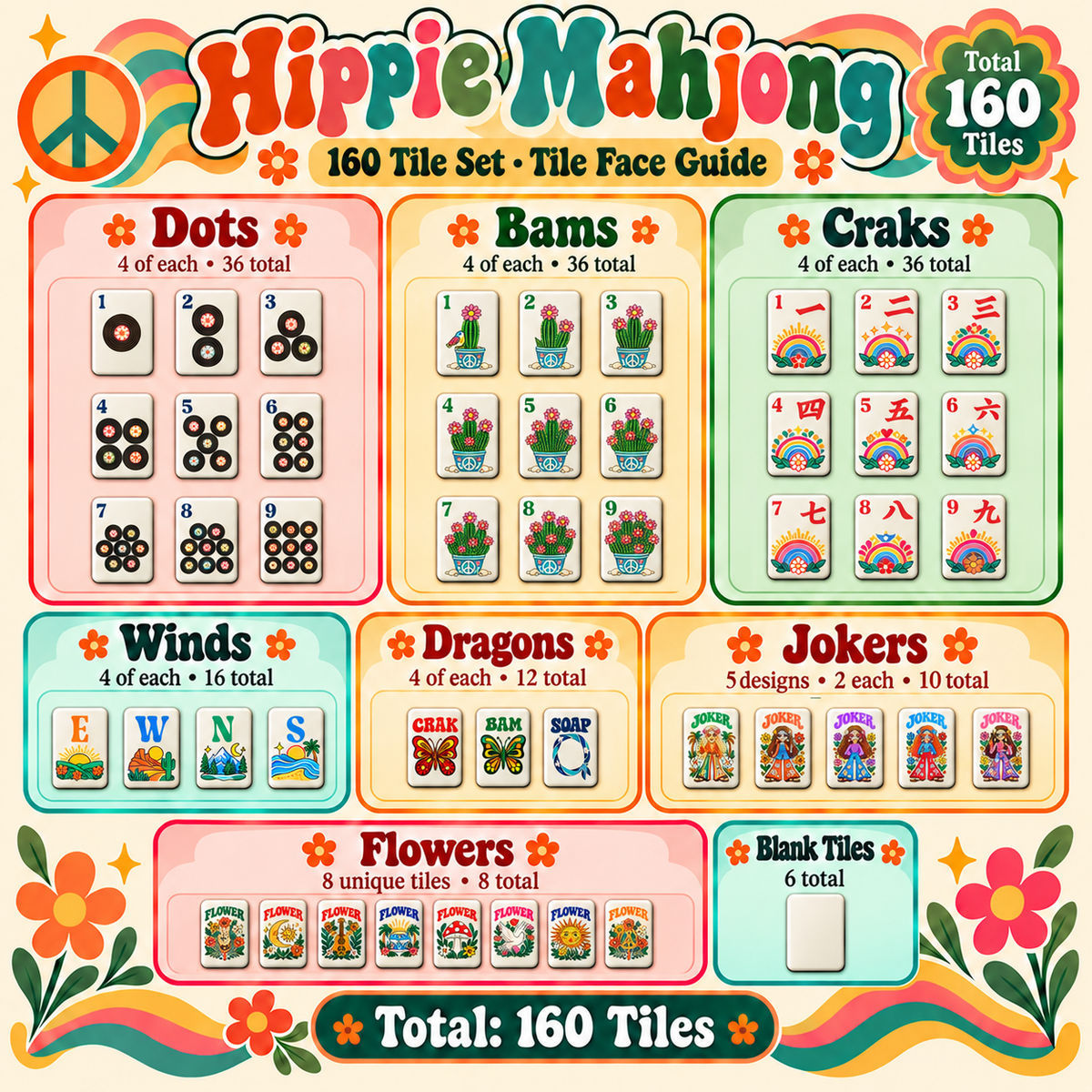
Vietnamese mahjong (typically called Cờ Tướng or regional variations) uses 144 tiles in suits, honors, and dragons—similar in structure to Chinese classical mahjong but with distinct hand-winning rules and a faster pace than American mahjong. Players draw and discard in turn, aiming to form melds (triplets called "pungs," sequences called "chows," and pairs) before anyone else. Games run 15–30 minutes per round. The tile count, hand validation, and scoring differ sharply from American mahjong, which uses 152 tiles, no sequences in exposed melds, and hands tied to an annual National Mah Jongg League card. If you're hosting mixed groups—Vietnamese players and American players—you'll need clear agreement on which rule set applies before the Charleston or first draw. Many players own both sets to preserve tradition and friendship.
Vietnamese mahjong blends Chinese traditions with local twists: faster rounds, unique tile rankings, and a tile-passing style that predates modern American rules. We'll walk you through the real differences.
What is Vietnamese mahjong and where does it come from?
Vietnamese mahjong evolved from Chinese classical mahjong, refined through decades of play in Vietnam and Vietnamese diaspora communities. It emphasizes speed and simplicity over the rigid hand patterns of American mahjong. Players treat the game as a social, fast-paced pastime rather than a competitive point-driven sport. The rules vary by region and family tradition; there is no single official governing body like the National Mah Jongg League. If you learn Vietnamese mahjong in Hanoi, Ho Chi Minh City, or a Vietnamese-American household in California or Texas, expect local house rules to shape whether bonus hands, draw limits, or discard penalties apply.

How many tiles does Vietnamese mahjong use?
Vietnamese mahjong typically uses 144 tiles: three suits (Bamboo, Character, Dot) numbered 1–9, four copies each (108 tiles); 16 Wind honors (North, East, South, West, four of each); 12 Dragon honors (Red, Green, White, four of each); and 8 Flower tiles. The 144-tile count is a standard foundation, though some regional variants add or remove flowers or blank tiles to suit house rules. This contrasts directly with American mahjong, which plays 152 tiles plus 8 jokers (160-tile sets include spares). The smaller tile pool makes Vietnamese rounds quicker and increases the likelihood of anyone holding a winning hand.
What's the key difference between Vietnamese and American mahjong rules?
The most critical difference: Vietnamese mahjong allows both pungs (three identical tiles) and chows (sequences like 1-2-3 of the same suit), exposed and callable by any player—American mahjong forbids exposed chows entirely. Vietnamese hand validation is open-ended: any combination of pungs, chows, and a single pair wins—American hands must match patterns printed on the yearly National Mah Jongg League card. Vietnamese gameplay allows players to declare winning hands at any turn; American requires a player to hold the exact pattern from the card and announce "mahjong." This freedom makes Vietnamese mahjong feel improvisational; American feels rule-bound but clear. If you switch between both variants, you'll recalibrate your strategy: in Vietnamese play, you're watching for simple hand completion; in American, you're hunting a specific pattern on a specific card, and the Charleston (tile-passing ritual) sets the tone before play begins.
How does the tile-passing ritual compare?
Vietnamese mahjong often skips formal tile-passing or uses a simplified version: players may exchange tiles or pass directly to the next player without the multi-directional Charleston. American mahjong's Charleston is formal and structured: three rounds of passing (right, left, across), then two rounds of optional passing, ending in a dead hand—before any tiles are drawn. The Charleston is ceremonial and strategic in American play; Vietnamese house rules tend toward simplicity. If you're hosting a mixed group, confirm the Charleston rule upfront: do you pass at all, and how many rounds? This avoids false starts and confusion.
What hands win in Vietnamese mahjong?
A winning Vietnamese hand contains four melds (each a pung or chow) plus a pair—that's 14 tiles total. Examples:
Example 1: Three Bamboo + Four Bamboo + Five Bamboo (chow), East Wind + East Wind + East Wind (pung), Two Dot + Two Dot + Two Dot (pung), Red Dragon + Red Dragon + Red Dragon (pung), White Dragon + White Dragon (pair).
Example 2: Two Character + Three Character + Four Character (chow), North + North + North (pung), One Dot + One Dot + One Dot (pung), Green Dragon + Green Dragon + Green Dragon (pung), Five Character + Five Character (pair).
The hand is valid once you reach 14 tiles in four melds and one pair. You do not need to match a printed card; any logical combination works. This is radically different from American mahjong, where your 14 tiles must match one of hundreds of published patterns on the current year's league card, and exposing a pung or kong freezes that set—you cannot change it later.
How does scoring work in Vietnamese mahjong?
Scoring varies widely by house rules and region. Many Vietnamese players use simple point systems: the winner collects a fixed amount from each other player, or scores are multiplied by bonuses for speed (finishing within a certain number of draws), or special hands (all one suit, all terminals, no chows). Some groups ignore scoring entirely and play for pride or a communal pot. American mahjong has a formal, complex scoring system: each hand pattern carries a specific point value (listed on the league card), modified by doubles (extra melds), and paid from each losing player according to their position relative to the winner. If you're used to American scoring, Vietnamese simplicity may feel refreshingly loose; if you're new to both, agree on a scoring rule before the first round and write it down.

Can you play Vietnamese mahjong with an American mahjong set?
Technically, yes—you have the core tiles (Bams, Craks, Dots, Winds, Dragons). But a standard 160-tile American mahjong set includes 8 jokers, which Vietnamese mahjong doesn't use. You'd set the jokers aside and play with 152 of the 160 tiles; you'd lose 8 tiles to spare status. You also won't have the Flower tiles if your American set omits them (some older sets do). The tile design matters: American sets often label suits as "B," "C," "D" or use English numerals; Vietnamese and Chinese sets use traditional symbols (bamboo stalks, characters, dots). The clearer labeling helps you read hands faster, especially if players are learning. If you're hosting a regular Vietnamese mahjong group, a mahjong set with clean, large character markings reduces errors and speeds up calls.
🀄 Shop best-selling mahjong sets →
What's the gameplay sequence in Vietnamese mahjong?
Setup: All 144 tiles are shuffled face-down on the table.
Wall building: Players or a dealer stacks tiles into a wall (two rows, 18 stacks per player).
Draw: Players take turns drawing from the wall, one tile per turn.
Discard: After drawing, a player discards one unwanted tile face-up to the center (the "discard pile").
Calls: Any player may claim the discard if it completes a pung or chow in their hand.
Continue: Play cycles until someone declares a winning hand (four melds + one pair).
Score & reset: Points are awarded; tiles are shuffled and returned; next round begins.
This flow is simpler and faster than American mahjong, where the Charleston consumes 10–15 minutes before the first tile is drawn, and exposure rules for pungs and kongs lock tiles into place. American rounds can stretch 30–45 minutes; Vietnamese rounds often finish in 15–20 minutes.
How do house rules shape Vietnamese mahjong?
Vietnamese mahjong thrives on adaptation. Common house rule variations include:
House Rule | Effect on Play | When to Use |
Draw limit (e.g., 20 draws max) | Speeds up the round; after limit, hand is a draw. | Social games with time limits. |
Bonus for "quick win" | Extra points if you win within first 3–5 draws. | Encourages aggressive play; increases stakes. |
No chows, only pungs | Simplifies melds; slows down hand completion. | Beginner groups; reduces complexity. |
Flowers are bonus points | Flower tiles in your hand earn bonus points. | Traditional play; adds scoring depth. |
One-suit bonus | Extra payout if your winning hand is all one suit. | Increases replay interest; adds excitement. |
Before you invite players, settle on three house rules: draw limit (if any), bonus hands (if any), and scoring multiplier (fixed points per loss, or scaled). Write them on a card and place it on the table—confusion loses friends faster than any tiles.
Vietnamese vs. American mahjong: side-by-side comparison
Aspect | Vietnamese | American |
Tile count | 144 tiles | 152 tiles + 8 jokers (160 total) |
Suits | Bamboo, Character, Dot (1–9, each) | Bam, Crak, Dot (1–9, each) |
Honors | 16 Winds, 12 Dragons, 8 Flowers | 16 Winds, 12 Dragons, 8 Flowers |
Hand structure | 4 melds (pung or chow) + 1 pair = 14 tiles | Pattern from current-year league card (always 14 tiles) |
Exposed melds | Pungs, chows, and sequences callable | Only pungs, kongs, quints, sextets—no chows |
Jokers | Not used | Required; essential for hand flexibility |
Winning condition | Any 4-pung-1-pair arrangement | Pattern match only; must match the card |
Gameplay pace | 15–30 min/round | 30–45 min/round (includes 10–15 min Charleston) |
Scoring | House rules vary; often simple/fast | Formal league-card scoring; complex doublings |
Governing body | None; regional/family traditions | National Mah Jongg League (annual card) |
What to check before you buy a set for Vietnamese mahjong
Tile clarity: Symbols (bamboo stalks, characters, dots) must be easy to read at a glance. Raised engraving or color differences help.
Tile count: Confirm the set includes 144 tiles (or 152 if you're supplementing American play) plus spares for broken tiles.
Flower tiles: If your group uses Flowers for bonuses, ensure the set includes all 8.
Table space: Vietnamese mahjong's rapid pace means you'll need a sturdy mat or table cover to protect the table and keep tiles visible. A mat with a cup holder or edge pocket for dice is a bonus.
Storage: Fast rounds mean you'll shuffle and reset often—use a bag or case to protect tiles from wear and keep them organized.
Tile material: Acrylic tiles are durable and won't chip as easily as bamboo or bone during frequent resets.
🎁 See our most-loved mahjong sets & accessories →
How to host a Vietnamese mahjong game: a quick checklist
Invite players (4 minimum; up to 4 is standard).
Confirm rules (hand types, draw limit, scoring, bonus hands).
Set up the space: shuffled tiles, mat or table cover, scorekeeping paper, drinks away from tiles.
Brief the group: Walk through one sample hand to confirm everyone understands melds and winning conditions.
Start a practice round: Play one round without scoring to warm up and clarify rules.
Play for points once everyone feels confident.
Reset between rounds (shuffle, rebuild the wall, clear discards).
Hosting Vietnamese mahjong is more relaxed than American mahjong—no Charleston overhead, no card reading—so you can start play 5 minutes after players arrive. Prepare light snacks and keep a pen handy for house-rule notes.
✨ Find your Mahstead set — free US shipping →

FAQ
Is Vietnamese mahjong the same as Chinese classical mahjong?
No. Vietnamese mahjong borrows structure from Chinese classical mahjong but often plays faster, with looser rules and no official governing body. House rules vary by family and region. Chinese classical mahjong has stricter regional standards (Hong Kong, Taiwanese, Cantonese variants), while Vietnamese play prioritizes social speed over competitive precision.
Can I play Vietnamese mahjong with an American mahjong set?
Yes, if the set includes all suits and Winds/Dragons. Set aside the 8 jokers—Vietnamese play doesn't use them. Check that your set has Flowers (8 tiles); not all American sets include them. You'll have 144 or 152 usable tiles depending on your set composition.
How long does a Vietnamese mahjong game take?
A single round typically takes 15–30 minutes. A full session (4–8 rounds) runs 1.5–3 hours. American mahjong rounds take 30–45 minutes due to the Charleston ritual and stricter hand validation, so Vietnamese play is significantly faster for casual groups.
Do I need to learn a specific hand pattern for Vietnamese mahjong?
No. Any valid combination of four melds (pungs or chows) plus one pair wins—there's no pattern card. American mahjong requires matching a published league-card pattern, which makes it more rule-intensive. Vietnamese mahjong's flexibility is part of its appeal.
What's the most common house rule for Vietnamese mahjong?
Draw limits (e.g., "if no one wins within 20 draws, the round is a draw") and bonus points for quick wins. Some groups use a one-suit bonus or award Flower tiles as bonus points. Always ask your host or group what rules apply before your first game.
Can beginners play Vietnamese mahjong easily?
Yes. The core concept—collect four melds and a pair—is simpler than American mahjong's pattern-card system. Beginners usually understand melds (pung and chow) within one practice round. A clear, well-organized set with readable tile markings helps new players learn faster.


View More
View More
View More
