
Three Player Mahjong Rules: Setup, Play & Scoring
Last updated: Nov 23, 2026
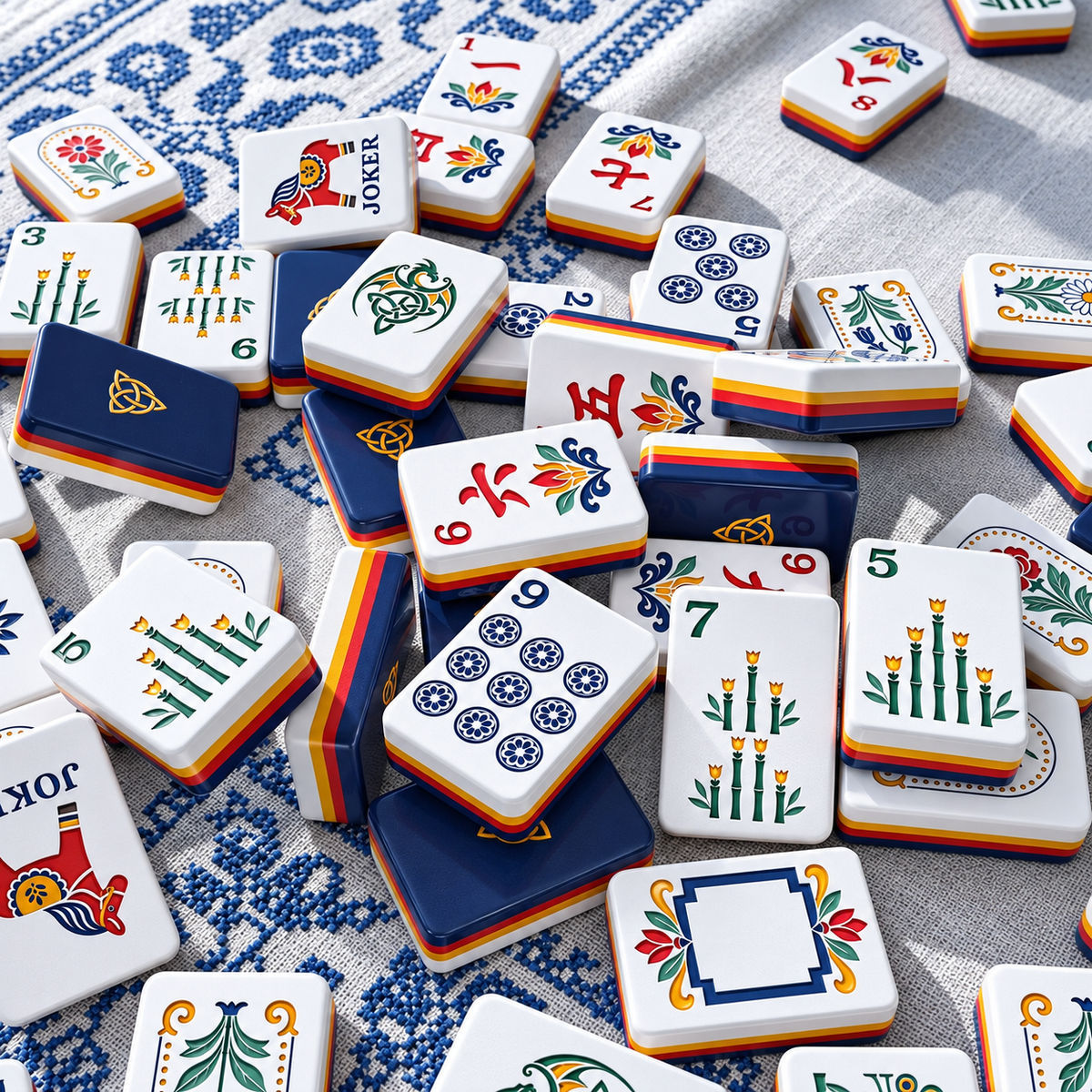
Three-player American mahjong uses all 152 tiles (the standard set) with one seat removed: typically the West wind is omitted, leaving North, East, and South. Each player draws 12 tiles instead of 13; the dealer (East) draws 14. The wall builds the same way—each player lays down 18 stacks of two tiles—but with only three pushes inward, the wall closes tighter. Discard patterns shift: players cycle through turns faster, Kong and exposure timing change, and jokers become more valuable because fewer tiles exist on the table. Winning hands come only from the current National Mah Jongg League card. We recommend a best-selling acrylic set with clear markings so three players can see the wall and hand boundaries clearly during quicker turns. Scoring adjusts by removing West wind references; most groups multiply hand values by 1.2× to account for higher difficulty with fewer tiles in play. 🀄 Shop best-selling mahjong sets →
How do you eliminate one seat in three-player setup?
The most common removal is the West wind seat. Before drawing, agree which player takes East (dealer), which takes North, and which takes South. The missing West seat stays empty. Each player sits where they would in a four-player game, but the fourth chair is skipped. Some groups rotate the omitted seat so each player sits it out one round; this keeps the math fair over multiple games. Keep your setup consistent within a session so wall positions and discard angles stay predictable.

What hand size does each player get in a three-player game?
The dealer (East) draws 14 tiles; North and South each draw 12. Total drawn: 38 tiles. The wall contains 152 − 8 (jokers removed from play) − 38 (drawn) = 106 tiles remaining on the wall at game start. Because fewer tiles are in circulation, draws happen faster. After the Charleston (the three-pass tile exchange), play begins with East's first discard. Each player in turn draws one tile from the wall and discards one. The wall empties more quickly—typically by turn 15–18 instead of turn 20+—so games are shorter and Kong exposure matters more because fewer "replacement" tiles exist in the wall. Write down the tile count if players are new; three-player rhythm feels rushed until it becomes routine.
How does the wall build differently with three players?
All three players build a wall on their side. East builds a wall starting at her lower right, moving left. North and South each build from their corner. Each player makes 18 stacks of two tiles. When all three walls stand, the total perimeter is three sides of a square (the West side is open). East breaks the wall: East and North each count together, then East pushes in. North then pushes in, and South pushes in once. Only three wall breaks happen instead of four. The wall shrinks faster because three players pull from it simultaneously. If a Kong is declared, the Kong replacement tile comes from the live wall—always from the right end (the "loose" tiles). Because the wall is shorter, Kong becomes a trade-off: you gain a tile for your hand but remove one from the pool, tightening everyone else's outs.
What changes in discard and exposure timing for three players?
Discard speed increases. In four-player, East discards on turn 1; turn 4 returns to East. In three-player, East discards on turn 1; turn 4 returns to East again—but East arrived by turn 4 instead of a full fourth rotation, making the pace snappier. Exposure (calling Pung, Kong, Quint, Sextet, or winning) follows the same rules: only one player can expose at a time, and the hierarchy is East > caller's seat > discarder—but with fewer seats, conflicts are rarer. Jokers remain critical: you cannot use a joker as a single tile or a pair, only in sets of three or more identical tiles. Because fewer tiles exist, a single joker on the table gets more attention—fewer copies of that tile are in play, so jokers draw earlier. Watch the discard pool closely: with only three players, you see patterns—repeated number, suit, or Wind—much faster. Some groups add a house rule: if a player Kongs, the next player can skip a draw (a "break"); this balances the Kong advantage. Test house rules before a session so all three are clear.
How do you score a three-player game?
Hands come from the current National Mah Jongg League card, just like four-player. The card lists hands with values—1, 2, 3, 5, 6, 8, etc. In four-player American mahjong, a player pays or receives points based on the hand value, the wind round, and who declared the win. In three-player, remove all West wind references from the card (you won't use them). Most groups multiply hand values by 1.2× to reflect the higher skill difficulty. For example, if the card lists a hand as worth 5 points in four-player, call it 6 points in three-player. This compensates for the tighter wall, fewer tile copies, and faster discard cycles. Payments stay the same shape: if you win, North and South each pay you the hand value. If someone else wins, you pay the winner. Each game round consists of the same three wind rounds as four-player: East, North, South (no West). After three rounds, rotate positions. Keep score on paper—three columns, one per player—and tally after each hand. After nine rounds (three full rotations), sum totals. The highest total wins the session.
Aspect | Four-Player | Three-Player | Why It Differs |
Total tiles drawn at start | 52 tiles (13 each × 4) | 38 tiles (14 + 12 + 12) | One fewer player |
Wall remaining at start | 100 tiles | 106 tiles | Fewer tiles drawn; wall starts tighter |
Typical game length (turns) | 18–22 | 14–18 | Fewer players means faster wall depletion |
Exposure order | East > seat > discarder | Same | Only three seats to track |
Hand value | Per National card | Card value × 1.2× | Fewer tiles = higher skill tax |
Winds used | East, South, West, North | East, South, North | West seat removed |
Joker importance | High | Critical | Fewer tile copies on table |

Can you use the same sets and cards for three-player?
Yes. A standard American mahjong set contains 152 tiles and 8 jokers—all you need. The current year's National Mah Jongg League card works directly: just skip hands that reference West wind and multiply values by 1.2×. You do not need a special "three-player card"—the same card works for all variants by omitting unavailable seats. The Charleston happens the same way: each player passes three tiles to the left, three straight across, and three to the right. After Charleston, play begins. If you host three-player regularly, a mat with clear markings helps keep hand boundaries visible, since turns move faster and fatigue sets in sooner. A mat also protects your tiles during rapid shuffles and prevents corner chips from wear.
🎁 See our most-loved mahjong sets & accessories →
What mistakes do three-player groups make early on?
The most common error: forgetting that the wall has only three sides. New players build as if a fourth wall exists, then get confused when the first Kong draw comes from an unexpected spot. Orient everyone before the first hand: East builds the bottom wall, North the left, South the right. West stays empty. Another slip: not adjusting the Charleston. Some groups pass tiles as if four players exist, then one player sits with a dead tile. Confirm: player on your left receives tiles; player on your right sends tiles. Three players, three passes, same rhythm as four-player. Third mistake: confusing hand values. If your group plays "card value × 1.2×," write it on a notecard at the table so no one argues mid-game. Fourth: forgetting that Jokers still cannot be a single tile or a pair. New players sometimes try to use a joker as the 14th tile to complete a hand. Jokers can only fill a set (Pung, Kong, Quint, Sextet). Before the first game, read the National Mah Jongg League rules on jokers aloud so all three confirm.
Why does the game feel faster, and how do you adapt?
Three-player moves faster because fewer players pull tiles, so the wall shrinks quicker and turns cycle sooner. If you have played four-player for years, the pace will feel rushed at first. Adapt by: (1) keeping a timer on your first few games—call a 90-second turn limit so no one delays the wall. (2) Writing down all Kongs and exposures immediately so you do not lose track. (3) Paying attention to the wall height constantly—when it drops below 20 tiles remaining, final turns approach. (4) Reviewing the card before the first hand so you know what hands are legal; less time exists to re-read during play. Many three-player groups play "no dead hands"—if the wall empties before anyone wins, nobody scores and the next round begins. This rule keeps the tempo up and prevents long recounts. Some groups allow a four-person winner to declare a win even after one player has drawn the last tile (called "robbing the Kong" or a "dead wall win," though rules vary). Agree on this before starting.
✨ Find your Mahstead set — free US shipping →
What to check before you buy a set for three-player
Tile clarity: Acrylic or engraved sets let three players read fast-moving discards from across the table. Bamboo or soft tiles can blur under quick shuffles.
Joker count: Standard sets have 8 jokers. Three-player uses all 8. Do not buy a set with fewer than 8.
Case or bag: Three players often play at smaller tables or rotate between homes. A compact travel bag or case keeps tiles safe during transport.
Rack height: Racks with pushers help three players hold 12–14 tiles without dropping them during rapid turns. Taller racks reduce fatigue.
Card sleeve or pocket: Buy a card holder or sleeve so the National card stays flat and protected during the game. Bent cards are hard to read mid-turn.
Mat: A mahjong mat with three-sided wall markings helps new players orient walls correctly and protects tiles from scratches during faster play.

FAQ
Do you need a special deck for three-player mahjong?
No. A standard 152-tile American mahjong set works for three-player. Simply remove the West wind references from hands on the National card and multiply hand values by 1.2×. All tiles, jokers, and rules remain the same.
How many tiles does each player draw at the start of a three-player game?
East (the dealer) draws 14 tiles. North and South each draw 12. Total: 38 tiles drawn; 106 remain on the wall at game start.
What if someone tries to use a joker as a single tile or pair in three-player?
That is illegal, just as in four-player. Jokers can only fill sets of three or more identical tiles (Pung, Kong, Quint, Sextet). A single joker or joker pair cannot complete a hand.
Does the Charleston work the same way with three players?
Yes. Each player passes three tiles left, three straight across, and three right—same pattern as four-player. Only three players participate instead of four, so the cycle stays identical.
Why do we multiply three-player hand values by 1.2×?
Fewer tiles and faster turns make it harder to form certain hands. The multiplier rewards skill and difficulty. For example, a hand worth 5 points in four-player becomes 6 points in three-player.
Can you play three-player mahjong on a regular dining table or do you need a special mat?
A dining table works, but a mahjong mat helps. It marks the three walls clearly, protects tiles from scratches during quick shuffles, and defines hand boundaries so turns move faster.


View More
View More
View More
