
Tanyao in Riichi Mahjong Explained
Last updated: Nov 23, 2026
Tanyao (たんやお) is a riichi mahjong hand composed entirely of middle-number tiles (2–8) in each suit—no 1s, 9s, or honor tiles (winds and dragons) anywhere in your melds or pair. It's one of the two simplest hands in riichi, along with pinfu. In riichi, tanyao scores 1 han (roughly equivalent to a low-scoring hand); when combined with other patterns, it multiplies the value. The hand requires all four melds and a pair to be valid; jokers don't exist in riichi as they do in American mahjong, so you build only with live draws and discards. Unlike American hands, which come from a fixed yearly card, riichi hands are defined by pattern rules that remain constant. Tanyao teaches new riichi players the core discipline: restricting tile types and thinking in melds from the start. If you're moving from American to riichi mahjong, tanyao is where beginners practice the mental shift from "find the card line" to "build pure combinations."
🀄 Shop best-selling mahjong sets →
What does "tanyao" mean in riichi mahjong?
Tanyao (たんやお) translates roughly to "all simple" in Japanese—it's the hand where every tile belongs to the middle numbers: 2, 3, 4, 5, 6, 7, or 8 of Bamboo (Bam), Characters (Crak), or Dots. No 1s, no 9s, no winds, no dragons anywhere. In riichi play, you need four melds (pung, kong, or chow) plus a pair, all containing only 2–8 tiles. Tanyao is deliberate: you're avoiding terminals (1 and 9) entirely, which means fewer tile options but a clear, learnable goal for beginners.

How does tanyao scoring work in riichi?
In riichi mahjong, tanyao alone scores 1 han (one doubled unit of base points). When you win a hand that includes tanyao and one or more other yaku (patterns)—such as all simples combined with a pung of dragons, or tanyao plus all one suit—the han values stack and your score multiplies. For example, a 1 han hand might be worth 1,000 points for a non-dealer (or 1,500 for the dealer); add another han (tanyao plus pung of winds, for instance) and it doubles. Scoring in riichi depends on three factors: han count, fu (base points), and whether you're the dealer; a chart or app tells you the final payout. This differs sharply from American mahjong, which scores by hand type and winner role only—no han system exists in American play.
What's the difference between tanyao and American mahjong hands?
American mahjong uses a fixed yearly card (issued each spring) that lists hundreds of valid hand patterns; you must match the exact sequence of melds shown on that card. Riichi mahjong, by contrast, uses open pattern rules that never change: tanyao is always "four melds of 2–8 tiles plus a pair," regardless of year or variant. American hands can include sequences (chows), pairs, kongs, and jokers used flexibly; American mahjong jokers can substitute for any tile, and you can expose melds during play. Riichi tiles are fixed: no wild jokers exist, and sequences must follow strict rules (1-2-3, 2-3-4, etc., no wrapping). If you've played American mahjong with our best-selling acrylic sets, switching to riichi requires learning new tile discipline and abandoning the card-line lookup habit.
Can you build tanyao with the tiles in an American mahjong set?
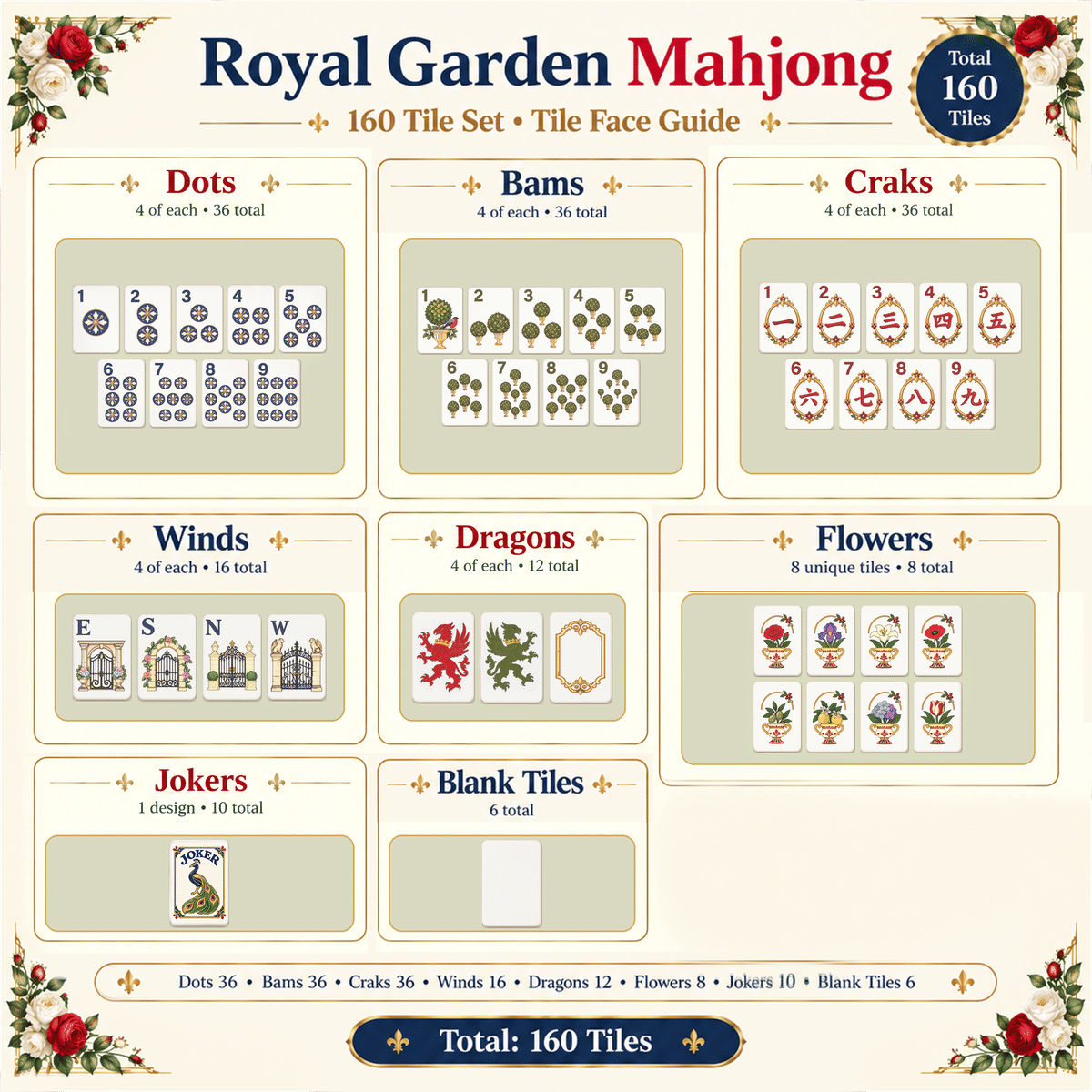
Yes, but with a caveat. A standard 160-tile American set contains Bams, Craks, and Dots (1–9 of each), plus Winds, Dragons, Flowers, and jokers. You have all the number tiles needed for tanyao (the 2–8s). However, American sets are designed for American play—the tile weight, finish, and often artwork differ from a riichi set. More importantly, American sets include 152 playing tiles and extras; riichi tournaments use a closed 136-tile set (four copies each of 1–9 in three suits, plus four each of the seven honor tiles: East, South, West, North, Red Dragon, Green Dragon, White Dragon). If you're serious about riichi play, use a dedicated riichi set; if you're learning tanyao casually at home with friends, an American set works for practice. Our travel-friendly mahjong bags can hold either, so portability isn't the issue—it's the tile design and feel.
How do you practice tanyao hands step-by-step?
Step 1: Gather your tiles. Use a riichi-standard 136-tile set (or practice with an American set's Bams, Craks, and Dots 2–8). Remove the 1s, 9s, and all honors.
Step 2: Place a pair. Pick any pair from 2–8 (e.g., two 5 Bams). Lay it face-up as your target.
Step 3: Build melds around the pair. Draw or select four melds, each a pung (three identical tiles), kong (four identical), or chow (three consecutive: 2-3-4, 5-6-7, etc.). All tiles must be 2–8 only.
Example hand:
Pair: 5-5 Bam
Pung: 3-3-3 Crak
Chow: 6-7-8 Dot
Pung: 2-2-2 Dot
Kong: 4-4-4-4 Bam
Step 4: Check validity. Confirm no 1s, 9s, or honors are present. If yes, it's a legal tanyao.
Step 5: Score it. Use a riichi scoring chart (print one or use an app) to calculate points: you have 1 han for tanyao alone, plus fu (base points calculated by meld types). In a casual game, agree before play whether to score full-riichi rules or a simplified "1 han = 1 point" method.
Comparison: Tanyao vs. Other Common Riichi Hands
Hand | Tile Range | Melds Required | Difficulty | Scoring (Han) |
Tanyao | 2–8 only | 4 melds + pair | Beginner | 1 han |
Pinfu | 2–8 + honors in pair only | All chows + honor pair | Beginner–Intermediate | 1 han |
Yakuhai | Any + honor pung/kong | At least 1 honor meld | Beginner | 1 han per honor meld |
Honitsu | One suit + honors | Mixed suit + honor melds | Intermediate | 2 han |
Chinitsu | One suit only | All one suit | Advanced | 6 han |
🎁 See our most-loved mahjong sets & accessories →

What mistakes do players make with tanyao?
Mistake 1: Including a 1 or 9. A chow of 1-2-3 is not tanyao—the 1 is a terminal. Same for 7-8-9. Double-check every tile.
Mistake 2: Using an honor tile in a meld. If your pair includes a Wind or Dragon, tanyao is void. The pair must also be 2–8.
Mistake 3: Forgetting the four-meld requirement. Tanyao requires exactly four melds (pung, kong, or chow) plus a pair—no fewer. A hand with three melds and two pairs is a different pattern (toitoi, if all pungs).
Mistake 4: Confusing tanyao with "any simple." Tanyao is all 2–8; "pin-fu" and other hands have their own rules. Don't mix patterns.
Mistake 5: Discarding early melds carelessly. In riichi play, once you call a meld (in formal play) or commit to a pattern (casual), you're locked in. Plan ahead before exposing.
What to check before you buy riichi tiles
Tile size. Riichi-standard tiles are typically smaller than American tiles. If you have large hands or play casual games, you'll feel the difference immediately. Test-hold tiles before committing to a set.
Language/markings. Riichi tiles bear Japanese numbers (1–9) or pips (dots). American sets use English letters (Bam, Crak, Dot) and larger numerals. If you're learning riichi, Japanese markings reinforce the rules; if you're casual, English is fine.
Honor tile clarity. Winds and Dragons in riichi sets use Chinese characters or color/symbol codes. Make sure you can distinguish East from South at a glance—character confusion ruins a game.
Completeness. A riichi set has exactly 136 playing tiles (no extras or jokers). Verify the count before your first game; an incomplete set derails play mid-hand.
Storage. Riichi tiles are smaller and lighter than American tiles, so they need a compact case. Our mahjong racks with pushers work for American play; for riichi, confirm your rack accommodates the narrower, shorter tiles. A travel bag protects either type equally well during transport.
✨ Find your Mahstead set — free US shipping →
How does tanyao fit into your riichi strategy?
Tanyao is a foundational hand, not a win condition by itself. Experienced riichi players don't hunt tanyao alone; instead, they build melds naturally and recognize when tanyao emerges as a bonus. For example, you're drawing a chow of 5-6-7 Dots and a pung of 3 Bams—you're accidentally on a tanyao path. Competitive players think in layers: "Do I already have 1 han from honor melds? If I switch to tanyao, can I add a second han (like all Simples + no Terminals)?" Tanyao teaches you discipline: restrict your tile choices and build melds methodically. Beginners should practice tanyao hands in casual games to internalize the "2–8 only" rule before adding complexity like mixed honors or color suits. The hand is intentionally simple so you can focus on the process of declaring melds and calculating score rather than memorizing 50 patterns at once.
When do you call tanyao in riichi?
In formal riichi, "calling" a hand means you've won (drawn or claimed a discard to complete melds + pair). At that moment, you declare which hand pattern(s) you hold; the table verifies against the yaku rules. Tanyao is declared as your hand's qualifier, not called mid-game like an American meld. In casual riichi or practice games, you simply lay down your melds and announce "tanyao" when you win—no formal call beforehand. The key difference from American mahjong: you don't collect a hand over multiple turns and then declare it on the card; in riichi, you're constantly reshaping your hand until you can win, at which point you reveal the full four melds and pair and state the yaku. Tanyao, being simple, is one of the easiest to verify: the table glances and confirms no 1s, 9s, or honors—hand valid, score it.

FAQ
Is tanyao the only hand beginners should learn first?
No, but it's a good first hand because the tile restriction is clear. Pinfu (all sequences, honor pair) is equally simple; some groups teach pinfu first instead. Either works—start with whichever your group prefers.
Can I use a computer app to learn tanyao instead of playing in person?
Yes, riichi apps (available free or paid on phones) include tanyao tutorials and let you practice hands solo. However, real play—hearing discards, feeling tile weight, and managing hand speed—teaches faster. Use apps as a supplement, not replacement.
Does tanyao score differently for the dealer (East) vs. non-dealer?
Tanyao itself scores 1 han for everyone. Dealer multiplier applies to the total hand score (all han combined), not tanyao alone. So a dealer's 1-han tanyao might be worth more points than a non-dealer's 1-han tanyao because the dealer bonus multiplies the base.
If I have American mahjong tiles at home, can I use them to teach a friend riichi tanyao?
Temporarily, yes—remove the 1s, 9s, Winds, Dragons, and Flowers, and use the remaining 2–8 tiles. But riichi players prefer riichi-standard tiles for the authentic feel and honor tiles. After your friend learns tanyao, transition to a proper riichi set.
How is tanyao in Hong Kong mahjong different from tanyao in riichi?
In Hong Kong mahjong, tanyao (無字牌 mouja, all simples) is very similar—no terminals, no honors. However, Hong Kong yaku scoring and meld calling differ from riichi. Riichi uses han/fu; Hong Kong uses point multipliers. Learn your local variant's rules before playing; the tile set is the same, but the scoring logic changes everything.


View More
View More
View More
