
Sichuan Mahjong Strategy: Winning Tactics & Defense
Last updated: Nov 23, 2026
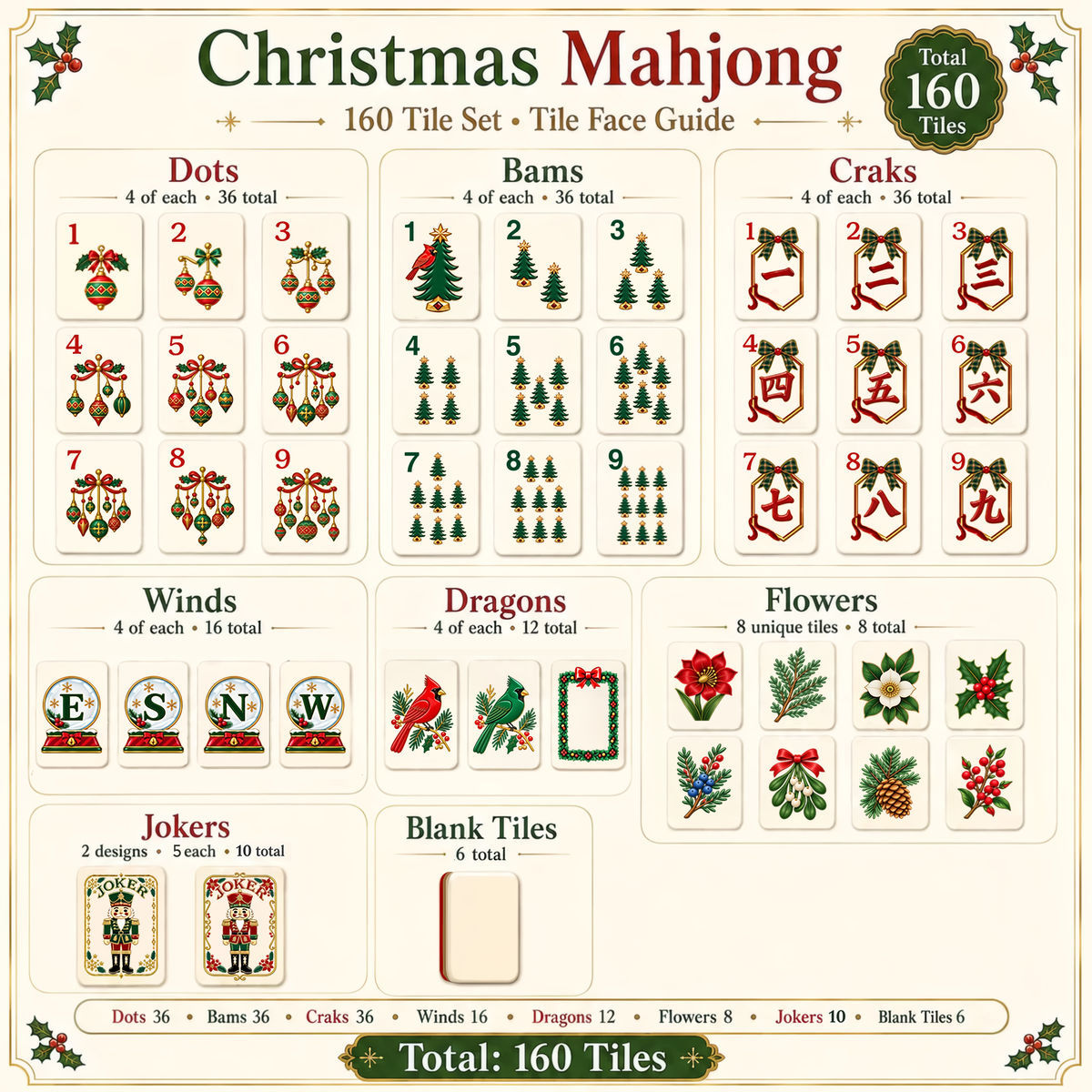
Sichuan mahjong (四川麻将) is a Chinese regional variant played with 108 tiles (no honors, flowers, or jokers) across three suits. The game prioritizes speed and hand-reading: players discard tiles face-up in a line, and anyone can claim them to form melds or go out. Strategy centers on tempo—forcing opponents into high-risk discards, reading discard sequences to infer their hands, and knowing when to hold back pairs or declare early. Unlike American mahjong's rigid card-based hands or Hong Kong's honor-heavy play, Sichuan rewards aggression and memory. Winning hands often rely on sequences (chows) over identical triplets, and most variants require concealed melds or specific point thresholds to win. The game typically concludes in 15–30 minutes per hand due to rapid discarding. If you play best-selling mahjong sets at home, understand Sichuan's tile economy differs radically from American rules: the pool shrinks faster and pressure compounds.
Why does Sichuan mahjong feel so aggressive compared to American play?
American mahjong enforces caution: hands are locked to the current season's card, the Charleston randomizes opening tiles, and exposing melds costs you points. Sichuan abolishes all three constraints. Players build hands freely, discards are instant and face-up, and any opponent can interrupt with a claim. This open economy means you cannot hide. If you draw a Crak and discard a Dot on turn two, every player logs it. By turn six, a sharp opponent knows you've seen six Dots and passed five—so your ninth tile must be a Bam or a Wind. Tempo pressure compounds: the discard line grows visibly; waiting feels like drowning. You must balance safety (discarding dead tiles) against speed (forcing the issue). In American mahjong, you study the card and lock down a single hand pattern. In Sichuan, you study the table and adapt.

How do you read an opponent's hand from discard patterns?
The discard line is your game. Record the sequence: Player A discards 1, 2, 5, 8 Craks in order, then 3, 4 Dots. That tells you (a) A has no two Craks running (or they'd hold them), (b) A's dots cluster around 3–4, and (c) A likely had a Crak pair early and burned it for speed. If A then claims your 6 Dot eagerly, A is chasing 5–6–7 or 4–5–6 Dots—a sequence. If A folds on your 7 Dot but claims on 9, A needs 8–9. In parallel, track which tiles have exited the game: if three 5 Craks are visible and none claimed, the fourth is either hidden or already melded. Dangerous. When Player B discards the same rank across suits (1 Bam, 1 Crak, 1 Dot), B is drowning—no safe tile exists—so B is near winning or near exhausted. Sichuan rewards obsessive tile accounting. American players study one hand; Sichuan players study four minds.
What's the optimal aggression curve: when to force versus hold back?
Early rounds (turns 1–6) favor patience. The pool is deep; forced discards often benefit opponents. Hold your pair (the key to winning) and discard your odd or duplicate suits first. If you hold 1–2–3 Bams and a loose 8 Dot, dump the 8 first; the Bam sequence can hide. By mid-game (turns 7–12), aggression peaks. The pool shrinks; opponents show their shapes. If you sense Player C is chasing a high hand, break their chains: discard tiles adjacent to their known sequences to block melds. If you're ahead (two melds + a pair), accelerate your discards and force exhaustion. Late game (turns 13–16) splits into two modes. If you're winning, decelerate and hold: let opponents overshoot. If you're losing, burst forward: claim anything that moves. Sichuan punishes hesitation and rewards decisiveness. A hand decided in 20 turns beats a hand played safely in 30.
How do melds and sequences work differently in Sichuan versus American mahjong?
Aspect | American Mahjong | Sichuan Mahjong | Strategic Implication |
Melds allowed | Pungs (3 identical), Kongs (4 identical), Quints (5), Sextets (6) — no sequences | Pungs, Kongs, and Chows (sequences 1–2–3, 2–3–4, etc.) | Sichuan opens hand variety; American forces identical grouping |
Joker use | Allowed in exposed melds; never in pairs or singles | None (no jokers in game) | American sets let you adapt mid-play; Sichuan is rigid |
Concealment | All tiles in hand until win declared | Many variants require 1–4 concealed melds to win | Sichuan rewards memory & defense; American rewards planning |
Tile count | 152 tiles per set | 108 tiles per set | Sichuan hands end faster; higher discard volume |
Hand patterns | Fixed to current year's card | Flexible (pairs + melds or specific combos) | American limits variance; Sichuan encourages risk-taking |
The chow (sequence) is Sichuan's lever. In American mahjong, you cannot claim or expose a sequence—only identical triplets or larger groups. Sichuan chains them: three 4–5–6 Dots is a legal meld, and opponents can claim your discards to complete sequences. This reshapes priority. In American play, you can discard mid-range numbers safely; no one can call them for sequences. In Sichuan, 5 is radioactive: it connects 1–2–3–4–5, 3–4–5–6, 4–5–6–7, and 5–6–7–8, 5–6–7–9. Dumping a 5 early signals weakness and risks feeding an opponent a meld. Early in your Sichuan learning curve, hold sequences longer and discard edges (1s, 9s) aggressively. American players often reverse this logic, which leads to costly giveaways.

What defensive tactics stop opponents from winning too fast?
Defense in Sichuan is active and vicious. First, track the pair. Every player needs one pair to win; once you spot Player D holding their pair (no discard of that rank in 10 turns), flag it. If D holds a 5 Dot pair, never discard 4, 5, or 6 Dots unless you're desperate; you're feeding their sequences. Second, honor the outs. If Player B's discard line shows 1–2–3–4–5–6–7–8, B has no 9s and needs them to win. Hoard your 9s or discard them face-down (if house rules allow) to choke B's window. Third, claim aggressively. If opponent A declares one meld and you can see a second forming, claim their discard for a competing meld, even if it delays your own hand. You're buying time and denying A tempo. Fourth, coordinate with downstream players. In turn order A → B → C → D → A, if B is winning, C should discard dead tiles (ranks B hasn't touched) to let D and A focus on blocking B. This sounds like table-talk, but sharp players signal through the discard line itself. Finally, never discard a tile your opponent just picked up unless you have no choice. If C just picked from the wall and kept a 7 Crak, and you hold two 7 Craks, your discard sets up C's win. Burn a less-connected rank instead. Defensive discipline separates good players from churn.
How should your strategy shift in the final rounds before someone wins?
The endgame transforms everything. Once any player has two or three melds and you suspect they're one or two tiles from winning, the game state narrows. First, assume they've seen your discards. If you've discarded six Dots and the eventual winner discards a 7 Dot, they are not chasing Dots—they're forcing you to discard Craks or Bams. Adjust your reads. Second, time your own push or fold. If you're far behind (one meld, no pair, eight turns left), it's mathematically unlikely you'll win; instead, maximize defense. Discard tiles that feed no one—genuine dead tiles from sequences your opponents have already shown they don't need. If you're even (two melds, a pair, waiting for one tile), accelerate and claim anything close. Speed kills in Sichuan; waiting is surrender. Third, watch the wall shrink. In many Sichuan variants, once fewer than 20 tiles remain in the draw pile, the game enters a "final push" phase. Some rules auto-win the hand if no one wins before the wall exhausts; others reset. Know your house rules. A player one tile away with 15 wall tiles left can afford patience; that same player with five tiles left must go out or lose. Finally, read the table's mood. If three players have folded mentally (loose discards, no blocking), the game is between two players. Focus only on them; discard for speed, not defense. If all four players are fighting, play for value—one point (by blocking) beats zero points (by being ignored).
🀄 Shop best-selling mahjong sets →
What equipment do you need to practice Sichuan mahjong strategy at home?
Sichuan uses only the 108 base tiles—no honors, flowers, or jokers—so a standard 108-tile set is ideal. However, most home players own best-selling mahjong sets with 152 tiles (suited for American mahjong), which include extras you simply don't use for Sichuan. That's fine. Set aside 108 tiles (three Craks, three Bams, three Dots ranked 1–9, four copies each) and remove the rest from play. You'll also benefit from a mahjong mat to organize the discard line: in Sichuan, that line is your primary data source, so a surface that keeps tiles neat and visible is non-negotiable. Some players use mats with labeled sections for each player's discard line. Racks with pushers help you store your hand neatly while freeing mental energy for reading the table. Sichuan rhythm is fast—13 turns is common—so fumbling with loose tiles costs tempo. A clean travel bag also prevents the 108-tile subset from mixing with the full set when stored.
What to check before you buy:
Tile clarity: Sichuan play demands rapid recognition at a glance. Choose tiles with crisp character printing (numbers/suits visible at arm's length).
Weight and feel: Fast play means frequent picks and discards. Lighter tiles (acrylic) suit speed; heavier tiles (bone/bamboo) can slow you down in back-to-back hands.
Size consistency: Uneven tiles jam in racks and slow your meld presentation, giving opponents read time you don't want to give.
Discard line space: Ensure your mat is wide enough for 50+ tiles in a single line (a typical Sichuan endgame discard pool).
🎁 See our most-loved mahjong sets & accessories →
Why do experienced Sichuan players say "the game is won at the discard line, not the hand"?
In American mahjong, your hand (the 13 tiles you hold) is your kingdom. You build to match the card; you expose melds for points. The outcome is semi-predetermined by luck and the card's structure. In Sichuan, your hand is just an inventory; your brain is the weapon. Every discard you make broadcasts data, every discard you see rewrites your strategy, and every opponent's decision is a confession. A player with a mediocre hand (e.g., three mismatched Bams, a rough Dot sequence) can still win if they read the table perfectly: they'll know which opponent is chasing what, which tiles are safe, and which are landmines. Conversely, a player with two melds and a beautiful pair can lose in seconds if they discard thoughtlessly and feed an opponent. The discard line—the public history of all 40–60 tiles played so far—is a ledger. In American play, you ignore opponent discards (they're locked out by the card). In Sichuan, every discard is a clue, a warning, a confession, or a trap. The best Sichuan players don't win because they have the prettiest hands; they win because they've solved the discard line before their opponents even know they're being read. That skill takes dozens of games to hone.
✨ Find your Mahstead set — free US shipping →

FAQ
Is Sichuan mahjong played in the U.S., or is it mainly a China-only game?
Sichuan is regional to China's Sichuan province and some parts of western China; it's rarely played in the U.S. outside of immigrants' home games. American and Hong Kong variants dominate U.S. clubs. If you want to learn Sichuan, find local Chinese community centers, universities, or online groups.
Can I use a full 152-tile American set to play Sichuan if I just remove the extra tiles?
Yes. Set aside 108 tiles (three suits, 1–9, four copies each) and leave the winds, dragons, flowers, and jokers out of play. The game works identically. Store them separately to avoid mixing them back in by accident.
How long does a typical Sichuan hand last compared to American mahjong?
Sichuan hands are fast, often 15–25 turns per player before someone wins. American hands average 30–50 turns. Sichuan's small tile pool and aggressive discarding drive speed.
What's the biggest mistake beginners make when switching from American to Sichuan strategy?
Discarding mid-range tiles (4–5–6) early. In American, sequences are impossible, so mid-range tiles feel safe. In Sichuan, mid-range are the densest, most connected tiles. Beginners hemorrhage them and feed opponents melds. Discard edges (1, 9) and honor observation instead.
Do you need to memorize every discard, or is "general reading" enough?
General reading (inferring hand direction) is enough to start. Serious players mentally track 20–30 key discards per hand and update their reads every turn. Record-keeping happens in real time; you don't need a notepad. Practice with one opponent first; four-player chaos comes later.
How does Sichuan scoring differ from American mahjong scoring?
Sichuan variants vary widely—some use point totals, others use rankings (first, second, third, fourth). Most American mahjong uses the seasonal card to set hand values. Ask your group for their specific scoring rules before playing; they differ more than strategy tips do.


View More
View More
View More
