
Riichi vs. Siamese Mahjong: Key Rules & Differences
Last updated: Nov 23, 2026
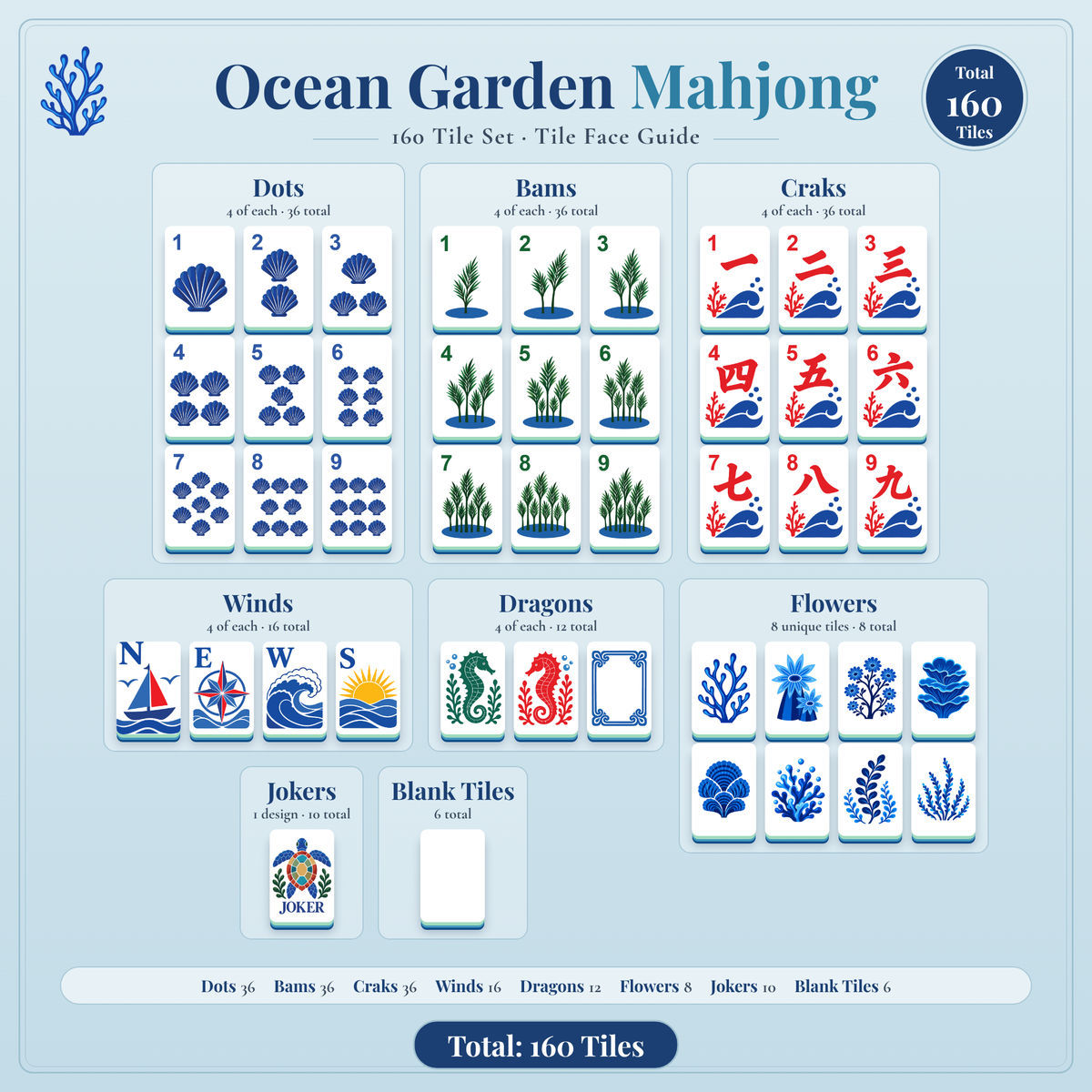
Riichi mahjong (Japanese, 136 tiles: three suits 1–9, honors, flowers, no jokers) requires players to declare "riichi" (a closed-hand bet) before winning, emphasizing hidden melds and specific hand patterns called yaku. Siamese mahjong (Thai, 144 tiles: four suits 1–9, honors, no flowers, no jokers) uses open melds freely, allows consecutive called sets, and requires majority-suit hands for winning. Neither uses jokers; both demand memorized hand patterns. Riichi scores via fu and han (base and multiplier points); Siamese uses point tables tied to hand complexity. Both are played with exactly four players over multiple rounds. If you're hosting cross-variant games at home, a best-selling flexible acrylic set works for learning, though dedicated Riichi and Siamese tile sets are purpose-built for their specific rules.
What tiles does Riichi mahjong use?
Riichi mahjong uses 136 tiles with no jokers and no blanks. The standard set contains three suits (Bams, Craks, Dots) numbered 1–9 in four copies each (108 tiles), plus 16 winds (four each: North, East, South, West), 12 dragons (Haku, Hatsu, Chun — four each), and no flowers. The 1 Bam shows a bird. Riichi players discard one tile after drawing, building hidden melds until they declare riichi (a closed-hand state betting they will win within a few turns) and then win by drawing the final tile or accepting a discard that completes their hand.

How does Siamese mahjong's tile set differ?
Siamese mahjong uses 144 tiles: three standard suits (Bams, Craks, Dots) 1–9 in four copies, plus 16 winds and 12 dragons — the same as Riichi — but adds a fourth suit (typically Birds or Flowers, depending on regional rules), making four suits × nine numbers × four copies. No jokers; no blanks. Siamese games require at least one tile from the majority suit to be visible in a hand (usually shown in an exposed pung or kong) for a hand to qualify as a winner, enforcing a "mixed suit" rule Riichi does not use.
🀄 Shop best-selling mahjong sets →
What is riichi, and why do Riichi players declare it?
Riichi (from Japanese "ready") is a declaration that your hand is one tile away from winning and will accept no more changes — all melds are locked, hidden, and closed. Once declared, you bet points; if you win, your payout is multiplied. If someone else wins while you are in riichi, you pay double penalty. Riichi exists to add strategy and drama; the bet creates tension and forces opponents to play defensively. This mechanic does not exist in Siamese mahjong, where hands remain fluid and open melds are called and displayed continuously until someone wins.
Can you call and expose melds in both games?
Riichi: Melds are never called or exposed during hand-building. Once you declare riichi, your hand is completely closed until you win. Before riichi, players may open a kan (kong of four identical tiles) to draw a bonus tile, but standard pungs and kongs are hidden.
Siamese: Players call and expose pungs (3), kongs (4), and consecutive sets (called chow or pung-kong sequences) freely throughout the hand, similar to Chinese or Hong Kong styles. Majority-suit melds must be visible.
The table below compares the two:
Feature | Riichi | Siamese |
Tile count | 136 | 144 |
Suits | 3 (Bam, Crak, Dot) | 4 (Bam, Crak, Dot, + fourth) |
Jokers | None | None |
Called melds allowed | Only kan before riichi | Yes, pungs, kongs, sequences |
Hand visibility | Closed until riichi declared | Open, progressive |
Winning condition | After riichi + draw or valid discard | Majority suit + melds + win tile |
Scoring method | Fu (base) × Han (multiplier) | Hand-type tables & point scale |
🎁 See our most-loved mahjong sets & accessories →

How do the winning hand patterns differ?
Riichi hands are built on yaku (named patterns with point values): sequences (shuntsu), pungs (koutsu), eyes (pair), and special forms like tanyao (all simples, no 1 or 9), honitsu (one suit + honors), or chinitsu (single suit). Each yaku has a han rating (1–13). Total score = fu (base: 20–110) × 2^(han+2), then multiplied by position (dealer or non-dealer). A mangan (8 han or high fu) or haneman (6 han) represents fixed payouts regardless of fu.
Siamese hands require a "majority suit" (more tiles in one suit than the other three combined); melds within that suit must be visible. Winning happens when a declared meld (pung, kong, or sequence) is complete and the hand contains the final winning tile. Siamese scoring uses a point table based on hand complexity and rarity rather than a mathematical formula. American mahjong, by contrast, uses hand lists from an annual card with no yaku or majority-suit rule.
Which variant should you learn first if you know American mahjong?
If you play American mahjong, Siamese will feel more familiar because both use open melds, called pungs and kongs, and progressive hand-building. However, Siamese replaces the NMJL card with memorized hand types and majority-suit logic. Riichi is harder for American players: closed hands, riichi betting, fu/han scoring, and yaku patterns are entirely different mental frameworks. Many players begin with American, add Siamese for a gentler bridge, then graduate to Riichi for the strategic depth. Each uses 136–152 playing tiles (no jokers), so tile inventory differs. For hosting mixed-variant games at home, a standard best-selling set of acrylic tiles can teach rules, but dedicated Riichi and Siamese sets are optimized for the tile count and mark system each variant requires.
What to check before you buy a Riichi or Siamese set
Tile count: Confirm the set contains 136 (Riichi) or 144 (Siamese) playing tiles, not 152.
Mark system: Riichi sets use Arabic numerals or kanji marks; Siamese often use Thai or simplified marks. Confirm readability under your lighting.
No jokers: Both variants prohibit jokers entirely, so do not buy a set marketed with extra jokers unless you plan to use it for American mahjong too.
Tile size & weight: Heavier tiles (polymer clay or resin) feel better in hand; check dimensions if your racks must fit a specific width.
Spare tiles: Riichi and Siamese sets rarely include spares. Buy a backup set of the fourth suit (Siamese) or extra winds (Riichi) if you play weekly and want to avoid lost-tile downtime.
✨ Find your Mahstead set — free US shipping →

FAQ
Can I use an American mahjong set (152 tiles + jokers) for Riichi?
No. Riichi requires exactly 136 tiles and forbids jokers entirely. American sets have extra jokers and blank tiles that violate Riichi rules. You need a dedicated Riichi set.
What does "majority suit" mean in Siamese mahjong?
At least half of your 14 tiles must be from one suit. If you have 5+ Bams, they are your majority suit, and at least one Bam meld must be exposed (pung or kong visible on the table) for your hand to win.
Is Riichi mahjong harder than American mahjong?
Riichi has a steeper learning curve because you must memorize 30+ yaku (hand patterns), understand fu/han scoring math, and play closed hands until riichi. American uses an annual card. Most players find Riichi requires 20–30 hours to play comfortably.
Can four players switch between Riichi and Siamese in one night?
Yes, but each requires a different tile set (136 vs. 144 tiles) and scoresheet. Switching mid-session wastes time. Plan separate nights or rotate games across weeks so one set is always in use.
Are Riichi and Siamese sets sold together as a combo?
Rarely. Most manufacturers sell them separately because the tile counts and mark systems are distinct. Buy each set separately, or check if a vendor offers a bundle.


View More
View More
View More
