
Riichi Mahjong Scoring: Rules, Point Calculation & Tables
Last updated: Nov 23, 2026
Riichi mahjong scoring awards points for winning hands based on two core values: fu (符, the base unit measuring hand complexity; typically 30–110 points) and han (飜, the count of scoring patterns or "doubles" in the hand; usually 1–13 han). A formula multiplies these values, then adjusts payments based on your seat position (dealer or non-dealer). Unlike American mahjong, which draws fixed hands from an annual card, riichi scoring applies to any valid winning combination and varies by hand pattern, tile concealment, and luck elements like self-drawn wins. Payment calculations involve four players contributing different amounts: the dealer pays more to others; non-dealers split payments among all three opponents. Online converters and printed scoring tables simplify calculation. Learning riichi opens play in Japanese clubs, international tournaments, and digital platforms like Mahjong Soul—making it one of the most widely played mahjong variants globally.
What are fu and han in riichi mahjong scoring?
Fu (符) is the base unit of hand value, representing structural complexity—how you assembled your melds, whether you drew the winning tile from the wall, and your hand configuration. Fu starts at 20 for special hands (all honor tiles, seven pairs) and climbs to 110 for hands with many concealed melds and a self-drawn win. Han (飜) counts scoring patterns: each valid pattern—like a winning pung of dragons, a sequence of the same suit, or declaring riichi—adds one or more han to your hand.
Your scoring formula: Base Points = (Fu × 2^Han) ÷ 2. Once you calculate base points, you multiply by 2, 4, or 6 depending on seat position and who won. Without this two-tier system, all hands would score identically; fu and han let riichi reward skillful play and lucky draws. Study the basic fu table in a rulebook or app; it becomes automatic after ten hands.

How does hand concealment affect riichi scoring?
A concealed hand (closed hand) is one where you drew every tile yourself and revealed nothing until win—it scores double han or even triple in some bonus situations. An open hand contains exposed melds (pungs, kongs, sequences) that you called from discard; these are worth half han or sometimes award no bonus. Open hands pay significantly less because they telegraph your strategy and reduce the luck element.
If you declare riichi early, your hand must stay closed; you cannot call any discard. This restriction makes riichi a high-risk, high-reward declaration. A closed hand that wins after riichi declaration is worth +2 han as a bonus alone. Conversely, if you open your hand by calling a tile, riichi is no longer an option, and your final hand value drops. New players often undercalculate how much being open reduces payment—track this in practice games to build intuition.
What are the main scoring categories in riichi mahjong?
Riichi mahjong recognizes mangan (満貫, 2,000 base points, an automatic floor), haneman (跳満, 3,000 base), baiman (倍満, 4,000 base), sanbaiman (三倍満, 6,000 base), and yakuman (役満, a "limit hand"—10,000+ base points). Many hands under mangan calculate using the fu-and-han formula; hands that reach mangan jump directly to these fixed values. Yakuman hands—like all terminals and honors, or all one suit—pay the maximum regardless of how many han they technically contain.
A comparison of common payoff tiers:
Tier | Base Points | Dealer Win | Non-Dealer Win (Discard) | Typical Han + Fu Example |
Mangan | 2,000 | 6,000 | 2,000/4,000 | 5 han (any fu) |
Haneman | 3,000 | 9,000 | 3,000/6,000 | 6 han (any fu) |
Baiman | 4,000 | 12,000 | 4,000/8,000 | 7-8 han (any fu) |
Sanbaiman | 6,000 | 18,000 | 6,000/12,000 | 11-12 han (any fu) |
Yakuman | 10,000–16,000 | 16,000–48,000 | 8,000–16,000 / 16,000–32,000 | Special patterns |
Learning these tiers first—before memorizing every fu combination—helps you estimate hand value on the fly and decide whether to chase a win or play safe.
🀄 Shop best-selling mahjong sets →
How does dealer position change payments in riichi scoring?
The dealer (東, East player) collects larger payments and pays more when losing; non-dealers split and receive smaller amounts. If the dealer wins, all three other players pay the dealer's full win amount. If a non-dealer wins from the dealer's discard, the dealer pays double; if they self-draw, the dealer pays double while the other two non-dealers pay single.
Dealer win (direct payment): Each opponent pays 1× the payment amount. Non-dealer win (from discard): Dealer pays 2×; other two non-dealers pay 1×. Non-dealer self-draw: Dealer pays 2×; other two pay 1×.
For example, if a non-dealer hand is worth 2,000 base points and the dealer paid the discard, the dealer sends 4,000; the other two non-dealers send 2,000 each. Dealer position rotates clockwise each hand. Watch for this rotation when settling scores; many mistakes come from misassigning who owes whom.
What hand patterns count as han in riichi mahjong?
Han come from yaku (役, scoring patterns). Common yaku include: riichi (+1 han for declaring before closing your hand), pinfu (+1 han for a hand of all sequences, no pungs, with a non-honor pair), tanyao (+1 han for using only middle tiles: 2–8, no 1 or 9), yakuhai (+1 han per pung of dragons or round/seat winds), sanshoku (+2 han for sequences spanning all three suits with identical numbers), toitoi (+2 han for all pungs, no sequences), shosangen (+2 han for pungs of all three dragon types), and yakuman hands like kokushi (all 13 unique terminal and honor tiles) worth 10,000+ base.
Each yaku has strict requirements; a hand can combine multiple yaku, summing their han. A hand worth 1 han fails to win (it must have at least 1 han after your opponent's turn); declaring riichi and catching bad luck means you cannot win that round. Studying a yaku chart—nearly every riichi rulebook and app includes one—is essential. Focus first on the five or six most common yaku in beginner play; advanced patterns become clearer once you've played 50–100 hands.
How do self-drawn wins affect riichi mahjong scoring?
A tsumo (自摸) or self-drawn win occurs when you draw your winning tile from the wall instead of calling an opponent's discard. Tsumo wins are worth an extra han or create different payment ratios. If you declare riichi and then tsumo, the bonus stacks. When you tsumo, all three opponents pay (no one escapes); if you ronned (won from discard), only the player who discarded pays—or, if that player is the dealer, they pay double and the other two pay nothing.
Tsumo wins often feel luckier and are celebrated in play; the scoring system rewards this by raising han or adjusting payment splits. Beginners often misjudge tsumo value—assume it's always worth more, and prioritize keeping your hand closed if you're close to tsumo (self-draw). Many intermediate players lean on tsumo-heavy strategies because the payment efficiency is real.
🎁 See our most-loved mahjong sets & accessories →

Comparison: Riichi Scoring vs. American Mahjong Scoring
Aspect | Riichi Mahjong | American Mahjong |
Hand Source | Any valid pattern (yaku) | Only hands on current year card |
Scoring Basis | Fu (base) + Han (doubles) | Fixed point value per hand |
Player Payments | Dealer/non-dealer split or asymmetric | Equal from all players (usually) |
Self-Draw Bonus | All three opponents pay; extra han/value | Rarely distinctions made |
Joker Use | Limited or forbidden in core play | Unlimited in pungs, kongs, etc. |
Pattern Flexibility | Many hand patterns count as yaku | Hands match card exactly; no variation |
Table Setup | 4 players only | 4 players (standard) |
Learning Curve | Moderate-to-steep; 100+ hands to fluency | Moderate; 30–50 hands to comfort |
Riichi offers deeper tactical choices and variable hand value; American mahjong emphasizes pattern recognition and speed.
What equipment do you need to learn riichi mahjong scoring?
A standard 136-tile Japanese mahjong set suffices (unlike American mahjong's 152 tiles). You'll want a hand scoring guide or smartphone app—most riichi platforms include built-in calculators—plus a pencil scorepad to track cumulative round scores. If you're hosting regular games at home, a quality mahjong mat with clear tile spaces helps all four players track hand progress; a mahjong rack with pushers steadies your hand and speeds tile arrangement when counting fu.
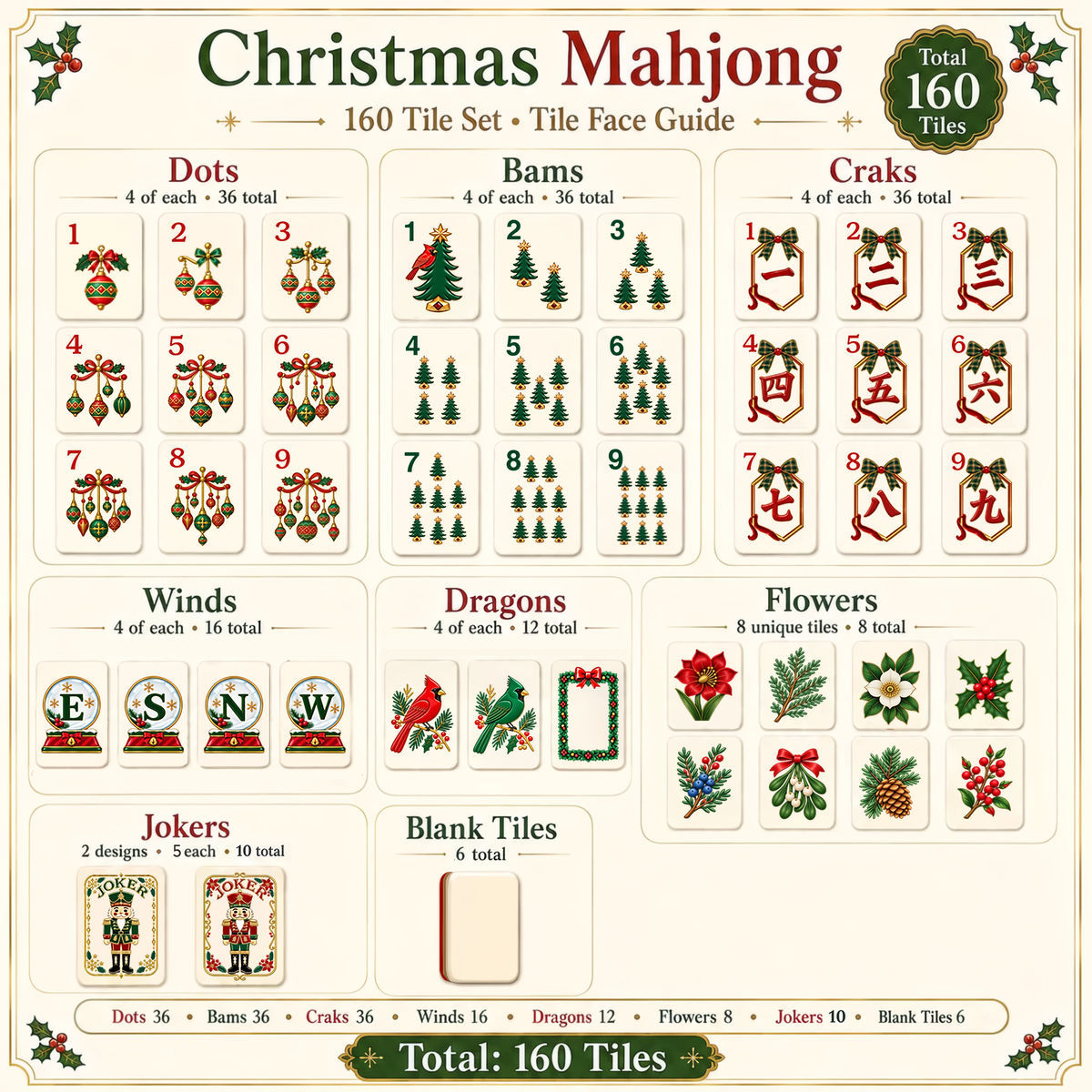
Many riichi players use a dedicated travel bag or case if they carry a set between clubs or tournaments. Note that Mahstead designs 160-tile American mahjong sets with engraved titles and custom themes—perfect if you're mixing American play with riichi study. For riichi-only play, a standard Japanese set from a specialist is more appropriate, but tracking two games on one premium mat makes sense.
✨ Find your Mahstead set — free US shipping →
What to check before you buy riichi mahjong learning materials
Rulebook or app clarity: Does it separate basic yaku (5–10 patterns) from advanced ones (20+)? Start with basics.
Scoring table format: Printed tables (fu rows vs. han columns) are easier than memorizing; apps auto-calculate but can hide the logic.
Language: English rulebooks exist; Japanese-only sources require translation apps but may be more authoritative.
Worked examples: Does your resource walk through a full hand—fu calculation, han count, payment assignment? If not, find one that does.
Playmate readiness: Can you find a beginner-friendly club or online platform (Mahjong Soul, Tenhou) where errors are forgiven? Solo study stalls fast.
Before your first session, practice calculating three hands on paper; time yourself. Once you hit 2–3 minutes per hand, you're ready for live play. Experienced players calculate mid-hand; this comes only with repetition.
Step-by-step: Calculate your first riichi mahjong hand
Verify the hand is winning: Does it contain four melds (three pungs/sequences/kongs plus a pair) or a special hand pattern (yakuman)?
Count han: Which yaku patterns appear? (Riichi +1, pinfu +1, yakuhai +1 per dragon pung, etc.) Sum them.
Assign fu: Use a fu chart. Closed hand + self-draw = 20 fu bonus; honor pair +2; sequence = 0; pung of terminals/honors = 8; etc.
Calculate base points: Use the formula or table. If hand reaches mangan (5 han or 40 fu with 4+ han), jump to mangan value (2,000 base).
Apply player position: If you're dealer, all three pay you 1× base amount (then ×2 for final payment). If you're non-dealer and won from dealer's discard, dealer pays 2×, others pay 1×.
Round and record: Payments round up to nearest 100. Write down total and move to next round.
Example: You win a non-dealer hand with 2 han and 30 fu. Base = 30 × 2^2 ÷ 2 = 60 × 4 ÷ 2 = 120. Multiply by 4 (non-dealer win from discard to dealer) = 480 → rounds to 500 from dealer; 250 each from the other two non-dealers. Total: 1,000 points credited to you that round.
Real differences: Riichi vs. American mahjong in context
We play American mahjong most weeks, but riichi is becoming more common in casual meetups. The scoring ceiling feels higher in riichi because yakuman hands can pay 48,000+ from the dealer, while American hands cap at standard payoff amounts. Riichi's fu/han system rewards close study of yaku patterns; American mahjong rewards speed and card memorization. Both demand the same hand speed and tile-reading skill, but riichi teaches deeper probability thinking because so many different hands can win—you're not locked into the year's card.
If you're learning both, start with American rules first (they're simpler), then move to riichi once you've played 100+ American hands. Your tile sense will transfer immediately.
When to play riichi mahjong: Tournaments and clubs
Most Japanese mahjong clubs worldwide now use standard riichi rules; online platforms (Mahjong Soul, Tenhou, dan rating servers) use them exclusively. North American riichi tournaments are smaller than American mahjong events but are growing. Look for mahjong clubs in community centers, libraries, or game shops near you; ask which variant they play. Many beginners start with riichi through mobile apps, then seek live game partners.
🀄 Shop best-selling mahjong sets →

FAQ
Is riichi mahjong harder to learn than American mahjong?
Riichi has a steeper initial curve (fu/han arithmetic, 20+ yaku patterns) but opens more hand possibilities. American mahjong is faster to start but plateaus quickly because you're matching cards. Most players find riichi more rewarding after 50 hands.
Can I use American mahjong tiles to play riichi?
No. American sets have 152 tiles (including jokers and flowers); riichi uses 136. Tiles also differ: no Bams/Craks/Dots suit labeling exists in Japanese sets (they use circle, bamboo, character marks). Buy a Japanese set for riichi.
What's the easiest yaku to remember first?
Riichi (+1 han) and yakuhai, dragon pung (+1 han each). These two appear in nearly every winning hand and require no complex logic—just tile matching.
Do I need a scoring app to play riichi, or can I use a printed table?
Both work. Printed tables are standard at tournaments and teach you the logic; apps are faster for casual play. Most players carry both—an app on their phone and a pocket scoresheet.
How long does a riichi mahjong round take compared to American?
Riichi rounds are slightly longer (10–20 minutes) because players must assess hand value on the fly. American rounds are often 15–25 minutes because hand matching and calling take focus. Speed improves with practice.
Can I play riichi with fewer than four players?
Technically yes, but it's unbalanced. Three-player variants exist (using 108 tiles) but are rare. Riichi is designed for four; stick to four if you're learning.


View More
View More
View More
