
Riichi Mahjong Minimum Points to Win: Rules & Strategy
Last updated: Nov 23, 2026
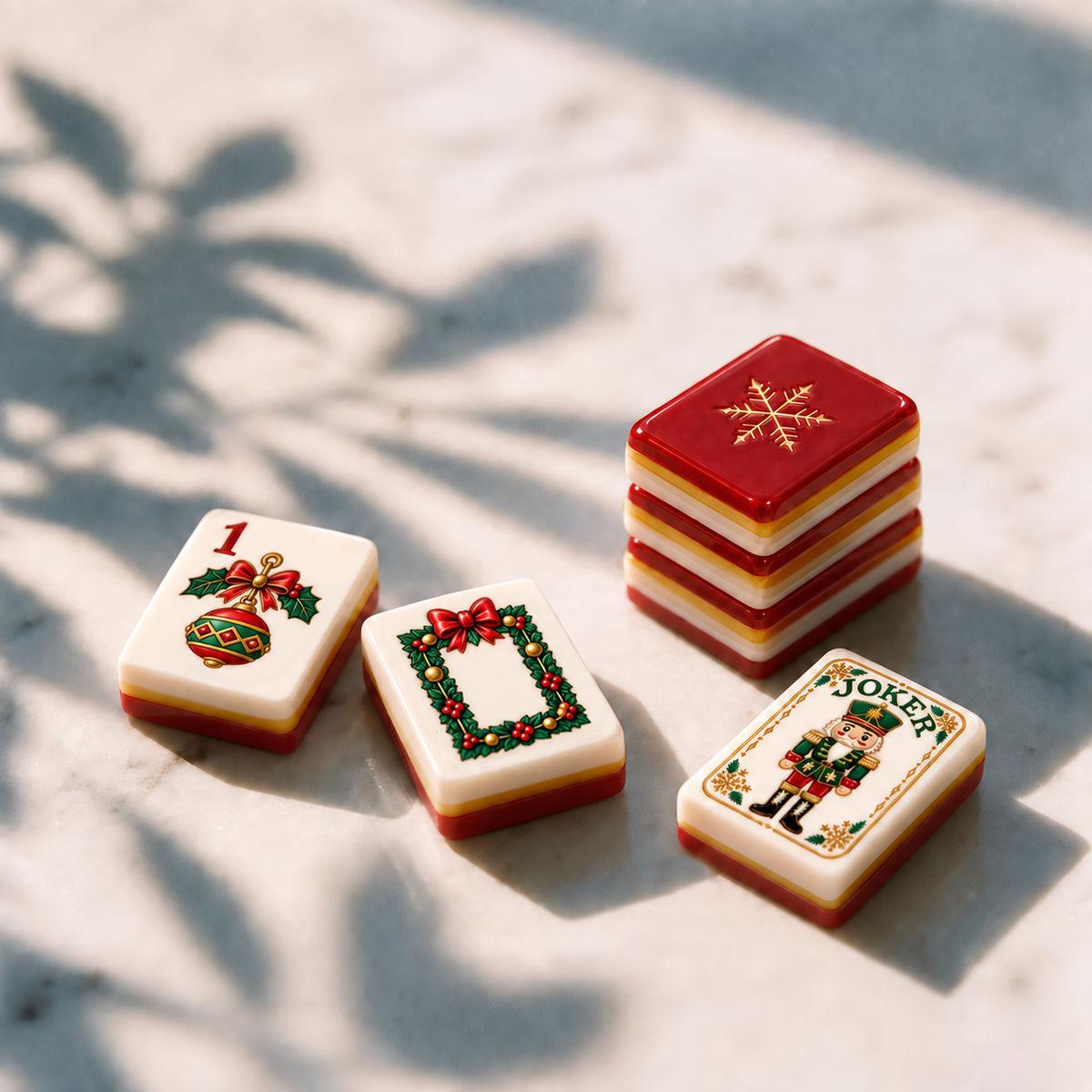
In riichi mahjong (also called Japanese mahjong), you cannot win on any hand: you must complete a yaku—a specific hand pattern—worth at least 1 point. Non-dealer players need a minimum 1 fu (base point unit) and 1 han (pattern rank); dealer players can sometimes win on pinfu (an invisible yaku worth 1 han with specific shape) if their hand totals 2 or more fu. Scoring follows a tiered formula based on fu and han combined, capping at mangan (2,000 base points for non-dealer, 3,000 for dealer) and climbing to haneman, baiman, sanbaiman, and yakuman. Unlike American mahjong—where hands come only from the current year's National Mah Jongg League card and carry fixed payouts—riichi requires you to recognize and count point-value patterns yourself. We've built this guide so you can move confidently from beginner-level awareness into live play.
What exactly is the minimum hand in riichi mahjong?
In riichi mahjong, the absolute floor is a 1 han, 1 fu hand—but only for non-dealers. Dealer hands must reach at least 1 han and 2 fu, or meet a special exception (like tanyao, which is 1 han and no fu minimum). If your hand falls short, you cannot declare tsumo (self-drawn win) or ron (win on another player's discard). This is the core rule that separates riichi from casual tile games: a pretty-looking hand means nothing without a valid yaku.

How do fu and han combine to set the winning threshold?
Fu counts structural points: a pair is 2 fu, an open pung is 2 fu, a closed pung is 4 fu, honor tiles or terminal tiles boost the count. Han measures hand complexity: each pattern you fulfill adds 1 han. A 1 han, 1 fu hand scores 1,000 points for a non-dealer (500 to each of the other three players); a 1 han, 2 fu hand pays 2,000 base. Once you hit 2 han, the payout jumps to mangan—a fixed 2,000 base (non-dealer) regardless of fu count. The reason: riichi rewards pattern recognition, not just structural luck. A hand with 3 han and 5 fu beats a hand with 2 han and 60 fu, because han stacks exponentially in the scoring table.
Where do minimum-point hands show up in real play?
The 1 han, 1 fu hand—called 1,000 point hand (non-dealer)—arrives most often when you complete a simple, low-scoring yaku like tanyao (all simples), dora (bonus tile match), or a one-sided chitoitsu (seven pairs). Dealers rarely see 1 han, 1 fu wins; they typically need 1 han, 2 fu minimum (2,000 points). In tournament and casual play alike, newer players sometimes underestimate the threshold and discard aggressively into a hand that looks complete but lacks a recognized yaku; when they draw the final tile, they cannot declare victory—they must discard and pass their turn. This happens frequently at week-night clubs in cities with established riichi communities; it's a learning moment, not a penalty.
What common mistakes lower your win rate at the table?
Mistake 1: Forgetting honor-tile fu. Winds (N/E/W/S) and dragons (Red, Green, White) each add 2 fu to your fu count if they form a pung. A new player might build a pung of East winds and count it as a regular pung (2 fu); actually, it's 4 fu because East is your seat wind (if you're East player) or the round wind. Mistake 2: Confusing open and closed fu. A pung you took from another player's discard (calling pon) is 2 fu; your own closed pung is 4 fu. Mistake 3: Assuming pinfu exists. Many variant rulebooks allow pinfu as a special 1 han, no-fu hand (dealer can win it if fu total is ≥2 from the shape alone); not all clubs recognize it—check before you sit. Mistake 4: Mixing American and riichi scoring. American mahjong has fixed hand payouts from the card; riichi calculates every hand fresh from fu, han, and dora. Switching between the two at the same table breeds confusion: agree on the rulebook before the first kyoku (round) begins.
🀄 Shop best-selling mahjong sets →
How do riichi rules differ from American mahjong minimum-win requirements?
American mahjong requires your completed hand to match a pattern from the current year's National Mah Jongg League card—and every pattern on that card is by definition a valid win. You cannot win on a pattern not listed. Payouts are fixed: each hand pattern carries a set value (e.g., All Pungs, 1 or 2 Jokers, pays a standard amount). Riichi mahjong, by contrast, lets you build any hand that meets the yaku rule—there is no "official card." Your 1 han win is valid even if no one else at the table has ever seen that combination. Scoring is dynamic: you compute fu and han on the spot. A riichi player needs judgment; an American player needs pattern recognition and a card. Both systems demand focus, but they reward different skills.
Aspect | American Mahjong | Riichi Mahjong |
Minimum Win | Pattern on current year's card | 1 han + valid yaku (1 fu non-dealer, 2 fu dealer) |
Payout | Fixed per pattern | Calculated from fu × han table |
Winning Patterns | Hundreds on the card | Infinite (any combo with a yaku) |
Jokers | 8 per set, can be exposed | 0 in play (dora ≠ joker) |
Sequences | Not allowed (no chows) | Required for many yaku |
Dealer Advantage | Exists but modest | Significant: dealer pays/receives double |
Complexity | Medium (learn the card) | High (learn 40+ yaku and scoring) |

What should you check before you play riichi for the first time?
Before joining a riichi table, ask: 1. Which rule variant are we using? (Japanese tournament rules, online platform rules like Mahjong Soul, or house rules?) 2. Is pinfu allowed as a standalone 1 han, 0 fu win?3. Do we count dora as part of the hand's han, or are dora strictly bonus multipliers?4. Are we playing honma (honors-only) or kuitan (open hand without honors)?5. How many rounds do we play—one full wind cycle, or to a set point total? A 15-minute conversation upfront saves 90 minutes of mid-game argument. Many cities with riichi clubs post rule summaries online or at meetup boards; review them before you arrive. If you're learning at home, invest time in a single rulebook (not three conflicting ones) and stick with it for a month before table play—muscle memory for yaku recognition matters more than speed.
🎁 See our most-loved mahjong sets & accessories →
What hand patterns count as valid winning yaku?
The most common yaku at beginner tables:
Pinfu (1 han): all sequences, no honors, no open pungs, no terminal pair. Dealer needs 2+ fu to win on it.
Tanyao (1 han): all simples (2–8 tiles), no terminals, no honors.
Yakuhai (1 han): a pung (3 or 4 tiles) of your seat wind, round wind, or a dragon (Red, Green, or White).
Tsumo (1 han): self-drawn win (no ron). Non-dealer pays 1,000 to the winner; dealer/non-dealer pair pays differ.
Riichi (1 han): declaring your hand closed and waiting for a single tile to complete it. Added only if you actually win after declaring.
Ippatsu (1 han): winning on the first discard after you declare riichi—tricky bonus, easy to lose.
A hand with 2+ yaku stacks: tanyao + tsumo = 2 han, and scoring jumps. Most 1-han hands don't win alone at dealer tables—you need 2+ han or a high fu count to compete. This is why riichi players obsess over finding a second yaku; that extra han often doubles their payout.
What you'll need: If you're hosting a riichi game at home or learning with friends, our best-selling mahjong sets come with a full 160-tile set (152 playing tiles, 8 jokers spare). Riichi play uses all 136 riichi-standard tiles—no American jokers—so if you're mixing American and riichi nights, make sure your set is labeled clearly. A mahjong mat with score tracking aids learning fast; racks with pushers let you hold your hand stable while you count fu and han. Digital scoreboards exist (apps, spreadsheets), but a pen-and-paper log trains your memory—essential for spotting patterns over time.
What point totals mark each tier above the minimum?
Once you clear 1 han, 1 fu, scoring climbs in tiers:
1 han, 1 fu (Non-dealer): 1,000 points base (500 per opponent).
1 han, 2 fu: 2,000 base (1,000 per opponent).
2 han:Mangan, 2,000 base (1,000 per opponent, non-dealer); dealer receives 4,000 base.
3 han:Haneman, 3,000 base (non-dealer); dealer 6,000.
4 han:Baiman, 4,000 base (non-dealer); dealer 8,000.
5 han:Sanbaiman, 6,000 base (non-dealer); dealer 12,000.
6+ han:Yakuman, 8,000 base (non-dealer); dealer 16,000. Special hands like kokushi (collecting one of every terminal and honor tile) or suuankou (four closed pungs) are single yakuman themselves, regardless of han count.
The jump from 1 to 2 han is the steepest: you double your payout. After 2 han, each extra han increases the payout by 50% (roughly). This is why intermediate players hunt for a second yaku—it's the difference between winning 500 points and 2,000.
✨ Find your Mahstead set — free US shipping →
What to check before you buy a set for riichi play
Tile count: Riichi uses 136 tiles in standard play (4 copies each of a smaller range than American). If you're buying for both American and riichi nights, a 160-tile set works for both—the spares never enter play. Confirm your set includes clearly labeled suits and honors.
Size & weight: Riichi players manipulate tiles frequently (counting fu, stacking pungs). Medium or large acrylic tiles reduce hand fatigue. Bamboo tiles look beautiful but wear faster; acrylic lasts decades.
Engraving legibility: If you're buying personalized sets for a regular group, ensure the engraving (names, dates, club info) doesn't obscure the tile symbols. From our Mahstead catalog, designs with titles or initials on the set bag or box are clearer than tiles themselves.
Spare tiles: Your set should include spares (extra jokers or blanks, depending on the variant). These are never added to play—they replace lost or damaged tiles.

FAQ
Can I win on a hand with 0 *yaku* but very high *fu*?
No. Zero yaku means zero win, regardless of fu. You must have at least one recognized yaku pattern to declare victory in riichi mahjong.
Does the dealer always need more points to win than a non-dealer?
Yes. Non-dealers need 1 han, 1 fu minimum; dealers need 1 han, 2 fu (unless pinfu or a no-fuyaku applies). Dealer hands also pay/receive double when closed (tsumo), keeping the game balanced.
If I draw a *dora* tile, does it count as a *yaku* by itself?
No. Dora is a bonus multiplier—it adds han to your existing yaku, but it is not a yaku itself. A hand with only a dora and no other pattern cannot win.
How is riichi mahjong played differently in online apps versus live clubs?
Rule variants differ widely. Some apps enforce strict tournament rules; others allow house-rule yaku or relax dealer bonus structures. Always confirm the rulebook before joining a new table or app.
What's the fastest way to learn riichi *yaku* before my first live game?
Memorize the top 10 common yaku (pinfu, tanyao, yakuhai, tsumo, riichi, ippatsu, toitoi, sanankou, sanshoku, honroutou). Master their fu and han values, then play 50+ practice hands (solo or online) while referencing a yaku guide. Speed comes naturally after that.


View More
View More
View More
