
Riichi Mahjong FAQ: Rules, Setup & American Differences
Last updated: Nov 23, 2026
Riichi mahjong (also spelled "reach") is a Japanese game played with 136 tiles in four suits: Honors (winds and dragons), plus three numerical suits (Bamboo, Circles, Characters) numbered 1–9. Players draw and discard tiles to form a complete hand of melds (three-tile chows or three/four-tile pungs) plus a pair, then declare "riichi" to announce their winning hand is nearly complete. Unlike American mahjong, riichi allows sequences (chows: 1-2-3 or 8-9-1), lets melds be called and shown openly, and uses a single National Mahjong Association ruleset worldwide. Hands are drawn from any valid pattern, not a yearly card. A riichi game typically takes 15–30 minutes per round; a full session runs 2–4 hours across 8 rounds. Setup mirrors American mahjong—wall-building and tile distribution—but scoring uses a point table tied to hand rarity and the dealer's position rather than tile count. If you play American mahjong and want to learn riichi, expect a 4–6 hour introduction to master tile recognition and the most common hands; competitive players study hand pattern books for months.
What is riichi mahjong, and how is it played?
Riichi mahjong is a four-player turn-based tile game where each player tries to complete a winning hand before anyone else. You start with 13 tiles, draw one each turn, and discard one. Your goal is to form four melds (groups of three or four identical tiles, or sequences of three consecutive tiles) plus one pair. Once your hand is "ready to win" (one tile away from completion), you declare "riichi" by discarding a tile sideways—a signal that your hand is locked and you're waiting for a specific winning tile. When you draw or someone discards the tile you need, you win. Scoring is awarded based on how difficult and rare your winning hand pattern is; the player in the "dealer" (east) seat has special status and slightly higher payouts.

How do riichi melds differ from American mahjong pungs and kongs?
In American mahjong, you can only show identical-tile melds: a pung (three identical) or kong (four identical), plus jokers as wildcards. Riichi mahjong allows two types of melds. A pung is still three identical tiles (three 5 Circles, for example). A chow—unique to riichi—is three consecutive tiles in the same suit: 1-2-3 Bamboo, or 7-8-9 Characters. Chows can wrap: 8-9-1 is valid, but 9-1-2 is not. A kong is four identical tiles. Crucially, in riichi you can call (claim) tiles discarded by other players to complete a pung, kong, or chow, then place that meld face-up on your rack. American mahjong does not allow calling chows at all, and calling a pung/kong is restricted. Jokers do not exist in riichi; tiles are never wildcarded. This fundamental difference makes riichi feel faster and more interactive—other players' discards directly shape your options.
What tiles and set size does riichi mahjong use?
Riichi mahjong uses 136 tiles total: 28 Honors (4 each of four winds: North, East, South, West; and 4 each of three dragons: Red, Green, White) and 108 number tiles (four copies each of 1–9 in Bamboo, Circles, and Characters suits). There are no jokers, no flowers, and no blanks in standard riichi play. Some casual sets include optional tiles like extra honor tiles or special markers, but the playable set is exactly 136. This is smaller and more portable than the 152-tile American mahjong sets hosted in most homes. If you're learning riichi, confirm your set includes all 136 tiles and includes a printed basic hand guide or wall-building diagram. Beginners often confuse tile counts—make sure your dealer or teacher verifies the set is complete before your first game.
How is scoring different in riichi versus American mahjong?
American mahjong scoring awards points based solely on tile count in melds: a pung is worth a base value, a kong worth more, and jokers adjust the total. The current year's National Mah Jongg League card determines which hand patterns are valid and their point values. Riichi mahjong uses a fundamentally different system: every valid winning hand has a base point value derived from its rarity and complexity—called a "fan" (difficulty level). For example, a simple hand (all pungs, no chows) is worth 1 fan; an all-chow hand is also 1 fan; an all-pair hand is rare and high-fan. The dealer (east) pays and receives more than non-dealers. A table typically plays 8 rounds (each player is dealer twice) and settles up money at the end based on cumulative score. American mahjong is often played by points per game without persistent settlement; riichi assumes a final cash or chip payout. Scoring is the steepest learning curve for American players switching to riichi—budget extra practice time.
Can I use my American mahjong set to play riichi?
No. An American set has 152 tiles (including jokers) and includes Flower tiles; a riichi set has exactly 136 tiles with no jokers or flowers. The tile faces are also different: American sets use Arabic numerals (1–9) for number tiles, while riichi tiles use traditional Chinese characters or Japanese symbols. Additionally, American sets are designed around the yearly National Mah Jongg League card system and call-restricted play; riichi sets assume open melds and free calling on every turn. If you own an American set and want to learn riichi, you'll need a separate riichi-specific set—they're not interchangeable. The good news: riichi sets are lightweight and portable, making them ideal for travel or learning. If you're building a home game library, keeping both means you can host American nights and riichi nights with the correct equipment for each.
What are the most common beginner mistakes in riichi?
Forgetting chow patterns. New American players assume all melds are pungs (three identical). Chows (sequences like 3-4-5) feel foreign. In your first 5–10 games, you'll discard tiles that could complete someone's chow and not realize it—that's normal. Study hand pattern charts and watch recorded games to internalize chow shapes.
Rushing to riichi. Beginners declare riichi too early, locking their hand before it's truly ready, then waiting forever for their winning tile. Experienced players riichi only when they're confident a draw or discard will come within 2–3 turns.
Misreading honor tiles. The four winds and three dragons look different across manufacturers. East, South, West, North, Red Dragon, Green Dragon, and White Dragon must be instantly recognizable. Spend 10 minutes at the start of your first game verifying each player can name every honor tile.
Not tracking the discard pile. In riichi, the discard pile—all tiles everyone has thrown—is public information. You must remember what's been discarded to know if your winning tile is still in the wall or already gone. American mahjong players are used to ignoring the discard pile because jokers and limited calling patterns make it less critical.
Calling tiles incorrectly. When you call a tile, your meld becomes public and locked (you cannot change it later). American players accustomed to hidden hand strategies sometimes call too greedily or realize mid-call they've made a mistake. Call only when you're certain.
Mistake | Why It Hurts | How to Avoid |
Confusing chows and pungs | You miss winning tiles or discard into someone's hand | Drill hand patterns before first game; keep a cheat sheet nearby |
Riichi too early | Your hand sits incomplete while others win around you | Wait until you have 1–2 tiles that guarantee a win within 2 turns |
Forgetting discards | You call or wait for tiles already in the discard pile | Glance at the pile after each turn; keep it in your line of sight |
Misidentifying honors | You call the wrong tile or can't read your own hand | Verify all eight honor tiles (4 winds + 3 dragons + 1 blank space if present) at setup |
Premature calling | You lock a meld and later regret it; you cannot undo | Call only after a 2-second pause; ask the table "Is this a good call?" if unsure |
How do I transition from American mahjong to riichi?
Start by learning tile names and suit symbols. Riichi uses Bamboo (looks like stalks), Circles (dots), and Characters (Chinese numerals or kanji). Honors are four winds (cardinal directions) and three dragons. Spend 20 minutes matching each tile name to its face.
Next, study the top 10–15 winning hand patterns: all pungs, all chows, one pair of honors, two pairs of honors, mixed pungs and chows, etc. These account for 80% of real games. Don't try to memorize 200 hand types upfront—you'll burn out.
Third, play two practice rounds (no money, no score tracking) with a patient teacher or group. Focus only on: can I form a legal meld? Do I understand what "riichi" means? Can I spot my winning tile when it appears? Speed and strategy come later.
Finally, play in a low-pressure money game (small stakes, 1–2 hour session) with a house rule that allows "teaching calls"—when you're about to call a tile, ask the table if it's wise, and they can advise. This builds confidence without punishing rookie mistakes harshly.
The transition typically takes 3–4 sessions to feel comfortable and 20–30 sessions to play competitively.
🀄 Shop best-selling mahjong sets →

How are walls built and tiles distributed in riichi?
Both riichi and American mahjong build a wall the same way: each player creates a two-tile-high, 17-tile-long wall in front of them. Players sit in compass order (East, South, West, North), and the dealer (East) sits in the East seat. The dealer and a non-dealer roll dice to determine where the wall "break" occurs—the point where tiles are drawn from. Tiles are drawn in a specific rotation: each player takes two tiles at a time, moving clockwise around the wall, until each player has 12 tiles. Then the dealer takes one tile, and each other player takes one more tile, leaving the dealer with 14 tiles and others with 13.
The first discard comes from the dealer; play moves clockwise. A "round" continues until someone wins or the wall empties (a draw). The dealer seat rotates, and the game continues. If you've played American mahjong, this part is nearly identical—the main difference is there's no tile-passing ritual (no Charleston in riichi).
What hands should a beginner memorize first?
Memorize these winning patterns in this order:
Kokushi Thirteen Orphans — one of each honor and 1/9 of each suit, plus one pair. Very rare, big payout. Recognize it by sight.
Standard hand — four melds (any mix of pungs/chows) plus a pair. This is your fallback; you'll complete this shape most games.
All Pungs — four pungs plus a pair, no chows. Slightly higher value than a standard hand.
All Chows — four chows plus a pair, no pungs. Also slightly elevated value.
Dragons and Winds — melds that include multiple honor tiles (dragons or winds). Valuable because honors are harder to collect.
One pair of Honors — at least one meld contains a wind or dragon. Common mid-tier hand.
Once these are automatic (you spot them in under 3 seconds), learn rare patterns: full flushes (all one suit), mixed flush-and-honors, and honor-heavy hands. Each region and ruleset has subtle variants, so ask your group's house rules before a game.
What's the fastest way to find a riichi mahjong group near me?
Search "riichi mahjong meetup" plus your city name on social meetup boards and community apps. University gaming clubs and East Asian cultural centers (universities with large Asian-American populations, local Buddhist temples, community colleges) often host riichi nights. Bars in neighborhoods with Japanese or Chinese communities sometimes run informal games. Ask at local board game cafes—many host mahjong events, including riichi variants.
If you can't find a group, start one. Invite two to three friends, watch a 30-minute YouTube tutorial together, and host a session in your home. Most beginners need only one experienced player at the table to learn—the rest can pick it up during play.
Online platforms also offer riichi play (search "Tenhou," a free web client) if you want to practice before joining a live group. Budget your first live session as a 3–4 hour commitment: 30 minutes of setup and explanation, 2–3 hours of play, 30 minutes of questions and debrief.
What equipment do I need to host a riichi game?
You need a riichi mahjong set (136 tiles), a flat table, and four chairs. Optional: a wind tile marker (a piece that rotates to show the dealer seat), a wind tile token, and a score marker. Some sets include these; others don't.
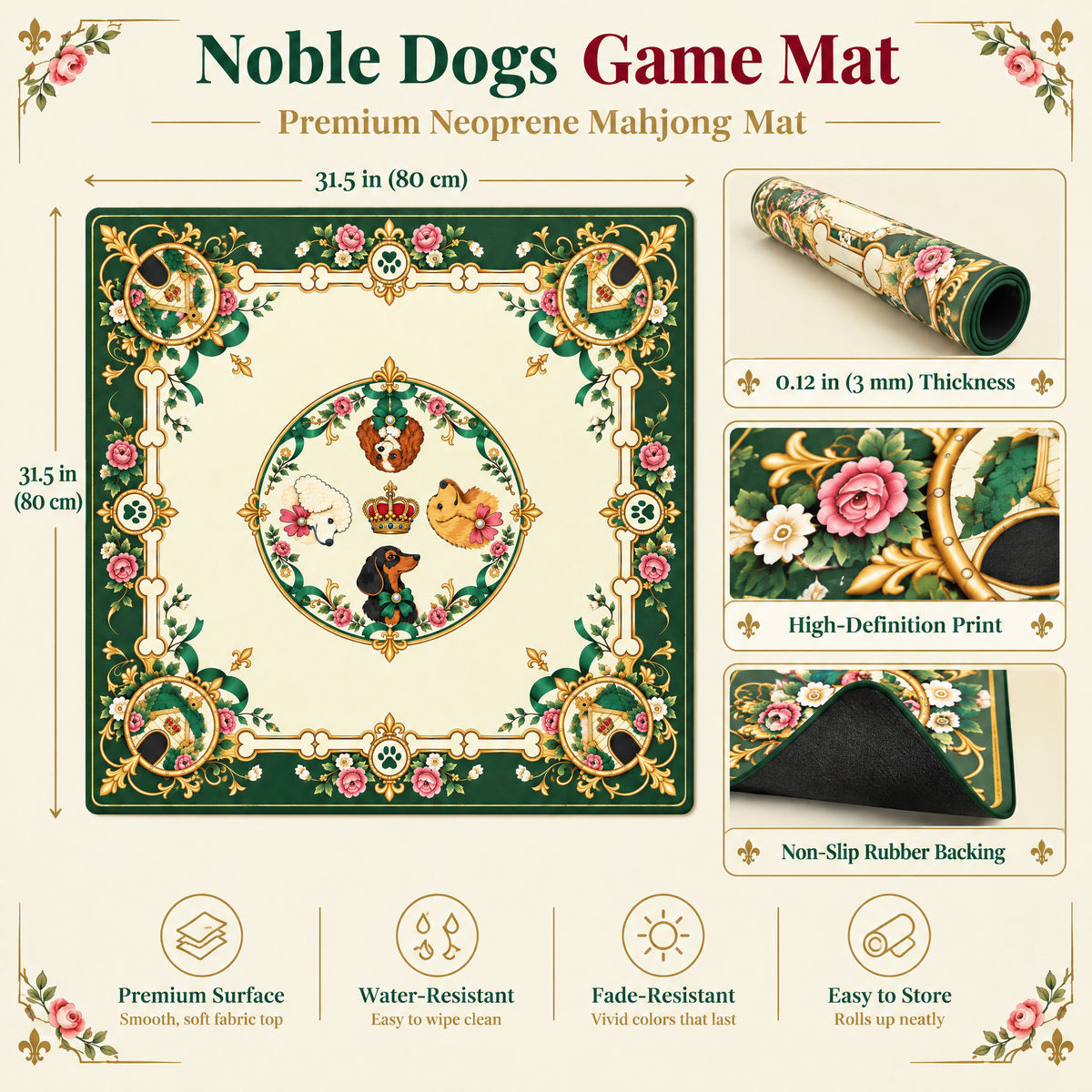
A mat designed for mahjong makes the game more comfortable and protects your table. Our best-selling mahjong sets pair well with a durable mat for a complete setup. Racks are optional but help organize your tiles, especially if players have arthritis or hand fatigue. If you're hosting weekly games, racks with pushers reduce fumbling and speed up play.
Dice (two 6-sided) are essential for determining the wall break. If your set doesn't include them, a standard pair from any game works fine.
For travel to a friend's house or a meetup, a carrying bag or case keeps tiles and components organized and protected. Riichi sets are smaller than American sets, so they fit compact travel bags designed for mahjong.
✨ Find your Mahstead set — free US shipping →
Honest check: Is riichi mahjong right for me?
Ask yourself:
Do I enjoy rules? Riichi has a single, universal ruleset. American mahjong has one card per year, and local groups tweak rules. If you want consistency and portability, riichi wins.
Do I have 3–4 hours weekly? Riichi sessions are 2–4 hours with setup. American games vary in length (30 min to 2 hours). Riichi assumes more committed players.
Do I want strategy or speed? American mahjong is a long puzzle; you're hunting one hand type all game. Riichi is faster and more reactive—you adapt to tiles as they appear. Speed players prefer riichi.
Do I have a local group? If your friends already play American mahjong, switching costs time for everyone. If no one plays mahjong yet, riichi is just as easy to teach.
Am I willing to buy a new set? Riichi sets are not expensive, but they're a separate purchase from an American set. If you're budget-conscious and already own an American set, stick with it until you're sure riichi fits your schedule.
What to check before you buy a riichi set
Confirm tile count is 136 (or 144 if the set includes spare tiles). Count them yourself or ask the seller for a manifest.
Verify honors are clearly labeled. If characters are tiny or faded, honors become unreadable under table light. Test readability in-person or look for close-up photos.
Check for a wall-building diagram or beginner's guide. Some sets ship with instruction cards; others don't. If the guide is missing, bookmark a YouTube tutorial beforehand.
Ensure tiles have heft and don't rattle. Flimsy plastic tiles are harder to shuffle and feel cheap. Heavier tiles (bamboo, resin, or thick acrylic) last longer and are more satisfying to play.
Look for dice, wind marker, and a storage box. These aren't always included. If missing, they're inexpensive to buy separately—just budget extra if needed.
🎁 See our most-loved mahjong sets & accessories →

FAQ
Can I play riichi mahjong online?
Yes. Tenhou (tenhou.net) is a free web client used worldwide. Janryze and MahjongSoul are other popular platforms. Online play teaches hand recognition and strategy but lacks the tactile and social pleasure of physical tiles. Most players use online practice to improve before live games.
How long does a riichi game session last?
A full session (8 rounds with all players as dealer twice) takes 2–4 hours including setup. A single round is 15–30 minutes depending on player skill and luck. Casual groups often play 4–6 rounds (1–2 hours) instead.
Is riichi mahjong gambling?
Riichi is often played with small money stakes (pennies to dollars per round), but it can be played without money for points only. House rules vary by group and region. Always clarify stakes before joining a game.
What's the difference between riichi mahjong and other Japanese mahjong variants?
Riichi is the most common Japanese variant and the one taught internationally. Other variants (Hong Kong, Taiwanese, Korean) use different tile counts, hand patterns, and calling rules. Riichi is the starting point for learning any Japanese-style mahjong.
Do I need to learn Japanese to play riichi mahjong?
No. Tile faces use universal symbols or kanji that are taught within the first game. Terms like "riichi," "tsumo," and "ron" are short (one or two syllables) and become automatic after 3–4 sessions. You don't need to speak Japanese to enjoy riichi.
Can riichi and American mahjong players switch between games easily?
Not in a single session. The rule sets, tile counts, hand patterns, and melds are too different. Most players learn both but play them on separate occasions. Switching between them mid-night leads to confusion and mistakes. Designate "American nights" and "riichi nights" to keep things clear.


View More
View More
View More
