
Riichi Mahjong Double Riichi Rules: Step-by-Step Guide
Last updated: Nov 23, 2026
Double riichi (W-riichi) is a Japanese mahjong rule that lets you score bonus points by declaring riichi on your very first turn as the discarder. You announce "riichi" on turn one, place a 1,000-point stick on the table, and commit to winning—your discards thereafter must follow an unbroken sequence of tiles (the "riichi pattern"). If you win, your hand's base points double. If your waiting hand is already complete when you declare (a rare state called "menzen tsumo" or fully concealed self-draw), double riichi adds even more. Riichi mahjong differs sharply from American mahjong: it uses 136 tiles, includes sequences (chows) as meld types, allows concealed hands, and scores by tile combinations and rounding. Mahstead's best-selling American mahjong sets follow the Charleston and current-year NMJL card format; for riichi, you'll need a 136-tile Japanese set with character, bamboo, and circle suits—not commonly stocked in American retailers.
Double riichi in Japanese mahjong is a high-scoring declaration made on your first turn when you're one tile away from winning. You announce "riichi" on turn one, place a 1,000-point stick on the table, and commit to winning—your discards thereafter must follow an unbroken sequence of tiles (the "riichi pattern"). If you win, your hand's base points double. If your waiting hand is already complete when you declare (a rare state called "menzen tsumo" or fully concealed self-draw), double riichi adds even more. Riichi mahjong differs sharply from American mahjong: it uses 136 tiles, includes sequences (chows) as meld types, allows concealed hands, and scores by tile combinations and rounding. Mahstead's best-selling American mahjong sets follow the Charleston and current-year NMJL card format; for riichi, you'll need a 136-tile Japanese set with character, bamboo, and circle suits—not commonly stocked in American retailers.
What is double riichi exactly?
Double riichi (sometimes written W-riichi or "two-stage riichi") is a declaration that applies only when you declare riichi on your first discard. You announce "riichi," place a 1,000-point marker (or payment) in front of you, and lock your waiting pattern: every tile you discard after that moment must logically lead toward the same winning hand—you cannot change your target mid-game. If you win before drawing another tile, your hand's base value (before rounding) is multiplied by 2. This is separate from the 300-point riichi bonus already paid to you by the loser; the doubling is strictly a scoring multiplier, not a cash reward.

Can you declare double riichi on turn two or later?
No. Double riichi must be declared on your first turn as the discarder—that is, immediately after the starting hand is dealt and before you draw from the wall on your opening move. If you pass your first turn without riichi, or if you riichi on turn two or later, you earn single riichi (with a 1,000-point bonus only, no point doubling). The rule exists to reward aggressive, committed play early in the hand and to create a clear moment of no-takeback commitment.
How do you maintain the riichi pattern after declaring?
Once you declare riichi and lock your waiting hand, every subsequent discard must be consistent with reaching that winning combination. For example, if your waiting hand needs a 3 Bamboo, 4 Bamboo, or 5 Bamboo to win (a "ryanmen" or two-sided wait), your discards must never suggest you're chasing a different tile—you cannot discard a 1 Bamboo, then later a 2 Bamboo, because that signals a changing target. Observers and opponents watch your discard sequence to judge whether you've violated the pattern. If you discard tiles that contradict your wait, you have "baited" the hand and can be challenged; violation means you lose the hand outright or pay a penalty (rules vary by club or tournament).
Riichi Type | When Declared | Base Points Multiplied | Single Bonus | Best For |
Single riichi | Turn 2+ or any turn after first | ×1 (no doubling) | 1,000-point payment | Defensive waiting, later draws |
Double riichi | Turn 1 only, before any draw | ×2 | 1,000-point payment | Aggressive opening hands, high-value combos |
Menzen tsumo + riichi | Turn 1, concealed hand + self-draw | ×4 (2× riichi doubling + 2× menzen) | 1,000-point payment | Rare; fully sealed hand plus draw |
What's the difference between riichi mahjong and American mahjong?
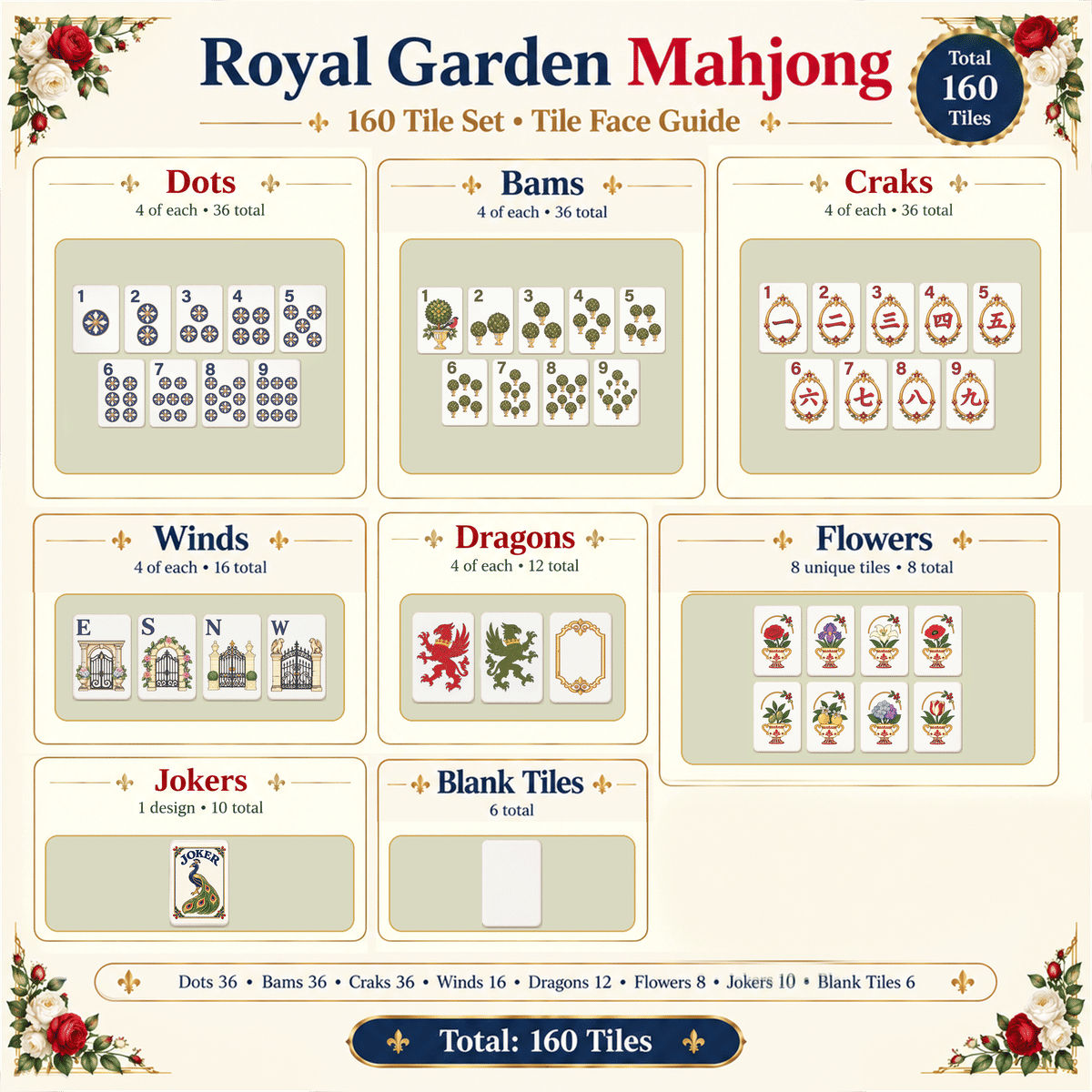
American mahjong uses 152 tiles, requires hands from the current year's National Mah Jongg League card, forbids sequences (only pungs, kongs, quints, sextets), involves a tile-passing Charleston before play, and has no riichi or doubling system. Japanese riichi mahjong uses 136 tiles, allows unlimited hand combinations (any pung, kong, or sequence of 3+ tiles), permits concealed hands (no public melding required until you win), features riichi declarations with point doubling, and scores by tile groups and rounding multipliers. An American set cannot be used for riichi mahjong; the tile set, hand structure, and scoring framework are entirely different. If you're building a mahjong library and want to host both variants, you need separate 160-tile American sets and 136-tile Japanese sets.
What happens if you don't win after declaring double riichi?
If you riichi (single or double) and do not win, you simply lose your 1,000-point payment to the winner and receive nothing. There is no extra penalty for declaring riichi and losing; the 1,000-point contribution goes to whoever won the hand. Some players, especially in casual games, may waive the riichi payment if play is for fun, but the formal rule is clear: riichi declaration is a financial commitment. You cannot take back a riichi once announced—it is binding until the hand ends.

How do you know if double riichi is worth the risk?
Double riichi is high-reward but only if your opening hand is already strong. If your initial hand suggests you're one tile away from winning (a one-tile wait, or "tenpai"), declaring double riichi on turn one locks you in and, if you draw the winning tile within a few turns, doubles your score. If your hand is weak or your wait is loose (three or more tiles that could complete you), riichi is riskier: you telegraph your weakness to opponents, who will avoid discarding those tiles, and if you don't win quickly, you've paid 1,000 points for nothing. Experienced players riichi on turn one only when their math is tight: a single-suit hand, a ready pattern (ryanmen, shanpon, or kanchan), and a high-value count already in the melds. Casual players often riichi speculatively and regret it.
🀄 Shop best-selling mahjong sets →
Common mistakes when declaring double riichi
Declaring too early with a weak hand: New players declare riichi on turn one with a five-tile wait and lose 1,000 points when nobody discards the winning tile.
Breaking the pattern unintentionally: You riichi on a wait, then discard a tile that opponents recognize as off-pattern. You lose the hand and face suspicion.
Confusing riichi with riichi tsumo: Riichi is a discard declaration; tsumo is self-drawing the winning tile. You can riichi and then draw your own tile (menzen tsumo), combining both bonuses.
Playing double riichi in American mahjong: The rule does not exist in American mahjong. American winners score based only on the hand pattern and current NMJL card. There is no tile-locking, no riichi payment, and no hand doubling.
Assuming riichi costs nothing: You pay 1,000 points immediately upon declaration. If you don't win or if opponents block your wait, you lose that money.
Comparison: Single vs. Double riichi scoring at a glance
Scenario | Single Riichi | Double Riichi |
Declared on turn 1 | Yes, but no doubling | Yes, ×2 multiplier applied |
Declared on turn 2+ | Yes, base ×1 | No; cannot declare |
You win (base 2,000 pts) | 2,000 + 1,000 bonus = 3,000 | 4,000 (doubled) + 1,000 bonus = 5,000 |
You don't win | Lose 1,000 | Lose 1,000 |
Menzen tsumo (self-draw) | +100% more | +200% more (stacks) |
What to check before you play riichi mahjong
Confirm the ruleset. Riichi rules vary by region (Japan, Hong Kong, online platform); clarify bonus amounts, penalty timing, and pattern enforcement before you play.
Use a 136-tile Japanese mahjong set, not an American set; tile counts and suits differ.
Understand your opening hand. Count your tiles, identify your wait (tenpai), and assess if double riichi is mathematically sound.
Watch the discard order. Memorize your pattern and ensure every subsequent discard aligns; one slip breaks riichi.
Agree on payment method. Confirm whether 1,000-point sticks, virtual points, or cash exchanges apply.
Play a few rounds without riichi first if you're new; learning hand combinations matters more than doubling on turn one.
🎁 See our most-loved mahjong sets & accessories →
For players serious about hosting weekly riichi games, investing in quality equipment matters: dedicated mahjong racks with pushers help organize your concealed hand and keep your discard pattern clear. A mahjong mat marks the center play area and speeds setup. Mahstead's best-selling sets are designed for American mahjong, but if you're dual-hosting American nights and riichi practice sessions, a travel-ready mahjong bag or case keeps both set types organized and portable.
✨ Find your Mahstead set — free US shipping →

FAQ
Can I declare double riichi if my hand is already complete (tenpai) before I discard?
Yes. If your starting hand is fully ready after the deal, you riichi on turn one, place your marker, and wait for your draw. Menzen tsumo (fully concealed plus self-draw) stacks with double riichi for maximum bonus. You still need an opponent to discard your winning tile or you draw it yourself to win.
What happens if I declare riichi and then someone immediately wins before I draw?
You lose your 1,000-point riichi payment to that winner. There is no additional penalty, but you did not get to attempt your winning hand. Riichi is a financial commitment regardless of outcome.
Is double riichi used in Hong Kong mahjong or only Japanese riichi?
Double riichi belongs to Japanese riichi mahjong rules. Hong Kong mahjong and other regional variants have different declarations, bonuses, and scoring. Always confirm your ruleset with the group or organization running the game.
Can I riichi if I'm already winning (have a complete hand)?
No. Riichi requires you to be one tile short (tenpai). If your hand is complete before your turn, you have already won and cannot declare riichi retroactively. You simply announce your winning hand and score it.
Do I have to follow a strict discard sequence, or can I discard any tile as long as my pattern isn't broken?
You must discard from your hand; you cannot choose which specific tile to discard in order. However, the sequence of discards you reveal to the table must align with your wait. If opponents see a logical contradiction, they can challenge you, and you lose the hand.
Why do American and Japanese mahjong have such different rules?
American mahjong evolved in the 1920s–1930s from Chinese and Japanese sources, but developed independently with an emphasis on the annual card, tile sets, and public melding. Japanese riichi mahjong standardized in mid-20th century Japan with sequences, concealment, and scoring multipliers. Both are valid; they're separate games.


View More
View More
View More
