
North Wind Mahjong Tile: Symbol, Rules & How to Play
Last updated: Nov 23, 2026
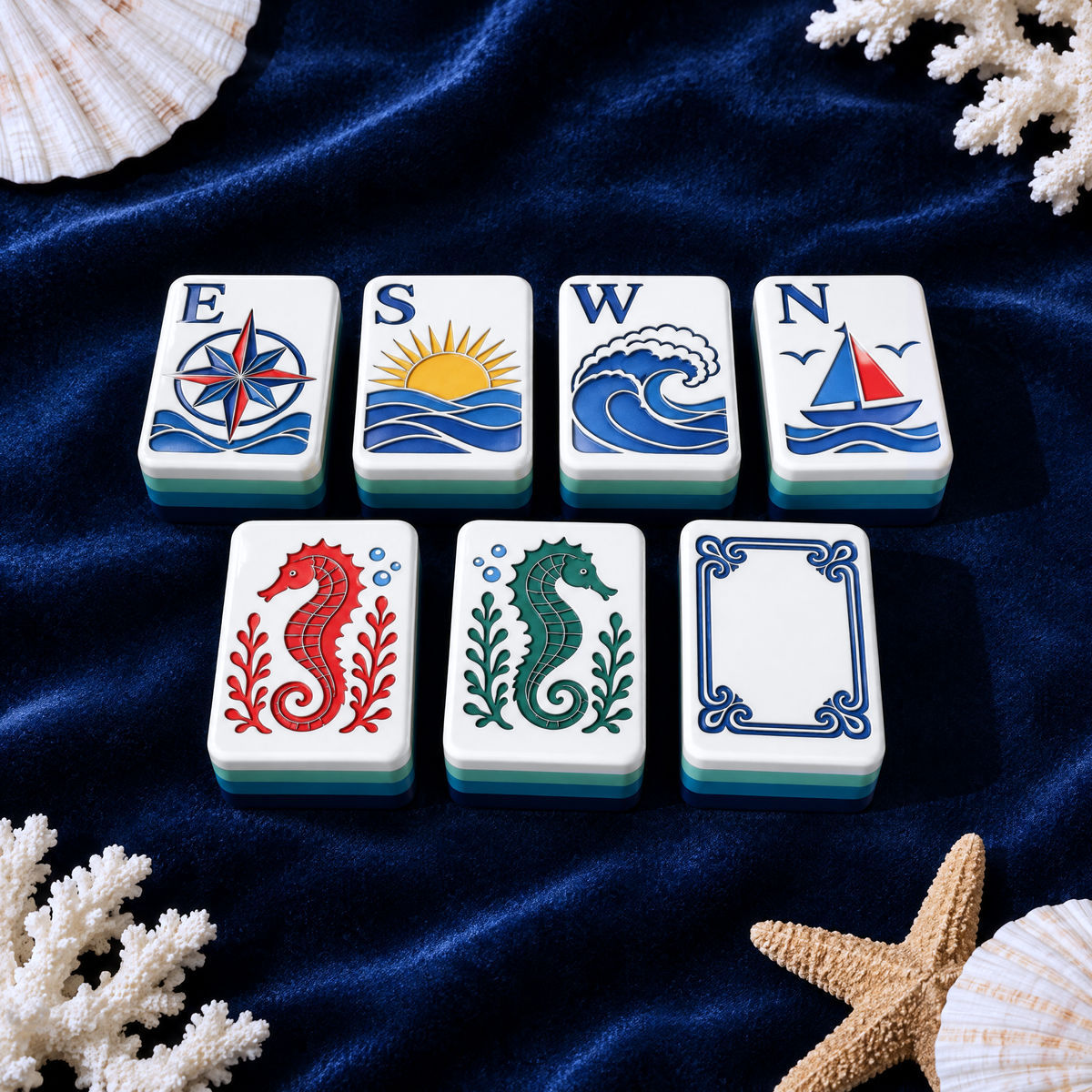
The North Wind (often printed with a stylized character or compass marking) is a wind tile used exclusively in American mahjong. One of four identical North Wind tiles per set, it ranks alongside East, West, and South Wind and lives with the 16 wind tiles in the tile rack. In American play, you cannot form chows (sequences) with winds; they must appear as pungs (3 identical tiles), kongs (4), quints (5), or sextets (6) to be exposed. The North Wind is scored by its placement on the current year's National Mah Jongg League card—a winning hand requires an exact match to a listed pattern including one or more wind suits. Jokers can substitute for any missing North Wind tile in an exposed set. Beginners often confuse winds with dragons; unlike dragons, winds cannot fulfill a pair role, nor can they mix with other suits to form runs.
The North Wind is one of four wind tiles in an American mahjong set, part of the 152-tile lineup that defines how an American mahjong set is constructed. Understanding its role—and the visual way it appears on your tiles—removes a major source of confusion at the table.
What does the North Wind tile look like?
The North Wind tile typically displays a character (often the Chinese character for "north"), a compass needle pointing up, or a stylized icon depending on the set's design. On acrylic tiles like those in our best-selling collections, the symbol is engraved or printed clearly so it reads the same from any angle. The tile is usually off-white or ivory, matching the other three wind tiles (East, West, South), and is distinct in size and weight from number tiles.
Professional and casual players agree: if you cannot read a wind tile at a glance from across the table, it causes delays and disputes. Many players prefer engraved designs over printed ones because they wear better and remain legible after hundreds of games.

How does North Wind fit into a winning hand?
A winning hand in American mahjong requires an exact match to one of the patterns listed on the National Mah Jongg League card for that year. Many patterns call for wind tiles, and some specify North Wind by name. For example, a pattern might require:
Three North Winds (a pung) + three East Winds (a pung) + five 3 Craks + three 5 Dots (a pung) + a pair of Red Dragons
If your hand includes this combination, you have won. The North Wind does not rank higher or lower than the other winds—it holds equal weight as East, West, or South Wind. Jokers can fill in for a missing North Wind tile in any exposed set.
Can you use North Wind in a chow or sequence?
No. American mahjong does not allow chows (sequences like 1-2-3) at all. Wind tiles, like dragon tiles and honor tiles in other variants, exist only as pungs, kongs, quints, or sextets—never in runs or rows. This is a critical difference from Chinese or Riichi mahjong, where winds can form chows. In American play, if you hold North, East, and West Wind in the same hand, those three tiles have no connection to each other unless the card lists them separately as part of two or more exposed melds.
This restriction is why beginners sometimes hold onto winds "hoping to build a sequence"—a strategy that loses fast in American mahjong.
What are the odds of drawing a North Wind in your opening hand?
Each suit in American mahjong has 4 identical tiles. With 152 playing tiles total and 14 tiles in your opening hand, the probability of holding at least one North Wind is about 35%, and holding two or more North Winds drops to around 9%. The odds improve when you pass tiles in the Charleston (the pre-game tile-passing ritual) and draw from the wall during play. If a pattern on the card requires multiple North Winds, many players adjust their strategy during the Charleston to keep or acquire them early.
How does North Wind scoring differ in other mahjong variants?
In Chinese and Hong Kong mahjong, winds do form chows and carry different scoring weights depending on which wind you are (seat wind, round wind, etc.). In Riichi (Japanese) mahjong, winds are called "jihai" and are treated as terminal tiles with their own scoring rules. American mahjong ignores all of this—winds are honor tiles with no scoring hierarchy. You win or lose based on whether your hand matches the card, not on how many points each component is worth. This is one reason American mahjong feels simpler to new players but requires mastery of the card itself rather than point calculation.

North Wind symbol guide: what to look for when you buy
Feature | Why it matters | What to check |
Engraved vs. printed | Engraving lasts longer; printing fades | Run your finger over the symbol; engraved feels textured |
Readability at distance | You read tiles from across the table | Can you identify it from 3 feet away in dim light? |
Consistent size | Mismatched tiles jam racks | All winds should feel the same in your hand |
High contrast | Acrylic can be translucent; dark symbols read better | Hold the tile up to light; symbol should be clear |
Tile weight | Heavy tiles feel premium and wear evenly | All four wind tiles should have identical heft |
When you're comparing engraved American mahjong sets, handle the wind tiles first. If you can't read them clearly, the entire set will slow your game down.
🀄 Shop best-selling mahjong sets →
How to avoid common North Wind mistakes at the table
Confusing winds with dragons: Dragons (Red, Green, White) are separate tiles with their own rules. A North Wind and a Red Dragon are never interchangeable, and they occupy different rows in your rack.
Assuming a North Wind can pair: In American mahjong, only the White Dragon can form a pair (it also serves as zero in some hands). Wind tiles cannot pair—you must use a joker or draw another identical wind to form a set.
Mixing up which wind is which: Some players struggle with the visual difference between North, East, West, and South, especially under poor lighting or if the design is subtle. Before your first game with a new set, spend 2 minutes laying out all four winds and memorizing their symbols.
Not using the Charleston to position winds: During the Charleston, if a pattern you're targeting requires North Winds, keep or request them. Many players passively discard winds without thinking about the card.
Forgetting winds cannot form chows: If you're new to American mahjong and have played Chinese or Riichi variants, this rule trips you up. Commit to memory: winds → pungs, kongs, quints, sextets only.
What to check before you buy a set with North Wind clarity in mind
Examine the wind tiles under table lighting, not showroom lights. Ask if the design is engraved or printed.
Compare the size and weight of the North Wind to the other three winds in the sample.
Read the North Wind symbol from at least 3 feet away while sitting. This is your actual play distance.
Ask how the symbol was applied. Engraving is irreversible and lasts decades; printing can fade or chip.
Confirm the set includes all four North Wind tiles. A 152-tile American mahjong set must have exactly four of each wind.
If you're ordering online, many sellers include close-up photos of the wind tiles. Request them if they're not shown.
🎁 See our most-loved mahjong sets & accessories →
The role of North Wind in the Charleston and strategy
The Charleston is the three-pass tile exchange that happens before the game begins. During this phase, you can influence which tiles you hold by discarding ones you don't need and requesting ones you do. If you're holding a North Wind early in the Charleston, you face a choice: does your target pattern on the card require it?
If yes, keep it and discard tiles that don't match your hand. If no, pass it. Many intermediate players use the Charleston to optimize their wind distribution before the draw wall is even opened. This is why practicing the Charleston with a quality mahjong mat and racks with pushers matters—you need smooth tile movement to see what you're trading.
✨ Find your Mahstead set — free US shipping →

FAQ
Is the North Wind tile worth more points than the East Wind?
No. In American mahjong, all wind tiles are equal. Your score depends only on whether your hand matches a pattern on the card, not on which wind you used. This differs from Chinese mahjong, where seat wind and round wind carry bonus points.
Can I use a joker in place of a North Wind?
Yes, jokers substitute for any tile in an exposed pung, kong, quint, or sextet. If you have two North Winds and a joker, that counts as a valid three-tile pung. However, jokers cannot form a pair, and they cannot fill a single tile role.
What happens if I draw all four North Wind tiles?
You can use them in a sextet (6 identical tiles) if the card lists a pattern with six North Winds. If the card doesn't call for it, you must discard one North Wind or use a joker strategically to form other sets. Drawing all four of any tile is rare but happens.
Why does my North Wind tile look faded compared to the others?
If your set is printed rather than engraved, the North Wind symbol may fade faster than the number tiles, especially if tiles are cleaned roughly or exposed to sunlight. Engraved tiles resist fading because the design is cut into the acrylic itself.
How do I teach a beginner to spot the North Wind quickly?
Use the Charleston to introduce all four winds. Have them lay out one of each wind and repeat the name and symbol three times. Practice picking each wind from a shuffled hand without looking. Muscle memory develops fast—most beginners recognize all four winds within two games.
Is North Wind the same in every American mahjong variant?
Yes. The National Mah Jongg League card sets the standard for American mahjong nationwide. Every 152-tile set includes the same North Wind tile, and the rules for its use never change. This consistency is one reason American mahjong is easier for players to learn—there's one authoritative rule source.


View More
View More
View More
