
Mahjong vs Euchre: Which Game Should You Learn?
Last updated: Nov 23, 2026
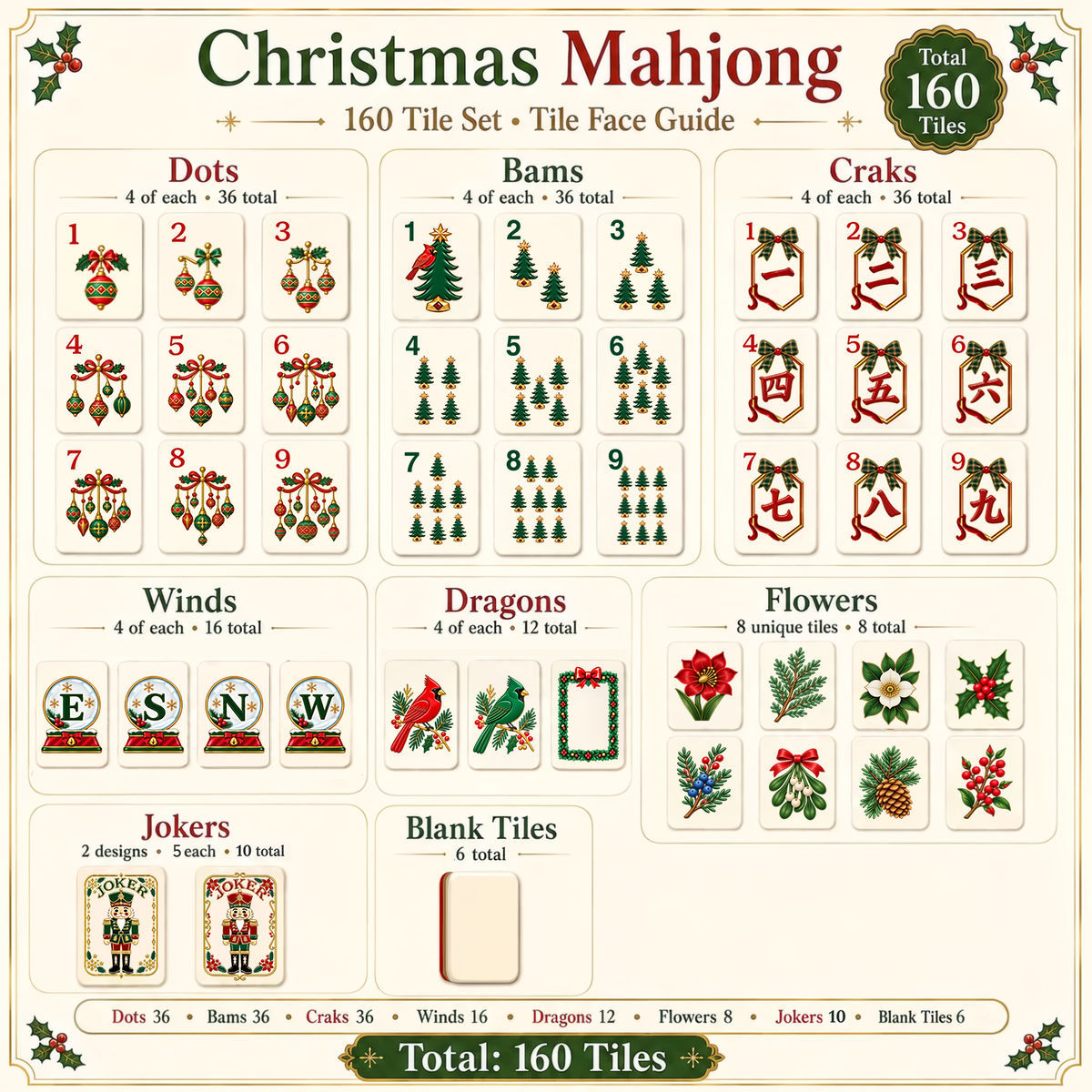
Mahjong and euchre are both social trick-and-meld games, but they operate on entirely different systems. American mahjong uses 152 tiles in three numbered suits (Bams, Craks, Dots), winds, dragons, and flowers; players build hands using the current year's National Mah Jongg League card, with no sequences allowed and strict rules on exposing sets. Euchre uses a 24-card deck, plays tricks in teams of two, and relies on trump suits and partner signaling. Mahjong typically seats four players and takes 30–45 minutes per game; euchre seats four with play around 15–20 minutes. Mahjong has a steeper entry hill—learning to read the card and recognize patterns takes 3–6 games—while euchre's trick mechanics click faster. Both reward long-term play: mahjong builds memory and spatial reasoning; euchre trains partnership communication and probability. Equipment matters too: mahjong requires a tile set, mat, and racks; euchre needs only a deck. Our best-selling mahjong sets pair tiles with mats for full setups.
Which game teaches you faster—mahjong or euchre?
Euchre has a gentler onboarding curve. In one session, new players grasp trick-taking, trump ranking, and go-alone calls. Mahjong's first hour is disorienting: you're learning hand patterns, Charleston passing mechanics, joker placement rules, and how to scan the card while tracking discards. That said, euchre's complexity lives in play—predicting partner intent and reading opponents—while mahjong's complexity is front-loaded into memorization. By game five, mahjong players report real flow; euchre players hit that sweet spot by game two. If your group values immediate fun, euchre wins. If you want depth that lasts years, mahjong pays off.
🀄 Shop best-selling mahjong sets →

Does mahjong or euchre work better for social groups?
Both excel at different group sizes and dynamics. Euchre thrives in tournaments and casual gatherings—four players, 45 minutes, clear winners, easy rules for drop-in guests. Mahjong demands four committed players with a shared commitment to learning the card and remembering discard etiquette; adding a fifth person mid-session breaks rotation and scorekeeping. Mahjong games are longer and more absorbing, which deepens friendships but requires dedicated time blocks. Euchre's quicker rounds let you host eight people across two tables in the same 90 minutes. Mahjong builds ritual: your group will settle into the same seats, develop house rules, and celebrate specific hand wins. Euchre is more adaptable and newbie-friendly for casual events. For a standing weekly game where players commit long-term, mahjong builds tighter bonds; for rotating guests or tournament play, euchre suits better.
How much gear do you need to start each game?
Game | Essential Gear | Optional Gear | Setup Time | Cost Basis |
Euchre | One 24-card deck | Scorepads, drinking glass for tricks | 2 minutes | Minimal—one deck |
Mahjong | 152-tile set, mat, National Mah Jongg League card | Racks with pushers, dice, bag | 10 minutes | Tile set + accessories |
Euchre requires almost nothing: grab a deck and sit anywhere. Mahjong asks for more ceremony. You need a proper 160-tile American mahjong set with accurate tile counts, a padded mat to protect your table and muffle tile noise, and a current League card—updated every spring with new hand combinations. Many serious players add racks with pushers to organize their tiles and speed play, plus a bag or case to transport the set between homes. A set without a mat feels incomplete; tiles scatter, cards get wet, and your table suffers. The ceremony of setup—laying the mat, shuffling tiles, conducting the Charleston—is part of mahjong's appeal, not a burden, once you embrace it. Euchre's simplicity is its strength; mahjong's ritual is its soul.
What's the learning curve difference in rule complexity?
Euchre rules fit on one page: rank your hand, play highest or lowest card per trick, call trump or pass, go alone to double points, earn points for winning tricks or stops. Partner communication is subtle—a wink, a hesitation—but the core rule set is locked in. Mahjong has layered complexity. First you learn tile composition (how many of each kind exist). Then hand patterns from the card—what "2468 Like" or "Pung Kong Pung Kong" mean. Then exposure rules: when you can claim a discard, what counts as a legal pung or kong, how jokers substitute. Then Charleston order and discard etiquette. Then scoring based on hand rarity and bonus conditions. A written euchre rulebook is 3–4 pages; a mahjong handbook is 20+. But euchre's subtlety lives in reading opponents and partner tendencies, which takes years to master. Mahjong's rules are transparent and shared—everyone's working with the same card. In weeks you play mahjong competently; in years you play it brilliantly.

Which game fits your table setup and hosting style?
Consider your space and rhythm. Euchre is nomadic: deal at a kitchen table, a bar, anywhere. Games finish before attention drifts. Mahjong demands a dedicated, cleared table 3–4 feet wide, enough room for tile racks, a discard wall, and the card propped visible. Games run long enough that interruptions sting. If you host rotating guests or small spaces, euchre is forgiving; mahjong requires commitment. However, if you're hosting your regular weekly group in a permanent setup, mahjong's mat and organized racks create an inviting ritual space. Many players report that mahjong's slower pace and tile clack create a meditative, almost zen atmosphere—you're not rushing to trick-take or score; you're building a hand mindfully. Euchre's energy is faster, more competitive, more celebratory. Choose mahjong if you want to build a lasting game night tradition around a table you control; choose euchre if you want portable, low-stakes fun that travels.
What equipment makes each game more enjoyable?
Euchre needs almost nothing beyond a deck, though scorepads and a quiet surface help. Mahjong rewards careful gear choices. A low-quality tile set—loose pieces, mismatched sizes, paint flaking—kills the game's flow; tiles jam on racks, the card gets oily, and you'll spend energy troubleshooting instead of playing. Our best-selling mahjong sets arrive in protective cases, with smooth acrylic tiles sized to fit standard racks with pushers and non-slip pads for the mat. A padded mahjong mat isn't luxury—it's functional. It protects your table, steadies tiles so they don't skitter, and signals to your group: this is our space. Once you've played mahjong on a mat with organized racks, playing on a bare table feels incomplete. Euchre's simplicity means there's no gear that transforms the experience; mahjong's setup is half the charm.
🎁 See our most-loved mahjong sets & accessories →
What to check before you buy
If you're choosing mahjong:
Verify the set includes all 152 tiles (count by suit if possible before committing; loose tiles are hard to track).
Confirm the set ships with a current-year National Mah Jongg League card or a reliable digital version.
Measure your table depth; a mat should fit without hanging off edges.
If you plan to host weekly, budget for racks with pushers and a carrying bag—these transform play from fiddly to fluid.
Test tile size and heft in person if possible, or order from a vendor with easy returns.
If you're choosing euchre:
A standard 24-card deck works fine; specialty decks add no rule advantage.
Ensure your group has a scorepad or agrees on scoring method beforehand.

FAQ
Can you play mahjong with euchre strategy—or vice versa?
No. Euchre is partnership trick-taking; mahjong is solitaire hand-building with defensive discard timing. Euchre rewards bluffing and signaling; mahjong punishes it. The games train opposite skills; strategy doesn't transfer.
Which game is easier to teach a beginner at the table?
Euchre. One round of observation and most new players can join. Mahjong requires pre-game instruction on the card, Charleston, and joker rules—usually 20–30 minutes before play. Euchre gets players in faster.
Do online versions exist for both?
Yes. Euchre has many digital options; mahjong online varies by region and variant. American mahjong's rules make online play less common than Chinese mahjong. Offline group play is how most American mahjong players learn best.
If I learn one, can I switch to the other easily?
Yes, but expect retraining. The rule sets don't conflict; you're just trading trick-based logic for pattern-matching logic. Most players pick up the second game in 2–3 sessions.
Which game has an active local community for tournaments or lessons?
Euchre has stronger tournament infrastructure in the Midwest and Northeast; regional championships run regularly. Mahjong communities cluster in urban areas and are growing. Search community centers, libraries, and synagogues in your area to find both. ✨ Find your Mahstead set — free US shipping → --- Ready to start playing mahjong? Check out our guide for mahjong beginners to learn hand basics, Charleston mechanics, and what comes in a real American mahjong set. Whether you choose mahjong or euchre, the goal is the same: a weekly gathering, genuine laughter, and a game that keeps you thinking days afterward.


View More
View More
View More
