
Mahjong Rack Bag Size Guide: Pick the Right Fit
Last updated: Nov 23, 2026
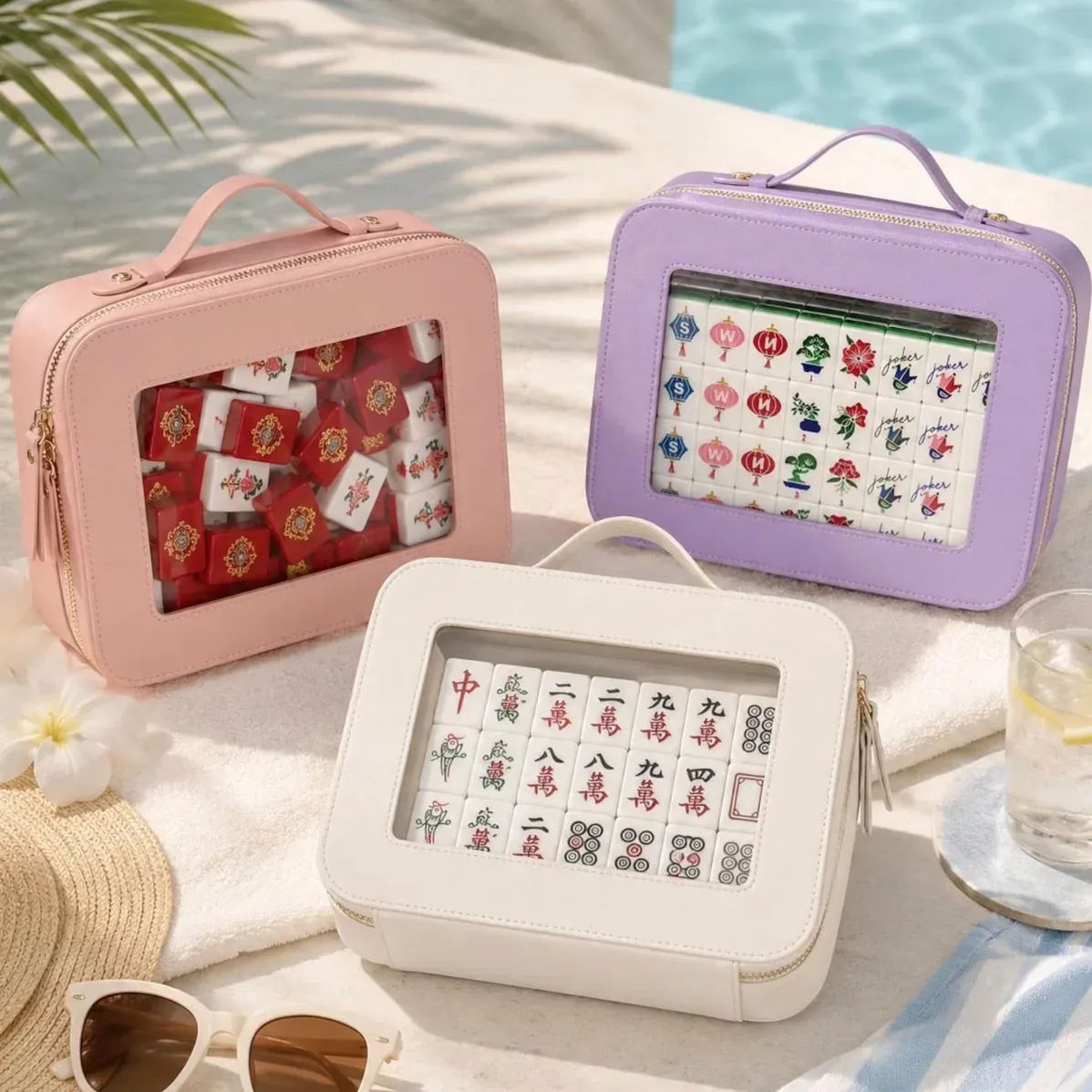
Mahjong rack bags come in two main categories: slim cases for sets and racks alone, and large travel bags that hold a complete setup (set, racks, mats, dice). Slim cases typically fit a 160-tile set plus one or two racks in roughly 16–18 inches long by 8–10 inches wide; large bags run 20–24 inches by 12–16 inches and accommodate a mat, set, four racks, and accessories. Choose a slim case if you play weekly at one venue or want portable backup storage; pick a large bag if you host or travel between homes and need to haul your entire station. Our travel bag collection includes both types, sized clearly so you can measure your own set and racks before ordering.
Our weekly games taught us that a bag sized wrong is a bag never used. You stuff a large mat into a slim case and it stays in the closet; you buy a huge travel bag for a single set and feel you wasted money. The right size balances what you actually need to carry, how often you move it, and where you play.
🀄 Shop best-selling mahjong sets →
What goes inside your bag?
The first step is naming what you'll pack. Most players carry (1) a 160-tile American mahjong set in its tile box, (2) four racks with pushers, (3) possibly a mat, (4) dice, and (5) score pads or a card holder. If you host at home, you might add spare tiles, extra dice, or backup racks. If you play one night a week at a friend's house, you pack only the set and racks. The bag must fit your actual routine, not a fantasy of what you think you should carry.

How do slim cases and large bags differ in space?
Bag Type | Best Dimensions | Fits | Who It's For |
Slim case | ~16–18" L × 8–10" W × 4–6" D | Set + 1–2 racks | Weekly casual players; car storage |
Medium travel bag | ~20–22" L × 12–14" W × 6–8" D | Set + 4 racks + dice | Regulars who move between venues |
Large travel bag | ~24–26" L × 16–18" W × 8–10" D | Set + 4 racks + mat + dice + extras | Hosts and frequent travelers |
Slim cases work because a 160-tile set's box is roughly 12 inches × 6 inches × 4 inches (the tile storage box itself, not the outer packaging), and a rack with pusher runs about 10 inches × 2 inches. Stack one or two racks beside the set and you fit snugly into a case 16 inches long. Add a mat (roughly 30 inches × 30 inches folded to 15 inches × 15 inches) and you need another 4–6 inches of depth and much more width—so you jump to a large bag. There's almost no "in between" because mats are the space hog.
✨ Find your Mahstead set — free US shipping →
Do you really need to carry a mat?
Many players don't. A mat protects the table surface and keeps tiles organized during play, but if you play at someone else's home or a venue that already has a mat or tablecloth, you leave yours at home. We've found that players who host—or who play on shared tables at clubs or community centers—carry a mat; casual weekly-game players often skip it. If you're unsure, ask the hosts whether they have a mat. If they do, you can fit everything else into a medium or even a slim case. If they don't and you're supplying the mat, you need a large bag.
How to measure before you order
Lay your own set, racks, and mat flat on a table. Measure the longest item end-to-end (usually the mat folded, or the set box plus two racks laid parallel). Measure the widest item side-to-side. Measure the stack height when all items lie flat. Now add 1–2 inches to each dimension for padding and zipper clearance—that's your minimum bag size. For example, if your folded mat is 16 inches long, your set is 12 inches, your four racks laid side-by-side are 8 inches wide, and the stack is 5 inches tall, you need at least 18 inches × 8 inches × 7 inches, so a medium travel bag (typically 20–22 inches × 12–14 inches) will work. A slim case (16 inches × 10 inches) would be too narrow for the racks side-by-side.
What to check before ordering a bag or case
Interior dimensions listed? Reputable sellers show inside width, length, and depth, not just the outer bag size. Check Mahstead's product pages for these specs.
Compartments or dividers? Slim cases often have a fixed tile box slot and a separate racks compartment; large bags may have a mesh pocket for dice and cards. Make sure the layout matches what you carry.
Zipper quality and handles. Cheap zippers fail after a few dozen open-close cycles. Look for YKK or equivalent and dual handles (two on top is better than one on the side for weight distribution).
Material durability. Nylon or canvas holds up; thin polyester tears when racks press against the seams. We've seen players replace flimsy cases within a year.
Try it with your set first. If you already own an acrylic set and racks, measure them and verify the bag's interior against those dimensions. If buying set and bag together, use the set dimensions we provide to estimate the fit.
🎁 See our most-loved mahjong sets & accessories →

Size guide by playing style
Weekly casual player (one fixed venue, no mat): You need a slim case (roughly 16–18" L × 10" W × 5" D). It holds a 160-tile set and one or two racks comfortably. Cost is lower, and you'll actually use it because it slides into a car door pocket or a hall closet. Many of our best-selling mahjong sets ship alongside a basic slim case option—check the product page.
Regular who plays multiple venues (set + racks + maybe a mat): A medium travel bag (20–22" L × 12–14" W × 6–8" D) is your sweet spot. You can add a rolled or folded mat without cramming, and the handle is sturdy enough for weekly car trips. This fits the job without bulk.
Host or frequent traveler (entire setup): Go large: 24–26" L × 16–18" W × 8–10" D. You'll pack a mat, four racks, a set, dice, spare jokers, and score pads. The bag should have a shoulder strap or well-padded handles because you're moving it regularly and it'll weigh 5–8 pounds when full.
Gift buyer or new player (unsure what you need): If you're buying a set and bag as a gift or for yourself and aren't sure of your playing habits yet, choose a medium travel bag. It's flexible: oversized enough that it won't be outgrown in a year, but not so large that it becomes storage furniture. It works for casual play, light hosting, and one-to-two-venue rotation.
Our travel bag collection displays options by size and material—browse by dimensions and interior layout to find your fit.
Real mistakes we see players make
Buying a slim case, then adding a mat. The mat folds to maybe 16 inches × 16 inches, which is wider than most slim cases. The player tries to roll it, it creases, and eventually the mat stays home and the case feels too small anyway. Measure first.
Choosing by outer dimensions only. A bag 20 inches on the outside might have an interior of only 18 inches because of thick walls and padding. Always request or check the inside measurements.
Underestimating weight. A full bag with a mat, set, and four racks weighs 6–10 pounds. Make sure the bag's handles are reinforced and won't tear at the seams after a year of use. Cheap zippers and thin nylon handles fail fast.
Overpacking "just in case." Some players cram three sets, spare racks, and extra mats into a huge bag "in case someone needs a backup." You'll carry it once and resent it forever. Pack for what you actually do, not worst-case fantasy.
Comparison: Slim vs. Medium vs. Large
Factor | Slim Case | Medium Bag | Large Bag |
Set + 1–2 racks | ✓ Ideal | ✓ Works | ✓ Overkill |
Set + 4 racks | ✗ Tight/won't fit | ✓ Ideal | ✓ Works |
Set + 4 racks + mat | ✗ No | ✗ Cramped | ✓ Ideal |
Set + full hosting kit | ✗ No | ✗ No | ✓ Ideal |
Weight when full | 2–3 lbs | 4–5 lbs | 6–10 lbs |
Best for | Car storage; casual weekly play | Multi-venue regulars | Hosts; frequent travel |
Comfort for hand-carry | ✓ Yes | ✓ Yes | ~ Requires shoulder strap |
How Mahstead bags and cases solve the problem
Our travel bag collection includes protective cases and bags in slim and large configurations, each designed to fit a standard 160-tile American mahjong set with racks and mats sized realistically. We list interior dimensions so you can compare against your own setup. All mahjong bags and cases ship with free US delivery—no hidden fees—so you can order, measure against your set, and keep what works.
✨ Find your Mahstead set — free US shipping →
Final checklist: Before you buy
[ ] Do you have a mat? If yes, you need medium or large. If no, slim works.
[ ] How many racks will you carry? (Usually four for a full set.)
[ ] Where do you play? One home, or multiple venues?
[ ] Measure your folded mat (if you have one) and your set's box.
[ ] Add 1–2 inches to both length and width for padding.
[ ] Check the bag's interior dimensions (not outer size).
[ ] Verify the zipper and handle reviews for durability.
[ ] If buying a set and bag together, cross-check the set's actual box size against the bag's interior.
FAQ
Can I fit a 160-tile set and four racks in a slim case?
No. A slim case typically holds a set and one or two racks snugly. Four racks side-by-side exceed the width. You need a medium or large travel bag for a full four-rack setup.
Do I need to carry a mat every time I play?
Not if you play at a venue or home that already has a mat or tablecloth. Ask your hosts first. Many casual weekly players never carry a mat because the venue supplies one.
What's the difference between a travel bag and a case?
A case is usually rigid or semi-rigid with a fixed tile compartment and racks slot, sized for a set and 1–2 racks. A travel bag is larger, more flexible inside, and holds a set, four racks, a mat, and extras. Cases are lighter and more compact; bags are roomier and easier to pack oddly-shaped items.
How much does a full mahjong bag weigh?
A set weighs roughly 2–3 pounds, four racks another 1–2 pounds, and a mat 1–2 pounds. A full setup typically runs 5–8 pounds depending on material density. Make sure the bag's handles are reinforced if you'll carry it regularly.
What size bag should I buy if I'm just starting?
If you're new, buy a medium travel bag (20–22 inches long). It's flexible enough for casual play, light hosting, and one-to-two-venue rotation, so you won't outgrow it quickly. You can always add a slim case later for car storage.
Are Mahstead bags sized for Mahstead sets, or do they fit any American mahjong set?
Mahstead bags are sized for standard 160-tile American mahjong sets and racks, which are uniform across manufacturers. Measure your own set's box against the bag's interior dimensions to confirm the fit before ordering.
Can I pack dice, score pads, and a card holder in a slim case?
Dice and a card holder, yes—they fit in small gaps. Score pads take more space. A slim case works if you're carrying only a set, 1–2 racks, and light accessories. For full hosting gear, upgrade to a medium or large bag.


View More
View More
View More
