
Mahjong Flashcards for Beginners: How to Learn Tiles Fast
Last updated: Nov 23, 2026
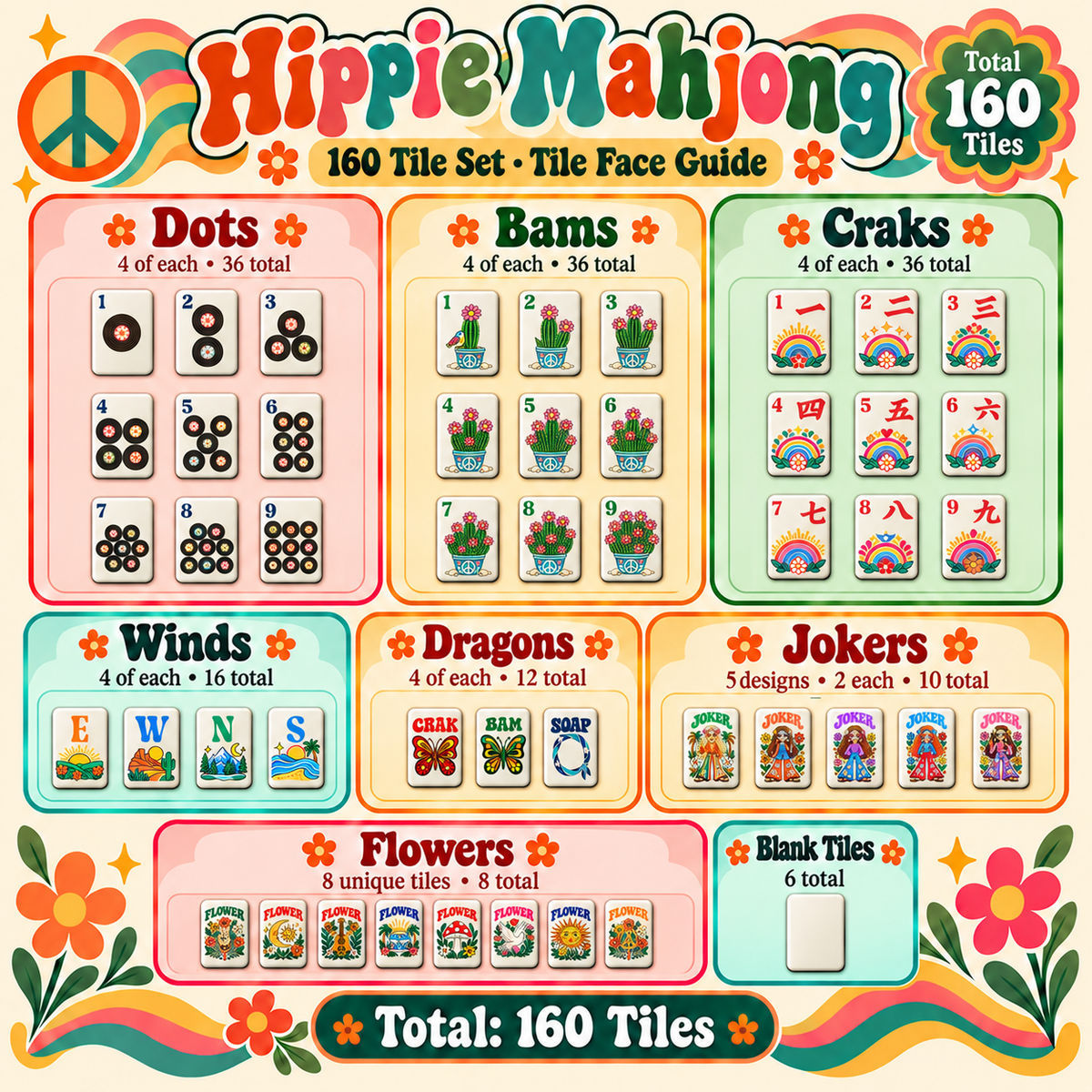
Mahjong flashcards are memory aids showing tile images (Bams, Craks, Dots, winds, dragons, honors) with names and numbers on the back, designed to drill tile recognition before you sit down with a real set. Beginners use them to memorize the 152-tile American mahjong deck—152 active tiles plus 8 jokers—in roughly 1–2 weeks of 10–15 minute daily practice. Flashcards cover suit patterns (1 Bam shows a bird; Craks have marks; Dots are pips), wind and dragon symbols, and flower pairs. You can buy printed flashcard decks online, make your own with photos of real tiles from a best-selling mahjong set, or use phone apps. The biggest mistake: trying to learn hands before you know individual tiles—flashcards prevent that by isolating recognition. Start with suits, then honors, then flowers; test yourself weekly to stay sharp.
Mahjong tile names and suit symbols confuse nearly every beginner in their first session. Flashcards solve that by separating tile learning from hand strategy, so you're not panicking mid-game. We've watched players move from "What's that green one?" to confident tile calls in under three weeks using nothing but 10 minutes a day with cards or photos. Here's the real workflow and the traps to skip.
Why do flashcards work faster than learning at the table?
At a live game, you're juggling hand strategy, tile calls, and tile names at once—mental overload. Flashcards isolate tile recognition, so your brain learns the shape, symbol, and name without pressure. You drill one tile 20 times, then move to the next. That repetition sticks: muscle memory for reading unfamiliar symbols (the bird on 1 Bam, the slash through Craks) is built offline. Most beginners who skip flashcards waste their first three games asking "What suit is that?" instead of playing.

What tiles should you flashcard first?
Start with the three suits: Bams (1–9), Craks (1–9), Dots (1–9). Bams show stick-like marks or a bird for 1. Craks have curved or hatched marks on each number. Dots are circles (1–9 circles). Drill one suit for 3–4 days until you can name a random Bam or Crak in under two seconds. Then move to winds (North, East, West, South—often shown as letters N, E, W, S or Chinese characters) and dragons (Red, Green, White/Soap). Flowers and jokers last; they're rarer and easier once suits stick. The card from the National Mah Jongg League (issued each spring) shows all these symbols in context—use photos of the card or a real set as your flashcard base.
How do you make or buy flashcards that actually work?
DIY method: Buy a best-selling acrylic set, photograph each unique tile (one 1 Bam, one 2 Bam, etc.), and print pairs or load into a flashcard app (Anki, Quizlet). One side shows the tile; the other shows the name and suit. Cost: roughly the price of a set plus ink. Bought method: Search for "American mahjong flashcards" on card retailers. Pros: professionally printed, durable. Cons: may not match your exact tile design, so tiles at the table look slightly different. Best hybrid: Print flashcards from photos of your set, so you train on the exact tiles you'll see in games. This removes the "that photo doesn't look like my tiles" friction.
What mistakes do most beginners make with flashcards?
Mistake | Impact | Fix |
Learning honors before suits | Can't read 60% of the deck | Start with Bams, Craks, Dots (3 weeks total) |
Drilling one tile once and moving on | Weak recall; tile names feel new each game | Repeat each tile 15–20 times over a week |
Mixing all 152 tiles in one deck | Cognitive overload; quits after day 2 | Separate by suit; introduce winds after 10 days |
No daily target or time limit | Feels like endless homework | Set 10–15 min daily; cover 5–7 tiles per session |
Skipping flowers and jokers | Confusion late in learning; unnecessary gaps | Add flowers once suits are solid; jokers are simple |
Not testing yourself under speed | Slow tile recognition at the table | Use a timer; aim for <2 sec per tile by week 2 |

When should you stop flashcards and start playing?
Once you can name random tiles (suits, winds, dragons) in under 2 seconds without hesitation, you're ready to play. That usually takes 10–14 days of daily practice. Don't wait until you're perfect—you'll learn the last 5% at the table. One sign you're ready: you can glance at a tile and its name pops into your head without sounding out symbols. At that point, join a beginner-friendly game and keep a spare set nearby so you can drill between rounds if tiles feel unfamiliar. Flowers and jokers will click within one or two games. The mahjong for beginners guide covers next steps after tile recognition—strategy, the Charleston, and hand reading.
🀄 Shop best-selling mahjong sets →
How do you speed up recognition without burning out?
Spacing is everything. Practice five Bams on day 1, five more on day 2, and cycle back through the first five on day 3. By day 10, you've seen all Bams three times each; your brain has moved them from "recognition" to "instant recall." Use a phone timer; 10–15 minutes daily beats two hours once a week. Quiz yourself in randomized order after day 5 so you're not relying on sequence memory. Many players also keep a physical tile set on their desk and pick random tiles during breaks—instant, zero-effort drilling. If you make your own flashcards from photos of a real Mahstead acrylic set, the visual match means you're not re-learning when you see tiles in person.
🎁 See our most-loved mahjong sets & accessories →
Should you learn hand patterns from flashcards too?
No. Hand patterns belong on the National Mah Jongg League card, not flashcards. Tile recognition and hand strategy are two separate skills. Flashcards teach you what each tile is; the League card and how to read the mahjong card guide teach you where tiles go in winning hands. Try to combine both too early and you'll confuse yourself. Finish tile flashcards first (2–3 weeks), then spend a week learning to read the League card, then join a game. That sequence takes roughly a month but saves you weeks of mixed-up learning.
✨ Find your Mahstead set — free US shipping →
What to check before you buy or make flashcards
Tile colors and symbols match your actual set. If your tiles are pastel and your flashcards are neon, the disconnect slows learning.
Card size is readable. Tiny flashcards waste time; aim for at least 3×5 inches.
You have a daily time slot. Commitment matters more than method; 10 minutes daily beats sporadic cramming.
Flower/joker cards are clear. These are rarer in games but must be instant; muddy images slow you down.
You number or label them. If you print them yourself, mark the suit on the back so you can organize by level (suits first, honors second).

FAQ
Can I learn mahjong tile names without flashcards?
Yes, but it takes longer. Playing games helps you learn over time, but flashcards let you drill recognition offline before sitting down, so your first game isn't overwhelming. Most players use both: flashcards for speed, live games for depth.
How long should I spend on flashcards each day?
10–15 minutes daily is ideal. Longer sessions lead to fatigue and poor retention. Consistency beats volume: two weeks of 10 minutes per day beats one day of two hours.
Should I memorize the order of tiles (1 through 9 in each suit)?
No. Shuffle your flashcards so you see random tiles. You need to recognize a tile regardless of where it sits, not recite them in order.
What if I can't find printed American mahjong flashcards?
Make your own by photographing tiles from a real set and loading them into Anki, Quizlet, or printing them on cardstock. Photos of your exact tiles are actually better than generic cards because they match what you'll see in games.
Can my phone app replace physical flashcards?
Both work. Apps are convenient and track your progress; physical cards are harder to lose and easier on the eyes during long sessions. Many players use both—cards at home, app on the commute.
Do I need to learn flowers and jokers before I start playing?
Not before your first game, but learn them within your first two weeks. They appear less often, so you can pick them up while you're drilling suits and honors. Jokers are especially easy once you know the other tiles.


View More
View More
View More
