
Mahjong Competition Rules & Special Hands
Last updated: Nov 23, 2026
American mahjong competition is governed by the National Mah Jongg League card, issued every spring, which lists all legal hand combinations for that year. A competition hand must match exactly one pattern on the card—no improvisation. The 152-tile deck includes Bams, Craks, Dots (1–9 in four copies each), 16 Winds, 12 Dragons, 8 Flowers, and 8 Jokers. You may expose Pungs (three identical tiles), Kongs (four identical), Quints (five), and Sextets (six), but never Chows (sequences)—that's the core rule separating American from Chinese variants. Jokers can substitute for any tile in exposed melds but never form a pair or single tile. The hand must use exactly 14 tiles: 13 in melds plus one winning tile drawn or called. Special hands on the card include Consecutive Pungs, Like Numbers, Dragon hands, and Quint variations; each carries different point values. Beginners often expose tiles incorrectly or misread the card; study it before playing. Mahstead's engraved acrylic sets come with enough tiles for regulation play, and a good mat helps organize exposed melds clearly.
Competition mahjong is governed by the National Mah Jongg League card, issued every spring, which lists all legal hand combinations for that year. A competition hand must match exactly one pattern on the card—no improvisation. The 152-tile deck includes Bams, Craks, Dots (1–9 in four copies each), 16 Winds, 12 Dragons, 8 Flowers, and 8 Jokers. You may expose Pungs (three identical tiles), Kongs (four identical), Quints (five), and Sextets (six), but never Chows (sequences)—that's the core rule separating American from Chinese variants. Jokers can substitute for any tile in exposed melds but never form a pair or single tile. The hand must use exactly 14 tiles: 13 in melds plus one winning tile drawn or called. Special hands on the card include Consecutive Pungs, Like Numbers, Dragon hands, and Quint variations; each carries different point values.
🀄 Shop best-selling mahjong sets →
What does the official mahjong card actually contain?
The National Mah Jongg League card organizes hands into sections: Basic, Like Numbers, Consecutive Pungs, Dragons, Winds, Flowers, and Quints. Each section shows hand patterns with required tile combinations, joker limits, and point values. The card changes yearly—hands legal one year may disappear the next, and new patterns appear. You must use the current year's card only; previous years' cards are not valid in competition. Most sections display 6–15 different hands, ranging from simple (three Pungs plus a pair) to complex (five identical numbers across all three suits plus Winds). The card notes exactly how many jokers each hand permits—some allow two, others allow none. Reading the card is a skill itself: rows and columns show suit combinations, and symbols indicate Dragons, Winds, or Flowers. New players often miscount jokers or confuse suit sequences with numbers, so spending 15 minutes decoding a few hands before your first game prevents costly errors at the table.

How do you expose tiles legally in competition play?
In American mahjong, an exposed meld means you place it face-up on the table for all to see—and you cannot change it after exposure. You may expose a Pung (three identical tiles), Kong (four identical), Quint (five identical), or Sextet (six identical); you may never expose a Chow (run like 1–2–3 Bams). Each exposed meld must match your hand on the current year's card. When you draw a tile that completes a Pung, Kong, or Quint from your closed hand, you may expose it immediately; your turn then ends unless you are winning. If another player discards a tile that completes your Pung or Kong, you may claim (call) it, expose it, and your turn continues. Jokers may substitute for any tile in an exposed meld but cannot form the entire meld alone. A common mistake: exposing a meld that fits no card hand—you cannot un-expose, so you are stuck and cannot win that round. Another trap: using a joker to make a pair, which is illegal. Always check the card before exposing; if uncertain, ask the player managing the table before you commit.
What are the point values for special hands?
Special hands earn higher points and are the goal of competitive play. Consecutive Pungs—three or more Pungs in consecutive numbers (like 4–5–6)—award bonus points depending on how many Pungs and whether they span all three suits. Like Numbers hands (same number in all three suits, such as three 7-Bams, 7-Craks, 7-Dots) reward 30–50 points based on whether you use Dragons or Winds. Dragon hands require at least one complete Dragon Pung or Kong and award 20–40 points depending on the rest of the hand. Quint hands—using one or more Quints (five identical tiles)—are worth 60+ points because Quints are rare and difficult to hold without discarding. Wind-only or Flower-only hands (called "Closed Hands" when made of only Winds or Flowers) deliver the highest payoff but are the hardest to complete. Basic hands (three Pungs, one pair, one Pung or Kong) are worth 10–20 points. The exact point schedule appears on the card under each hand pattern. In a round, players track points across four hands (one as each player in each wind position); cumulative score determines the season winner. Always note the point value before committing to a hand—chasing a 30-point hand when a 50-point hand is within reach is a costly mistake.

How do American, Chinese, and Riichi rules differ on special hands?
Rule | American | Chinese (Cantonese) | Riichi (Japanese) |
Legal melds | Pungs, Kongs, Quints, Sextets only—no Chows | Chows (sequences) allowed; Pungs, Kongs | Chows allowed; Pungs, Kongs; sequences called "Shuntsu" |
Special hands | From current year's League card only | Patterns vary by region; no official card | Yaku (hand types) defined by rulebook |
Joker use | Jokers substitute in exposed melds only; never in pairs | Typically no jokers (tile-based variant) | No jokers in standard play |
Hand size | Always 14 tiles (13 melds + 1 winning tile) | 14 tiles (some variants 16) | 14 tiles |
Exposure | Pungs/Kongs/Quints exposed and locked | Often all melds exposed | Melds exposed similarly |
Winning tile | Must be drawn from wall or called from discard | Drawn from wall or called | Drawn from wall or "Ron" (called) |
Point system | Scored by hand pattern on card | Regional scoring tables vary widely | Yaku + fan (multiplier) system |
The biggest difference: American mahjong forbids Chows and relies on a single official card updated yearly, while Chinese variants embrace sequences and follow regional rules, and Riichi uses a standardized yaku system with multipliers. If you switch variants, relearn the legal melds and hand definitions—a "winning hand" in American may not be valid in Cantonese or Riichi.
🎁 See our most-loved mahjong sets & accessories →
What mistakes disqualify your hand in competition?
A disqualified hand means you cannot win that round and must wait for the next deal. The most common error is misreading the card: exposing a meld that doesn't match any hand on the current year's card. For example, you expose three consecutive Pungs of Bams (4, 5, 6 Bam Pungs) but the hand you claim requires those Pungs plus a Dragon Pung in a specific spot—if your hand layout doesn't match, it's invalid. Another frequent mistake is using a joker illegally: as a pair, as a single tile, or in a hand that forbids jokers altogether. The card notes joker limits; some hands permit zero jokers, others allow two. Using more jokers than the card allows disqualifies you. A third trap: declaring a hand before your 14th tile is placed—you must have exactly 14 tiles (13 in melds or pairs, plus one winning tile) and show it clearly. Exposing tiles then un-exposing them is illegal; once exposed, a meld is locked. Finally, claiming a called tile when you don't have a legal Pung or Kong to form with it invalidates your claim—the discarding player may demand proof before releasing the tile. Always verify your hand against the card before declaring; asking the table's card keeper or experienced player takes 10 seconds and prevents a forfeit.
✨ Find your Mahstead set — free US shipping →
What to check before you buy a competition mahjong set
Tile count: A regulation set has exactly 152 playing tiles (108 number tiles, 16 Winds, 12 Dragons, 8 Flowers, 8 Jokers) plus spare tiles. Count or trust the seller's specification; short sets will force borrowed tiles and table disputes.
Tile clarity: Each tile must be legible at arm's length. If numbers or symbols are faint, small, or poorly printed, reading the card becomes painful during play. Engraved acrylic or clear tile faces help under table lighting.
Set organization: Does the set include racks with pushers? Racks keep your hand hidden and organized; pushers make sliding tiles smooth. Without them, players drop tiles and accidentally expose hidden melds.
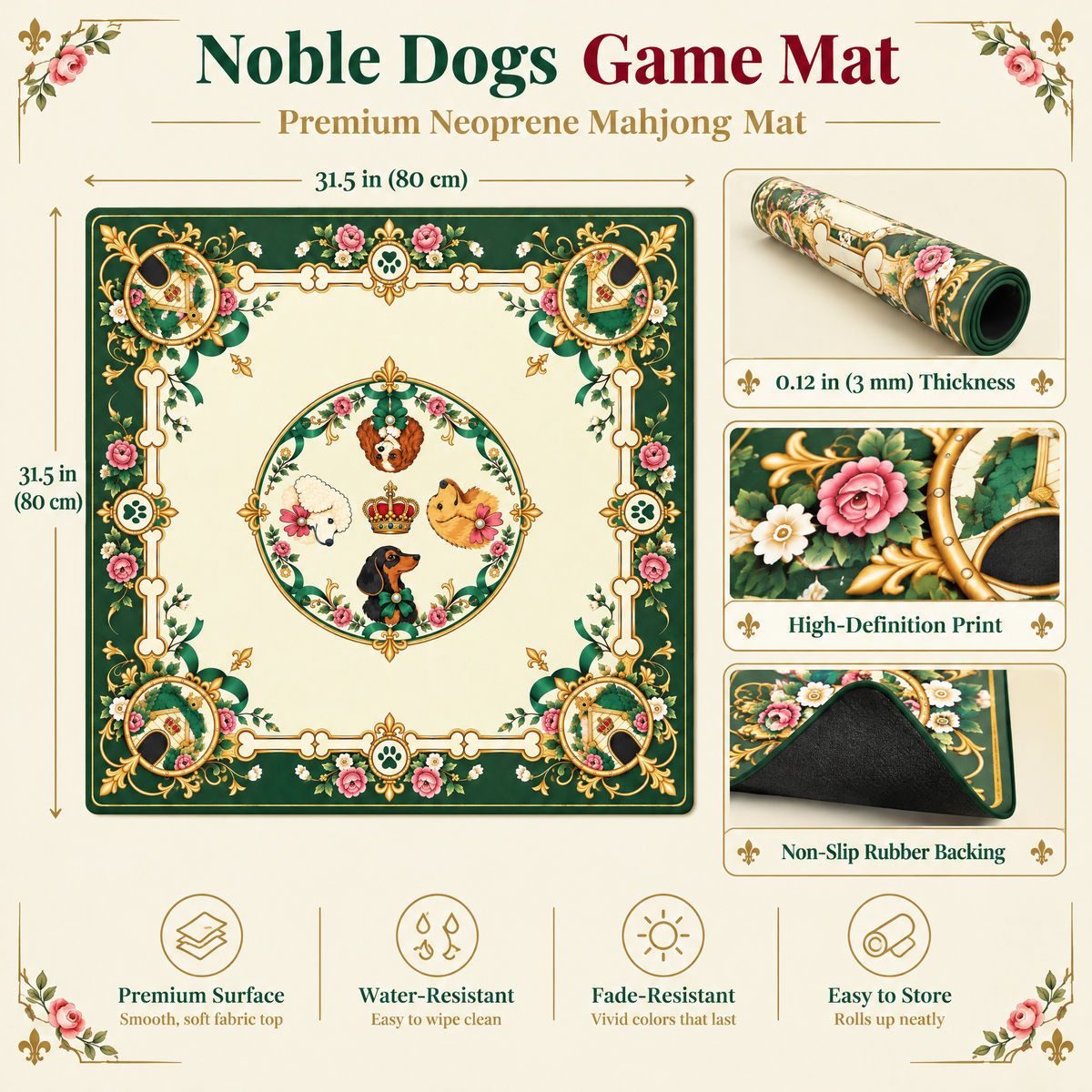
Mat quality: A good mat provides a smooth play surface and divides the table into clear zones for the discard pile, each player's area, and dead wall. A mat also protects tiles from scratches and makes called tiles audible.
Portability: If you travel to games weekly, a bag or case protects your set and keeps all pieces together. Without one, tiles scatter and jokers get lost.
Our best-selling mahjong sets come as complete, regulation 160-tile acrylic sets with enough spare tiles to replace any chip. If you're entering a competition league, confirm the host's tile standards (some require specific tile sizes or materials) before ordering.

FAQ
Can I use last year's mahjong card in a competition?
No. The National Mah Jongg League issues a new card every spring, and only that year's card is valid in sanctioned play. Previous years' hands are no longer legal. Check the card date before sitting down.
What happens if I expose a meld by mistake?
Once exposed, a meld is locked—you cannot take it back or rearrange it. If it doesn't match any hand on the card, your hand is invalid for that round. Always verify the card before exposing.
Can a joker replace a tile in a pair?
No. Jokers may substitute for tiles in Pungs, Kongs, Quints, and Sextets, but they cannot form a pair and cannot be a single tile. Violating this forfeits your hand.
How many jokers does each hand on the card allow?
The card specifies the joker limit for each hand pattern—some permit zero, others allow one or two. Exceeding the limit disqualifies your hand. Check the pattern before declaring a win.
What is the difference between "Like Numbers" and "Consecutive Pungs"?
Like Numbers use the same number across all three suits (e.g., three 7-Pungs: 7 Bam, 7 Crak, 7 Dot). Consecutive Pungs are different numbers in sequence (e.g., 4 Bam, 5 Bam, 6 Bam Pung). They are separate card sections with different point values and rules.
If I call a discarded tile to complete a Pung, does my turn continue?
Yes. When you claim a tile to expose a Pung or Kong, you place it on the table, then continue your turn by drawing a new tile. Your turn ends only if you win or if you expose a Pung but draw no useful tile.
What makes a hand "closed" versus "open"?
A closed hand has no exposed melds—all tiles remain in your rack until you win. An open hand includes one or more exposed Pungs, Kongs, Quints, or Sextets. Closed hands typically award more points because they require fewer drawn tiles and more skill to conceal.


View More
View More
View More
