
Mahjong Competition Rules & Scoring Chart Explained
Last updated: Nov 23, 2026
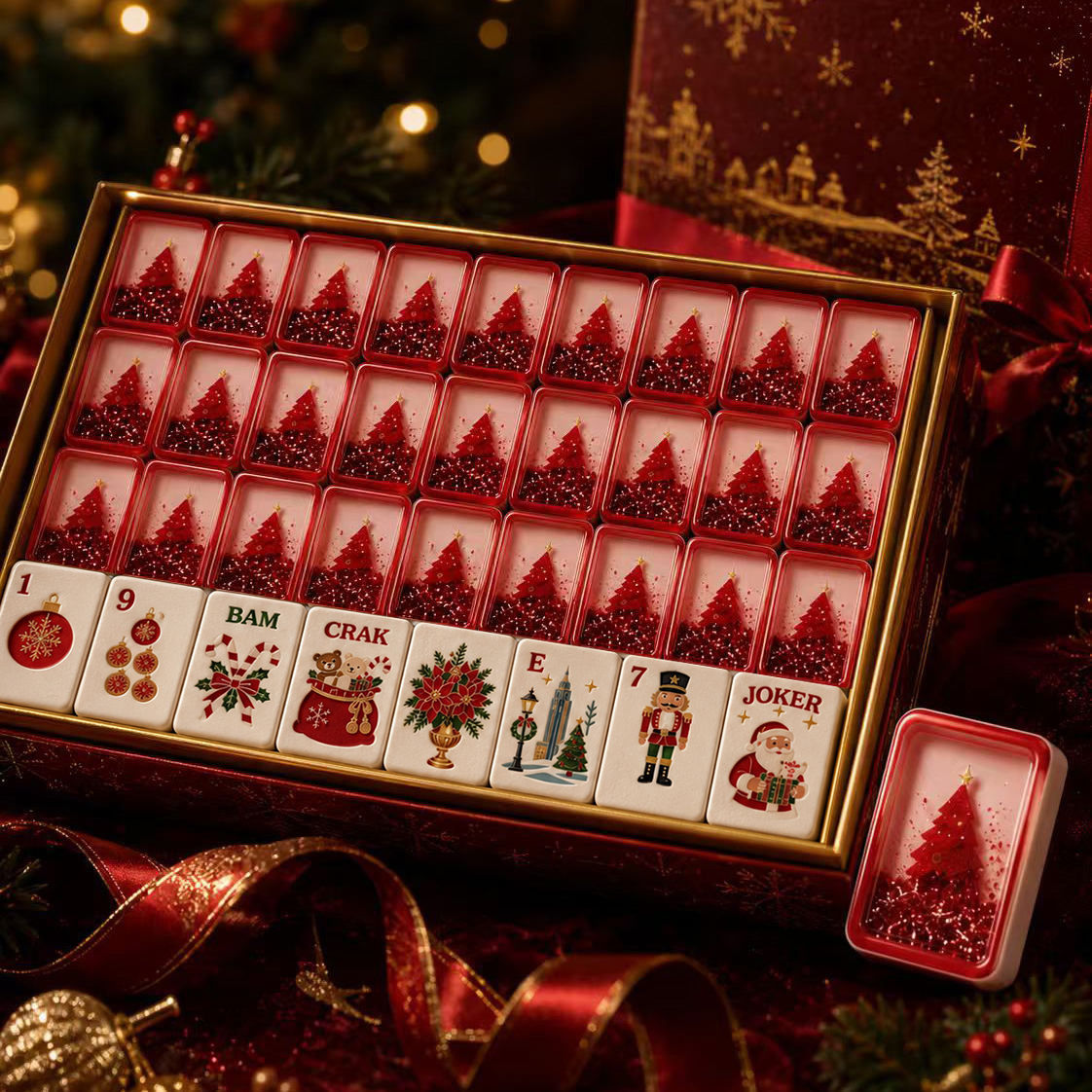
American mahjong scoring is based on the hand pattern you declare on the current year's National Mah Jongg League card. The card lists hundreds of legal hand combinations, each assigned a fixed point value (typically 20–70 points). In competition, your score depends on three factors: the hand value itself, whether you won by self-draw or claim, and your wind position (East pays and receives double). The Charleston (tile-passing ritual) happens before play. All four players use the same 152-tile set plus 8 jokers. Points are settled after each hand — the discarder or all players pay the winner according to the hand value and position. Competition rules enforce strict hand validity: you must match the card exactly, jokers count as declared, and no exposed pungs or kongs without valid pairs. Mahstead's best-selling mahjong sets include clear acrylic tiles and racks designed for competitive play. --- 🀄 Shop best-selling mahjong sets →
How Does the Scoring Chart Work?
The National Mah Jongg League card is published every spring and lists all legal hands for that year. Each hand is printed with a point value—usually 20, 25, 30, 40, 50, 60, or 70 points—based on the difficulty and rarity of the combination. When you declare "Mah Jongg," you're saying your tiles match one specific line on the card. The dealer (East) first checks that your hand is valid: all tiles present, correct joker placement, no illegal substitutions. Only then do calculations begin. Your actual payment depends on whether you won by drawing from the wall (self-draw) or by claiming another player's discard, and which position you held. The card itself contains no joker-free hands (all legal hands contain at least one joker), which keeps American mahjong distinctly different from Chinese variants.

What's the Difference Between Self-Draw and Discard Wins?
When you declare Mah Jongg after drawing from the wall (self-draw win), all three other players pay you the full hand value. When you claim someone's discard to complete your hand (discard win), only the discarder pays you the full hand value; the other two players pay nothing. This creates strategy: early in a hand, players are cautious about which tiles they discard. Late in a hand, when the wall is nearly empty, players know self-draw is less likely, so they discard more freely. East (the dealer) always pays and receives double, so winning as East is worth twice the hand value, and losing as East costs twice as much. Wind position is announced before the Charleston begins and rotates after each hand (North → East → South → West → North). Many weekly games use a "settle at the end" system where all four players tally points and money changes hands once, rather than after each hand.
How Do You Calculate the Final Payment?
Payment is calculated per hand, not accumulated. Here's the step-by-step process:
Identify the winner and the hand value — find the hand on the card and note its point value.
Check the wind position — if the winner is East, double the hand value; if a discarder is East, they pay double.
Apply the win type — self-draw means all three others pay the full value; discard means only the discarder pays.
Settle immediately or at game end — most casual groups settle after each hand; tournament play settles immediately.
Example: Self-draw win (non-East position, hand value 40 points) You draw from the wall and declare Mah Jongg. Each other player pays you 40 points. You receive 120 points total; each opponent loses 40 points.
Example: Discard win (East position, hand value 30 points) You claim the discard and declare Mah Jongg as East. The discarder pays 60 points (30 × 2 because you're East). The other two players pay nothing. You receive 60 points; the discarder loses 60 points.
Scenario | Winner Position | Hand Value | Discarder Pays | Other Players Pay Each | Winner Total |
Self-draw win | North | 40 pts | N/A | 40 pts each | 120 pts |
Self-draw win | East | 30 pts | N/A | 60 pts each | 180 pts |
Discard win | North | 40 pts | 40 pts | 0 pts | 40 pts |
Discard win | East | 30 pts | 60 pts | 0 pts | 60 pts |
The card printed each spring lists every hand with its point value, so you never calculate difficulty or points yourself—you simply read and apply.
🎁 See our most-loved mahjong sets & accessories →

What Are the Most Common Scoring Mistakes?
Mistake 1: Forgetting that East doubles. Many casual players forget to multiply by 2 when East wins or loses. Check the wind before settling; if East is involved (either as winner or discarder), the relevant amounts are double.
Mistake 2: Paying non-discarders on a discard win. On a discard win, only the player who discarded the winning tile pays the winner. The other two players owe nothing. This is drastically different from self-draw, where all three pay. New players often confuse the two.
Mistake 3: Paying before verifying the hand on the card. Always cross-check the winning hand against the current year's card before money changes hands. Joker placement must match exactly; a single incorrect joker invalidates the hand, and play continues.
Mistake 4: Using last year's card. The card changes every spring. A hand that was legal last year may not appear on the current card, and vice versa. Keep the current year's card visible at the table and replace it each April.
Mistake 5: Confusing joker value with hand position. A joker never represents a specific tile value; it stands in for any tile required by the hand. If your hand calls for a Crak, a joker in that position acts as a Crak, but the joker itself has no independent value. Jokers are counted during verification but do not change the hand value.
How Do Tournament Rules Differ From Casual Play?
Tournament play enforces stricter standards and uses standardized formats. In competition, players are assigned winds at the start (not randomly drawn), and wind rotations are predetermined. Scoring is always settled immediately after each hand, not pooled at the end. The dealer (East) is often rotated based on wins, not a fixed schedule. Players are not allowed to discuss hands or strategy between rounds; casual groups often chat freely.
In casual play, house rules vary widely. Some groups settle at game end; others after each hand. Some rotate the dealer; others keep the same East throughout. Some allow "house hands" (combinations not on the official card); tournament play allows only hands on the current card. One critical rule is universal: you cannot win on your own discard (if you throw a tile and no one claims it, that tile cannot be your Mah Jongg tile on the next draw cycle).
American mahjong is always played with 152 tiles plus 8 jokers—never more, never fewer—regardless of competitive level. If you're planning to host regular games with friends, engraved American mahjong sets make it easy to track sets and rotations. For tournament-style hosting, mahjong mats help standardize table layout and tile visibility.
✨ Find your Mahstead set — free US shipping →
What Should You Check Before Hosting Competitive Play?
Before your first competitive game or tournament, verify these points:
Card date: Confirm you have the current year's National Mah Jongg League card (published in spring). Older cards make hands invalid and disputes unsettable.
Tile count: Count 152 playing tiles plus 8 jokers. Do not add spare tiles to the play set; spares remain outside the game.
Tile condition: Check that no tiles are cracked, faded, or missing. Unreadable tiles cause disputes and slow play.
Wind agreement: Before the Charleston, announce each player's starting wind position so there's no confusion during settlement.
Settlement method: Agree in advance whether you'll settle after each hand or at game end. Write it down.
Joker placement: Everyone must understand that jokers are wild (they stand in for any tile) and that joker placement must match the card exactly.
Speed: Set a reasonable draw-and-discard pace. Tournament games usually allow 30–60 seconds per turn; casual play is slower.
If you're playing for stakes (money or points that carry forward), use mahjong racks with pushers so tiles are securely organized and harder to accidentally expose. A well-lit table and a printed card (not a phone screen) reduce errors and disputes.

FAQ
If I win on a discard as East, how much do I get paid?
Only the discarder pays you, and the amount is double the hand value (because you're East). The other two players pay nothing. Example: 30-point hand, you're East, discard win = discarder pays 60 points to you.
Can I use last year's mahjong card to play?
No. The National Mah Jongg League issues a new card every spring, and only hands on the current card are legal. Using an old card will make hands invalid and cause disputes.
What happens if I declare Mah Jongg but my hand doesn't match the card exactly?
Your hand is invalid. Play continues, you do not win, and no payment is made. Always verify your hand against the card before declaring.
Why does East pay and receive double?
East (the dealer) is in a more influential position because they draw first and set the pace. Double payment reflects this advantage and is standard in all American mahjong variants.
If I win by drawing from the wall, do all three other players pay me?
Yes. Self-draw (drawing from the wall to complete your hand) means all three other players pay the full hand value—or double if you're East. If you claim a discard, only the discarder pays.
How many points is each hand worth?
The point value is printed on the current year's National Mah Jongg League card next to each hand pattern. Values typically range from 20 to 70 points; you read it directly—no calculation needed.
Can I use a joker anywhere I want in my hand?
No. A joker must substitute for a tile that is actually part of your declared hand. You cannot add extra jokers or place them in positions the hand does not require.
What tile count do I need to play American mahjong competitively?
Exactly 152 playing tiles plus 8 jokers—no more, no fewer. If your set includes spare tiles, they remain off the table during play.


View More
View More
View More
