
Mahjong Competition Rules & Scoring: American vs. Chinese Variants
Last updated: Nov 23, 2026
American mahjong competition uses the National Mah Jongg League's yearly hand card; you score points based on the specific hand pattern you complete, with values ranging from 20 to 70+ points depending on difficulty and tile composition. Chinese variants (Simplified and Classical) employ a fan-and-base system: a "win" earns points multiplied by the number of "fans" (pattern bonuses) achieved, typically 1–8 fans per hand. Hong Kong mahjong uses a similar but faster fan system, often played to 1,000 points per round. Riichi (Japanese) mahjong scores via "meld" (pattern) values and a stricter hand requirement. American play ends when one player reaches a predetermined total (often 500 points or a set number of rounds), while Chinese and Hong Kong games typically run to a fixed points target per session. All variants require identical exposed melds (pungs, kongs), but only American mahjong forbids chow sequences entirely. Scoring disputes are rare when players consult the official rules card or league guidelines before each session.
How does American mahjong competition scoring work?
American mahjong scoring is deterministic: every winning hand on the official National Mah Jongg League card has a fixed point value. A hand worth 20 points is simpler (e.g., a pung of Winds plus a pung of Dragons); hands worth 60+ points require rare combinations (like five consecutive kongs or specific limit hands). You earn exactly the card value when you declare your win with 13 tiles in hand plus one drawn tile—no bonuses for difficulty after the fact, no penalties for exposures unless house rules dictate. Most American club players play to 500 total points (first to reach 500 wins the session), though some groups use 1,000 or play a fixed number of hands. Scoring is recorded on paper or a scorecard; when you win, everyone else pays you according to the hand value (a 40-point hand means each player pays 40 points).

What's the difference between American and Chinese mahjong scoring?
Chinese mahjong scoring is proportional, not fixed: you earn points based on how many "fans" your winning hand contains, then multiply by a base unit. A 1-fan hand (simple, like three Pungs) might earn 8 base points, while a 3-fan hand (same hand plus a bonus for all Simples) earns 24. Higher fan counts—6, 7, 8 (limit)—reward rare patterns exponentially. American scoring assigns fixed values per hand; Chinese rewards pattern rarity dynamically. Chinese games often track a "draw" payment (if no one wins, everyone pays an ante into the pot), and winners collect from all players equally. American games never end in a draw; someone must win each round by declaring Mahjong. Chinese play typically ends after 8, 16, or 32 rounds (called "circuits"), while American continues until a points target is met. Both require a current year's hand list or reference card at the table; the National Mah Jongg League card is mandatory for American, while Chinese clubs use region-specific rule books or printed fan tables.
How does Hong Kong mahjong scoring differ from American?
Hong Kong mahjong uses a fan system similar to Chinese but with faster rounds and smaller point increments. A 1-fan win pays 2 base units per player; a 3-fan pays 8 units; an 8-fan "limit" pays 32+ units or a fixed payout (often 120 points). Games are usually short—four rounds of four hands each (16 hands total), each player taking East twice. Rounds end when a player reaches or exceeds 1,000 points (or a house-set total); the player with the highest score wins the session. Hong Kong rules allow chows (1-2-3 sequences), unlike American, and jokers are used differently—often freely replacing any tile in a meld. American games run longer (to 500+ points over many hands) and cannot use sequences at all. Hong Kong is faster-paced, with scoring calculated mid-hand (announced before payment); American requires the full hand to be verified against the card first. Hong Kong players often memorize 10–15 high-value fan combinations; American players rely solely on the year's printed card.
What's the difference between fan scoring and fixed point systems?
Aspect | Fixed Points (American) | Fan Scoring (Chinese/Hong Kong) |
How it works | Every hand on the card = one point value (20–70+) | Points = fan count × base multiplier |
Skill advantage | Card knowledge and tile memory | Pattern recognition and fan calculation |
Payment variance | Same win = same payout every time | Same tiles, different arrangement = different fan count, different payout |
Player pay-outs | Always three losers pay winner equally | Can vary (sometimes one player pays double, sometimes split payments) |
Complexity | Beginner-friendly (read the card) | Medium (must learn fan rules) |
Game length | Often longer (to 500+ points) | Often shorter (16 hands, rounds end faster) |
Scoring disputes | Less common (card is law) | More common (fan interpretation varies by house rules) |
Fixed-point systems (American) remove argument because the card is absolute. Fan systems reward pattern sophistication but introduce ambiguity—does a hand count as 2 fans or 3? House rules matter. If you're hosting competition-level play, commit to one system and print the reference card or fan table on your mahjong mat or have it laminated at the table.
What are limit hands and how do they score?
Limit hands are rare, ultra-high-value winning combinations. In American mahjong, limit hands (like all kongs or all flowers plus dragons) are marked on the card and score 70 points—the maximum. In Chinese mahjong, a "limit" (palacehand or 8-fan hand) pays 32 base units or a fixed payout (often 320 points or 1,000 points depending on house stakes). In Hong Kong mahjong, a limit is typically 8 fans, paying 32 units per player. All limit hands are pre-defined; you cannot invent one mid-game. They're rare—most players never see a limit hand in casual play, though competitive tournaments track their frequency. Limits exist to reward exceptional board circumstances and to cap potential winnings (so one hand cannot bankrupt a player). When a limit hand appears, verify it against the official card or fan table before payment; some house rules allow a player to discard and refuse a limit hand mid-game to avoid paying out, but this is regional and must be agreed before play begins.

How do you record and dispute competition scores?
Scores are recorded on a scorecard or in a dedicated scorekeeping app; each player's cumulative total is updated after every hand. At the end of a session, the player with the highest total wins. Most clubs keep a running tally on paper, writing each hand's payment in and out for each player; pen-and-paper minimizes disagreement because both scorekeeper and players see the same ledger. Disputes arise when: (1) a player claims a winning hand that doesn't match the card—verify immediately before tile cleanup; (2) payment amount is mismatch—recount the hand value on the card together; (3) tile wasn't properly discarded—most groups rule "if you touched it, you must discard it" to speed play. To avoid disputes, announce your hand clearly ("I have Mahjong"), wait for all players to verify before anyone pays, and use a single, neutral scorekeeper. If playing at a club or tournament, the host maintains the official score; casual house games should assign one player (rotate each session) to keep the official record. Photograph the final scorecard before players leave.
🀄 Shop best-selling mahjong sets →
What scoring system should I use if I'm starting a new mahjong group?
Choose based on your group's goal: if players are new and want simplicity, American is best (fixed card, no calculation mid-game). If your group includes experience or wants faster rounds, Hong Kong fan scoring is ideal. Chinese Classical (full 8-fan system) suits experienced players who enjoy pattern theory. Agree on the system before the first session and commit for a full season (at least 4–8 weeks) so players build intuition. Print the reference card or fan table for every seat; laminate it if possible for durability. Our mahjong mats can be paired with a scorecard holder or printed score guide. Avoid switching systems mid-season—players lose confidence and disputes multiply. If your group spans skill levels, offer a "beginner table" (American) and an "advanced table" (Chinese or Hong Kong) during the same session. This keeps new players engaged and allows experienced players to explore variant rules simultaneously. Most successful clubs standardize one system for 12 months, then survey the group on whether to continue or switch.
What if we play with non-standard house rules?
House rules override any published system, but only if all four players agree before the session starts and you document them. Common house rules include: "limit hand payments triple," "concealed hand pays double," "draw hands split the pot equally," or "East position gets +10 points per round." Write house rules on the scorecard or mat so no one forgets. If a new player joins mid-session, read the rules aloud before dealing. Most competitive clubs and tournaments ban house rules entirely—they use only the National Mah Jongg League card (American) or official fan tables (Chinese/Hong Kong). If you ever play in a league or tournament, confirm the rules at check-in; your house rules won't apply. Non-standardized play is fine for family or casual friends, but it prevents you from transitioning to organized competition. We recommend engraved mahjong sets with your group's house rules printed on a custom card holder—it's a fun way to formalize your variant and makes setup instant when new players ask, "What are we playing?"
🎁 See our most-loved mahjong sets & accessories →
What to check before you buy a mahjong set for competition play
Tile readability: Numbers and suit symbols must be sharp and large enough for players to read from 2 feet away; low-contrast engraved tiles cause disputes.
Consistency: All 152 tiles (plus spares) should feel uniform in weight and thickness so they shuffle and draw fairly.
Pung/kong verification: If you expose a 3- or 4-tile meld, all tiles must match perfectly; mixed fonts or faded prints lead to arguments.
Joker count: Competition American mahjong uses exactly 8 jokers during play; confirm your set has at least 8 before starting.
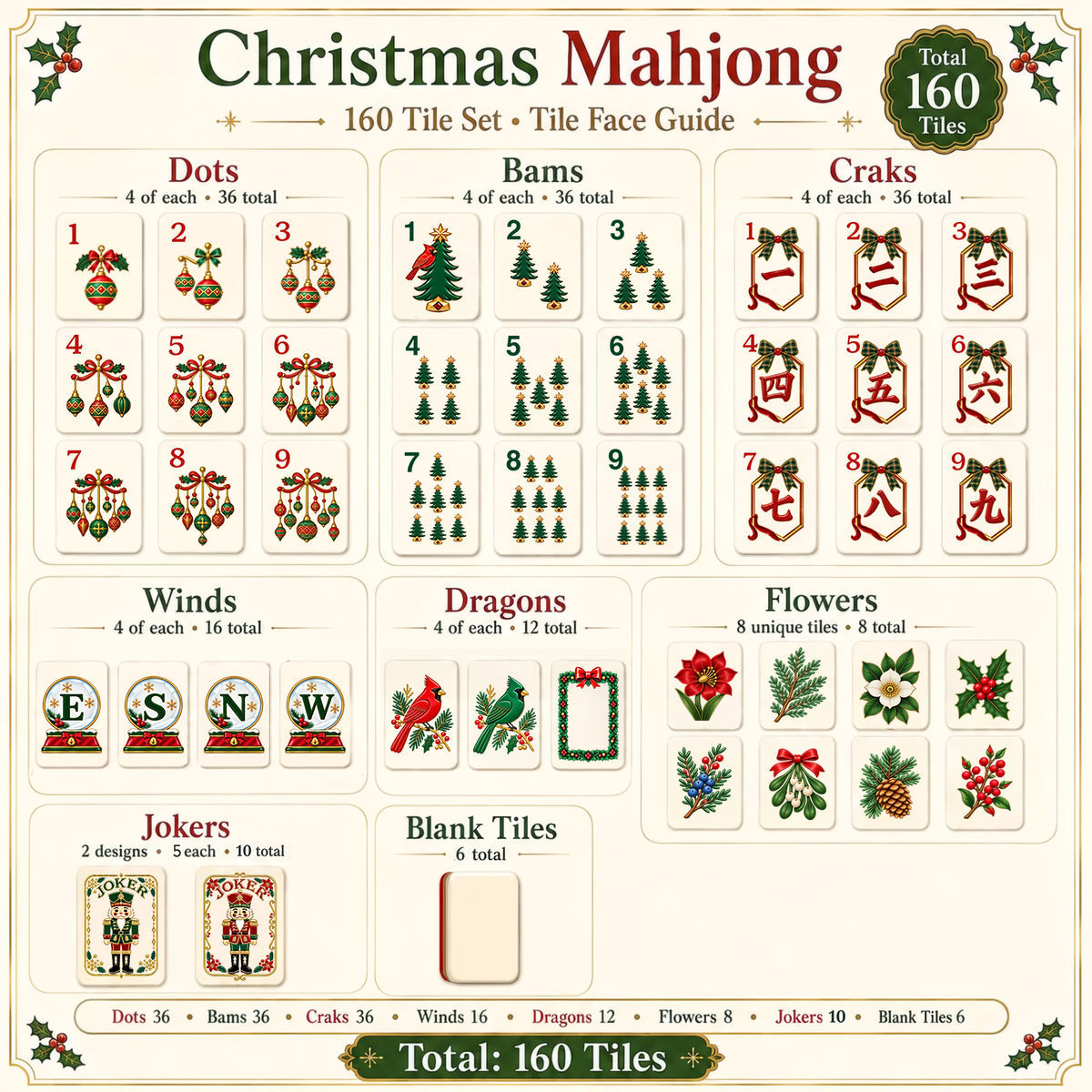
Spare tiles: A 160-tile set includes spare jokers and blanks for replacement mid-game if a tile cracks or loses print; never use a spare as a playable tile.
Storage & transport: If your group rotates hosts, invest in a durable travel bag or case to protect tiles and ensure consistency across sessions.
Official card access: Print a current-year National Mah Jongg League card for American play, or download an official fan table for Chinese/Hong Kong; verify the publication date.
✨ Find your Mahstead set — free US shipping →

FAQ
Can I use the same scoring system if I switch between American and Chinese mahjong?
No. American uses fixed card values; Chinese uses fan multipliers. Switching mid-game breaks scoring logic. Pick one system per session and stick to it.
What happens if a player wins but their hand isn't on the current year's American mahjong card?
They cannot claim the win. All winning hands must appear on that year's National Mah Jongg League card. No hand = no Mahjong. Discard and play continues.
Does the East player get bonus points in American mahjong competition?
No. American scoring is equal for all players; East position has no scoring advantage. Some house rules award East a bonus, but official League play does not.
How do I calculate payments if two players reach their winning tile at the same time?
In American mahjong, the player who goes out first (by discarding or drawing) wins and collects from all three others; there is no tie. If a dispute arises, the discarder has priority over the drawer in most clubs.
What's the minimum score needed to win an American mahjong session?
Most groups play to 500 points, but house rules vary (250, 1,000, or a fixed number of hands). Agree on the target before play; it's usually printed on your scorecard.
If I misdeclare my hand and realize the error mid-payment, can I take it back?
House rules vary. In competitive League play, once you declare Mahjong and claim the win, it's final if tiles have been verified. In casual home play, many groups allow a one-time redo if caught immediately. Clarify your group's rule before the first game.
Do I need a different tile set to play Chinese mahjong instead of American?
Not necessarily. A standard 152-tile American set contains all suits and wind/dragon tiles needed for Chinese play. The difference is the hand card (American League card vs. Chinese fan table) and scoring method, not the physical tiles.
Can I use jokers as wild tiles in Chinese mahjong the same way I do in American?
Hong Kong mahjong allows jokers to substitute for any tile. Classical Chinese mahjong restricts joker use (often only in kongs). Check your regional rules; American mahjong forbids jokers in single tiles or pairs.


View More
View More
View More
