
Mahjong Competition Rules: American League Play Explained
Last updated: Nov 23, 2026
American mahjong competition is governed by the National Mah Jongg League, which publishes an official hand card each spring that all competitive players must use. A standard game uses exactly 152 tiles (three suits of 1–9, four copies each; 16 winds; 12 dragons; 8 flowers; 8 jokers). Competition rules require players to form hands only from the current year's card, expose only pungs (3 identical), kongs (4 identical), quints (5 identical), and sextets (6 identical)—never sequences or chows—and use jokers strategically without placing them in single tiles or pairs. The game lasts roughly 45–90 minutes depending on skill level and house pace. Scoring and winning standards are published on the league card by hand pattern. Whether you play in a local club or tournament, knowing these constraints prevents penalties and lets you compete fairly.
What is the National Mah Jongg League card?
The NMJL card is a laminated chart released every spring listing all legal winning hands for that year. Each hand is displayed as a pattern of suits, numbers, and symbols (like pung, kong, or pair) that you must match exactly on the table—no substitutions, no house variations. Players must use the current year's card; old cards are invalid in competition. The card also specifies winning conditions and how many points each hand is worth. Without the official card, you cannot verify a win or resolve disputes fairly.

How do jokers work in competition play?
Jokers are wildcards that can replace any tile except the pair (the final two-tile set), and you can use up to eight jokers per hand, distributed across your melds—never more than one per meld, and never in a single exposed tile. A joker must always represent a tile that could legally complete that pung, kong, quint, or sextet. For instance, a joker can stand in for the third 5 Dot in a pung, but it cannot be the only tile in a position or fill a pair slot. Jokers are also never discarded; once played, they remain on the table for the rest of the hand.
What exposures are allowed in competition?
In American mahjong, you may only expose (place face-up on the table) pungs, kongs, quints, sextets, and the pair once you've won. You cannot expose sequences (1-2-3) or call tiles from other players' discards mid-game—only the discarder can retrieve their own tile if they mistakenly play one you were waiting for (a rare situation). All other tiles remain hidden in your rack until you declare a win. This differs sharply from Chinese or Hong Kong variants, where sequences and calling are core mechanics. The rigid American exposure rule keeps strategy concealed until the moment of victory.
How does the Charleston work in tournament settings?
The Charleston is the mandatory tile-passing ritual before every hand, and competition rules enforce a strict sequence: the player to your right passes three tiles (face-down), you must pass three back, then the player to your left passes three, you return three, and finally there is an optional pass across the table. Each pass must involve exactly three tiles, and all tiles move simultaneously—no peeking, no swapping back. Tournament play enforces these timing and passing rules strictly; casual clubs may speed through or skip the Charleston entirely, but leagues always require it. The Charleston disrupts tile clusters and adds an element of luck to hand formation.
What mistakes disqualify a hand in league play?
Common infractions include: declaring a win with fewer than four melds or without a pair, using a joker in a pair or single tile, exposing a sequence or calling a discard mid-hand, or using a hand pattern not listed on the current year's card. If you declare and your hand does not match the card exactly, you lose points and may face a penalty depending on league house rules. Exposing a meld incorrectly (e.g., a chow, which is illegal in American play) also voids the exposure. The most frequent error is using an expired card from a previous year—always verify the publication date before league play.
How are points and penalties scored in competition?
The NMJL card assigns a point value to each hand pattern, typically ranging from one to ten, though some hands carry special bonuses (all Simples, Dragons, or difficult patterns). A player who declares a win collects the hand's point value from each of the three other players. If a discard was used to win, the discarder pays double. Penalties for infractions—wrong hand, illegal joker placement, exposure error—vary by league; most deduct points or force a replay. Scoring is cumulative across multiple hands; the player with the highest total at the end of the session wins. Tournaments rank players by point differential, not just wins.

How does competition differ from casual home play?
Tournament play enforces strict timing (no extended consultation), mandatory use of the current-year card only, no house rule modifications, and formal notation of all exposures and discards. Casual play often allows last-year's card, accepts regional variants (like flexibility on joker placement), permits discussion of strategy mid-hand, and may skip the Charleston. Competition requires a scorekeeper, forbids coaching, and mandates immediate disclosure of errors. Most importantly, league play uses a single rule set nationwide, while home games adapt rules to suit the players. If you plan to move from casual play to a club or tournament, expect a learning curve in pace, documentation, and rule rigidity.
What are the key differences from Chinese, Hong Kong, and Riichi variants?
American mahjong has no exposed sequences (chows), no calling or robbing of discards, and hand patterns are published on a card—all different from Chinese play, which relies on memorized hand patterns and allows exposed sequences. Hong Kong mahjong uses wind scoring and rapid exposure of melds but permits more tile substitution than American rules allow. Riichi (Japanese mahjong) involves closed melds throughout play and complex scoring multipliers unknown to American players. Taiwanese play allows flexible hand formation without a card. The core difference: American mahjong is the most restrictive and rule-bound variant, designed for fairness and consistency, not speed or strategic complexity. If you play multiple variants, American competition requires the strictest discipline.
What do you need before your first league game?
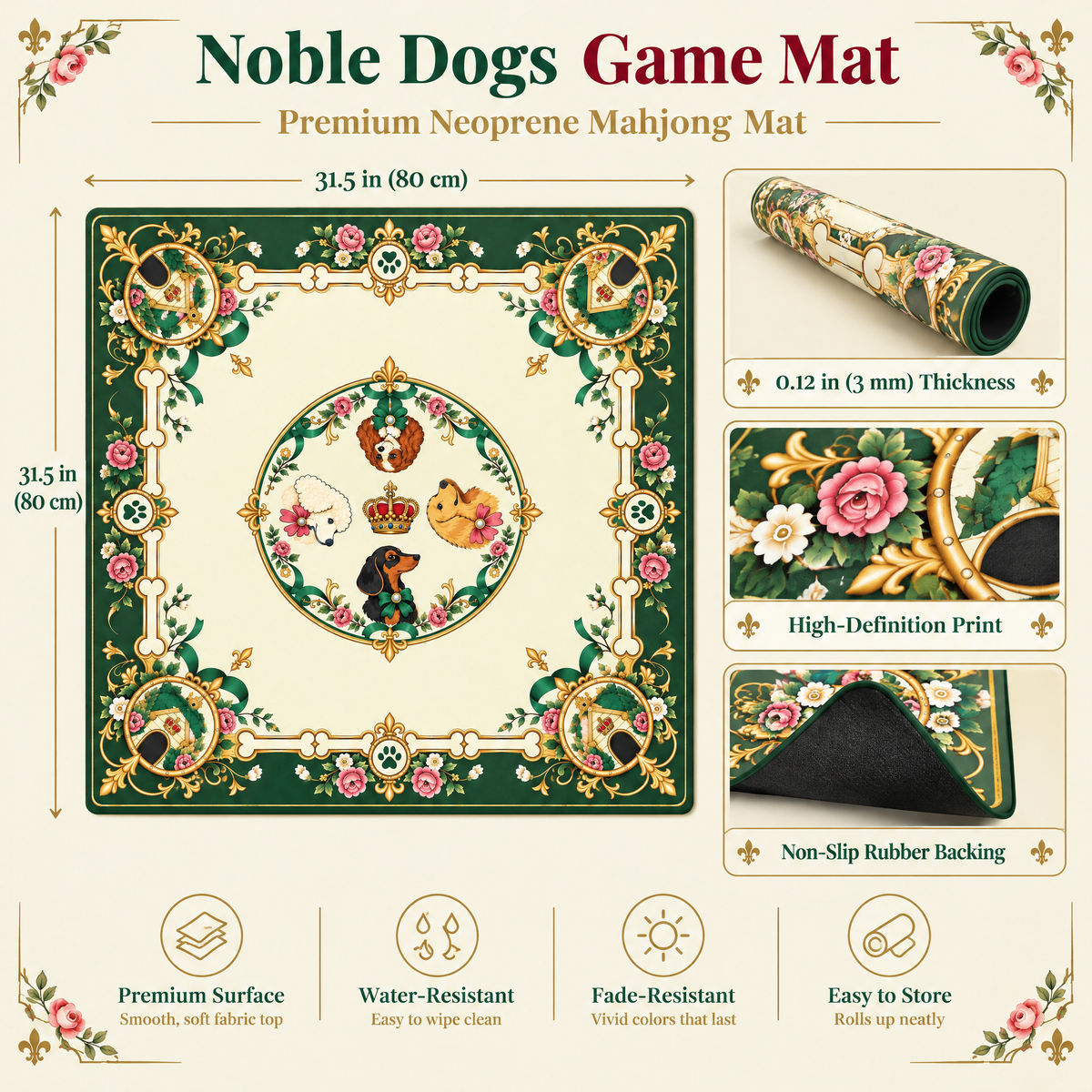
You'll need the current year's NMJL card (laminated, updated every spring), a best-selling mahjong set with all 152 tiles intact, a mahjong mat to organize your hand clearly, racks with pushers to display melds neatly, and a pen or scoresheet to track points. Many competitive players also carry a travel bag or case to transport their set safely between venues. A set with engraved tiles can help you identify tiles faster during play, reducing hesitation and keeping pace with experienced players.
🀄 Shop best-selling mahjong sets →
Comparison: Competition vs. Casual Play Rules
Rule | Competition | Casual Play |
Hand card | Current year only; NMJL official | Varies; may accept old cards |
Sequences | Never exposed or called | Some groups allow them |
Jokers per meld | Max 1; never in pair | Flexible; house rules vary |
Discards | Only winner can use from discard pile | Often allow calling from anyone |
Charleston | Mandatory; strict 3-tile passes | Optional; may be skipped |
Timing | Enforced; no extended consultation | Relaxed; discussion encouraged |
Scoring | NMJL card values; point collection | Varies widely by group |
Penalties | Formal; league-standard | Informal or non-existent |
Documentation | Scorekeeper required; formal record | Casual or mental tally |
What to check before you buy a set for league play
Verify tile count: Competition requires exactly 152 playing tiles plus jokers. Make sure your set arrives complete and intact.
Inspect joker clarity: All eight jokers must be visually distinct and unmistakable during rapid play—no faded or ambiguous jokers.
Confirm tile size: Standard American mahjong tiles are approximately 1¼ inches wide. Oversized or undersized tiles can slow down shuffling and exposure.
Check rack fit: If using racks with pushers, tiles should slide smoothly without jamming or falling out during quick melds.
Laminate your card: Protect the NMJL card in a clear sleeve or laminated holder so it remains readable through an entire season.
Label your set: Mark your tiles with initials or a symbol to identify them quickly in multi-group tournament venues.
🎁 See our most-loved mahjong sets & accessories →
Key Takeaway: Five Steps to Enter Competition Play
Get the current year's NMJL card (released each spring) and study a few hand patterns to familiarize yourself with notation.
Acquire a complete 152-tile set with clear, readable tiles and all eight jokers in good condition.
Practice the Charleston sequence with three friends until the passing rhythm is automatic.
Learn joker placement rules thoroughly: one per meld, never in pair or single, always representing a legal tile.
Attend a beginner session at a local club or league (typically hosted at community centers, libraries, or synagogues) to observe live play before committing to tournament fees.
✨ Find your Mahstead set — free US shipping →

FAQ
Can I use an old mahjong card from last year if it has the same hands?
No. The NMJL issues a new card every spring, and league play requires the current year's card only. Hand patterns or scoring may differ between years, and using an outdated card results in an invalid hand and penalty.
What happens if I accidentally expose a sequence (1-2-3) in American competition?
An illegal exposure voids that meld and typically forfeits the hand. The player(s) who exposed the sequence lose points, and play resumes. Always verify the NMJL card to confirm that your exposed meld is listed as a pung, kong, quint, or sextet—never a sequence.
How many jokers can I use in a single meld?
Exactly one joker per meld (pung, kong, quint, or sextet). If a hand requires multiple jokers across different melds, that is allowed—up to eight total in a hand—but never more than one per meld.
If I declare a win and my hand doesn't match the card, do I lose all my points for the session?
Penalties vary by league, but typically you lose the points for that hand and may lose points from previous hands in the same session. Repeated errors can result in suspension or removal from league play.
Where can I find a local competition group or tournament?
Check community centers, libraries, synagogues, country clubs, and Meetup-style boards in your city. Many areas have weekly club nights with open tables for beginners; call ahead to confirm rules and beginner-friendly times.


View More
View More
View More
