
Mahjong Character Tiles 1 to 9: What They Are & How to Use Them
Last updated: Nov 23, 2026
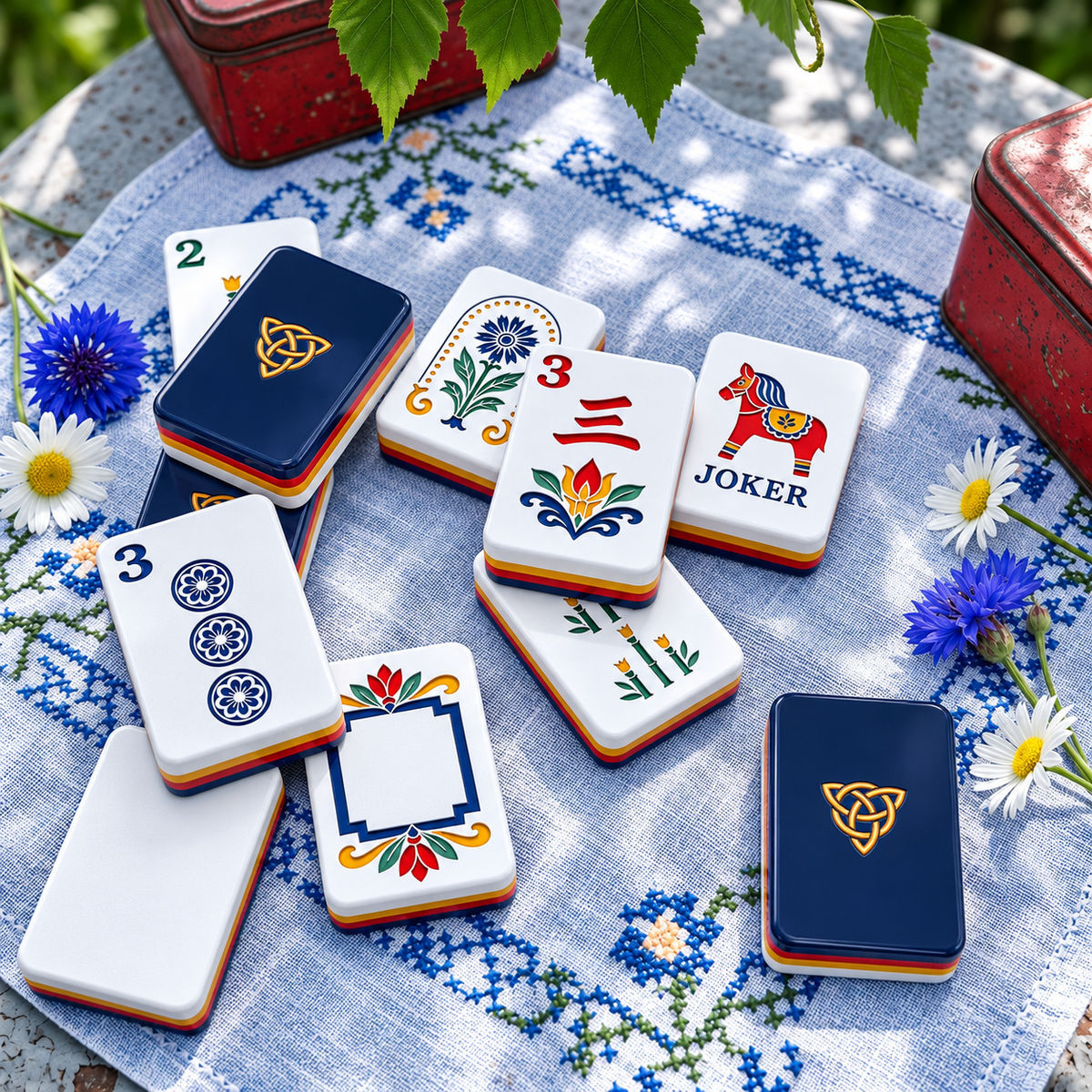
American mahjong uses 108 tiles divided into three suits: Bams (bamboo), Craks (characters), and Dots (circles), each numbered 1 to 9. You receive four identical copies of each number per suit, giving 36 tiles per suit total. The 1 Bam shows a bird illustration; the others depict their number in the suit's symbol. These character tiles, combined with winds, dragons, flowers, and jokers, form the 152-tile foundation of American mahjong. When reading hands from the annual National Mah Jongg League card, you'll call "1 Bam–2 Bam–3 Bam" (pung or sequence) or "5 Crak–5 Crak–5 Crak" (pung). Dot tiles are sometimes called "wheels" in shorthand. The three-suit system dates from Chinese games but remains unchanged in American play since the early 20th century.
How do the three suits differ visually and in play?
Each suit has a distinct symbol. Bams show bamboo sticks arranged by number (1 Bam is a single stick with a bird). Craks display Chinese characters or circles grouped by count. Dots show round circles or "wheels" in matching patterns. In American mahjong play, the suits function identically—no suit outranks another, and you can't "convert" between them. The visual difference matters for speed and accuracy at the table: after 100 games, your eye recognizes a 5 Dot instantly, so you don't fumble or misread tiles during the fast-paced draw and discard phase. Our best-selling sets feature clear, large characters that make distinction effortless across a standard mahjong mat.

Why does the 1 Bam show a bird instead of a stick?
The 1 Bam depicts a bird perched on a single bamboo stalk—a detail carried from traditional Chinese tiles. Early mahjong legend attributes the bird to a tale of fortune; in modern play, it's purely a design convention and a visual anchor. The bird makes the 1 Bam unmistakable on the table, so new players quickly learn: "That's the bird tile—1 Bam." Some acrylic sets render the bird in relief or with fine detail; others use flat printing. The rule is simple: a 1 Bam is a 1 Bam regardless of art style, and it counts as exactly one tile in any pung, kong, or hand sequence on the card. Recognizing this tile early prevents rookie errors like confusing it with a blank or thinking it's a special trump tile.
What combinations of character tiles can you play together?
In American mahjong, character tiles 1–9 form only two types of combinations: pungs and kongs. A pung is three identical tiles (three 5 Dots, three 5 Dots, three 5 Dots). A kong is four identical tiles (four 5 Dots repeated). American mahjong has no sequences (1-2-3 progressions) that can be called or exposed; sequences appear only on the card as melds you build in your hand before calling "Mahjong!" Jokers can replace one tile in a pung or kong but cannot form a single tile, pair, or complete a sequence. Examples:
Valid pung: 3 Bam + 3 Bam + 3 Bam
Valid kong: 7 Crak + 7 Crak + 7 Crak + 7 Crak
Invalid: 2 Dot + 3 Dot + 4 Dot (sequence, unplayable in American mahjong)
Invalid: 1 Bam + 1 Bam + joker (a joker cannot stand alone as a tile)
Once you understand that all combinations are identical, not sequential, you avoid the most common beginner mistake: trying to call a run like "1-2-3" when it isn't listed on the current card as an exposed or hidden meld.
How do you read character tiles on the current National Mah Jongg League card?
The annual card (released each spring) lists legal hands for the year. Hands are divided into sections—Like Numbers, Consecutive Run, etc.—and within each section, rows show combinations using the shorthand "1 Bam," "5 Crak," "2 Dot," and so on. When you spot a hand that matches your drawn tiles, you identify which character tiles make it playable. For example, a Like Numbers section might show "all 4s"—meaning 4 Bam, 4 Crak, 4 Dot in specific quantities (pung, quint, sextet). To read it accurately: match tile face to name (1 Bam = bird; 5 Crak = five character marks; 9 Dot = nine circles), count the quantity, and check whether you have them in your rack. Learn more about reading the card structure here. Misreading a Bam for a Dot costs you a winning hand—quality tile sets with sharp, color-distinct designs eliminate this costly slip.

What's the difference between American and Chinese mahjong character tiles?
Chinese mahjong (and Cantonese variants) use the same three suits and 1–9 numbering, but play rules differ drastically. Chinese mahjong allows sequences (1-2-3 progressions) to be called and exposed—a core mechanic absent in American play. Chinese tiles also include extra honor combinations and different scoring systems. American mahjong froze its hand list and tile structure in 1937 when the National Mah Jongg League was founded; the card updates yearly but the 152-tile set and American-only rules remain constant. If you play both games, the tile names and symbols stay the same, but the strategy and legal combinations diverge completely. Most Western players stick to American mahjong because the annual card simplifies learning: you don't memorize all hand combos—the card shows them for you.
🀄 Shop best-selling mahjong sets →
Why does tile clarity matter when learning character tiles?
New players learn suit symbols through repetition and visual memory. A fuzzy, faded, or tiny tile face slows you down and invites mistakes during the draw-and-discard cycle. If you can't instantly tell a 5 Bam from a 5 Dot at arm's length, you'll hesitate—and hesitation breaks the table's rhythm, frustrates your group, and costs you focus. Acrylic tiles with large, color-keyed glyphs (Bams often in one hue, Craks in another, Dots in a third) train your eye faster. Engraved sets with custom titles or designs combine clarity with personality—so you own a set that's both fast and meaningful. After 20 hours of play on a quality set, character tile recognition becomes automatic; on a low-contrast set, it may never fully click.
Tile Feature | Why It Matters | Effect on Learning |
Large glyph size (½ inch+) | Readable at table distance | Faster recognition; fewer errors |
Color separation by suit | Bams ≠ Craks ≠ Dots visually | Intuitive grouping; reduced confusion |
Smooth, uniform finish | No glare or printing defects | Consistent ID across the full set |
High-contrast engraving or print | Text/image distinct from tile face | Instant parsing under standard lighting |
🎁 See our most-loved mahjong sets & accessories →
What to check before you buy a new mahjong set
Count: Verify the set includes all 36 tiles per suit (108 total character tiles). A 160-tile set includes spare jokers and blanks so you always have replacements if one cracks.
Print quality: Inspect a sample or photo for sharp, dark glyphs. Faded or bleeding print speeds up tile fatigue.
Suit color coding: Confirm Bams, Craks, and Dots are visually distinct—check under your home or table lighting.
1 Bam bird: Ensure it's clear and recognizable. If it looks like a smudge, return it or switch sets.
Joker count: American mahjong uses exactly 8 jokers in play per game; your set must have at least 8. A 160-tile set provides spares.
Material: Acrylic tiles resist cracking and fading better than bamboo or bone over years of weekly play.
Test a hand: Before committing to play, lay out one full hand from the card and ensure every tile reads correctly under your gaming lights.
How does American mahjong tile numbering compare to other variants?
All major mahjong variants (American, Chinese, Hong Kong, Taiwanese, Riichi) use 1–9 numbering in three suits. The combination rules differ: Chinese variants allow sequences; Riichi (Japanese) adds melds and scoring layers; Taiwanese uses ranking suits. But the basic tile faces remain identical across traditions—so a 5 Crak looks the same in Dallas and Taipei. American mahjong's fixed annual card and pung-only rule system make it unique, not the tiles themselves. This universality is why cross-cultural mahjong groups can teach newcomers quickly: the tiles are the anchor, the rules are the variable.
✨ Find your Mahstead set — free US shipping →

FAQ
What does the bird on the 1 Bam mean in American mahjong?
The bird is a traditional design detail carried from Chinese tile art—no special meaning in modern play. It's purely a visual marker to distinguish 1 Bam instantly. A 1 Bam with a bird is identical in value and function to any other 1 Bam and is read simply as "one" in all hands and melds.
Can I use a Bam tile where the card shows a Crak tile?
No. Bams, Craks, and Dots are distinct suits. You must match the exact suit and number shown on the card. Mixing suits voids your hand. Always read the card closely—"1 Bam" is not "1 Crak," and the penalty for confusion is an invalid win.
How many of each character tile (1–9 per suit) are in a standard set?
Exactly four identical copies of each number per suit. Four 1 Bams, four 2 Bams, … four 9 Bams; same for Craks and Dots. This 36-tile-per-suit structure is fixed across all American mahjong games and sets.
Why does American mahjong not allow sequences like 1-2-3 Dots in exposed melds?
American mahjong was designed in 1937 to simplify Chinese play and rely on an annual card of valid hands. Restricting exposed melds to identical tiles (pungs/kongs) makes the game faster and removes ambiguity. Sequences only exist in hidden hands before you call "Mahjong!"—they're never exposed or called mid-game.
If I'm new to mahjong, should I start by learning all 9 numbers in each suit, or learn as I go?
Beginners often learn by playing. Familiarize yourself with the 1 Bam (bird) first, then practice naming tiles aloud during the first 2–3 games. After 10 hours of weekly play on a clear set, number-and-suit recognition becomes automatic. Don't memorize in isolation—play and train your eye at the table.
What's the difference between a Dot and a Crak visually, and why do new players confuse them?
Dots show circles or "wheels" in cluster patterns; Craks display character marks or radials in Chinese style. Confusion arises when printing is small, faded, or uses similar colors. A high-contrast, large-glyph set eliminates most confusion within the first game session.


View More
View More
View More
