
Mahjong and Memory: Why the Game Sharpens Your Mind
Last updated: Nov 23, 2026
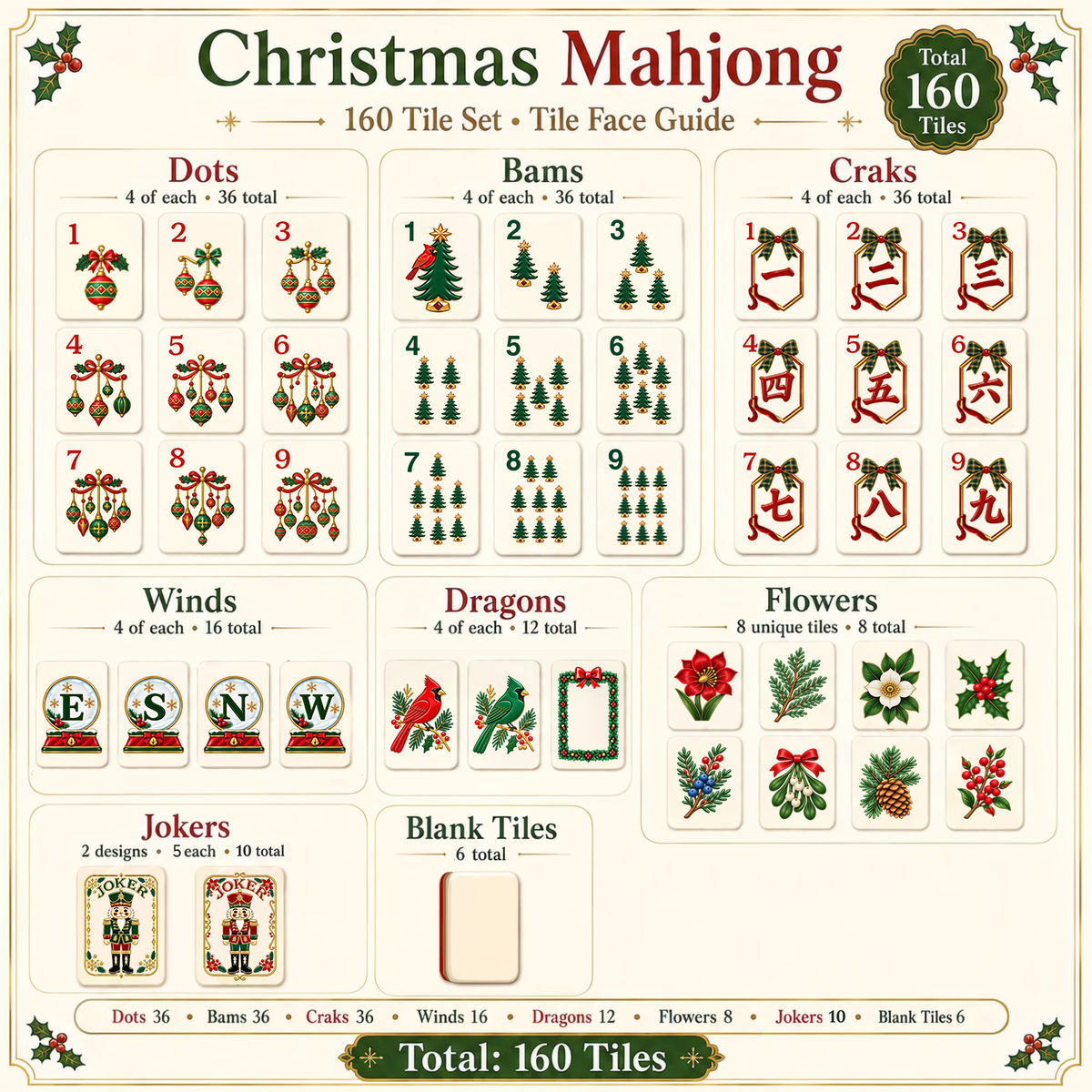
Mahjong strengthens working memory and pattern recognition because the game requires you to simultaneously track 34 unique tiles in hand, remember 50+ discarded tiles, recognize legal combinations from the annual hand card, and anticipate opponents' likely plays. Every turn forces you to hold multiple tile sequences in mind while filtering noise. The Charleston shuffle before play adds an extra memory layer—you're passing sets of three tiles and calculating probability. Unlike solitaire or passive card games, mahjong demands active decision-making under time pressure, which cognitive research links to sustained improvement in recall and executive function. A typical game lasts 2–4 hours with dozens of hands played; players report improved concentration and sharper tile-spotting ability after 4–6 weeks of weekly play. Mahstead sets in our best-selling collection feature clearly printed tiles that reduce eye strain, letting you focus on strategy rather than squinting.
Does mahjong actually improve memory?
Yes—but it depends on how you play and what you're tracking. Neuroscience distinguishes between working memory (holding information briefly) and long-term retention; mahjong primarily strengthens the former. During a single hand, your brain juggles your 14 tiles, the 3–4 visible melds on the table, 30+ discards, and probabilities of the remaining 100+ undrawn tiles. That's a working-memory load comparable to mental arithmetic or language translation. Players who analyze hands after—"I should have tracked that 2 Bam earlier"—begin building pattern libraries that transfer to long-term memory. Casual players see modest gains; serious players who study the yearly card and review strategy improve measurably within a season.

What specific memory skills does mahjong train?
Mahjong isolates four distinct memory demands: discard tracking (remembering which 40+ tiles have been played), hand pattern recognition (spotting legal combos within seconds), probability judgment (inferring which tiles remain based on passes and discards), and strategic sequencing (ordering your plays to keep options open). Discard tracking is hardest for newcomers; many players create mental "zones" (north player's discards here, east player's there) to avoid overwhelm. Pattern recognition improves fastest because the hand card repeats similar structures weekly—your brain builds a visual index. Probability judgment, the deepest skill, separates casual players from regular winners. This specificity matters: mahjong doesn't make you better at random memorization tasks (like memorizing a phone number), but it builds contextual memory—your ability to hold meaningful patterns and act on them quickly.
How long before you notice memory improvement?
Most players report sharper tile-spotting within 2–3 weeks of weekly games; measurable discard-recall improvement takes 4–8 weeks. Early progress feels like "I remembered someone threw that 5 Crak—I'll discard its neighbor." Deeper pattern recognition—spotting a hand structure mid-play—takes 8–12 weeks. The rate depends on table intensity: a casual game with slow turns (10 seconds per play) builds memory slower than a fast table with quick decisions. Players who review hands afterward ("Why did you discard that?") progress 30–40% faster than those who simply play. A weekly 2-hour game, played consistently, is a realistic baseline; daily play would accelerate gains, but many of us simply don't have that schedule.
Why does mahjong memory training feel different from study?
Mahjong memory improvement feels effortless because the brain is engaged in play, not rote drilling. You're not consciously memorizing tiles; you're solving a puzzle under social and competitive pressure, which triggers deeper encoding. This is why mahjong players often remember a tile sequence from a game three months ago but forget a grocery list from yesterday—context and emotional stakes drive recall. The game also uses spatial memory (where on the table was that discard?) and visual-pattern recognition (shape of a quint versus a kong), which are more durable than verbal memory. Additionally, you're competing against human opponents who trick and bluff you, adding emotional color to memories. Boring study tasks activate rote memory; mahjong activates episodic and spatial memory systems, which are more robust.
Which mahjong variants demand the most memory?
American mahjong requires high discard memory because you cannot call or expose sequences (chows)—you see only pungs, kongs, quints, sextets, and joker combos. This means you're constantly tracking which opponent is closest to which hand type. Chinese Classical and Hong Kong mahjong expose sequences, so your visible information is richer, reducing discard-memory load. Riichi (Japanese) mahjong uses a smaller 34-tile set but adds concealed hand pressure (you don't know others' tiles at all), shifting memory from "what's been discarded" to "what's statistically likely." For pure working-memory training, American mahjong is the hardest because discard tracking is nearly mandatory to play well. If you're learning, start with a beginner-friendly set and clear tiles; once you're comfortable, harder memory demands become rewarding rather than frustrating.
🀄 Shop best-selling mahjong sets →

Memory tactics every player should know
The strongest players use chunking—grouping tiles mentally into zones or patterns rather than tracking each one. For example, instead of remembering "North threw 1 Bam, 2 Bam, 3 Bam, 5 Dot, 7 Dot," you note "North's discards are mostly low Craks and high Dots"—a rule, not a list. Another tactic: anchor on extremes. The 1 Bam (bird) and 9 Dot are visually distinct, so your brain flags them first; use them as memory hooks for the surrounding tiles. Third tactic: discard piles create stories. If East threw a 5 Crak, then White Dragon, then 3 Bam, you might tell yourself "East broke up a 3-4-5 run and wanted Winds"—a narrative sticks better than isolated facts. Players who table-test these tactics report 20–30% faster pattern recall. Our engraved sets with custom themes sometimes help: your brain anchors memories to visual or humorous cues, making discard sequences more vivid.
Memory Tactic | What It Does | Difficulty | Best For |
Chunking by zone | Groups discards spatially | Beginner | Reducing discard overwhelm |
Anchor on extremes | Flags 1 Bam, 9 Dot first | Beginner–Intermediate | Fast visual recall |
Narrative chaining | Links tiles into a story | Intermediate | Remembering sequences |
Probability math | "Only 2 more 7 Dots remain" | Intermediate–Advanced | Strategic discard choices |
Hand-pattern indexing | Builds a visual library | Advanced | 2–3 second pattern spotting |
🎁 See our most-loved mahjong sets & accessories →
How tile quality affects memory performance
Clear, well-spaced characters reduce cognitive load—you're not squinting or misreading tiles mid-game. Acrylic tiles with engraved characters (as opposed to printed) stay legible through hundreds of plays; faded tiles force your brain to "fill in the gaps," which drains working memory. Tile weight also matters: heavier tiles (around 8–10 grams each) feel deliberate in hand, triggering slower, more mindful play—many players report better discard recall after switching to substantial tiles. Lightweight plastic tiles, conversely, encourage fast, distracted play; your memory of discards is hazier. Our standard 160-tile acrylic sets are engineered for this reason: thick acrylic, clear inlay, balanced weight. A worn-out set from a garage sale might save money but will frustrate you and slow your memory training. If you're serious about improving, invest in a clean, durable set; you'll play more hands weekly and build skills faster.
What to check before you buy
Tile size: Standard American tiles are 1.25″ × 1″; if your hands are smaller or you have vision limits, check dimensions before ordering.
Clarity: Run your finger across the tile face; it should feel smooth and the character should be readable from 3–4 feet away.
Joker count: A 160-tile set includes 152 playing tiles plus spares; verify the set includes 8 jokers for play, not fewer.
Storage: A cloth bag keeps tiles from rattling during transport; if you'll move your set weekly, prioritize a case.
Card legibility: Bring a 2026 National Mah Jongg League card to the table; if it's older than one year, your hands won't match the current game.
✨ Find your Mahstead set — free US shipping →
Why a good mat improves memory training
A mat with clear grid lines and numbered player zones helps you organize discards spatially, which anchors memory. Instead of "I think North threw a 3 Bam," you remember "North threw a 3 Bam in the second row, middle pile"—spatial memory is more robust than abstract. Many players pair a quality mat with racks and pushers to keep tiles upright and organized. Disorganized tiles scattered across a bare table demand more working memory to track; a structured layout frees your brain to focus on strategy. For serious memory training, invest in a mat.

FAQ
Does playing mahjong prevent dementia?
Research suggests regular cognitive engagement (including tile games) correlates with slower age-related decline, but mahjong alone is not a dementia treatment. Combine it with exercise, social connection, and other hobbies for best results.
How much mahjong per week improves memory?
One weekly 2–3 hour session builds noticeable working-memory gains over 4–8 weeks. Daily play would accelerate progress, but consistency matters more than volume.
Can beginners improve memory while learning rules?
Yes, but slowly. Your brain allocates attention to rule-learning first; once rules become automatic (week 3–4), memory-training acceleration kicks in. Stick with it.
Does mahjong memory skill transfer to other games?
Partially. You'll improve at any tile or card game requiring discard tracking. Pattern recognition transfers less directly; chess or Tetris use different pattern systems.
What if I have a bad memory to start?
Mahjong is ideal for you. Start at a casual table, use our chunking tactics, and review hands afterward. You'll see faster relative improvement than strong-memoried players.
Should I study the mahjong card to improve memory?
Yes. Reviewing hand patterns 10 minutes before play builds your visual index, accelerating pattern recognition by 2–3 weeks compared to learn-as-you-go.


View More
View More
View More
