
Korean Mahjong Rules: Tile Sets, Melding & How It Differs from American
Last updated: Nov 23, 2026
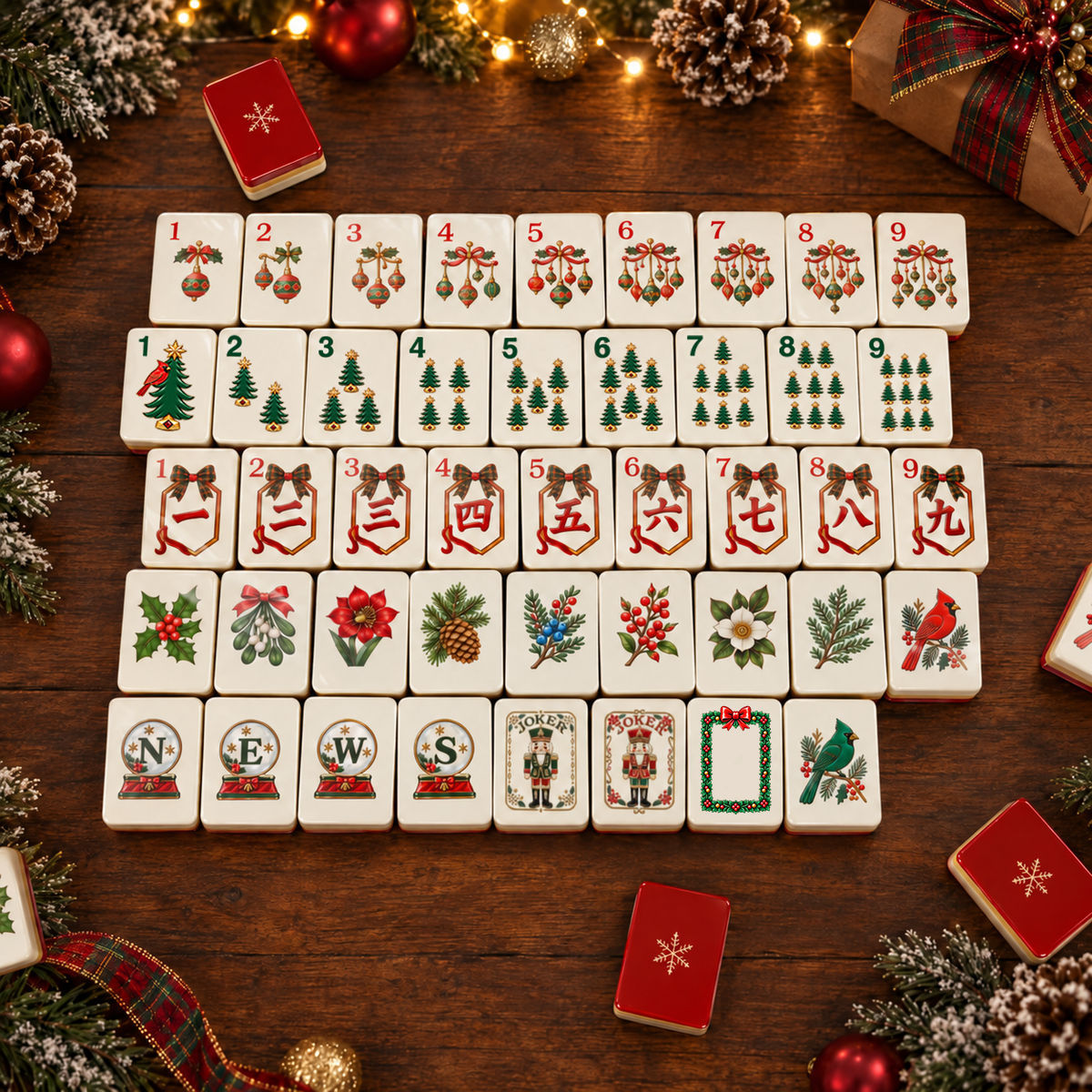
Korean mahjong uses 108 tiles (one suit: Bams 1–9, each appearing 4 times; 16 Honors: winds and dragons; no Flowers or Jokers). Three players sit at the table. The goal is to form a winning hand (typically a specific pattern of pungs and chows) and be the first to declare "mahjong." Games move quickly—usually 10–20 minutes per hand. Unlike American mahjong, which relies on an annual card of legal patterns and prohibits sequences (chows), Korean play allows both exposed pungs and chows, and patterns vary by regional house rules. Players draw and discard in turn order, calling tiles when they can add to exposed melds. The winner scores points from the hand strength and pot; losers pay the winner. You don't need an engraved American set for Korean play—a standard 108-tile Chinese set works best, though any mahjong set with clear suits and honors will serve.
Korean mahjong (also called Korean mah-jong) is a three-player variant with unique tile sets, hand patterns, and a faster pace than American mahjong. Three players sit at the table. The goal is to form a winning hand—typically a specific pattern of pungs and chows—and be the first to declare "mahjong." Games move quickly: usually 10–20 minutes per hand. Unlike American mahjong, which relies on an annual card of legal patterns and prohibits sequences, Korean play allows both exposed pungs and chows, and patterns vary by regional house rules. Players draw and discard in turn order, calling tiles when they can add to exposed melds. The winner scores points from hand strength and pot; losers pay the winner. You don't need an engraved American set for Korean play—a standard 108-tile Chinese set works best, though any mahjong set with clear suits and honors will serve.
What tiles are in a Korean mahjong set?
Korean mahjong uses 108 tiles, not the 152 of American play. The set includes only Bams (characters that look like sticks or symbols), each numbered 1–9, with four copies of every tile; 16 Honors divided equally among the four winds (North, East, South, West) and three Dragons (Red, Green, White); and no Flowers, Seasons or Jokers. A Chinese or Hong Kong standard set fits this perfectly. The simpler inventory means fewer tiles to track and faster hand construction than American mahjong, where you manage three suits (Bams, Craks, Dots), Flowers, Winds, Dragons and Jokers across 152 tiles. Korean sets often feature bone or plastic tiles with embossed faces, making them durable and easy to shuffle on a mat during long sessions.

How does Korean melds and hand-building work?
In Korean mahjong, you build your winning hand by forming pungs (three identical tiles) and chows (three consecutive tiles in the same suit—for example, 3 Bam, 4 Bam, 5 Bam). You can also form kongs (four identical tiles). Exposed melds—pungs, chows, and kongs—are placed face-up on the table when you acquire them, and any player can contribute a tile to complete them under certain conditions. This is fundamentally different from American mahjong, where chows cannot be formed or called at all; American players only expose pungs, kongs, quints, and sextets from a pre-set card of legal patterns. In Korean play, your winning hand typically consists of four melds and a pair (14 tiles total), though some regional variants accept three melds and a pair or five melds with no pair. The pair can be any two identical tiles and does not have to be unique. Play rotates counterclockwise, and you draw one tile and discard one each turn.
How is Korean mahjong scored and who wins?
The winner is the first player to complete a legal hand and declare "mahjong." Scoring depends on what pattern they hold: a hand of all pungs (no chows) is worth more than a mixed hand; a hand where all four melds are identical suits scores higher than a mixed-suit hand. Each region or group plays by slightly different multipliers, but the basic principle is that the winning hand's point value is multiplied by the number of opponents who must pay—in three-player Korean mahjong, two losers pay the winner. The winner collects a pot that grows during the hand as players pay penalties for specific events (drawing a tile, claiming a discard out of turn, or declaring a false win). American mahjong, by contrast, uses a fixed scoring table keyed to hand patterns from the National Mah Jongg League card, and players typically play four-handed with no mid-hand penalties. Korean games resolve faster and involve more direct financial exchange, making them feel more competitive and social.
What are the key differences from American mahjong?
Feature | Korean Mahjong | American Mahjong |
Tile count | 108 tiles | 152 tiles + 8 jokers |
Suits | 1 suit (Bams) + Honors | 3 suits (Bams, Craks, Dots) + Honors + Flowers |
Players | 3 | 4 |
Hand patterns | Flexible; vary by region | Fixed to current year's National Mah Jongg League card |
Chows allowed | Yes; can be formed and exposed | No; strictly prohibited |
Melds called | Pungs, chows, kongs; exposed and called freely | Pungs, kongs, quints, sextets only; no chows |
Hand length | 14 tiles (4 melds + 1 pair) | 14 tiles (hand must match card pattern exactly) |
Joker use | None | 8 jokers; can replace any tile except pairs |
Winning declaration | Player announces "mahjong" | Player declares hand and proves it matches card |
Game speed | Fast (10–20 min per hand) | Moderate (15–30 min per hand) |
Scoring system | Pot-based, multipliers vary | Points per hand pattern, settles at game end |
Korean mahjong is fundamentally a speed game with simpler tile management and direct player-to-player payoffs, while American mahjong emphasizes legal pattern recognition and strategy around the annual card. Both are deeply social, but they reward different skills.

What house rules and regional variations exist?
Korean mahjong has no single governing body like the National Mah Jongg League does for American play, so house rules dominate. Some groups allow a "loose pair" (any two tiles) in the winning hand; others require the pair to be Honors or Dragons. Some allow a player to claim a discarded tile even when out of turn if they can complete a meld (called "stealing" the discard); others restrict this. The first player to form a complete hand may declare "mahjong" immediately or may wait to draw from the wall on their next turn—this timing affects strategy and hand value. Some games permit bonus tiles (similar to Flowers in Chinese mahjong) that add points; others skip them entirely. Before you sit down, always ask the host or regular players: What tiles count as the winning pair? Can you steal discards? Do we play bonus tiles? What's the point multiplier for all-pung hands? Clarifying these rules upfront prevents disputes and keeps the game social and fun.
🀄 Shop best-selling mahjong sets →
What equipment do you need to play Korean mahjong at home?
To host Korean mahjong, you need an 108-tile Chinese or Hong Kong mahjong set (not an American 152-tile set, which includes extra suits and jokers you won't use). You'll also want a mahjong mat to define the play surface, protect tiles from spills, and keep the game organized—a mat makes it easier for three players to see all tiles clearly and reduces tile noise. Some players use mahjong racks with pushers to organize their hand tidily, though in three-player Korean mahjong, hand management is simpler than American play because you have fewer tiles total. A dice set (usually two dice) determines who deals first, and a notebook or phone tracks score across rounds. Our best-selling mahjong sets include clear tile faces and durable acrylic or bone construction, making them ideal for beginners and serious players alike.
🎁 See our most-loved mahjong sets & accessories →
Common mistakes and how to avoid them
Forgetting the 108-tile constraint. Beginners sometimes grab an American 152-tile set and try to play Korean mahjong, then realize they have extra Craks, Dots, Flowers and Jokers that have no role. Before you buy, confirm your set is 108 tiles or compatible with Chinese/Hong Kong rules. If you already own an American set, set aside the Craks, Dots, and Flowers, and use only the Bams, Winds, and Dragons—you'll have 64 tiles left, which is short. It's cleaner to use a dedicated 108-tile set for Korean play.
Playing without agreed house rules. Many house disputes arise because players assume different regional variants apply. Spend five minutes before the first hand clarifying: which tiles form a legal pair? Can you steal a discard? Are Honors more valuable? What's the payment multiplier for all-pung hands? Write these rules down if you're hosting regularly.
Drawing and discarding out of sequence. Korean mahjong has strict turn order—counterclockwise from the dealer. If a player draws and discards out of turn, the hand is typically voided or a penalty is assessed. Always confirm whose turn it is before drawing.
Misidentifying winning hands. In Korean play, a winning hand must contain four melds (pungs, chows, or kongs) plus a pair, unless your house rules allow three melds and a pair. Check that all four melds are legal before announcing "mahjong." Some players accidentally count a single tile or an incomplete set as a meld and declare prematurely.
What to check before you buy a Korean mahjong set
Tile count: Confirm the set has 108 tiles (4 each of Bams 1–9, 4 each of four winds, 4 each of three Dragons, totaling 28 honor tiles).
Clarity: Ensure Bams, winds, and dragons are clearly marked and easy to read at a glance. Acrylic or bone-faced tiles are clearer than cheap plastic.
Durability: Look for sets with tiles that don't chip or fade after 20+ hands. Heavier tiles and reinforced edges survive shuffling better.
Completeness: Verify the set includes a carrying case or bag if you plan to move it between homes. A travel bag protects your investment.
Regional fit: If you're joining an existing group, ask what tile style they prefer (Chinese symbols, Japanese characters, numeric). Some groups have strong preferences.
✨ Find your Mahstead set — free US shipping →

FAQ
Can I play Korean mahjong with an American mahjong set?
Not directly. American sets have 152 tiles with three suits (Bams, Craks, Dots), Flowers, and Jokers; Korean mahjong uses only 108 tiles (Bams, Winds, Dragons, no Flowers or Jokers). You'd have to remove two-thirds of the tiles, which defeats the purpose of buying an American set. Use a dedicated Chinese or Hong Kong 108-tile set for Korean play.
How many people can play Korean mahjong?
Korean mahjong is designed for three players. Some regional variants permit two or four players, but three is standard. The game loses flow and balance with fewer or more players, and scoring adjustments become complicated. If you have four people, American mahjong is a better fit.
What's a "loose pair" in Korean mahjong?
A loose pair is any two identical tiles that form the winning hand's final pair. Most Korean house rules allow this—the pair doesn't have to be Honors or Dragons. Some stricter groups require the pair to be Honors or Dragons only, which makes winning slightly harder. Confirm with your host before the first hand.
Is Korean mahjong faster than American mahjong?
Yes. Korean hands typically resolve in 10–20 minutes, while American hands take 15–30 minutes. The smaller tile set (108 vs. 152), simpler hand patterns (no annual card to memorize), and three-player format keep Korean games brisk. Both are social, but Korean play suits impatient players and shorter gaming sessions.
Do I need a mahjong mat for Korean mahjong?
No, but it's highly recommended. A mat protects your tiles, reduces noise, and gives three players a clear view of all melds and discards. It also extends the life of your tiles by cushioning them during shuffles and play.
Where can I find people to play Korean mahjong in my area?
Look for community centers, libraries, and cultural centers (especially those serving Korean or East Asian communities). Online meetup boards and neighborhood apps like Nextdoor often have mahjong groups. Many Korean restaurants or social clubs also host games. Attend a session first to learn local house rules before investing in your own set.


View More
View More
View More
