
Korean Mahjong for Beginners: Rules, Tiles & How to Start
Last updated: Nov 23, 2026
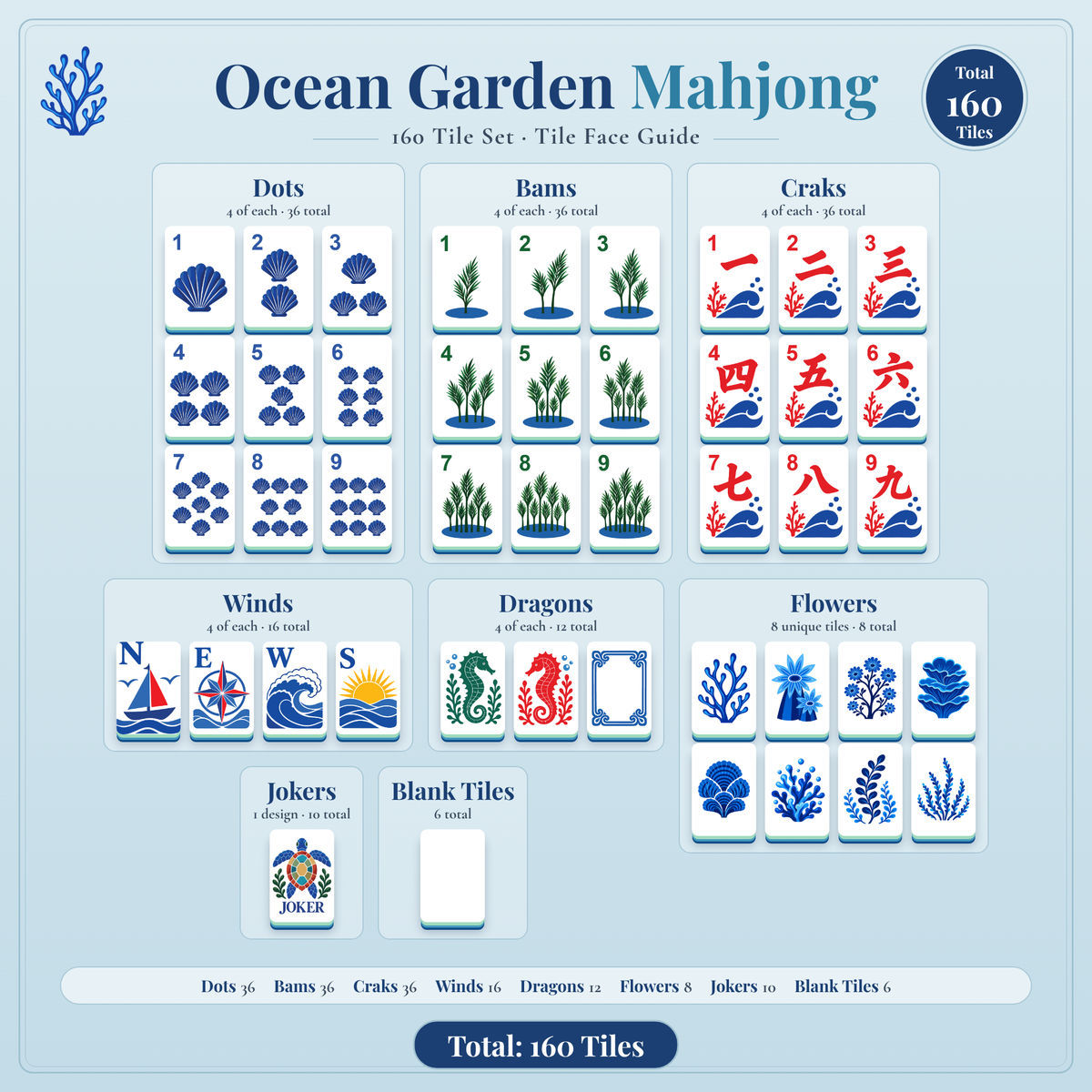
Korean mahjong differs from American mahjong in tile count (144 vs. 152), hand patterns (simpler combos, no rigid annual card), and pacing (shorter rounds, looser rules). You play with three suits (Bams, Craks, Dots numbered 1–9, four copies each), winds, and dragons, drawing and discarding to form four melds plus a pair. Unlike American mahjong, you can form and call sequences (chows: three consecutive tiles in one suit) and expose them mid-game—a core flexibility. Korean mahjong has no Charleston, no jokers in most traditional play, and no single annual hand list; winners are determined by tile combinations, not a reference card. A beginner can learn the core mechanics in one sitting and play a full round in 20–30 minutes.
What tiles do you need for Korean mahjong?
Korean mahjong uses 144 tiles: 108 from three numbered suits (Bams, Craks, Dots, 1–9 each, four copies), 16 winds (N, E, W, S, four each), and 12 dragons (Red, Green, White, four each). No jokers, no flowers. Some regional sets add honor tiles or blank jokers for optional house rules, but the core 144 is universal. The tile distribution is identical to the core of an American mahjong set minus jokers and flowers—so if you already own American tiles, you can filter them to play Korean mahjong.

How do you form winning hands in Korean mahjong?
In Korean mahjong, a winning hand has 14 tiles: four melds (each 3 or 4 tiles) plus one pair (2 identical tiles). A meld is either a pung (three identical tiles), a kong (four identical tiles), or a chow (three consecutive tiles in one suit—for example, 2 Bams, 3 Bams, 4 Bams). You draw and discard on your turn, and you can call and expose a pung, kong, or chow immediately. Unlike American mahjong, chows are legal and callable, which makes Korean mahjong faster and more open. Scoring varies by hand type and pay structure—usually the winner collects from all three opponents, but point values depend on your house rules.
What's the key difference between Korean and American mahjong?
American mahjong locks you into one annual hand card with rigid patterns (no sequences allowed, only pungs and kongs exposed). Korean mahjong is freeform: you build any combination of pungs, kongs, and chows that total four melds plus a pair, and the hand card doesn't exist. This makes Korean mahjong fluid and social—beginners can jump into a game without memorizing 144 hands. American mahjong rewards pattern recognition and strategy; Korean rewards speed and adaptability. If you've played American mahjong, Korean will feel refreshingly loose. If you're new to mahjong entirely, Korean is often easier to pick up because the rules are simpler and rounds move faster.
How do you draw and discard in Korean mahjong?
The game starts with each player taking 36 tiles in rounds of four, plus a bonus tile draw to begin play. On your turn, you draw one tile from the wall, then discard one tile face-up. Before you discard, other players can call your discard to complete a pung, kong, or chow—the call interrupts play, and they must show the meld on the table. If no one calls, play passes to the next player. Drawing and discarding is continuous until someone completes a winning hand (four melds plus a pair) or the wall runs out. The rhythm is faster than American mahjong because you're not constrained by a card; experienced players can complete rounds in 15–20 minutes.

What common beginner mistakes should you avoid?
Holding onto high-value tiles too long: New players hoard dragons and winds hoping to use them later. Discard them early if they don't form a meld immediately—sitting on them makes you slow and predictable.
Not watching the discard pile: In Korean mahjong, the discard pile is public strategy. Note what others have thrown and avoid drawing similar tiles; it telegraphs what you need.
Forgetting chows are legal: Beginners trained in American mahjong sometimes overlook that three consecutive tiles (like 5 Craks, 6 Craks, 7 Craks) are a valid meld. Use chows to complete hands faster.
Calling too greedily: Exposing every pung or chow you can slows you down and reveals your hand. Sometimes it's faster to stay hidden and win without calling.
Ignoring table pace: Korean mahjong is social and quick. If you're agonizing over every discard, you're not keeping the game alive. Play briskly and learn as you go.
Aspect | Korean Mahjong | American Mahjong | Why It Matters |
Tiles | 144 (no jokers, flowers) | 152 (8 jokers, 8 flowers) | Korean is simpler setup; American is richer scoring |
Sequences (chows) | Legal and callable | Not legal; forbidden | Korean is open; American is closed |
Hand card | None; freeform combos | Annual card; 144 hands | Korean faster to learn; American needs memorization |
Pacing | 20–30 min/round | 30–60 min/round | Korean suits casual play; American suits serious clubs |
Best for | Social, casual, speed | Strategy, depth, tradition | Pick by mood and group size |
What to check before you buy a Korean mahjong set
Tile count: Confirm the set includes 144 playable tiles. Some sets sold as "Korean mahjong" actually contain 152 American-style tiles (extra jokers and flowers). Count or ask the seller.
Tile size and material: Standard tiles are roughly 1.25" × 1" (32–35 mm). Acrylic and resin tiles are durable and washable; bamboo/wood tiles are heavier and classier but need care. For beginners, acrylic is forgiving and affordable.
Character clarity: Ensure tiles are stamped (not printed) and read clearly under table light. Faded or blurry tiles slow play and cause disputes.
Completeness: Verify four copies of each number 1–9 in each suit, four of each wind, four of each dragon. Unbalanced sets cause frustration mid-game.
Case or storage: A padded mat or bag keeps tiles organized during play and protected in storage. Many sets don't come with these; budget accordingly.
If you're starting from scratch, a standard mahjong set with a matching mat and bag is the quickest path. No need to overthink it—Korean mahjong is forgiving of equipment, as long as tiles are readable and complete.
Setting up your first Korean mahjong game
Step 1: Seat four players. Draw a wind tile (N, E, W, S) to assign seating; East is dealer and plays first.
Step 2: Build the wall. Each player builds a wall of 36 tiles (9 tiles × 4 rows) face-down on their side of the table, stacked two high.
Step 3: Deal. Starting from East, each player draws four tiles at a time in counterclockwise order until all players have 12 tiles.
Step 4: Draw the bonus tile. East draws an extra tile (from the end of their own wall). Now East has 14 and plays first.
Step 5: Begin play. East discards one tile face-up. Play moves counterclockwise. Each turn: draw from the wall, call if you match another player's discard, then discard. Continue until someone completes a winning hand (four melds + one pair) or the wall is exhausted.
Step 6: Settle and reseat. If East wins, East plays again (bonus round). If someone else wins, that player becomes the new East.
Playing with experienced players for your first 2–3 games accelerates learning far more than reading rules. Find a local community center, library, synagogue, or country club with open mahjong nights (search online for "mahjong meetup" or "open mahjong" in your city). Most welcome newcomers and lend teaching sets.
🀄 Shop best-selling mahjong sets →
Why Korean mahjong is worth learning
Korean mahjong offers a faster, more accessible entry point to tile games than American mahjong. No rigid hand card, no tile-passing ritual, no jokers to track—just draw, discard, form melds, and win. Rounds are short enough for casual play between friends or family, yet deep enough to develop strategy over time. The game thrives in Korean communities and is growing globally as players discover how easy it is to teach.
The biggest win is social: Korean mahjong brings people together for 20–30 minutes of genuine fun. No one needs to study a reference card or wait for dealer shuffles. Everyone plays at the same pace, and beginners catch up instantly.
If you decide to pursue both American and Korean mahjong, the skills cross over: tile recognition, counting, reading opponents, and risk management are universal. Many experienced players enjoy switching between variants depending on the night and the crowd.
🎁 See our most-loved mahjong sets & accessories →

FAQ
Can I use an American mahjong set to play Korean mahjong?
Yes, if you remove the jokers and flowers (American sets have 152 tiles; Korean uses 144). Separate the core numbered and honor tiles and set aside the extras. You'll have a playable Korean set without buying new equipment.
Do I need to learn American mahjong before Korean mahjong?
No. Korean mahjong is actually simpler to start with because there's no annual hand card and chows are legal. American mahjong players often find Korean intuitive after the first round.
How long does a game of Korean mahjong take?
A single round (one player winning or the wall running dry) typically takes 15–30 minutes. A full session of 4–6 rounds takes 1–2 hours, depending on table pace and house rules.
Is scoring the same in all Korean mahjong games?
No. House rules vary by region and group. Most use a point system where the winner collects from all three opponents based on hand type (pung-heavy hands, concealed hands, etc.). Ask your group for their scoring rules before playing.
Where can I find people to play Korean mahjong with?
Search online for "mahjong meetup," "Korean cultural center," or "mahjong club" in your city. Community centers, libraries, and cultural organizations often host open games. Ask locals at your first game where regular groups meet.
What's the best tile material for beginners?
Acrylic or resin tiles are durable, affordable, and washable—ideal for learning. Bamboo or bone tiles are heavier and feel premium but require more care and cost more upfront.


View More
View More
View More
