
Japanese Mahjong Scoring Chart Explained
Last updated: Nov 23, 2026
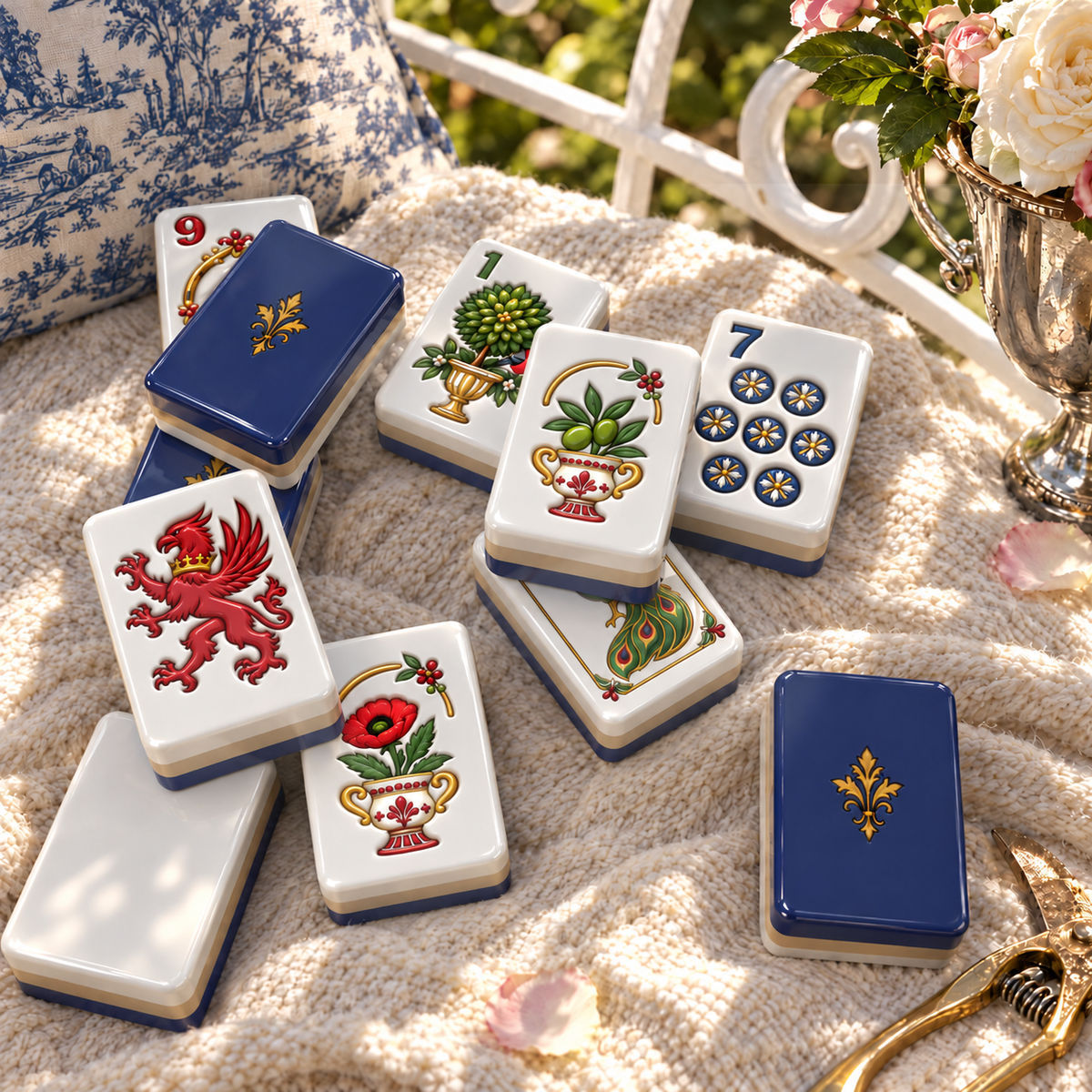
Japanese mahjong scoring awards points based on yaku (winning patterns) and han (complexity levels), multiplied by fu (base points). A complete hand earns a yaku—patterns like toitoi (all triplets), honitsu (mixed terminals/honors), or tanyao (1–9 sequence ends)—each worth 1–13 han. Fu measures tile sets: a closed pung = 4 fu, an open pung = 2 fu, plus base 20 fu per hand. Points multiply: a 3-han, 30-fu hand pays roughly 1,000 base points in a four-player game (values scale by wind position: East pays double). Winning on the final draw (tsumo) or after discard (ron) both score, though payment structure differs. Mahstead's best-selling mahjong sets serve American players; Japanese mahjong uses identical 136 tiles (13 tile types × 4 copies each) and is played with a scoring chart or calculator alongside the table.
Japanese mahjong (Riichi mahjong) uses a fundamentally different scoring system than American mahjong, based on hand complexity and winning patterns called yakus. A complete hand earns a yaku—patterns like toitoi (all triplets), honitsu (mixed terminals/honors), or tanyao (1–9 sequence ends)—each worth 1–13 han. Fu measures tile sets: a closed pung = 4 fu, an open pung = 2 fu, plus base 20 fu per hand. Points multiply: a 3-han, 30-fu hand pays roughly 1,000 base points in a four-player game (values scale by wind position: East pays double). Winning on the final draw (tsumo) or after discard (ron) both score, though payment structure differs.
What are yakus and why does every winning hand need one?
A yaku is a pattern or condition required to win at Riichi mahjong—without one, your hand is "furiten" (invalid). Each yaku carries a han value (1–13) that determines your score. Common 1-han yakus include tanyao (no terminals or honors), pinfu (no triplets, winning pair is not a dragon), and yakuhai (your pair or pung is the prevailing wind or your seat wind). Higher-han yakus—chitoitsu (seven distinct pairs), sanshoku (three color sequences in order), or kokushi (all thirteen unique tiles plus one duplicate)—reward riskier, less common hands. Multiple yakus stack: toitoi (all triplets, 2-han) plus honitsu (one suit plus honors, 3-han) = 5 han total. You must memorize at least 15–20 yakus to play; most players keep a reference chart at the table. The yaku list is identical across all Riichi variants worldwide, unlike American mahjong's annual card changes.

How does fu (base points) work and what counts?
Fu represents the structural complexity of your hand tiles and is calculated after you confirm a yaku. Base fu is always 20; then you add fu for each tile set: a closed triplet (pung you drew yourself) = 4 fu, an open triplet (called from discard) = 2 fu, a closed sequence (chow you drew) = 0 fu, an open sequence (called) = 0 fu. The pair adds 2 fu only if it is a "honor" pair (dragon, wind, or prevailing/seat wind)—a number pair adds 0. Winning by tsumo (drawing your own winning tile) adds 2 fu; winning by ron (on someone's discard) adds 0 fu. A hand must reach at least 30 fu to score unless it is a special limit hand (mangan, haneman, etc.). Example: a closed hand with one closed triplet (4 fu) + one open triplet (2 fu) + one pair (0, not an honor) + 20 base = 26 fu; if you tsumo, add 2 fu = 28 fu (still below 30, so you round up to 30). Many hands fall into simpler categories—chirashi (mixed hand, 1-han, 30 fu) is a shortcut so you do not recalculate fu every game.
What is the point chart and how do you use it?
The point chart is a grid showing han (rows, 1–13) and fu (columns, 30–40+) with pre-calculated payouts. To score: (1) confirm your yaku and count han, (2) count fu from your tiles, (3) find the intersection on the chart, (4) read the base points, then (5) multiply by player wind. In a four-player game, non-East players who win ron receive the discarder's full base points × 4; non-East who tsumo receive each opponent 1× base points. East (dealer) who wins ron receives base × 6 from discarder; East who tsumo receives base × 2 from each opponent. Example: 2-han, 30-fu hand scored by non-East ron = 1,000 base points (read from chart) → discarder pays 4,000 total. East scoring the same hand → discarder pays 6,000. Charts stop at mangan (2,000 base) and above; 5-han or 3-han + 60-fu and higher pay fixed amounts (mangan 8,000, haneman 12,000, baiman 16,000, sanbaiman 24,000, yakuman 32,000 per unit). Most players download or print a chart or use a scoring app to avoid mental math mid-game.
Scenario | Han | Fu | Base | Non-East Ron | East Ron | Notes |
Simple winning hand | 1 | 30 | 1,000 | 4,000 | 6,000 | Most common |
Mid-range hand | 3 | 30 | 3,900 | 11,700 | 17,600 | Rounds to 4,000/12,000/18,000 |
Five han (mangan) | 5 | — | 2,000 | 8,000 | 12,000 | Fixed value, fu ignored |
Haneman (6–7 han) | 6 | — | 3,000 | 12,000 | 18,000 | High-complexity reward |
Yakuman (13-han special) | 13 | — | 8,000 | 32,000 | 48,000 | Kokoushi, suuanko, etc. |
🀄 Shop best-selling mahjong sets →

How do you track scores across multiple rounds?
Riichi mahjong games typically run four rounds (one for each wind: East, South, West, North) or eight rounds (two full circuits). Each player starts with a reference score—usually 25,000 points in casual play, sometimes 30,000 in tournament format. After each hand, the winner receives points from losers and the loser's scores decrease accordingly. A running scoresheet is essential: record each player's name, starting points, then add/subtract per round. After East round completes, winds rotate: the East player moves to South, South to West, West to North, North becomes new East (or in some variants, players rotate seats but winds stay fixed). At the end of eight rounds, the player with the highest score wins; if tied, the player who won as East more times breaks the tie, or you play one extra tie-breaker hand. Tournament rules may impose a final payment: if you finish below starting score (negative), you pay a set penalty per 1,000 points; winners split the pool. This system rewards consistency and aggressive play early more than American mahjong's single-hand scoring.
What are the major differences from American mahjong scoring?
American mahjong awards one point per game (all players pay winner equally) based solely on whether your hand matches the current year's National Mah Jongg League card—no yaku requirement, no fu, no multiplier by wind. Japanese mahjong multiplies points by han, fu, and player position, rewarding complexity and risk. American uses 152 tiles (3 suits × 9 + winds, dragons, flowers, jokers); Japanese uses 136 tiles (one suit × 9 × 4 copies + 7 honors × 4 copies each), no flowers or jokers. American hands reset each year when the card changes; Japanese yakus are permanent across all games and all countries. American play is turn-based with no melds until you call: you cannot discard safely until your hand is nearly complete. Japanese play exposes melds openly (called "open" hands, often riskier but faster to complete) and allows more complex tile interactions (furiten rule penalizes calling after discarding a tile you need). Scoring speed: American = instant (1 point); Japanese = 2–5 minutes per hand (chart lookup or calculation). For players switching from American to Japanese, the shift from "just match the card" to "learn 20 yakus and memorize a chart" is steep but unlocks thousands of hand combinations instead of one year's ~50.
🎁 See our most-loved mahjong sets & accessories →
What to check before you play Japanese mahjong
If you are learning Japanese mahjong or teaching a new player:
Bring a printed or digital scoring chart to the table; mental math during play slows rounds. Bookmark a scoring app or laminate a chart.
Confirm fu calculation rules at your table before starting; some casual groups skip fu and use "simplified" scoring (only 2,000-base and above, no sub-mangan). Verify beforehand.
Use a scorekeeper app or notation sheet to track round-by-round points, especially over eight rounds or tournament play. Errors cascade quickly.
Learn the core 10–15 yakus first (tanyao, pinfu, open/closed riichi, toitoi, honitsu, chinitsu); you can add rare yakus later.
Confirm East-round payment multipliers with your group: some play "East pays/receives double," others use flat multipliers. No two casual groups are identical.
✨ Find your Mahstead set — free US shipping →
Japanese mahjong scoring is more transparent than it appears: once you anchor on the yaku requirement, han/fu multiplication, and a simple chart, hands resolve faster and feel fairer than single-point American games. The key is drilling yakus during early rounds, printing or bookmarking a chart, and tracking scores carefully. Many players moving between American and Japanese variants report that Japanese scoring feels more rewarding—your effort to create a complex hand is directly visible in point multipliers.

FAQ
Can you win a hand in Riichi mahjong without a yaku?
No. Every winning hand must contain at least one yaku (valid pattern). Hands without a yaku are furiten (invalid) and cannot score, even if the tiles form a closed triplet set. This forces strategic thinking: you chase yakus, not just tile combinations.
How is East wind different from South, West, or North in scoring?
East (dealer) receives and pays double points compared to non-East players. East ron wins 6× base instead of 4×; East tsumo wins 2× base per opponent instead of 1×. East rotation and the East advantage are why many players play conservatively when not East and aggressive when holding the wind.
What is the difference between tsumo and ron scoring?
Tsumo (drawing your winning tile) adds 2 fu and triggers shared payment: each opponent pays you 1× base points. Ron (winning on a discard) adds 0 fu and the discarder pays you the full 4× or 6× base. Ron always scores higher because of the multiplier structure.
How often do you use fu in casual play?
Most casual groups calculate fu for sub-mangan hands (below 2,000 base points) and then simplify: anything 5-han or above defaults to fixed payouts. Serious tournament play uses fu strictly for all hands; speed players or online platforms often use apps to skip mental math entirely.
Why do some Japanese mahjong groups use different yakus than others?
They don't. The yaku list is standardized globally and does not change year to year. Confusion usually stems from "simplified" house rules (some groups allow "no-yaku" wins) or regional variants like Tenhou (video game mahjong) which tweaks meld rules slightly but keeps yakus identical.
Can you play Japanese mahjong with an American mahjong set?
No. American sets have 152 tiles (flowers, extra jokers, three suits with 1–9 each); Japanese mahjong requires 136 tiles (one suit 1–9, seven honor types). The tile count and symbols are fundamentally different, and you cannot substitute.


View More
View More
View More
