
Ittsu in Riichi Mahjong Explained
Last updated: Nov 23, 2026
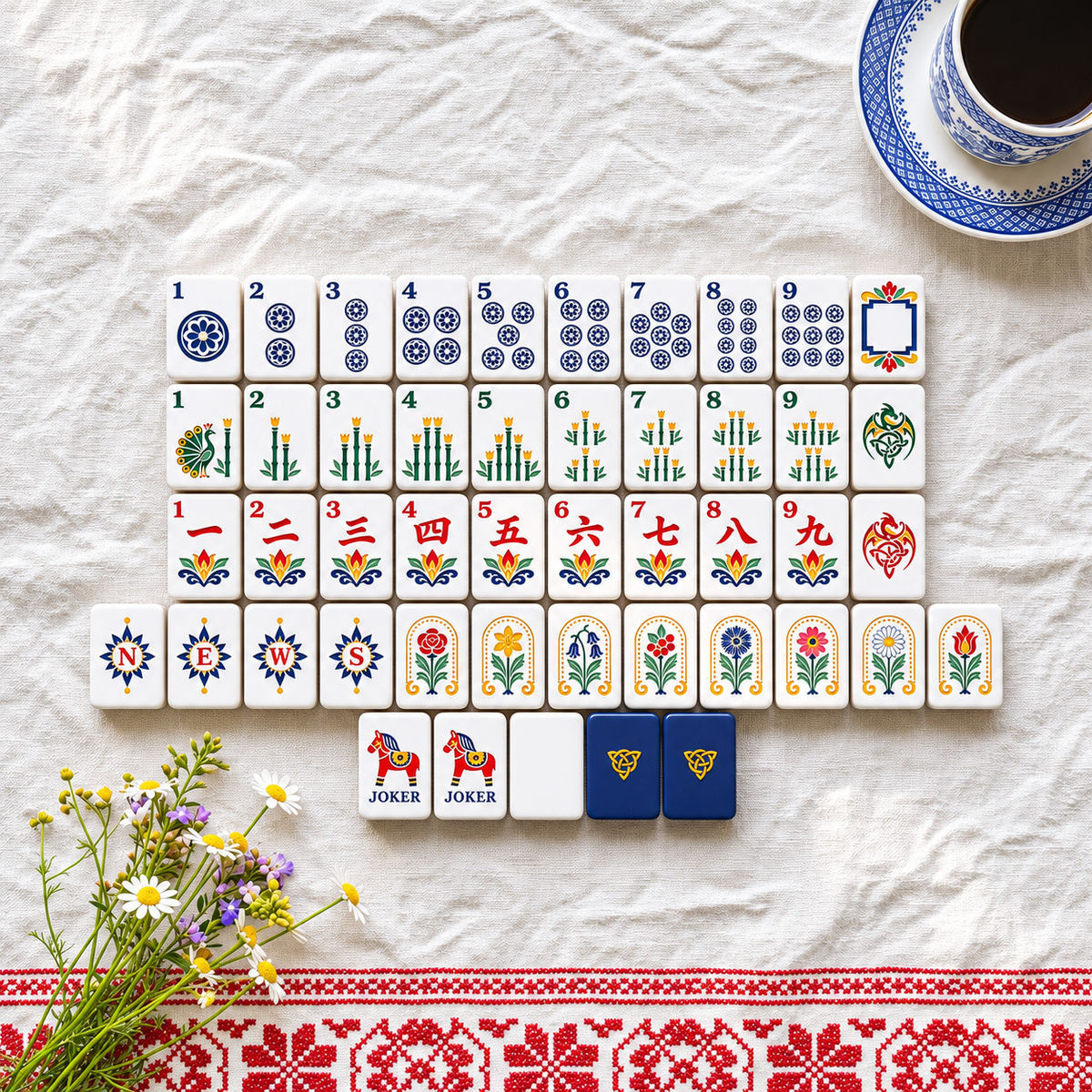
Ittsu is a yaku (scoring hand) in riichi mahjong where you hold sequences 1-2-3, 4-5-6, and 7-8-9 all in one suit (Bamboo, Characters, or Dots). Each sequence is a chow (three consecutive tiles). You complete ittsu by adding one pair (any two identical tiles) to those nine tiles. It scores 2 han (base points). Unlike American mahjong's rigid card-driven hands, riichi mahjong rewards natural sequences built during play. Ittsu is mid-difficulty to call; it's common enough to chase but rare enough to feel rewarding when you win with it. If you play riichi casually, you'll see ittsu in roughly one or two games per session.
Ittsu (一通, "one through") is one of riichi mahjong's defining hands. While American mahjong players follow a printed card each year, riichi players memorize yaku—scoring patterns—and build hands dynamically. Ittsu sits at the crossroads: it's beginner-friendly to understand but tactically demanding to assemble and recognize in live play.
We've hosted hundreds of mahjong nights, mixing American players who visit our Dallas shop with riichi regulars. The shift from "follow the card" to "remember the yaku" confuses newcomers. Ittsu is the perfect bridge: it's concrete, visual, and teaches you how sequences work in riichi.
What exactly is ittsu, and how do you win with it?
Ittsu requires three chows (sequences) in a single suit plus one pair. A chow is three consecutive tiles: 1-2-3, 4-5-6, or 7-8-9. You need all three of those sequences in Bamboo, Characters, or Dots—never mixed suits. Your pair can be any two identical tiles: a dragon, a wind, a tile from your suit, or even a terminal (1 or 9). Ittsu completes when you draw or claim a discard that fills your final meld or pair.

How does ittsu differ from American mahjong hands?
American mahjong ties all hands to the yearly National Mah Jongg League card. You memorize patterns on that card (by section), and you call "meld" when your tiles match one printed hand exactly. Riichi mahjong has no card; instead, you learn yaku and build hands from the tile flow. Ittsu is radically simpler in one way: you only need to remember three sequences and a pair. But it's harder tactically because you must read your opponents' discards, anticipate draws, and decide when to go "riichi" (lock your hand and wait for one final tile). American mahjong favors memorization; riichi favors observation and gambling.
Why is ittsu a high-value yaku in competitive riichi?
Ittsu scores 2 han, which in many scoring systems translates to mangan (2,000 points for non-dealer) or higher depending on fu. Two han is respectable—not a quick win, but solid money. The value comes partly from scarcity: drawing or claiming tiles to complete three full sequences is harder than, say, an all-pung hand. Strategically, you signal weakness by chasing ittsu; you must discard openly, tempt your left-hand opponent (the player who discards to you) to give you safe tiles, and stay patient. Conversely, if you see an opponent greedily collecting 1s, 2s, 3s, 4s, 5s, 6s, 7s, 8s, and 9s of one suit, you can block them by hoarding those tiles or discarding dangerous ones late. Ittsu teaches reading.
What's the step-by-step process for building ittsu in live play?
Step 1: Decide your suit early (often Bamboo or Dots in casual games, Characters in tight defensive play). Step 2: Stay open to calls. You need at least nine tile draws and strategic claims from opponents. Step 3: Build sequences systematically. Prioritize one sequence first (say, 1-2-3), then work the second, then the third. A half-built sequence (two tiles waiting for one) is called a "ryanmen" or "side wait"—chase these early. Step 4: When two sequences are solid, commit to riichi or enter "tanyao" (if chasing all simple tiles) to lock your hand and accelerate draws. Step 5: Discard unpaired, unrelated tiles. If your pair is a Wind, discard Dragons and your suit's pair-candidates until forced. Step 6: Claim with "pon" (pung) or "chow" if a discard speeds you up—but calling slows your hand slightly and signals your strategy to all players. Many competitive players stay concealed as long as possible.
Common mistakes beginners make when chasing ittsu
Mistake 1: Changing suits midway. You've got 1-2-3-4-5-6 in Bamboo, then draw a tempting 1-2-3 in Dots. Beginner instinct: "I'll go for a pair of hands." Reality: You abandon both. Stick to one suit. Mistake 2: Over-calling early. Calling "chow" on a discard feels safe, but you expose your intention and slow your draw rate (concealed tiles draw faster). Only call if the tile directly completes a sequence you'd otherwise struggle to find. Mistake 3: Ignoring your hand's backup yaku. While chasing ittsu, keep a secondary win condition (like a pung-heavy hand or honaoroshi—all terminals and honors). If ittsu stalls, you bail to the backup and win small rather than lose. Mistake 4: Discarding unsafe tiles too late. Once three players have discarded a Bamboo 3, the fourth player's hand is likely "waiting" on that tile—calling it is risky. Track the discard tile count by suit and sequence to avoid feeding someone their win.
Beginner Error | Why It Happens | Fix | Result |
Suit switching | Greed; seeing two similar starts | Commit to one suit by turn 3 | Consistent tile flow, fewer dead draws |
Over-calling | Fear of missing; feeling "safe" | Call only if claiming completes a sequence | Concealed bonus speeds your hand |
Ignoring backup yaku | Tunnel vision on ittsu | Build a second win condition passively | Escape route if ittsu freezes |
Late unsafe discard | Not tracking disposed tiles | Count suits; discard blocked tiles first | Avoid feeding opponents; stay safe longer |
How do you read your opponents' ittsu chase?
Watch discard order and speed. If a player rapidly discards 5s, 6s, and 8s—keeping 1s, 2s, 3s, 4s, 7s, and 9s—they're chasing ittsu or a terminal hand. If they call "chow" greedily, they're rushing. If they call rarely, they're protecting a concealed bonus. Count their tile claims: three calls means three melds (often chows), which points toward ittsu, pung-heavy hands, or straight hands. If a player discards their suit's 1 and 2 early, they likely aren't chasing ittsu in that suit. Riichi mahjong is a poker-like read. After a few games, you'll spot ittsu chasers instantly.
🀄 Shop best-selling mahjong sets →

What tiles and equipment do you need to play riichi mahjong?
Riichi uses the same 136-tile standard set as classic Chinese mahjong (four copies each of 1–9 in Bamboo, Characters, and Dots; four each of North, East, South, West winds; four each of Red, Green, White dragons). American mahjong sets contain extra tiles (flowers, jokers) and are not suitable for riichi. If you're learning riichi seriously, buy or borrow a Chinese/Japanese set specifically marked for riichi play. Our best-selling mahjong sets are designed for American play, but understanding the equipment difference helps when you transition games.
You'll also benefit from a dedicated mat—riichi typically uses a smaller, harder-surfaced mat than American play (which favors cushioned surfaces). Keeping clear tile lines is crucial for tracking sequences and discards. A set of four racks with pushers helps you organize chows and pairs visibly, and a sturdy travel bag protects your riichi set during transport to clubs or tournaments.
Ittsu scoring: how many points is it really worth?
Ittsu alone = 2 han. In the most common riichi scoring system (tenhou/chiitoitsu variant), 2 han + fu determines payout. With minimal fu (30–40, typical for simple hands), you earn 2,000–3,000 points as non-dealer. Dealer wins are roughly 1.5× higher. If your ittsu pairs with another yaku (say, all simple tiles, or a wind pair), you stack to 3–4 han, worth 4,000–8,000 points. The system rewards combination, not raw yaku count. One player we see weekly chases ittsu + pinfu (all chows, no honor melds) for a clean 4-han combo. Once it clicks, you play riichi less mechanically and more like a mathematician.
How does ittsu fit into your overall riichi strategy?
Ittsu is a mid-tier yaku. It's worth chasing if your tiles naturally fall into a three-sequence pattern, but it's not your primary goal in most hands. Compare it to other 2-han yaku: pinfu (all chows, simple pair, no melds) is easier and often wins faster; tanyao (all simple tiles, 2–8) is rarer but higher-reward. Ittsu shines in "open play" (calling and claiming melds) because revealing sequences doesn't spoil the yaku. Beginners often spend too much energy on ittsu when a quick tanyao or pung-heavy hand would pay out sooner. Advanced players use ittsu as a psychological bluff: they chase it aggressively to hide a concealed pung hand building underneath. Riichi mahjong rewards layered thinking. Ittsu teaches you to build toward a primary win, scout a secondary, and feint a third.
🎁 See our most-loved mahjong sets & accessories →
What to check before you play riichi with an American set
If you own only an American set (with flowers and jokers), don't try riichi on it—you'll have 160 tiles instead of 136, and flowers break the yaku system entirely. Riichi is unforgiving about tiles. You need a Chinese-standard set. If you're testing riichi casually with friends, borrow or buy a dedicated riichi set; the clarity will help you learn yaku faster. Once you commit to riichi seriously, invest in a quality set with clear tile markings, a protective mat, and a travel bag if you play at clubs. Clean, durable equipment removes distractions and lets you focus on strategy—the real game.
Playing ittsu in mixed American/riichi groups
If your game mixes American and riichi players, you'll eventually face the "which rule set?" question. Our advice: designate game nights. Riichi Tuesday, American Thursday. Forcing one set on both communities frustrates everyone. However, American players curious about riichi often start by learning ittsu as a first yaku because it's visual, memorable, and teaches sequence thinking without the full yaku library. If you're teaching someone riichi, start with ittsu, tanyao (all simples), and yakuhai (honor tiles) as your first three yaku. Once those click, expand to 20+ yaku at a club or via study. Ittsu is your bridge hand.
✨ Find your Mahstead set — free US shipping →

FAQ
Is ittsu the easiest yaku to win with?
No. Tanyao (all simple tiles 2–8) and yakuhai (three or more honor tiles as melds) are simpler. Ittsu is mid-difficulty; you need three full sequences plus a pair, which requires patience and open calls.
Can I make ittsu with mixed suits (1-2-3 Bamboo, 4-5-6 Characters, 7-8-9 Dots)?
No. Ittsu requires all nine tiles from one suit only. Mixed suits form a different hand (chinitsu incomplete or other yaku).
Does ittsu count if I call "chow" on every sequence, or do I need concealed sequences?
Ittsu counts regardless of whether sequences are called or concealed. Calling doesn't reduce the yaku value, but concealed tiles award a fu bonus, which raises payout slightly.
How many games will it take me to see ittsu regularly?
In casual riichi play, roughly one ittsu appears per 5–10 games played (not always won—often declared but blocked). In competitive play, every session has 2–3 ittsu attempts.
Can I combine ittsu with pinfu (no melds)?
Yes. If your three sequences are all called "chow," you have no honor melds and a simple pair—that's pinfu stacked with ittsu, worth 4 han total. It's rare and highly valuable.
Should I switch to riichi mahjong if I only know American rules?
No pressure. Both are complete games. American mahjong is easier to learn (card-based); riichi is deeper strategically. Try riichi casually to expand your skill. Many players enjoy both.


View More
View More
View More
