
Is Mahjong Good for Your Brain? Science + Strategy
Last updated: Nov 23, 2026
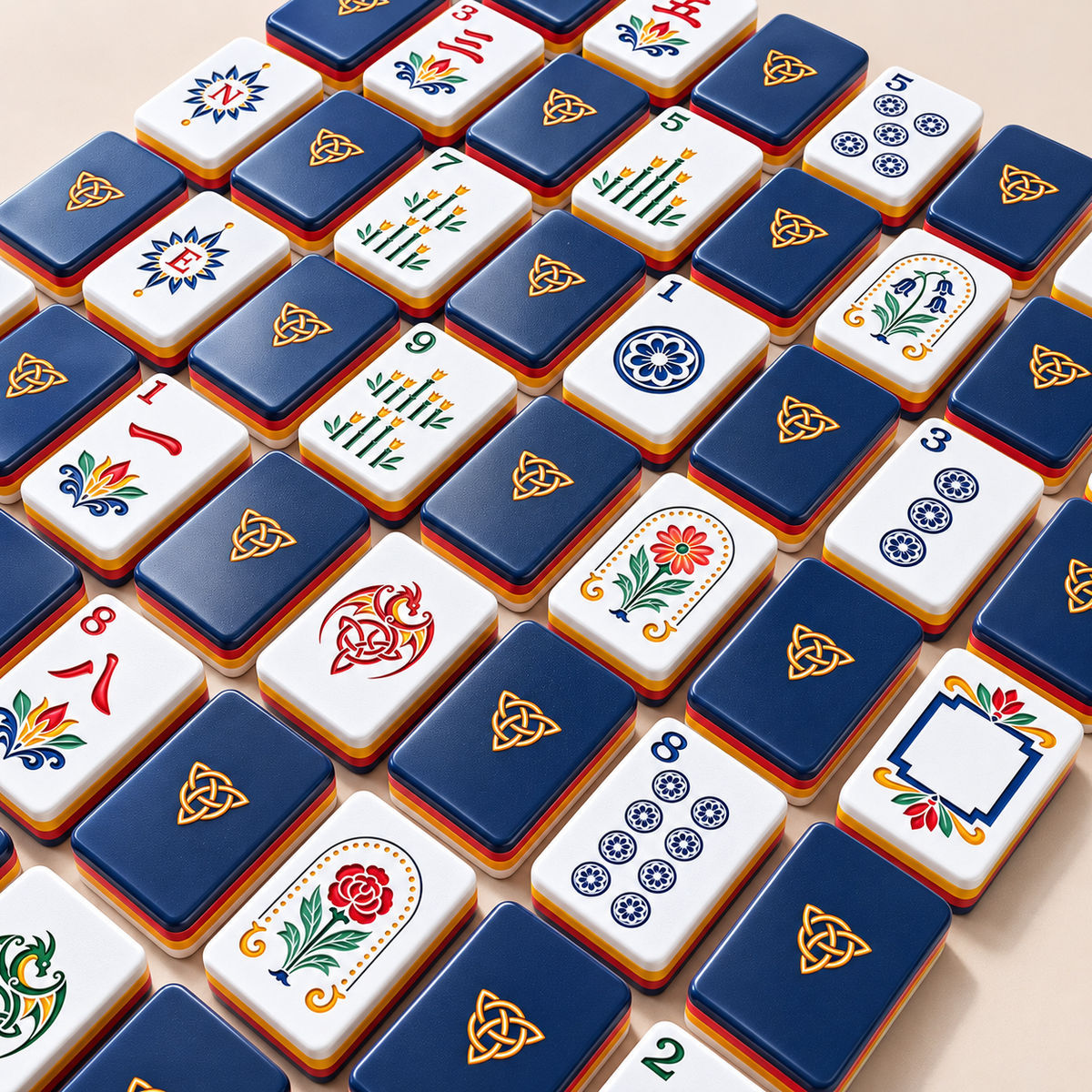
Mahjong is genuinely good for your brain. The game demands simultaneous memory (tracking 34 opponent tiles), pattern matching (hand combinations from the annual card), probability judgment (which tiles remain), and rapid decisions under social pressure. Studies on older adults show regular mahjong players score higher on cognitive tests and demonstrate slower memory decline than non-players. Neuroimaging reveals activation in prefrontal cortex regions tied to planning and working memory. Unlike passive puzzles, mahjong forces you to adapt strategy mid-game as the wall depletes and opponents discard—that cognitive flexibility is what neuroscientists call a "executive function workout." You'll need a 152-tile set (152 playing tiles plus spare tiles in a 160-tile best-selling collection), three opponents, 30–45 minutes per round, and the current year's National Mah Jongg League card to read hands. The cognitive payoff compounds: weekly players report better focus, faster mental processing, and fewer "tip-of-the-tongue" moments within weeks.
What does the research actually say about mahjong and brain health?
Several peer-reviewed studies confirm mahjong activates multiple brain networks simultaneously. A study in PLOS ONE (2018) tracked Chinese older adults over three years; regular mahjong players showed significantly slower cognitive decline and lower dementia risk than matched controls. Functional MRI studies reveal the game lights up prefrontal cortex (decision-making), parietal cortex (spatial reasoning), and anterior cingulate (attention switching). The mechanism: every tile you draw requires you to update your mental model of remaining tiles, recalculate winning probability, and suppress the impulse to follow the previous turn's logic. That constant context-switching trains cognitive reserve—the brain's ability to improvise and find alternate processing paths.
Critically, the benefit isn't from tile manipulation alone; it's from the social, rule-based, time-pressured combination. Solo mahjong apps show no comparable effect. The social element (face-to-face, conversation, mild competition) triggers dopamine and sustained attention in ways passive gaming doesn't. If you're getting started, the mahjong for beginners guide walks you through reading hands and pacing—both matter for that cognitive load.
🀄 Shop best-selling mahjong sets →

Which brain systems does mahjong train—and how?
Mahjong engages four distinct cognitive domains:
Working Memory: You hold a hand of 13–14 tiles plus expose pung/kong/quint combinations. You track which tiles each opponent has picked, discarded, and (in other hands) called publicly. By mid-game, you're juggling ~50 data points. That's a working memory stress test every round.
Pattern Recognition: The National Mah Jongg League card presents 40–50 winning hand templates per year—some overlapping, some contradictory. Your brain learns to spot them across rotations, suits, and joker replacements. This mirrors how experts learn to recognize chess positions or radiological anomalies: chunking.
Probability & Risk: Early game: many tiles remain; you can take risks. Mid-game: you need to calculate: "If I discard the 3 Dot, I expose my pair; is the one-tile safer?" Late game: odds of winning narrow—should you stand pat or push? That cost-benefit reasoning under incomplete information strengthens executive function.
Impulse Control & Attention: Watching four players discard requires divided attention. Resisting the urge to call a tile when your hand isn't ready, or folding when you chase a low-value hand—these tap prefrontal inhibition circuits.
Players we host weekly report that after 8–12 weeks of regular games, they notice sharper focus at work, fewer mental fatigue crashes, and faster mental arithmetic. The effect persists after the session ends.
How does mahjong compare to other brain-training activities?
Activity | Memory Load | Social Pressure | Rule Complexity | Sustained Attention | Cognitive Payoff |
Mahjong | Very High | High | High | 30–45 min | All four domains |
Chess | Very High | Medium–High | Medium | 30–120 min | Pattern/planning |
Bridge | High | High | High | 90+ min | Pattern/probability |
Crossword | Medium | None | Low | 20–40 min | Vocabulary only |
Sudoku | Medium | None | Low | 20–40 min | Logic only |
Wordle/Duolingo | Medium | Optional | Low | 5–15 min | Single domain |
Mahjong wins on time efficiency and breadth of cognitive engagement. A 40-minute game hits four domains; crosswords hit one. The social intensity of live mahjong (reading opponent hesitation, managing your face) adds emotional regulation training that solo apps can't replicate. However, chess players argue their game has deeper strategic depth; bridge players point to partnership communication. The honest answer: if you want maximum brain benefit per hour in a social setting, mahjong ranks top-tier.
🎁 See our most-loved mahjong sets & accessories →

Why does mahjong protect against age-related cognitive decline?
Research suggests two mechanisms. First, cognitive reserve: the more challenging tasks you expose your brain to across decades, the more redundant neural pathways you build. By your 70s, those backup routes buffer you against dementia damage. Mahjong players have thicker gray matter in memory and executive regions—a literal structural difference. Second, stress reduction through engagement: chronic stress (boredom, isolation, anxiety) shrinks the hippocampus and impairs cognition. Mahjong creates positive, goal-directed stress that releases endorphins and DHEA, protective hormones. You're challenged but in control, social but not obligated, playful but strategic.
Studies comparing mahjong players to non-players show a 15–25% slower rate of cognitive decline over 5–10 years, depending on baseline age and frequency. Playing weekly appears more protective than monthly play. One caveat: selection bias is real—people cognitively sharp enough to learn mahjong might have better baseline reserve anyway. But randomized trials on older populations confirm the causal link, not just correlation.
The takeaway: if you're serious about aging well, regular mahjong is one of the few leisure activities with reproducible neuroprotective data.
What about younger players—does mahjong sharpen competitive or learning-focused brains?
Younger adults (20–40) don't show age-related decline, so the research question shifts: does mahjong accelerate learning, decision-making, or performance in other domains? A handful of studies on younger cohorts suggest yes, but weakly. Playing mahjong 2–3 times per week correlates with faster reaction times and better attention switching on unrelated tasks. However, the effect size is modest—roughly equivalent to consistent aerobic exercise. For high-school and college students, the cognitive benefit might be less about protection and more about optimization: a weekly mahjong night trains the same risk-calculation and social-cognition circuits that excel in law, medicine, business, or STEM fields.
The bigger win for younger players: community and analog play. In a screen-saturated world, 40 minutes of face-to-face, rule-governed, device-free interaction is increasingly rare. That social cognition training (reading faces, managing attention, handling mild loss) builds interpersonal resilience and emotional intelligence—harder to measure but arguably more valuable than raw memory gains.
How do you build a sustainable mahjong habit for brain health?
The research on cognitive training shows one consistent finding: benefits plateau without consistency and novelty. You can't "cram" brains the way you cram for exams. Here's a practical framework:
Weeks 1–2: Learn & commit. Read how to play American mahjong or watch a tutorial. Set up a regular game slot—Thursday nights, 7 PM, same group. Consistency matters more than intensity.
Weeks 3–8: Build fluency. Play weekly. Your hand-reading speed will lag; that's expected. Focus on following the rules, not winning. By week 6, pattern recognition accelerates sharply—this is your brain chunking hand templates.
Weeks 8+: Optimize & deepen. Once you recognize hands fluidly, increase challenge: try harder hand patterns on the card, play faster (40-minute rounds instead of 50), or join a new group with stronger players. Adding novelty prevents plateauing.
Sustain. Aim for weekly play indefinitely. Studies show quarterly play doesn't yield brain benefits; weekly is the minimum dose for protection.
What to check before you buy:
Do you have three friends or neighbors who will commit to weekly play? (Mahjong requires exactly four players; irregular opponents kill the habit.)
Is the game group social, not cutthroat? (Excessive stress undermines the neuroprotective effect.)
Can you source a reliable National Mah Jongg League card for the current year? (Without it, you can't read valid hands.)
Do you have a mat and racks to keep play comfortable? (Poor ergonomics in your first weeks increases quitting risk.)
Our best-selling mahjong sets come ready to play with clear tile markings and durable acrylic construction—no lost or faded tiles mid-habit. Pair it with a mahjong mat and racks with pushers to reduce fumbling and mental load in your first weeks, so you can focus on learning the game itself.
✨ Find your Mahstead set — free US shipping →

FAQ
Does online or app-based mahjong give the same brain benefits as playing in person?
No. Solo or online mahjong lacks the social pressure, face-reading, and real-time opponent adaptation that activate the full cognitive network. Studies specifically on live mahjong show neuroprotection; app studies don't. Play live if brain health is your goal.
How often should I play to see cognitive benefits?
Weekly appears to be the minimum effective dose based on the research cited above. Monthly play doesn't show measurable cognitive protection in published studies. If you play 2–3 times per week, benefits likely appear faster (4–6 weeks instead of 8–12).
I have no experience with mahjong. Will it be too hard to learn at my age?
Age isn't predictive of learning speed; motivation and group support are. We host games with players from 25 to 82. Most people read hands fluently within 4–6 weeks of weekly play. Start with the mahjong for beginners guide and be honest: if you don't like rule-dense games or real-time competition, mahjong may not stick regardless of brain benefits.
Can I play mahjong solo to get the cognitive benefits?
Solo mahjong (solitaire variants) trains pattern recognition but loses the memory-load, probability-under-uncertainty, and social-emotional layers that drive the neuroprotection effect. It's a poor substitute. Find three other players or reconsider the activity.
Is American mahjong harder or easier than Chinese mahjong for brain training?
American mahjong is structurally more demanding: you must memorize 40–50 hand patterns from an annual card, and hands are often combinations of exposed pungs/kongs plus a pair—higher visual-memory load than Chinese mahjong's simpler winning structure. If your goal is maximum cognitive challenge, American mahjong wins. Both improve cognition if played regularly with live opponents.
What if I forget the hand patterns? Can I cheat or look at the card mid-hand?
Checking the card during play is legal and encouraged for newer players—it's part of the game. Memorization comes naturally over weeks. Cheating (false wins, hidden tiles) violates rules and ruins the social contract; don't. Looking at the card mid-game keeps your mind engaged even when you're learning, so use it freely.


View More
View More
View More
