
How to Play Taiwanese Mahjong: Rules, Tiles, and Scoring
Last updated: Nov 23, 2026
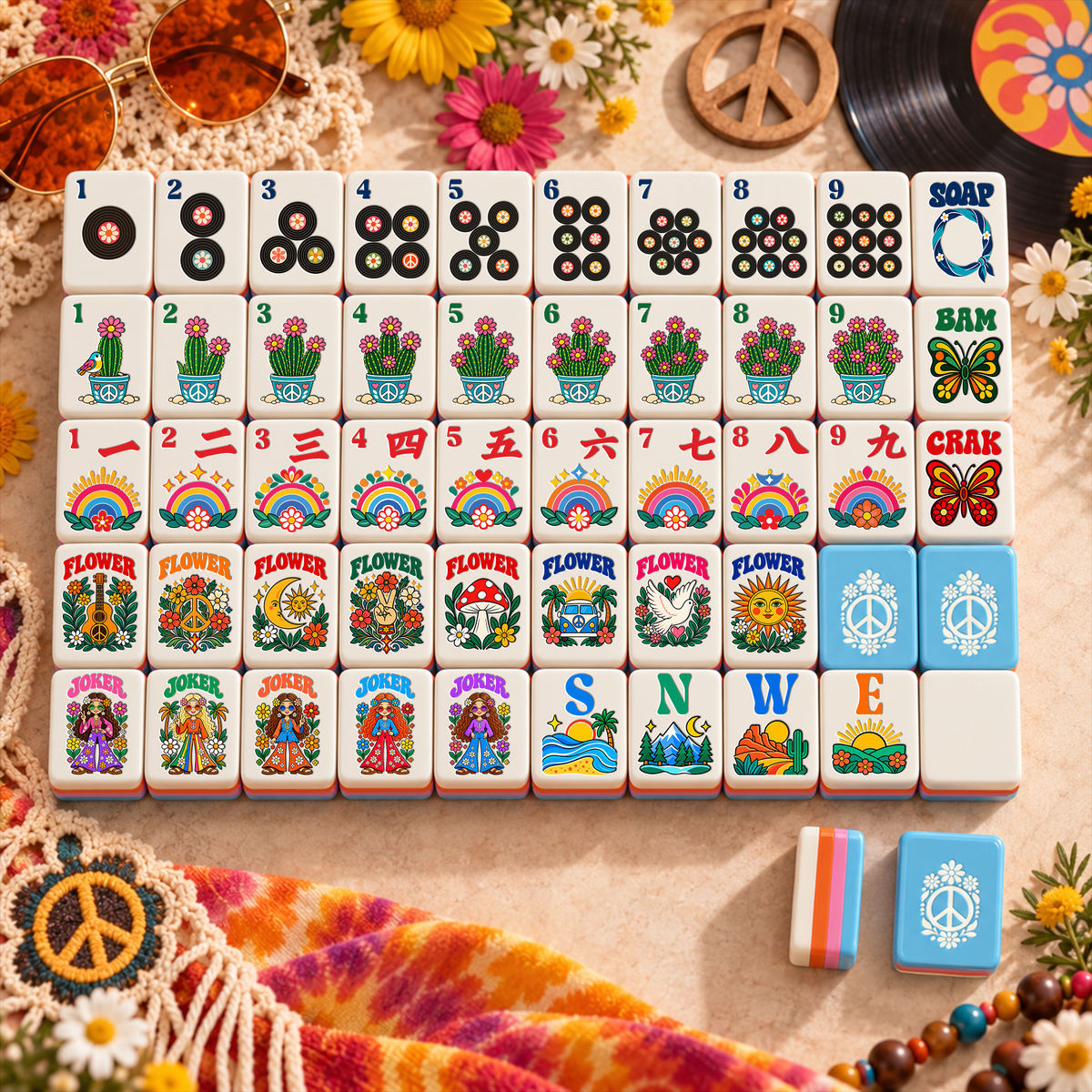
Taiwanese mahjong uses a 144-tile deck (suits: Bamboo, Character, Dot × 1–9, plus 16 winds, 12 dragons, 8 flowers) in a four-player game where each player draws 16 tiles at start. Unlike American mahjong, there is no hand card—players memorize or recognize winning patterns on the fly. A round lasts 4–8 minutes; a player wins by completing a legal hand (typically four groups of three plus a pair, though some combos include all pairs or all simples). Scoring is point-based, fast, and often uses betting chips. Taiwanese mahjong emphasizes discard reading, tile counting, and luck; no jokers exist, and draws happen rapidly. Beginners learn it in one or two sessions. We recommend our best-selling mahjong sets as a way to study American patterns first, then adapt to Taiwanese tile recognition once you understand the core groups.
Taiwanese mahjong is played in living rooms across Taiwan, Singapore, and Chinese diaspora communities worldwide. It evolved from classical Chinese mahjong and stripped away the hand card and complex melds, leaving pure pattern-matching and speed. The game moves faster than American mahjong, with rounds resolving in minutes, and wins often trigger immediate payouts or point settlements. If you've played American mahjong, Taiwanese mahjong will feel familiar in tiles and groups—but the pace and lack of a reference card make it feel like a different game.
What tiles do you use in Taiwanese mahjong?
A Taiwanese mahjong set has 144 tiles, not 152. The core is three suits (Bamboo, Character, Dot)—numbers 1 through 9, four copies of each (36 per suit, 108 total). Add 16 winds (North, East, South, West, four of each), 12 dragons (Red, Green, White, four of each), and 8 flowers (Spring, Summer, Autumn, Winter, Plum, Orchid, Bamboo, Chrysanthemum). There are no jokers or blanks. In a four-player game, 16 tiles stay in the wall; 128 are drawn. The deck is fixed and deterministic—no substitutes. If you own an American set, you can play Taiwanese mahjong by removing the jokers and extra blank tiles and using only 144 tiles; American and Taiwanese tiles are identical in suit and number, so translation is seamless.

How do the deal and hand setup work?
One player is the Dealer (often East wind). The Dealer rolls dice to determine who draws first. Players take turns drawing 16 tiles in four rounds of four (4-4-4-4), working counter-clockwise. After the fourth draw, the Dealer draws tile 17 (the "first draw" of play). The other three players now hold 16 tiles each; the Dealer holds 17. No player ever sees a printed hand card. All patterns must be recognized and remembered—or deduced from discards and wall flow. A player who cannot recall all 49 possible hand patterns is at a disadvantage, but luck and discard reading carry the game. Beginners often write down patterns on scrap paper during early practice.
What patterns win, and how do you score?
A standard winning hand is four groups (pung, kong, or sequence) plus one pair. A pung is three identical tiles (e.g., three 5 Bamboo); a kong is four identical tiles; a sequence (chow) is three consecutive numbers in the same suit (e.g., 4-5-6 Dots). A pair is two identical tiles. Examples: (pung: 5-5-5 Bamboo) + (sequence: 1-2-3 Character) + (kong: 9-9-9-9 Dot) + (sequence: 4-5-6 Dot) + (pair: East-East). Hand combinations vary—all pairs, all simples (no honors), all terminals, mixed counts—and each has a point multiplier. Scoring is immediate: the winner collects payment from the other three players based on hand value. A basic pung hand might pay 1 unit; an all-pairs hand or a hand with many honor tiles might pay 4–8 units. Fast and high-variance, Taiwanese mahjong is as much luck as skill, unlike the long-term percentage play in American mahjong.
How is Taiwanese mahjong different from American mahjong?
Feature | American | Taiwanese |
Tile count | 152 (8 jokers) | 144 (no jokers) |
Hand card | Yes (required) | No (memorize patterns) |
Play duration | 45 min–2 hours | 4–8 min per round |
Sequences allowed | No (American-only rule) | Yes (chows are legal) |
Exposed melds | Pungs, kongs, quints, sextets | Pungs, kongs, sequences (any size) |
Discard pacing | Deliberate | Rapid |
Scoring | Point spreads at round end | Immediate payout per hand |
Lucky tile draws | No; draws are known | Yes; drawing from the wall is crucial |
American mahjong is a reference-card game that tests your ability to read the current-year National Mah Jongg League card and plan ahead across a full 45-minute round. Taiwanese mahjong is a speed game: you are handed tiles, you see a win coming (or you don't), and you discard aggressively to keep your options open. American mahjong rewards long-term tile tracking; Taiwanese rewards fast recognition and gambling nerve. Neither is harder—they are different games played on the same tiles.
🀄 Shop best-selling mahjong sets →

How do you master discard reading and speed?
In Taiwanese mahjong, the discard pile is the primary source of information. When a player discards a tile, they are signaling what they do not need. If East discards a 3 Bamboo and North discards a 3 Character, you infer that neither is building a low-count hand (1-2-3-4-5 runs are common). Smart players count discards in their head: how many Reds are gone? How many sequences of 1-2-3 are still possible? Over 20–30 hands, you internalize which tiles move early and which linger in the wall. Speed comes from repetition. New players should play 10+ hands in one sitting to build muscle memory. Within a week of weekly play, your eyes will scan your hand automatically and spot patterns without conscious effort—the same way you read English words without sounding them out. Veterans can see a winning hand three discards in advance and know which tile to throw to stay flexible.
What are common beginner mistakes, and how do you avoid them?
Holding too many honor tiles early. Winds and dragons feel valuable because they complete groups without sequences, but a hand of 14 honors and 2 simples is unwinnable. Discard honors aggressively unless you are building a specific honor-heavy hand. Not counting the wall. If 30 tiles have been drawn and 18 discarded, 96 remain in the wall—and only 18 draws are left before the hand ends. Playing as if you have unlimited draws is a sure path to defeat. Forgetting pairs. A pair is the hardest part of the hand to complete. Keep at least two candidates for pairs (e.g., hold two 5 Bamboos and two East winds) so you have backup. Ignoring discard patterns. If three 7 Craks have been thrown, do not wait for the fourth; pivot. Discard history drives probability. Playing too many hands in a row. Taiwanese mahjong is psychologically demanding because it is fast. Take a 5-minute break after four rounds; your decision-making will improve.
🎁 See our most-loved mahjong sets & accessories →
What should you check before you buy a Taiwanese mahjong set?
Tile count: Confirm the set has 144 tiles and no jokers. Many mass-market sets are 144-tile but include blanks or feature jokers in an honor slot—useless for Taiwanese play. Tile size and weight: Taiwanese tiles are often slightly smaller and lighter than American tiles (comfort matters during 20-tile sessions). Honor tile clarity: Winds and dragons must be unmistakably clear; if a Red and a White dragon look similar, misreads will happen. Backing material: Choose acrylic or plastic with a felt backing if the set will be played on a wood or glass surface; poor backing causes tiles to slip and slow the game. Rack quality: Racks with pushers are not essential in Taiwanese mahjong (some players prefer to hold tiles in hand), but they reduce tile spillage and keep your hand organized. Case or bag: Taiwanese players often store their set in a compact cloth bag; a rigid case is less common because sets travel frequently between homes.
Taiwanese sets sold at our shop are full 144-tile acrylic sets, typically thicker and more durable than casual plastic versions. Check our full collection of best-selling mahjong sets to compare build quality and designs—we pack all sets with care for US shipping, and many players use our sets for both American and Taiwanese play by swapping in or removing the hand card.

FAQ
Can I use an American mahjong set to play Taiwanese mahjong?
Yes. Remove the jokers and any blanks, leaving 144 tiles. The suit names are identical (Bamboo, Character, Dot), and tile artwork is the same. American sets are slightly heavier, but gameplay is unaffected. Many households keep one set and switch games by pulling out or hiding the hand card.
Do I need to memorize all 49 Taiwanese hand patterns before I play?
No. Write patterns on index cards or a sheet of paper and keep them at the table for your first 10 hands. After 20–30 hands, most patterns become automatic. Speed will come naturally as familiarity grows.
How long does a round of Taiwanese mahjong take?
Typically 4–8 minutes. Deal takes 1 minute, play lasts 3–7 minutes depending on how quickly someone wins or the wall is exhausted. A full session (four players, 16 rounds, one set) takes about 2 hours including breaks.
What is the difference between a pung and a kong in Taiwanese mahjong?
A pung is three identical tiles; a kong is four identical tiles. Both are exposure-ready (you can announce them and place them face-up to show the table). A kong is rarer and usually signals a strong hand, but it also uses four tiles that could have been part of pairs or sequences elsewhere.
Is Taiwanese mahjong harder than American mahjong?
They are differently demanding. American mahjong requires strategic planning over 45 minutes and mastery of a yearly hand card. Taiwanese mahjong demands rapid pattern recognition and nerve—you have seconds to decide. Most players find Taiwanese easier to learn (fewer rules) but harder to win consistently (higher luck factor).
Can fewer than four players play Taiwanese mahjong?
Formally, no—the 144-tile deck and deal structure are built for four. Three-player variants exist but require house rules and are not standard. American mahjong supports 2–4 players; if you want flexible player counts, American is a better choice.
What tiles should I discard first in Taiwanese mahjong?
Discard honors (winds, dragons) and edge numbers (1s and 9s) first unless they are part of your intended hand. Throw the most common/most-recently-drawn tiles to stay unpredictable. Keep mid-range numbers (4-5-6) and pairs longer; they are harder to replace.


View More
View More
View More
