
How to Play Singapore Mahjong: Rules & Tile Setup
Last updated: Nov 23, 2026
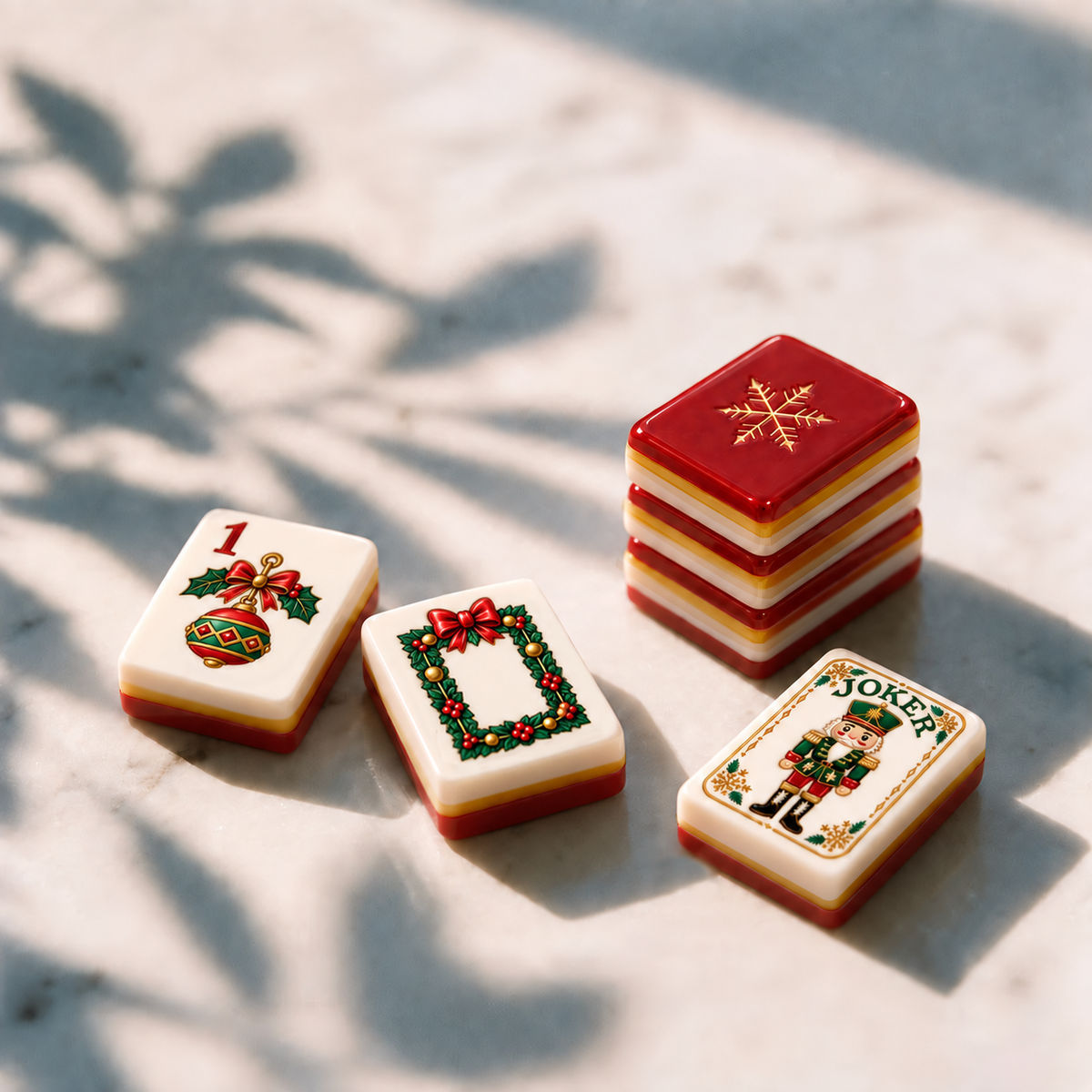
Singapore mahjong uses 144 tiles (four each of Bams, Craks, Dots 1–9; winds; dragons; flowers; seasons) with four players sitting at a table. Each player draws 13 tiles at the start, then draws and discards one tile per turn until someone melds four groups plus a pair (winning hand). Unlike American mahjong, Singapore allows melds of three consecutive numbers in the same suit—called chows—which can be called and exposed on the table. Jokers are not used. Rounds last 15–30 minutes. A hand costs nothing to join; scoring depends on the winning tile, hand composition, and house rules. Players moving between variants often trip up on chows (forbidden in American play) and the absence of jokers. Mahstead sells acrylic American mahjong sets, so if you're hosting cross-variant nights, keep a dedicated set for Singapore play.
Singapore mahjong is a fast-paced variant played with 144 tiles (four each of Bams, Craks, Dots 1–9; winds; dragons; flowers; seasons) with four players sitting at a table. Each player draws 13 tiles at the start, then draws and discards one tile per turn until someone melds four groups plus a pair (winning hand). Unlike American mahjong, Singapore allows melds of three consecutive numbers in the same suit—called chows—which can be called and exposed on the table. Jokers are not used. Rounds last 15–30 minutes. A hand costs nothing to join; scoring depends on the winning tile, hand composition, and house rules. Players moving between variants often trip up on chows (forbidden in American play) and the absence of jokers. Mahstead sells acrylic American mahjong sets, so if you're hosting cross-variant nights, keep a dedicated set for Singapore play.
What tiles do you use for Singapore mahjong?
Singapore mahjong uses 144 tiles total: Bams (cracked sticks), Craks (characters), and Dots (circles), each numbered 1–9 in four copies. Add four winds (North, East, South, West in four copies), three dragons (Red, Green, White in four copies each), plus four flowers and four seasons. No jokers exist in Singapore play. Before each round, one tile is set aside as the "dead wall"—it's not drawn into play. The tiles are usually bone and bamboo or acrylic, with Chinese characters and symbols on a white or cream face. If you own an American set, you cannot use it for Singapore play; American sets include jokers and different tile counts, so buy or borrow a dedicated 144-tile set from a player or instructor in your area.

How is Singapore mahjong dealt and what happens first?
The dealer (East wind) sits at the table with three other players. Each player draws tiles one by one from a face-down wall until each holds 13 tiles; the dealer then draws one more, making 14. The dealer discards one tile face-up in the center. Play moves counterclockwise (West, North, South, then back to East). Each non-dealer player draws one tile from the wall, melds if able, and discards one tile face-up. If a discard matches another player's hand, that player may call it to complete a pung (three identical), kong (four identical), or chow (three consecutive in one suit). Called tiles are placed face-up on the caller's rack to show the meld. If no one calls, the next player draws and plays. The round ends when someone completes four melds plus a pair and announces the win, or when the wall runs out (a draw). Learning to spot calling opportunities quickly makes Singapore play snappier than American play.
What counts as a winning hand in Singapore mahjong?
A winning hand is four melds—each a pung (three identical tiles), a kong (four identical), or a chow (three consecutive numbers, same suit)—plus one pair (two identical tiles). For example: three 5 Dots, three 7 Craks, 2–3–4 Bams (a chow), East wind–East wind–East wind (a pung), plus two White dragons (the pair). The 14th tile (the final draw or called tile) must complete one of the melds or the pair; you cannot win by holding a hand that's already complete. Singapore allows melds to be called from the discard and exposed on your rack, unlike American mahjong where you may only expose pungs, kongs, and certain combinations from a specific hand card. Concealed hands (not calling any discards) earn bonus points in some house rules. First to announce a win collects from all three opponents based on hand value and the tile that completed it.

How does Singapore mahjong differ from American mahjong?
Aspect | Singapore | American |
Tile count | 144 tiles | 152 tiles (plays with 144) |
Jokers | None | 8 jokers (used in play) |
Sequences allowed | Yes (chows: 1-2-3, 7-8-9, etc.) | No—no sequences |
Calling melds | Chows, pungs, kongs called from discards | Only pungs, kongs, quints, sextets called |
Hand selection | Free choice of any four melds + pair | Fixed combinations from current year's card |
Scoring | Simple (tile value, meld type, concealment) | Complex (hand patterns, points, limits) |
Round time | 15–30 minutes | 20–45 minutes |
Setup ritual | Direct draw and deal | Charleston tile exchange first |
American mahjong is rule-rigid: only hands printed on the National Mah Jongg League card are valid, and jokers replace any tile you need. Singapore is rule-flexible: any four melds plus a pair wins, and no jokers exist. American pungs and kongs are always identical tiles from a single suit; Singapore chows span three consecutive numbers in one suit, so 3–4–5 Craks is legal but 3 Craks–4 Dots–5 Bams is not. American players must pass tiles during the Charleston before play starts; Singapore players do not. American rounds often run longer because hands are harder to construct. If you play both, keep separate sets or mark tiles clearly to avoid mixing rules mid-game—confusion between chows and the American ban on sequences is the most common mistake we see at mixed tables.
What are common beginner mistakes in Singapore mahjong?
New Singapore players often assume jokers exist, because American sets include them—then discard jokers into play and confuse the dealer. Do not bring an American set to Singapore play; the tile mix is wrong. Another trap: thinking a chow can span suits, like 3 Craks–4 Dots–5 Bams. Chows must be three consecutive numbers in the same suit only. Beginners also call melds too slowly, wasting turns while faster players snatch discards. If you want to call a tile, announce it immediately; hesitation often costs you the meld. A third error is forgetting that the first tile drawn by the dealer is tile 14 (not 13 like the others), so the dealer is the only player who starts with a full meld option on the opening turn. East wind always has an advantage: learn to spot it and play tighter early if you're not the dealer. Finally, many players new to Singapore underestimate concealed hands—if you form your winning hand without calling any discards, some house rules award you bonus points, so balance speed with stealth.
🀄 Shop best-selling mahjong sets →
What should you check before hosting a Singapore mahjong night?
Before your first Singapore session, verify that everyone agrees on scoring rules—house rules vary widely by region and group, so ask your teacher or a veteran player to write them down. Confirm tile ownership: if you own an American set, you cannot use it for Singapore play without a dedicated 144-tile set. Check that all 144 tiles are present and undamaged; a missing tile ruins a round. If you plan to host regularly, consider a mat designed for mahjong to protect the tiles and table surface from wear. Ensure good lighting so all players can see discards clearly and spot calling opportunities. Lay out the dead wall (one tile set aside) before dealing, and keep score in writing to avoid disputes. Brief new players on the no-chow rule in American play before they sit down for an American round, and vice versa for Singapore—mixing the two leads to arguments. If players are switching between variants in one evening, use physically different sets or store them in labeled bags or cases so no one accidentally grabs the wrong game.
🎁 See our most-loved mahjong sets & accessories →
Singapore mahjong is welcoming to beginners because hands are freeform and rounds are quick, yet it demands speed and attention at the table. The big jump for American players is learning to spot and call chows, and accepting that jokers don't exist in this world. Once you nail the basic rhythm—draw, check for melds, discard, watch the wall—Singapore play becomes addictive. We recommend visiting local community centers, libraries, or cultural groups to find a regular Singapore game and learn house rules from experienced players face-to-face; online tutorials can teach the mechanics, but live play teaches rhythm and strategy. If you're moving to Singapore mahjong after years of American play, expect your first five rounds to feel chaotic. That's normal. By round ten, you'll be calling chows without thinking and reading the table like a pro.
✨ Find your Mahstead set — free US shipping →

FAQ
Can I use an American mahjong set to play Singapore mahjong?
No. American sets have 152 tiles plus 8 jokers; Singapore uses 144 tiles with no jokers. The tile mix, counts, and joker role are incompatible. Buy or borrow a dedicated 144-tile set.
What is a chow, and why can't I play it in American mahjong?
A chow is three consecutive numbers in the same suit—like 2–3–4 Dots. Singapore allows chows and you can call them from discards. American mahjong forbids all sequences; only pungs, kongs, and certain fixed patterns from the card are valid.
How many tiles does each player start with in Singapore mahjong?
Each player draws 13 tiles from the wall. The dealer then draws a 14th tile and plays first. Non-dealers draw one tile each turn to stay at 13, draw to 14 on their turn, then discard back to 13.
Is there a hand card or reference sheet for Singapore mahjong?
No. Singapore mahjong has no official hand card. Any four melds (pungs, kongs, chows) plus a pair wins. American mahjong requires hands from the National Mah Jongg League card issued each spring.
What happens if someone calls a tile at the same moment another player discards?
Calling takes priority over drawing. If multiple players want the same discard (e.g., two want to call chow), the player closest in turn order—usually moving counterclockwise from the discarder—gets it first. House rules vary; agree before play starts.
How do I score a win in Singapore mahjong?
Scoring depends on house rules, but typically: the winner collects from each opponent based on (1) the base hand value, (2) whether it was concealed (not called) or open (called melds visible), and (3) the tile that completed the hand. Simpler than American scoring, which uses points and limits from the card.


View More
View More
View More
