
How to Play Mahjong Solitaire: Rules, Setups & Tips
Last updated: Nov 23, 2026
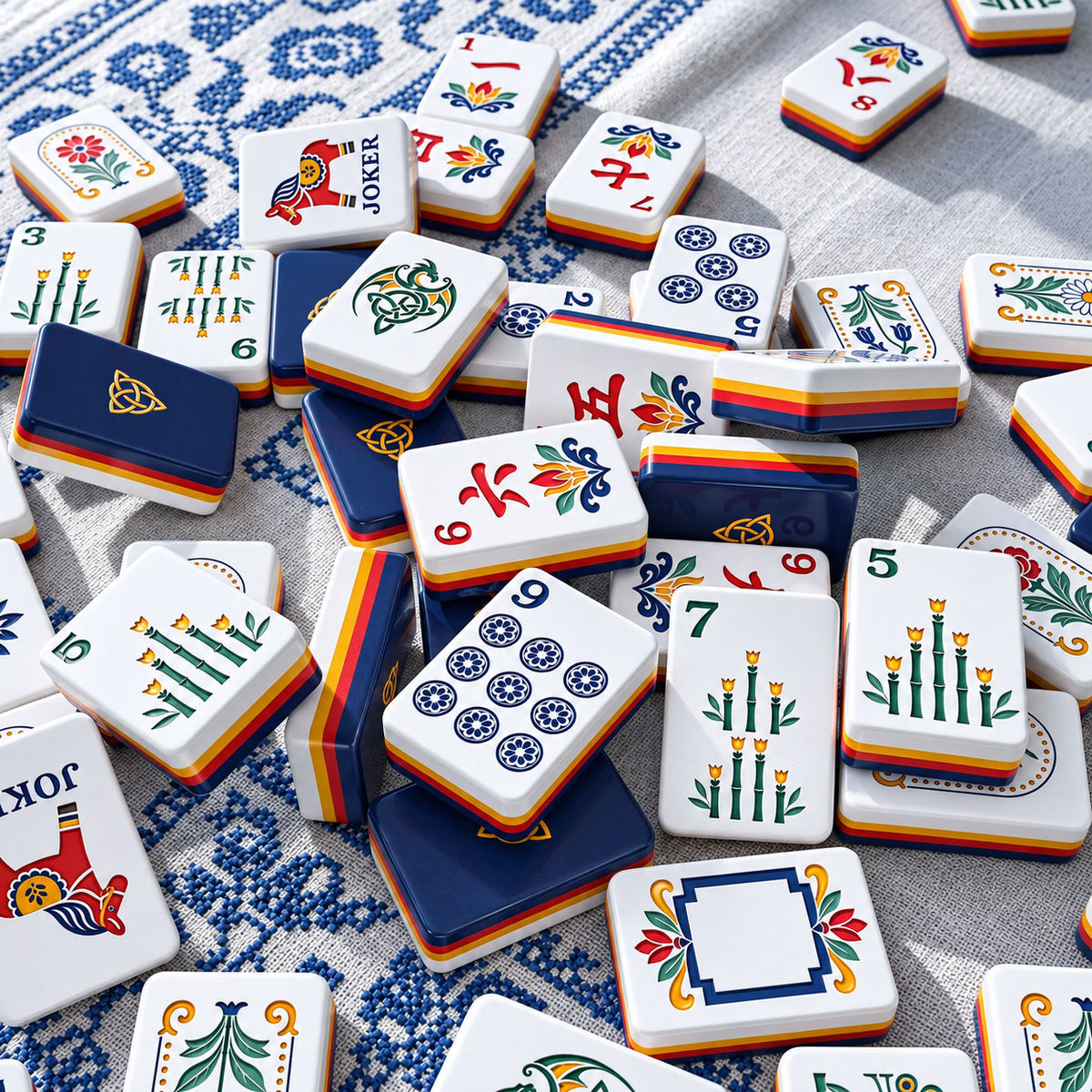
Mahjong solitaire is a one-player puzzle game using a 152-tile standard mahjong set. You arrange all tiles into a pyramid, wall, or grid layout, then remove matching pairs by clicking or removing exposed tiles until none remain. A pair is any two identical tiles (same number and suit, same dragon, same wind, or same flower). Tiles must be completely unblocked on at least one side to be eligible; you cannot remove tiles buried under others or locked between two adjacent tiles. A typical game lasts 15–30 minutes. Unlike American group mahjong (which requires hand learning and opponents), solitaire is purely tactical—no card, no scoring, no luck in tile draws. You win by clearing the board; you lose if no legal pairs remain but tiles are left. Many players use digital versions online, but some host solitaire tournaments with physical tile sets to test speed and skill across multiple layouts.
Mahjong solitaire strips away the complexity of four-player American mahjong and distills the game to its most meditative core: matching, strategy, and patience. Over a decade of hosting weekly game nights, we've seen this puzzle captivate newcomers who find four-player rules overwhelming—and challenge seasoned players who compete on speed and solution count. Whether you're learning the rules or looking to improve your play, this guide covers the setup, the matching logic, common traps, and the gear that makes solitaire sessions faster and more enjoyable.
What Exactly Is a Mahjong Solitaire Match?
Mahjong solitaire is a tile-removal puzzle where you match and eliminate pairs from a pre-arranged board until the table is empty or no legal moves remain. Each pair must consist of two identical tiles—no substitutions, no wild cards, no suit sequences allowed. The board state (which tiles block which) determines legal moves at any moment; a tile is "available" only if at least one full side is exposed to open air. You win by clearing every tile; you lose if matching pairs exist but all are trapped.
The game has no luck element once the board is laid out. Every outcome depends on your choice of which pair to remove first and how that choice opens or closes future moves. This makes solitaire both relaxing (no opponent pressure) and deeply strategic (one wrong pair can doom the entire game). Most solitaire layouts are solvable, but not every sequence of moves leads to victory—the order matters.
🀄 Shop best-selling mahjong sets →

How Do You Know If Two Tiles Match?
Two tiles form a valid pair if and only if they are identical in rank and suit. Here's what matches and what doesn't:
Numbered tiles: 5 Bams + 5 Bams ✓ | 5 Bams + 5 Craks ✗
Winds: East + East ✓ | East + North ✗
Dragons: Red + Red ✓ | Red + Green ✗
Flowers: Any flower + any other flower ✓ (all eight flowers are interchangeable in most solitaire variants)
Jokers: Joker + Joker ✓ (but rarely used in solitaire layouts)
A standard 152-tile mahjong set includes three suits (Bams, Craks, Dots) with numbers 1–9, four copies of each number per suit (108 numbered tiles), 16 winds (four each of North, East, South, West), 12 dragons (four Red, four Green, four White), and eight flowers. When you play solitaire with a physical set, you use all 152 tiles—no blanks or spares are added to play.
The one-tile-per-position rule in solitaire differs sharply from American group mahjong, where jokers substitute for missing tiles in hands and melds must be pungs (three identical), kongs (four identical), quints, or sextets. In solitaire, jokers are often excluded from layouts entirely, or used only as literal tile fills in special challenge boards.
What Are the Main Board Layouts?
Different pyramid, grid, and custom shapes create varied difficulty and strategy. Here are the classics:
Pyramid layout: Tiles stack in rows—base row has many tiles, each upper row has fewer. From the side, it looks like a triangle. You can only remove tiles from the outer edges (base and sides of the pyramid). This layout is moderately difficult because tiles above you become accessible only after you clear the row below. Beginners often get stuck halfway through because they didn't plan which pairs to clear in the right order.
Spiral or concentric layout: Tiles form rings from the center outward. The innermost ring is often accessible first; as you clear it, the next ring opens. These layouts have a natural flow and teach forward-planning well.
Grid or mat layout: All tiles lie flat in a rectangular grid, often with a specific shape (cross, castle, dragon silhouette). Availability depends on the exact ruleset—in the most common version, a tile is removable if it has at least one fully exposed long side. In stricter versions, both long sides must be free. Grid layouts require the most pattern-spotting because you're not guided by level or layer.
Random or challenge layouts: Some solitaire apps and tournament organizers create bespoke boards to test memory and adaptability. Physical sets are rarely used for random layouts because setup takes too long.
When you buy a best-selling mahjong set from Mahstead, you receive a complete 160-tile collection (152 playing tiles plus spares) with acrylic tiles and often a mat or bag. The mat is especially useful for solitaire because it defines boundaries, protects your table, and makes it easier to arrange tiles in tight formations without them sliding.
🎁 See our most-loved mahjong sets & accessories →
What's the Single Biggest Beginner Mistake?
The most common error is removing a pair that seems to unlock tiles but actually traps future matches. Here's a concrete example:
Imagine a pyramid where you see two easily accessible 5 Craks near the top, and below them are two 3 Dots blocking access to a hidden 5 Bam on the lower level. If you remove the 5 Craks first, you feel progress. But now the 3 Dots remain side-by-side and inaccessible because nothing above them changed. You're left unable to match them or anything behind them. You lose.
The right move: scan the entire board before removing anything. Identify which tiles are blocking which, and work backward from the end state (all tiles gone) to find a winning sequence. Often you must clear low-value or "obvious" pairs last, not first, to keep the board fluid.
Another mistake: assuming jokers or blank tiles can substitute for a missing match. In standard solitaire, jokers and blanks—if included at all—are treated as a single tile type that only matches another joker or blank. They don't act as wildcards. Clarify your ruleset before you play.
How Do You Play Digitally vs. With a Physical Set?
Digital solitaire (apps and websites) automates rule checking, prevents illegal moves, and offers instant feedback. You tap or click pairs; the game highlights legal options or shakes the screen if you try an invalid move. Pros: fast, forgiving, unlimited layouts. Cons: no tactile pleasure, no speed advantage from years of tile recognition, no social element.
Physical solitaire (with a real mahjong set) lets you handle tiles, arrange custom boards, and host friendly competitions or timed challenges with friends. You arrange all 152 tiles into your chosen layout on a table or mat, then remove pairs by hand. Pros: meditative, social, builds tile familiarity for group play later. Cons: setup takes 5–10 minutes, no automatic rule checking, tiles can shift or fall.
Most new players start digital to learn patterns and rules risk-free. Once comfortable, many switch to physical sets for the sensory experience. If you host regular solitaire nights or casual group play, a dedicated mat with raised edges prevents tile spillage, and a padded travel bag keeps your set intact during transport.

How Do You Build Winning Strategy?
Winning solitaire combines forward planning with moment-to-moment adaptation. Here's a tested approach:
Scan the entire board before your first move. Identify the deepest, most-buried tiles and the pairs that surround them.
Work backward: Which pairs must be removed before the final pair? What's the only way to expose them?
Avoid dead ends: If two pairs seem equally removable now, pick the one that opens more tiles for later. If unsure, take notes or photograph the board and think about it offline.
Keep the board fluid: Prefer to remove pairs that are side-by-side or stacked directly (in a pyramid), so the layer beneath them opens entirely. Avoid removing isolated pairs in the middle if it leaves orphan tiles with no mates.
Watch for symmetry: Many classic layouts are symmetric. If you can match tiles on one side, look for matching pairs on the other side. This reduces cognitive load and prevents asymmetric dead ends.
Time yourself: After a few solitaire games, challenge yourself to clear the board in under 20 minutes, then 15. This sharpens your scanning speed and decision-making.
Players who compete in solitaire tournaments often memorize 10–20 classic layouts and practice them repeatedly to beat previous times. The fastest players can clear a standard pyramid in 3–5 minutes.
Skill Level | Typical Clear Time | Key Challenge |
Beginner | 30–45 min | Finding legal pairs, missing matches |
Intermediate | 15–25 min | Planning ahead, avoiding dead ends |
Advanced | 5–12 min | Optimizing move order, minimizing backtrack |
Tournament | <5 min | Pattern instant-recognition, muscle memory |
✨ Find your Mahstead set — free US shipping →
What Equipment Makes Solitaire Easier and Faster?
Mahjong mat: A cloth or neoprene mat with grid lines or borders keeps tiles from sliding, defines the play area, and protects your table. When you arrange 152 tiles in a pyramid or spiral, a mat prevents the base from creeping outward. Mahstead's mahjong mats come in various sizes; choose one that fits your preferred layout with 1–2 inches of margin on all sides. Most mats measure roughly 2–3 feet on a side, which suits pyramid and grid layouts well.
Acrylic or composite tiles: Plastic tiles (not bone or bamboo) are lighter, quieter, and less likely to damage a mat or table surface. They're also easier to see and handle quickly during timed play. All Mahstead sets use acrylic tiles with engraved or printed characters, so they're durable through hundreds of games.
Dedicated storage bag: Keeping your set in a padded bag or case prevents tile loss, keeps your mat accessible, and makes transport trivial if you host solitaire nights at different locations. A good bag holds the full 160-tile set, a mat, and sometimes dice or racks.
Timer: Use a phone stopwatch or kitchen timer to track your clear time. Recording times across multiple plays (even on the same layout) creates a personal benchmark and makes the game more engaging.
Notebook or phone camera: Photograph tricky board states to analyze later or share with friends. This turns a solo activity into a collaborative puzzle-solving event.
What to Check Before You Buy a Set for Solitaire
Tile count: Verify the set includes the full 152 playing tiles (plus spares in a 160-tile set). Solitaire uses every tile; incomplete sets won't work.
Tile visibility: Ensure characters (numbers, suits, winds, dragons, flowers) are clearly printed or engraved and distinguishable at a glance. Mahstead sets include a readable character size suitable for fast play.
Tile size and weight: Smaller tiles (standard ~0.75 inches) are easier to handle and arrange quickly; heavier tiles (bone or stone) can strain your hands over 20+ minutes of play. Acrylic is the sweet spot.
Mat compatibility: If you buy a mat, confirm it fits the tile size. Most mats are designed for standard tiles. A mat with a grid helps you keep rows straight.
Durability: Check that tiles don't chip or crack after repeated use. Mahstead acrylic sets withstand thousands of games without wear.
Aesthetic appeal: Solitaire is meditative, so choose a design you enjoy looking at. Mahstead offers engraved sets with titles (like "Mahjong & Cocktails" or personalized names), which add personality to solo or group play.
Honest Take: When Solitaire Is the Right Choice
Solitaire is ideal if you want a low-pressure, solo puzzle that improves pattern recognition and tile familiarity without the social complexity of four-player mahjong. It's also excellent practice for American mahjong beginners—you'll learn to spot matching tiles instantly, which is half the battle in group play.
However, if you're buying a set solely for solitaire and never plan to play group mahjong, a standard American mahjong set is overkill. Digital apps are free and infinitely varied. A physical set makes sense if you also host group games, appreciate the tactile experience, or want to host casual solitaire tournaments with friends.
For serious players who do both group play and solitaire, a best-selling mahjong set paired with a mat and bag is a worthwhile investment. The set pays for itself through years of use, and the aesthetic quality—especially with custom engravings—makes it a conversation piece at game night.

FAQ
Can you use jokers in mahjong solitaire?
In most classic solitaire layouts, jokers are excluded entirely because they complicate matching rules. Some modern digital versions or challenge boards include jokers as a single tile type that matches only other jokers. Always clarify the ruleset before you start; if jokers are in play, they don't substitute for missing tiles—they match only each other.
What's the difference between mahjong solitaire and the group game?
Mahjong solitaire is a solo puzzle with no opponent, no card, no scoring, and no hands to memorize. American group mahjong requires four players, a hand card (issued yearly), tile passing (the Charleston), and strategic play against opponents. Solitaire teaches tile recognition; group play teaches judgment and social strategy.
How long does a solitaire game usually take?
Beginners often take 30–45 minutes to clear a standard pyramid. Intermediate players average 15–25 minutes. Advanced players clear in 5–12 minutes, and tournament competitors can finish under 5 minutes on known layouts. Time depends on board layout, your familiarity with it, and whether you prioritize speed or just enjoying the puzzle.
Do I need a special mat for solitaire?
No, but a mat is highly useful. It prevents tiles from sliding, defines play boundaries, and protects your table. If you only play solitaire occasionally on a desk, a large cutting board or felt cloth works fine. If you play weekly or host others, a dedicated mahjong mat is worth the investment for durability and aesthetics.
Can you play solitaire competitively or is it just for fun?
Both. Casual players enjoy solitaire for the meditation and puzzle-solving. Competitive players time themselves, memorize layouts, and compete for speed records or participate in organized solitaire tournaments. Some clubs host monthly or annual solitaire challenges where players try to clear identical boards faster than rivals.
What happens if you get stuck—are there no legal moves left but tiles remain?
You've hit a dead end and lost that round. It means an earlier choice of which pair to remove locked you out of winning. Experienced players analyze these defeats offline, replay the board mentally, and try a different sequence next time. This is why solitaire builds strategic thinking: there's always a "better" first move if you think hard enough.


View More
View More
View More
