
How to Play Chinese Mahjong: Rules, Tiles & Winning Hands
Last updated: Nov 23, 2026
Chinese mahjong uses 136 tiles (not 152): three numbered suits—Bams, Craks, Dots 1–9, four copies each—plus winds, dragons, and often flowers and seasons. Games run 13–16 rounds. Players draw and discard one tile per turn, building a hand of 14 tiles. A winning hand (called "tying" or "going out") requires four melds (either runs of three consecutive numbers, or three/four identical tiles) plus a pair. Unlike American mahjong, Chinese variants permit runs, expose melds freely, require no printed card, and jokers aren't always used. Rounds end when someone wins, no one can play, or the wall empties. Speed and regional variation are defining: Hong Kong play emphasizes speed; Taiwanese variants add complicated scoring bonuses. Mahstead carries modern acrylic sets that suit casual play; confirm tile count and suit symbols before choosing, since American and Chinese tile layouts differ.
What are the core tiles and their ranks?
Chinese mahjong starts with 136 tiles divided into three numbered suits (Bams—bamboo; Craks—characters; Dots—circles), each numbered 1–9 with four copies, totaling 108 tiles. The remaining 28 tiles are honors: four each of North, East, South, West winds; three each of red, green, white dragons; eight flowers (often only 0–3 are used); four seasons (often omitted in casual play). The 1 Bam typically displays a bird. Winds and dragons are high-value honors; players must memorize their rank and seat-wind pairings. Jokers are uncommon in classical Chinese play but appear in some variants. The white dragon is the "soap" tile and often denotes zero. Unlike American mahjong, every Chinese hand obeys the same winning pattern—no season-specific card needed.

How do you build a winning hand?
A winning hand contains exactly 14 tiles arranged as four melds (groups of three or four) plus one pair. A meld is either a pung (three identical tiles: three 5 Craks), a kong (four identical tiles), a chow (run of three consecutive numbers in one suit: 4–5–6 Dots), or a quint/sextet (five or six identical tiles, rare in casual play). The pair must be two identical tiles. On your turn, you draw one tile, then discard one, keeping your hand at 13 tiles until someone wins. Any player can claim a discard if it completes a pung, kong, or chow—an action called claiming or winning. The first player to form a legal 14-tile hand wins the round and collects points from other players based on your tile combination's base value, multiplied by bonuses. In some variants, players may only win on their own draw (self-drawn win) or off any discard (open win); check house rules before play.
🀄 Shop best-selling mahjong sets →
What's the difference between Chinese and American mahjong?
American mahjong is built around a printed card that changes every year; Chinese mahjong has no card—winning patterns are memorized. American sets include 152 tiles with 16 winds, 12 dragons, 8 flowers, and 8 jokers; Chinese uses 136 tiles with four of each wind, three dragons each, and optional flowers. American forbids runs—melds are only pungs, kongs, quints, sextets, and pairs; Chinese demands runs as core strategy. American games use a shuffling ritual called the Charleston before play; Chinese skip this entirely. American mahjong rounds reset when no one wins and the wall exhausts; Chinese may require a dealer to play additional hands. American jokers substitute for any tile in exposed melds; Chinese rarely uses jokers and never in pairs. Both games teach hand-reading and probability, but Chinese demands faster calculation and deeper memorization. If you're learning both, set them apart clearly—tile counts, suit layouts, and hand logic differ enough to confuse beginners.
How do you actually play a round from start to finish?
Setup: Shuffle all 136 tiles face-down. Each player builds a wall 18 tiles wide and 2 tiles tall in front of them (72 tiles per wall, 288 total—one shared wall). Dealer sits East and draws first.
Opening draw: East draws 14 tiles; other players (South, West, North) each draw 13. Everyone arranges their tiles privately.
Turn cycle: East discards one tile to the center table. South draws from the wall (replacing that discard). South then discards. Repeat until someone wins or the wall empties.
Winning: If your discard completes another player's hand, they win and you pay double. If you draw your own winning tile, you also pay double and declare tzihu (self-drawn). Points are calculated using a base score (e.g., 2 points for a simple all-chow hand) × multipliers (2× for all-pungs, 4× for all-honors, 8× for winning on your first turn).
Settlement: Winner collects points from all players. The next dealer is determined by house rule—often the player who scored East wind in the round, or players rotate.
A full game typically runs 16 rounds (East ×4, South ×4, West ×4, North ×4). Casual play often stops after 4–8 rounds.
Variant | Tile Count | Runs Allowed? | Card Used? | Jokers? | Speed | Best For |
Hong Kong | 136 | Yes | No | No | Very fast | Experienced players |
Taiwanese | 136 | Yes | No | Sometimes | Medium | Strategy & bonuses |
Shanghai | 136 | Yes | No | No | Medium | Honors & bonuses |
Classical Cantonese | 136 | Yes | No | No | Slow | Learning & tradition |

What mistakes do new players make—and how to avoid them?
Miscounting the hand. Players often forget they hold 13 tiles before their turn draw. Count on the table every turn. Avoid keeping mental inventory.
Confusing a run with a pair. A chow (3–4–5 Craks) is not interchangeable with a pung (three 4 Craks). Verify meld type aloud before laying down.
Claiming the wrong discard. Only claim a tile if it completes a pung, kong, or chow—never a single tile or pair addition. Hold your hand back until the full meld is ready.
Exposing too early. Once you claim a discard, your melds become public and other players see them. Keep melds closed (in your hand) as long as possible to stay unpredictable.
Breaking house rules on self-drawn wins. Some play allows winning off any discard; others require self-draw only. Confirm rules before Round 1 to avoid scoring disputes.
Mixing up wind and dragon rank. East wind beats South; red dragon beats green. Write a cheat sheet and post it at the table your first few games. Memorize after five sessions of play.
Forgetting to check tile integrity. Before shuffling, count all 136 tiles and inspect for cracks, fading, or missing pieces. A damaged tile ruins a game mid-round.
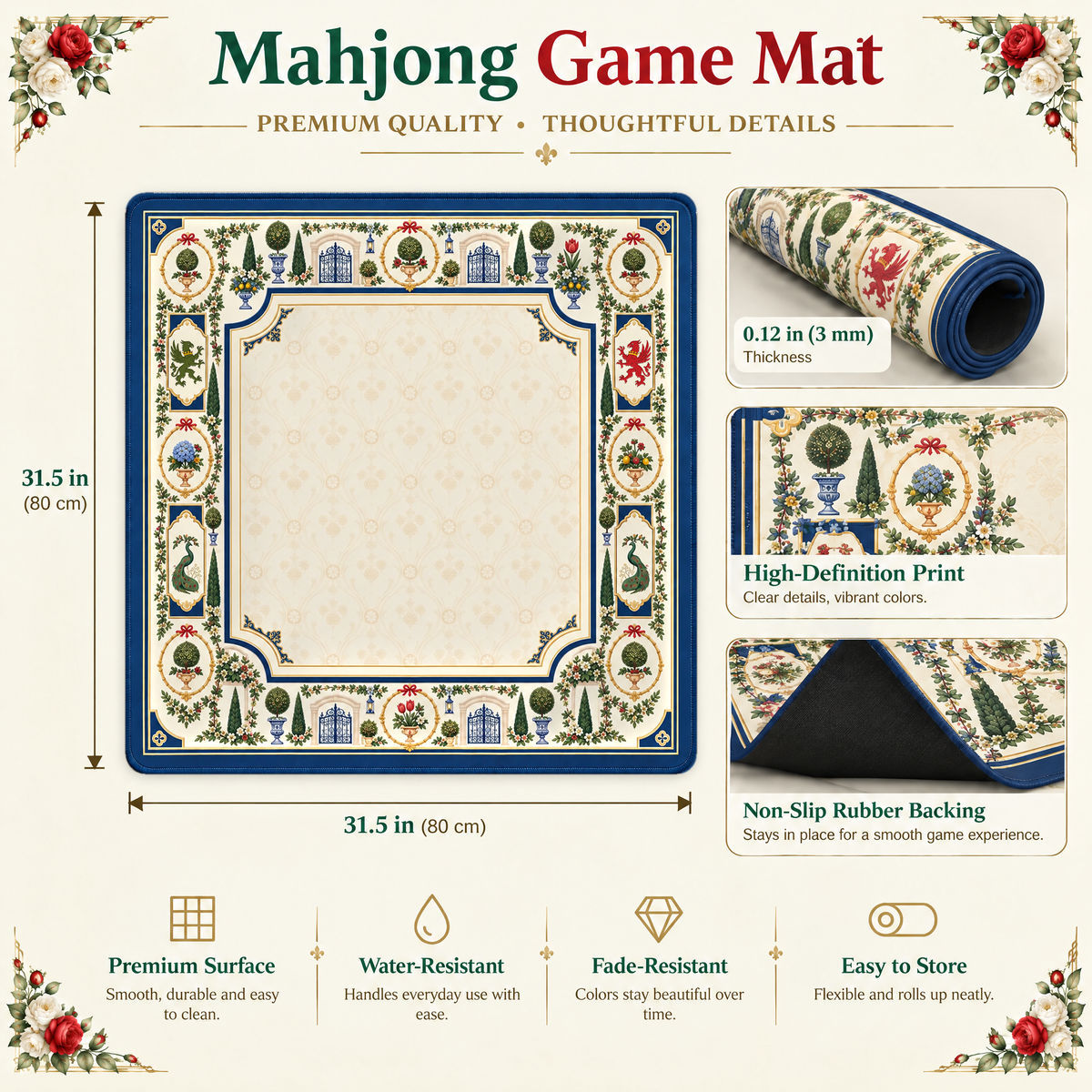
What you'll need: A full 136-tile set in acrylic or wood with clear, legible suit symbols; a soft playing surface like a mahjong mat to protect tiles and muffle noise; racks with pushers to organize your hand; and a travel bag or case if you play at different homes. For a casual weekly game group, a best-selling set in acrylic is durable, affordable, and won't chip if tiles are dropped. If you host regularly, a mat with embroidered tiles or engraved designs creates a welcoming table—check the mahjong titles collection for custom options.
How do regional variants change the game?
Hong Kong mahjong prioritizes speed—rounds last 10 minutes. Scoring uses a simpler base (e.g., 1 point per meld type) with minimal multipliers. Players discard openly and claim fast; silence is expected. Ideal for experienced players who've memorized winning patterns.
Taiwanese mahjong adds bonuses: bonus points for sequences of honors, for completing all melds of one type, or for all closed melds (hand not exposed until win). Base score rises to 4–8 points, multiplied by bonuses. Games run 20–30 minutes per round. Best for strategy-focused groups.
Shanghai mahjong emphasizes dragon and wind value—a pung of white dragon scores higher than a pung of 1 Dots. Jokers sometimes appear. Rounds vary 15–25 minutes.
Classical Cantonese play is the oldest surviving form and the slowest. It teaches pure tile logic and hand construction without modern speed pressures. Rounds run 30–45 minutes. Many regional clubs in North America teach Cantonese as the foundation before moving to Hong Kong or Taiwanese speed play.
Ask your group which variant they prefer before joining. Starting with Cantonese (if available) builds better hand-reading; switching to Hong Kong later feels natural. Mixing variants in one table causes rules confusion and disputes.
🎁 See our most-loved mahjong sets & accessories →
What to check before you buy a Chinese mahjong set
Tile count: Confirm the set includes 136 playable tiles (not 152, which is American). Some casual sets omit flowers and seasons—verify the tally matches your variant's standard.
Suit symbols: Chinese Bams, Craks, and Dots differ from American tile graphics. Inspect close-up photos online or in person. Avoid sets where symbols blend or fade.
Wind/dragon clarity: Winds (四風, N/E/S/W) and dragons (三龍, red/green/white) must be crisp and instantly recognizable. Blurry honors tiles cause misreads in fast play.
Acrylic vs. wood: Acrylic is durable, won't chip easily, and is lighter to travel; wood is quieter, looks classic, and ages beautifully. Choose based on your hosting frequency and table noise tolerance.
Weight and surface feel: Chinese tiles are typically slightly lighter than American tiles and have a smoother finish. Play with a set before buying if possible.
Spare tiles included: Check whether the set includes spare tiles or jokers. Most 136-tile sets do not; if your variant uses jokers, confirm they're included or purchasable separately.
Mat and rack compatibility: If buying accessories, ensure tiles fit standard acrylic racks and that your mat's bamboo frame accommodates the tile thickness.
✨ Find your Mahstead set — free US shipping →

FAQ
Can American mahjong players switch to Chinese mahjong easily?
No—the tile count, suit symbols, rules for runs, and hand patterns differ fundamentally. Expect a 3–5 game learning curve. Study a variant guide or play with an experienced player your first session.
Do I need a mat and racks to play Chinese mahjong?
A mat is optional but helpful—it protects tiles and muffles clatter. Racks are nice but not required; holding tiles in your hand works. Both improve comfort in long games.
What's the fastest variant to learn?
Hong Kong mahjong teaches fastest once you memorize the winning patterns (usually after 4–6 games). Classical Cantonese takes longer but builds stronger fundamentals.
Can I play Chinese mahjong with only three players?
Chinese mahjong is designed for four players. Three-player variants exist but require tile removal and rule adjustments; they're less standardized. Stick to four-player games until you're expert.
How long does a full game take?
A 16-round game (four players, casual Taiwanese play) runs 60–90 minutes. Hong Kong speed play: 45–60 minutes. Classical Cantonese: 2+ hours. Casual play with frequent teaching pauses: 2–3 hours.
Is scoring in Chinese mahjong harder than American?
Yes—Chinese scoring uses a base multiplied by bonus combinations, and bonuses vary by variant. American uses a printed card. Spend one full session on your variant's scoring table before hosting.


View More
View More
View More
