
How to Host a Cocktail Mahjong Party
Last updated: Nov 23, 2026
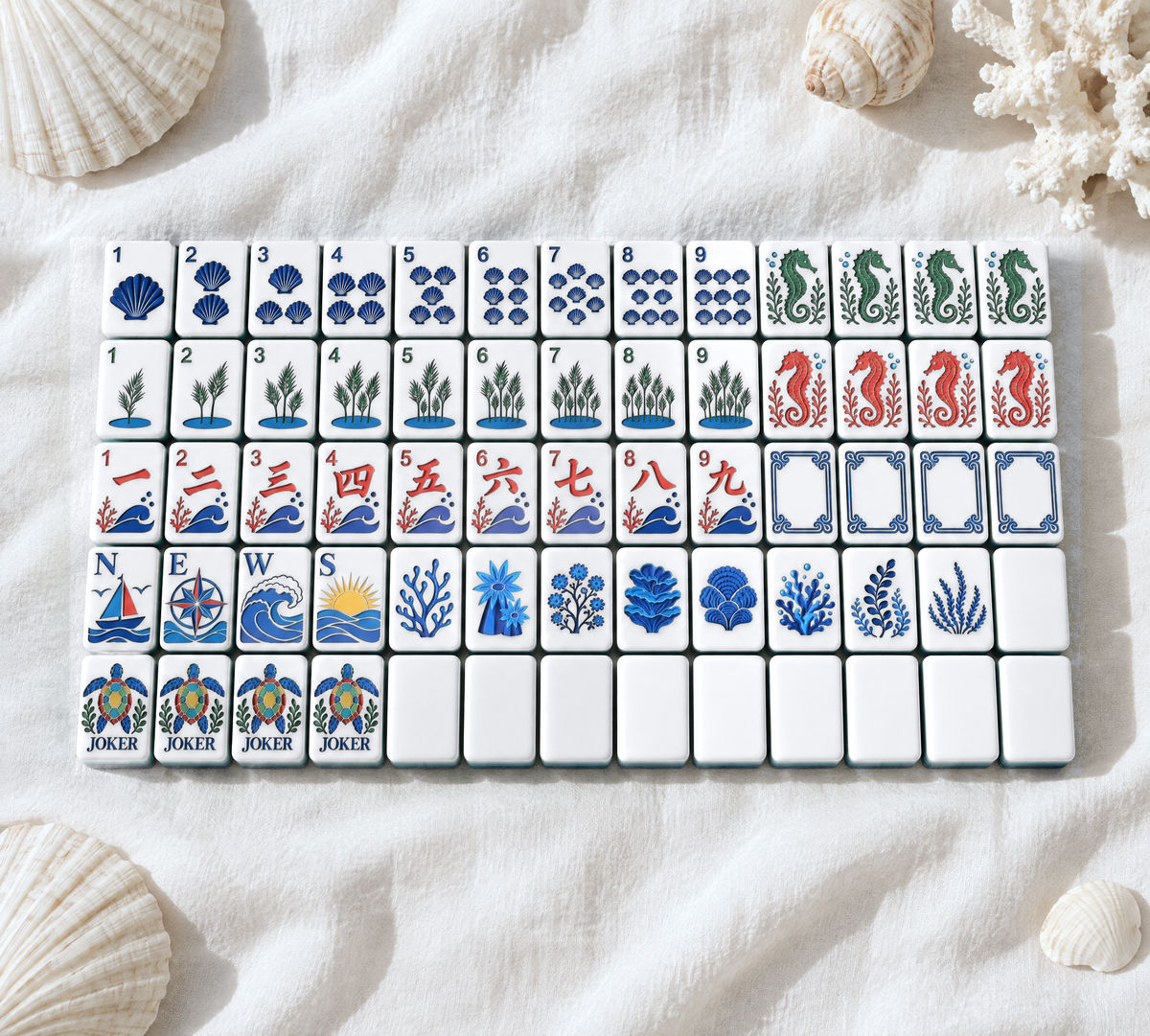
A cocktail mahjong party is a social American mahjong game played by four players over drinks and appetizers, usually lasting 2–4 hours. You'll need a dedicated surface (table, mat, or both), one 160-tile set with eight jokers, the current year's National Mah Jongg League card, and four racks to hold tiles. The night unfolds in rounds: each round begins with the Charleston (a three-step tile pass between all four players), then the dealer draws and discards until someone wins by matching a hand to the League card. Plan for loose, conversational play rather than tournament speed. Most hosts invest in a quality mat to protect the surface and cushion play, and engraved sets add personality without breaking focus. Avoid cramped seating, unclear tile visibility, or missing the League card—these kill momentum faster than bad tiles.
A cocktail mahjong party blends strategic play with social drinking and conversation—the perfect excuse to gather friends around a table with style. You'll need a dedicated surface, one 160-tile set with eight jokers, the current year's National Mah Jongg League card, and four racks to hold tiles. The night unfolds in rounds: each round begins with the Charleston (a three-step tile pass between all four players), then the dealer draws and discards until someone wins by matching a hand to the League card. Plan for loose, conversational play rather than tournament speed. Most hosts invest in a quality mat to protect the surface and cushion play, and engraved sets add personality without breaking focus. Avoid cramped seating, unclear tile visibility, or missing the League card—these kill momentum faster than bad tiles.
How much space do you really need?
A standard mahjong table occupies roughly 36–42 inches per side (a comfortable four-foot square), plus elbow room for drinks and snacks. If you're using a dining table or console, plan for 48 inches minimum width so players can sit comfortably without crowding. Seats should be at least 18 inches apart, and each player needs 3–4 feet of reach-back to access their tile rack. A dedicated mahjong mat reduces noise, protects your furniture, and makes tiles glide smoothly—critical for a relaxed, cocktail-paced evening where someone's holding a drink in one hand.
🀄 Shop best-selling mahjong sets →

What tile set and card should you buy?
You need exactly one complete 160-tile American set with the eight jokers intact—no more, no fewer. The set must include three suits (Bams, Craks, Dots: numbers 1–9, four copies of each), 16 winds (North, East, West, South: four copies each), 12 dragons (four Red, four Green, four White), eight flowers, and eight jokers. The 160-tile count includes spare tiles, which never enter play. You also need the current year's National Mah Jongg League card—players match their hand to a pattern printed on that year's card (patterns change annually). The card is not negotiable: without it, there's no legal winning hand. Pick a set from our best-selling collection that suits your decor. Many hosts choose engraved sets because they spark conversation and make the event feel intentional rather than generic.
Should you use racks, and how do you explain them to new players?
Racks are not optional if anyone is new or casual: they hide your hand from neighbors, keep tiles upright and organized, and let you focus on strategy instead of tile management. A rack with pushers (small sticks that move tiles along a groove) is a game-changer for speed and accuracy. Without a rack, players prop tiles against a water glass or just hold them—fine for one game, exhausting for a party. If you're mixing experience levels, mahjong racks with pushers are the single best investment after the tile set itself. Explain to new players: "Your rack is like your hand of cards in Poker—nobody sees it but you. The pusher moves one tile at a time, so you never fumble or expose your hand by accident."
What are the actual rules for a cocktail game versus tournament play?
In American mahjong, all four players draw and discard in turn. The dealer (usually East) draws first; after the Charleston is complete, the dealer draws one more tile, then each player draws and discards clockwise. A player wins by completing a hand that matches a pattern on the League card—using only Pungs (three identical tiles), Kongs (four identical tiles), quints (five identical tiles), sextets (six identical tiles), or pairs. No sequences (Chows). Jokers can substitute for any tile except a single tile or a pair. At cocktail parties, we skip tournament timing rules: play at your own pace. New players often try to form sequences like 1-2-3, which don't exist in American mahjong—catch this early. Also clarify: a winning hand is always exactly 14 tiles (a hand structure from the League card). If someone says "I'm one tile away," they're still learning. Keep the League card visible and read aloud when someone claims a win, so everyone verifies it together. This slows the pace but builds trust and keeps the evening social.
🎁 See our most-loved mahjong sets & accessories →
How do you set the mood and pace for a relaxed night?
Cocktail mahjong is slower than tournament play, and that's the point. Use soft background music (no lyrics at loud volume—tiles and conversation are enough), keep drinks in designated spots away from the table, and set a "no phone" rule so everyone is present. Arrange the Charleston before tiles touch the table, so there's a ritual feel to the start. Have the League card printed (or photographed on a tablet) and visible—people need to see possible hands. Plan for about 45 minutes per round (including Charleston, play, and scoring), so a four-hour party holds roughly four to five complete rounds. Seasoned players will finish faster; beginners will take longer, and that's fine. If someone's frustrated, remind them: American mahjong is 90% luck (the Charleston) and 10% strategy. Laughter beats perfection every time.
Setup Element | What it is | Why it matters for cocktails |
Mat | Cloth surface with grid | Quiets tile noise, protects furniture, looks intentional |
Racks with pushers | Holders + sticks | Keeps hands hidden, speeds tile movement, looks professional |
League card (current year) | Printed pattern sheet | Only legal reference for winning hands—non-negotiable |
Tile set (160-tile) | 152 play tiles + 8 jokers + spares | No mixing sets; must have exact joker count |
Seating (18"+ apart) | Four chairs around table | Reduces crowding, lets people relax with drinks |
Lighting | Overhead or table lamp | Bright enough to read tiles and card without squinting |

What about new players—how do you onboard them fast?
Start with the core rule: "You draw one tile, discard one tile, and try to match a hand pattern to the League card." Explain the Charleston once (they pass tiles three times in a specific order) and then just guide them through it. Show them one winning hand example from the League card so they see what "a match" looks like. Sit a new player next to an experienced player so they can ask mid-game without halting the table. Have them discard visibly—call out "Three Dot" so others hear—so they learn tile names by ear. Avoid rules-lawyering: if a beginner makes a small error (exposing a tile, miscounting), just fix it and move on. The goal is comfort, not perfection. Many seasoned players enjoy teaching, so let them help. After one full round, a new player usually understands the flow; after two, they're dangerous.
What else do you need to buy, and what's just nice-to-have?
Must-have:
One 160-tile American mahjong set with eight jokers
Current year's National Mah Jongg League card
Four tile racks (or at minimum, two for new players)
A mat or dedicated table surface
Strongly recommended:
Racks with pushers (speeds play, hides hands perfectly)
A cloth mahjong mat (protects your table, reduces noise, adds elegance)
Nice-to-have (but can skip):
A mahjong bag or case if you're hosting regularly and need to store or transport the set between parties
Extra jokers or a second set if you're hosting multiple tables simultaneously
An engraved set from Mahstead makes a strong statement without extra cost—it shows you've thought about the event. Skip decorative extras (colored dice, novelty tiles, themed tablecloths) until you've hosted once. The game itself is visual and social enough.
✨ Find your Mahstead set — free US shipping →
What common mistakes kill the party vibe?
Missing or outdated League card. You cannot play American mahjong without the current year's card. If you don't have it, download and print it before guests arrive, or have it on a large tablet. A player claiming a win without verifying against the card is the fastest way to end the evening. Cramped seating or unclear tile visibility. If players can't see the discard pile or read tiles from their seat, frustration builds fast. Invest in a mat with clear suits and colors. Starting without explaining the Charleston. The Charleston is the scariest part for newcomers because it looks complicated. Walk through it slowly before the first round, even if everyone knows it. Mixing house rules with American mahjong rules. Stick to League rules: no sequences, jokers only as substitutes, pairs always identical tiles. If you want to house-rule scoring, wait until round two. Running out of jokers or having a broken tile. Verify your set is complete (all 152 play tiles, all eight jokers, no cracks) before guests arrive. If the set is damaged, cancel and order a replacement. Not having racks for new players. Watching someone juggle eight tiles while holding a cocktail is painful. Four racks cost less than two cocktails. Get them.
How do you manage scoring and keep it simple?
In American mahjong, each pattern on the League card has a point value (usually 30–70 points, depending on the hand difficulty and year). When someone wins, look up their hand on the card, announce the points, and add them to a scorecard. The winner also scores "double" if they won on a discard (versus drawing the winning tile themselves) or if conditions bonus to their hand (some years the card includes doubling conditions). For a cocktail party, don't sweat bonus scoring; just track base points and add them up. After four or five rounds, highest score wins bragging rights. If scoring feels too detailed, play "first to five wins" instead—just count victories. Most casual players remember the gossip and laughter more than exact points anyway.
What to check before you buy
Set completeness: Count 152 tiles (if your retailer provides a count), verify all eight jokers are present, check that no tiles are cracked or sticky
Card currency: Confirm it's the 2026 League card (changes every spring); an outdated card makes hands unrecognizable
Rack quality: If you're buying racks, make sure they're the right size for your tile set (most standard racks fit American tiles)
Mat thickness: A mat under ¼ inch is too thin for comfort; aim for 3/8 inch or more if you're playing on a hard table
Shipping and arrival: Order at least two weeks before your party to allow for delivery and any issues with the set

FAQ
Can I play cocktail mahjong with just three people?
No. American mahjong is always four-player. Two-player or three-player variants exist, but they use different hand structures and rules. Stick with four for a true cocktail game.
What if someone spills a drink on the tiles?
Tiles are acrylic and water-resistant. Wipe them dry immediately and let them air-dry. They'll be fine. That's why a mat is smart—it absorbs spills and keeps the table dry.
How do I explain the Charleston to someone who's never heard of it?
"Before the game starts, we pass tiles three times in a specific direction: first right, then left, then right again. You take 14 tiles at the start, then pass 13 to your neighbor, keep one. It's the game's way of shuffling the deck fairly. We'll do it together step by step."
Do I need to buy four separate tile racks, or can I share them?
All four players need to be holding racks at the same time during play—you can't share. If budget is tight, buy two racks for the newest players and have experienced players hold their tiles by hand for the first round. Then rotate.
What if a player claims they won, but I'm not sure the hand is legal?
Stop play, look up their hand on the League card together, and read it aloud. If it matches, it's legal. If it doesn't match, they haven't won. The card is the referee—no arguments. This is why the card must be visible and accessible to everyone.
Can I use a tile set from another language or country (Chinese, Riichi, etc.) for American mahjong?
No. Only American mahjong sets have the exact tile composition and suit markings for the National Mah Jongg League card. Chinese and Riichi sets use different tile counts and patterns. Stick with an American set.
How often should I replace the tiles or the mat?
Acrylic tiles last decades if stored dry and handled normally. A mat will show wear after 50–100 games (depending on use) but doesn't need replacing unless it splits or becomes sticky. Replace either only if they fail.


View More
View More
View More
