
How Many Tiles in Riichi Mahjong? The Complete Tile Count
Last updated: Nov 23, 2026
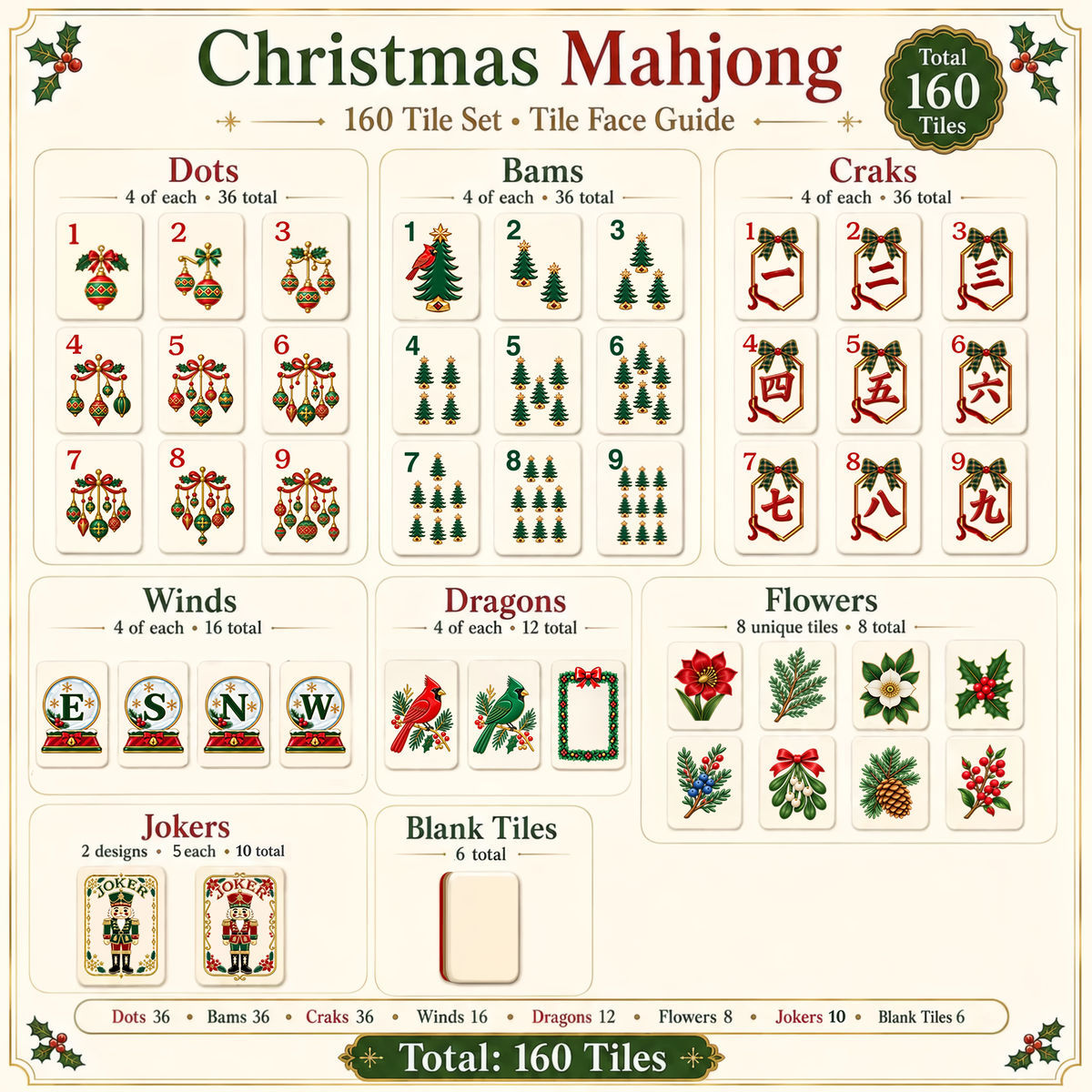
Riichi mahjong (also called Japanese or Jp mahjong) uses 136 tiles total: three suits (Pins, Honors, Souzu) numbered 1–9, four copies of each (108 tiles) plus 28 Honors comprising four each of East, South, West, North winds and three each of Red, Green, White dragons. There are no flowers, no jokers, and no blanks in a standard Riichi set—every tile plays. The 136-tile count is fixed; no spares. Riichi hands rely on melds (Pung = 3 identical, Kong = 4 identical, Chow = three consecutive numbers in one suit, Pair = 2 identical) and winning combinations called Yaku, scored by point value and complexity. American mahjong, by contrast, uses 152 tiles plus 8 jokers and hands come only from the current National Mah Jongg League card, making the two games structurally incompatible. If you host weekly games and players mix variants, Mahstead's best-selling collection includes American-only sets; clarify your house variant before buying. 🀄 Shop best-selling mahjong sets →
Why Does Riichi Use 136 Tiles Instead of 152?
Riichi evolved in early 20th-century Japan from Chinese classical mahjong, which also runs on 136 tiles. The Japanese standardized the variant to remove luck-heavy elements (flowers, jokers) and emphasize probability and hand discipline. American mahjong, invented in the 1920s–1930s, added jokers and flowers to increase complexity and hand variety. The 136-tile framework means Riichi players memorize all possible winning patterns (Yaku) rather than consulting a seasonal card; that's why Riichi is the only mahjong variant you can play identically year-round.

What's Inside a 136-Tile Riichi Set?
A Riichi set contains three identical suits—Pins (circles), Honors (calligraphy), Souzu (bamboo)—each numbered 1 to 9 with four copies per number. That's 36 tiles per suit, 108 total. The remaining 28 tiles are Honors: four each of East, South, West, North (the four winds) and three each of Red Dragon, Green Dragon, White Dragon. No jokers, no flowers, no blanks. Every tile is used in every game; nothing sits on the rack as a spare. If you've only played American mahjong—where 152 tiles include 8 jokers that bridge gaps between hands—Riichi feels tighter and more tactical. The absence of jokers means every draw counts; there's no "wild card" rescue.
How Does Riichi Tile Count Affect Strategy?
With 136 tiles and no jokers, Riichi players must discard strategically and read opponents' needs from the wall. Drawing a tile your neighbor just discarded risks signaling your hand; conversely, drawing from the wall (the face-down pile) keeps your strategy hidden. In American mahjong, jokers let you substitute into almost any meld, so players can adapt mid-game. Riichi forces you to commit: if you need a specific tile and can't access it, you've lost that hand. The smaller tile pool also means duplicate hands occur more often—two players might chase the same Yaku, creating a race to declare "Ron" (win off an opponent's discard). This scarcity drives the social tension Riichi players love.

Riichi vs. American Mahjong: Tile Count Side-by-Side
Variant | Total Tiles | Jokers | Flowers | Blanks | Suits | Numbered 1–9 | Dragons | Winds | Chows Allowed? |
Riichi (Japanese) | 136 | 0 | 0 | 0 | 3 | Yes, 4 each | 3 (Red, Green, White) | 4 (E/S/W/N) | Yes, always |
American | 152 | 8 | 8 | 0 (or spares) | 3 | Yes, 4 each | 3 (Red/Green/White) + neutral | 4 (E/S/W/N) | No—pungs/kongs/quints only |
Hong Kong | 136 or 144 | Varies | Usually 8 | Varies | 3 | Yes, 4 each | 3 | 4 | Yes, always |
Chinese (Classical) | 136 | 0 | 8 | 0 | 3 | Yes, 4 each | 3 | 4 | Yes, always |
The core difference: Riichi and classical sets contain zero non-functional tiles. American mahjong packs extra tiles (jokers, flowers) to increase hand diversity and reduce draws that are dead ends. If your group plays multiple variants, buying separate sets prevents confusion—one set, one rulebook, one way to play.
🎁 See our most-loved mahjong sets & accessories →
Where to Buy Riichi Mahjong Sets
Riichi sets are less common in Western retail than American sets; most online vendors stock only American 160-tile designs. Specialty shops that focus on best-selling mahjong sets typically carry American variants, but some design custom orders for players wanting Riichi compatibility. When shopping, confirm the tile count in the product description—if it says 136, you're buying Riichi; if 152, it's American. Riichi sets often feature resin or bone tiles (heavier, more durable) because the variant is popular in Japan and competitive circles. Acrylic Riichi sets exist but are rarer stateside. Consider your play frequency: casual weekly home games work fine with acrylic; competitive Riichi requires noise-resistant, easy-to-shuffle materials. Avoid buying American sets if your group plays Riichi—the jokers and flowers will sit unused, and the hand patterns won't match.
Can You Convert an American Set to Play Riichi?
Technically, no. An American 152-tile set includes jokers and flowers that Riichi never uses; worse, Riichi hands require Chows (sequences like 1-2-3 Pins), and American rules forbid calling or exposing Chows at all. The hand structure is incompatible. A group that wants both variants must own two sets: one for American (152 tiles, 8 jokers), one for Riichi (136 tiles, zero jokers). Mixing sets mid-session guarantees confusion and house-rule arguments. If half your group plays American and half wants Riichi, host separate nights or invest in both. The cost difference is modest, and clarity prevents disputes. Many players who rotate between variants keep travel bags for mahjong sets to store multiple sets and switch quickly.
What to Check Before You Buy
Tile count: Confirm 136 (Riichi) vs. 152 (American) in the product listing.
Suit names: Riichi uses Pins, Honors, Souzu; American uses Bams, Craks, Dots. Labels matter for learning.
Joker presence: If zero jokers are listed, it's likely Riichi-compatible; 8 jokers = American only.
Material: Acrylic works for casual play; bone or resin for competitive Riichi (quieter, faster shuffles).
Rack compatibility: Riichi racks are often narrower (136 tiles take less space). Check that pushers and tile-holders fit before ordering.
✨ Find your Mahstead set — free US shipping →

FAQ
Is Riichi mahjong the same as Japanese mahjong?
Yes. "Riichi" (the declaring rule) is the most popular Japanese variant, so "Japanese mahjong" and "Riichi mahjong" are used interchangeably. Both use 136 tiles, no jokers, and Yaku-based scoring. Classical Chinese mahjong also uses 136 tiles but differs in rules and discard customs.
Why do Riichi sets have no jokers?
Riichi prioritizes pure probability and hand memory over luck-based substitution. Jokers—common in American mahjong—let players adapt mid-game, reducing strategy depth. Riichi designers removed them to reward pattern recognition and forced decisiveness.
Can I play American mahjong with a Riichi set?
No. American hands require the current year's National Mah Jongg League card, which assumes 152 tiles, 8 jokers, and 8 flowers. A Riichi 136-tile set lacks jokers and flowers, so hands won't match the card's patterns.
What's the cost difference between a Riichi set and an American set?
Pricing varies by material and seller; see current prices on the product pages. Generally, acrylic Riichi sets cost similar to American acrylic sets, but Riichi bone or resin tiles (more durable for competitive play) command higher prices.
How long does a Riichi game take compared to American mahjong?
Riichi rounds average 15–20 minutes per hand; American rounds are similar, though joker substitution can slow decisions. Total game length depends on skill level and house rules, not primarily on tile count.
Where can I find a Riichi mahjong set in the US?
Specialty mahjong retailers and online shops stock them, though less commonly than American sets. Confirm "136 tiles" and "no jokers" in the listing. Some sellers offer custom orders; reach out directly if you can't find Riichi-specific designs in stock.


View More
View More
View More
