
How Many Tiles in Harbin Mahjong: Variants Explained
Last updated: Nov 23, 2026
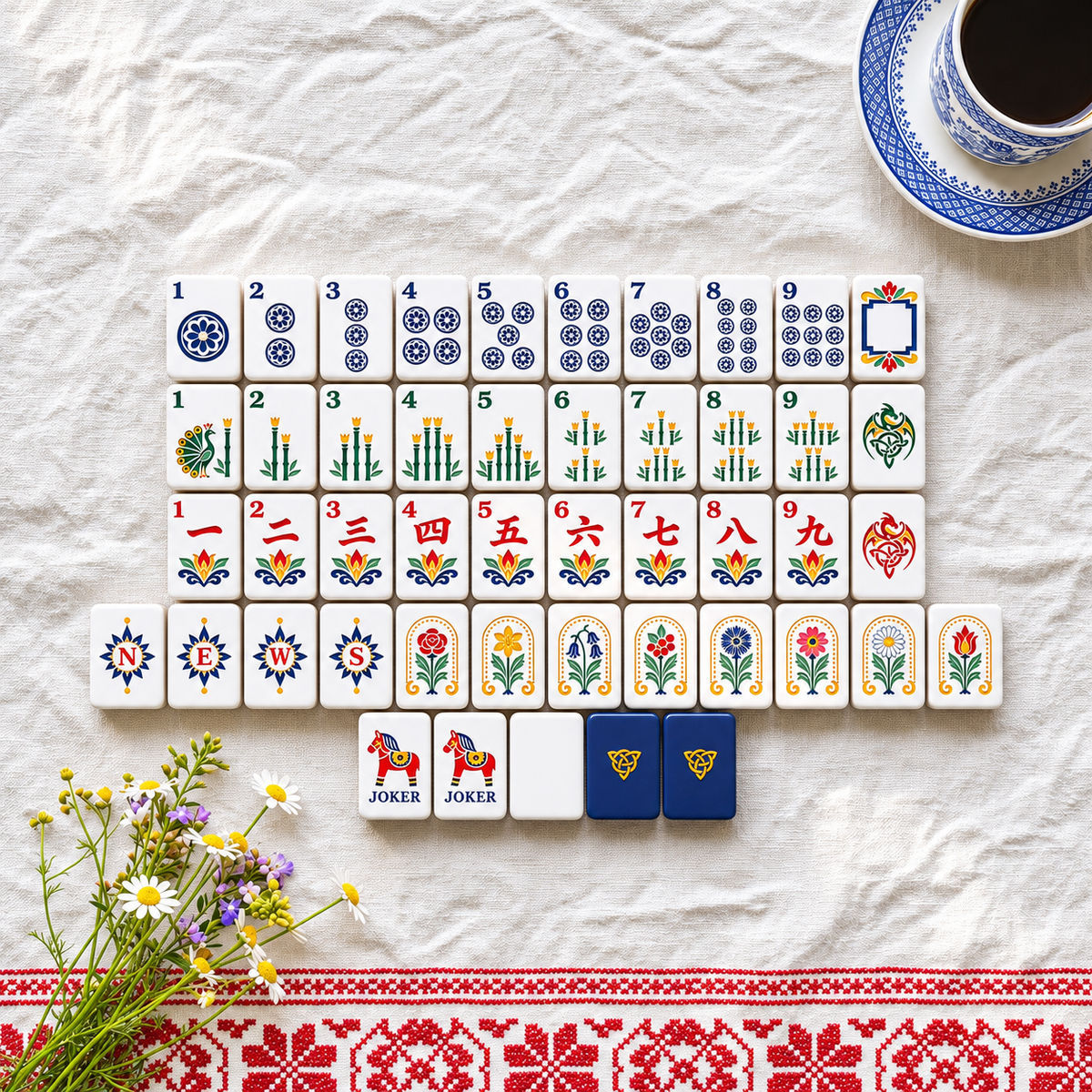
Harbin mahjong uses 108 tiles total: three suits (Bams, Craks, Dots) numbered 1–9 with four copies each (108 tiles), with no winds, dragons, flowers, or jokers. This stripped-down version is faster and simpler than American mahjong's 152-tile format. The game relies entirely on melds (sets of three or four identical tiles and sequences of consecutive numbers within a suit—unlike American mahjong, which forbids sequences). Hands are not drawn from a card; instead, players learn about 80 standard winning patterns by heart. Harbin is popular in China's Heilongjiang province and among diaspora players who prefer speed over complexity. The scoring is also simpler, based on melds and pattern rather than hand rarity. If you're switching between American and Harbin, you'll notice immediately that Harbin moves faster, has no luck-based joker element, and feels more like traditional Chinese play. Many Western players trying Harbin appreciate the lower barrier to memory and the focus on skill.
What Exactly Is Harbin Mahjong?
Harbin mahjong is a regional Chinese variant named after the city in Heilongjiang province. It strips away winds, dragons, flowers, and jokers entirely—keeping only the three numerical suits. Unlike American mahjong, where the National Mah Jongg League card dictates every legal hand shape each year, Harbin players memorize roughly 80 standard winning patterns and play from memory. The game emphasizes fast rounds, rapid decision-making, and pure tile-reading skill. We've found that players who learn Harbin often say it feels closer to the "pure" essence of mahjong than the card-based American version. If you already know American rules, Harbin will feel both familiar and radically different—same tiles, completely different logic.
Why Does Harbin Use Only 108 Tiles?
The 108-tile count comes from classical Chinese mahjong tradition: 4 copies of each number (1–9) in three suits = 36 tiles per suit × 3 = 108 total. This number has roots in Chinese cosmology and game design that predate Western standardization. The absence of winds and dragons keeps the game lean and fast, perfect for casual play and learning. Because no jokers exist in Harbin, every tile is "real"—there's no wildcard substitution to fall back on. This means players must plan every meld carefully and adapt as tiles are drawn. The smaller tile pool also means fewer combinations to track in memory, which is why Harbin appeals to players who find American mahjong's complexity overwhelming. Harbin's simplicity doesn't mean it's easier—it means the difficulty shifts from memorizing a giant card to recognizing patterns instantly and predicting what others need.

How Does Harbin Differ from American Mahjong?
Aspect | Harbin | American |
Tile count | 108 | 152 (with 8 jokers) |
Suits | 3 (Bams, Craks, Dots) | 3 suits + winds + dragons + flowers |
Sequences allowed | Yes, in melds | No—no chows; only pungs, kongs, quints, sextets |
Hand reference | Memorized patterns (~80) | Current year's National Mah Jongg League card |
Jokers | None | 8 (cannot be used alone or in pairs) |
Scoring | Pattern-based, simpler | Complex hand rarity system |
Game speed | Fast (20–40 min) | Medium (45–90 min) |
Learning curve | Moderate (memorize patterns) | Steep (read card + learn exceptions) |
The biggest tactical shift: in American mahjong, jokers let you build flexibility into your hand, but in Harbin, you must commit to a path early because every tile is fixed. This makes reading your opponents—and discards—far more critical. Many Harbin players feel American mahjong is more forgiving; Harbin players feel American is cluttered. Both are right, depending on what you want from a game night.
🀄 Shop best-selling mahjong sets →
Can You Play Harbin on an American Mahjong Set?
Yes—with a small caveat. A standard best-selling mahjong set includes 152 tiles. To play Harbin, you simply set aside all winds, dragons, flowers, and the 8 jokers, leaving the 108 numbered suit tiles on the table. You won't use the National Mah Jongg League card; instead, refer to a printed Harbin pattern sheet (available from online Chinese mahjong resources). The advantage: you own one set and can play both games. The drawback: you're leaving 44 tiles in the box, and swapping between variants each time you switch games eats time. If you host weekly Harbin nights, many players prefer a dedicated 108-tile set—lighter, simpler, harder to miscount. We've found that groups mixing American and Harbin players often keep both sets on hand; it signals clearly to everyone which game you're about to play and eliminates the "wait, do we use jokers?" confusion mid-round.
What's the Best Way to Learn Harbin if You Know American Mahjong?
Start by learning 5–10 of the most common winning patterns: for example, "all pungs" (four sets of three identical tiles plus a pair), "all sequences in one suit" (four melds of consecutive numbers, one suit only), and "mixed suits with a terminal requirement" (at least one meld contains a 1 or 9). Write these down on a sheet and keep it at the table for the first 10 games. As you play, patterns will start to click. The cardinal rule in Harbin is that you're always building toward one of these known shapes; you don't "discover" a hand mid-game like you might on the American card. This feels restrictive at first—it's not. It's liberating, because you know exactly what you're hunting for. Play a few casual rounds with patient opponents willing to pause and explain. Most important: stop using jokers mentally, even if you're playing on an American set. Jokers don't exist in Harbin mindset, so ignore them completely. Within 5–10 games, the rhythm clicks.

What Equipment Do You Need to Play Harbin?
You need tile racks for your hand, a mat to play on, and a way to shuffle. If you're using a full American set, just pull out the 108 tiles and store the rest. A dedicated 108-tile Harbin set is lighter to carry and cleaner to count. We recommend a mahjong mat for any game—it protects your table, keeps tiles visible and organized, and signals to guests that mahjong is about to happen. Add racks with pushers—they hold your tiles, keep them hidden from other players, and let you organize your hand instantly. If you travel between locations, a travel bag or case keeps your set safe. Harbin rounds move fast, so clear surface, good lighting, and quick tile access matter more than in American mahjong. If you're hosting regular games, invest in a mat and racks; they transform a coffee table into a proper game space and make setup under two minutes.
🎁 See our most-loved mahjong sets & accessories →
Should You Buy a Separate Harbin Set or Use an American One?
If you play American mahjong weekly, keeping your American set is fine. You'll just remove the winds, dragons, flowers, and jokers before each Harbin night. The cost is zero; the friction is minimal.
If you're learning Harbin for the first time and expect to play it regularly, a dedicated 108-tile set speeds up setup and eliminates errors. Fewer tiles to count, no stray jokers to accidentally shuffle in, and your opponents instantly see you're serious about the game. A 108-tile set is lighter and cheaper than a 152-tile set because it has fewer components.
If you host both American and Harbin nights, keep both sets visible and labeled. Guests appreciate clarity: one set = one game. It also prevents the awkward mid-game realization that someone didn't remove the jokers.
If you travel or gift mahjong, an American 160-tile set from our collection offers flexibility—one recipient can play American, Harbin, or other variants. It's the safe choice.
The honest truth: Harbin is regional and less common in the US than American mahjong. If you're just curious, borrow a set or use what you have. If you're joining a Harbin club or planning to teach it, buy or commission a dedicated set.
What to Check Before You Buy
Tile count: Confirm it's 108 (or 152 if you want to play both variants). Don't buy a set with extra blanks or jokers if Harbin is your only game.
Suit clarity: Make sure Bams, Craks, and Dots are visually distinct. Harbin relies on quick pattern recognition, so poor contrast slows play.
Thickness and weight: Harbin tiles travel fast on the mat. Heavier tiles (like acrylic) feel more premium and handle quick shuffles better than light plastic.
Included racks and mat: Check whether the set includes racks and a mat. If not, budget for these separately—they're essential for comfortable play, especially in fast rounds.
Storage: Where will you keep unused tiles (winds, dragons, jokers if you own an American set)? A clear bag or labeled compartment prevents them from mixing back in.
✨ Find your Mahstead set — free US shipping →

FAQ
Is Harbin mahjong the same as Chinese classical mahjong?
Harbin is one regional variant of classical Chinese mahjong. It's closer to classical than American is, but other Chinese variants (Cantonese, Taiwanese, Shanghai, Riichi) have their own rules. Harbin is specifically the northeast China standard.
Can I learn Harbin and American mahjong at the same time?
Yes, but it's easier to learn one first. American mahjong is card-driven; Harbin is pattern-memory driven. Learn one deeply, then add the other once you're fluent. Most players find American easier to learn but slower to master; Harbin is harder initially but rewards repetition fast.
How long does a Harbin game take?
Most Harbin rounds last 20–40 minutes, compared to 45–90 minutes for American mahjong. The smaller tile pool, simpler scoring, and focus on speed make Harbin faster. Casual games can vary wildly depending on player pace.
Do I need to memorize all 80 Harbin patterns before I play?
No. Start with 5–10 common patterns and expand as you play. Most casual Harbin players keep a pattern sheet at the table for the first 10 games. After 20 games, the main patterns stick naturally.
Where can I find Harbin mahjong players or lessons?
Search for Chinese cultural centers, community centers, or libraries in areas with significant Chinese diaspora communities. Online mahjong communities and forums also host Harbin games and tutorials. Regional Facebook groups and meetup boards often list informal game nights.
If I buy an American mahjong set, is it easy to remove winds and dragons for Harbin?
Very easy. Lay out all 152 tiles, set aside the 16 winds, 12 dragons, 8 flowers, and 8 jokers, and play with the 108 suit tiles. It takes two minutes. The only risk is accidentally mixing them back in during reshuffling—use a separate bag to store removed tiles.


View More
View More
View More
