
Hong Kong vs Taiwanese Mahjong: Core Rule Differences
Last updated: Nov 23, 2026
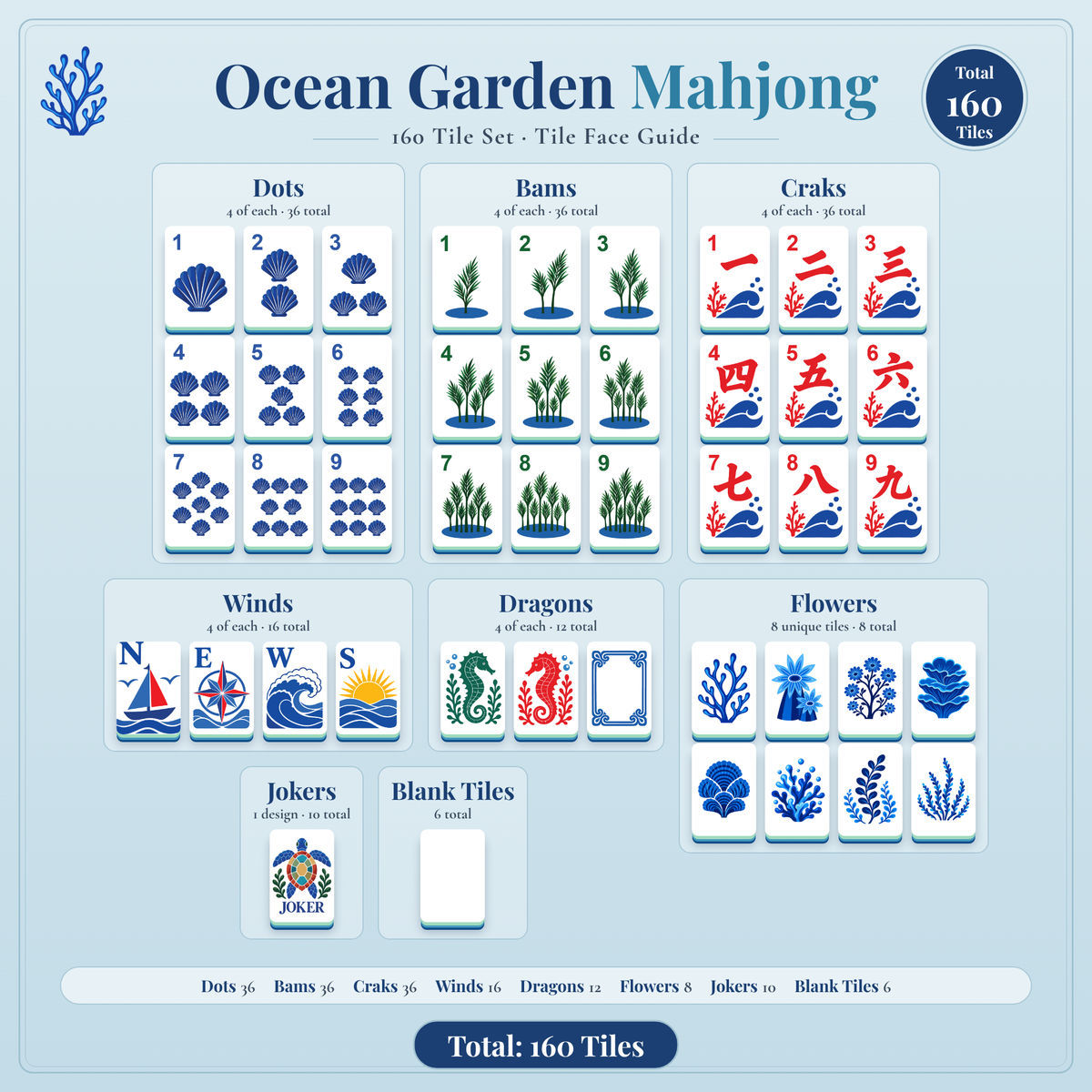
Hong Kong mahjong uses all 34 base tiles (characters, bamboos, circles 1–9 each; winds; dragons) drawn from a 108-tile deck, forming hands through melds (pungs/kongs) and one pair, with winners calling specific hand patterns. Taiwanese mahjong allows identical tile melds but adds bonus tiles (flowers, seasons), uses 144 tiles total, and permits more flexible hand completion—including winning on drawn or discarded tiles—with different scoring multipliers per hand type. Both are "closed" games: tiles remain face-down during play until exposed in a meld, unlike American mahjong's discarded tile row and seasonal flowers. A typical game lasts 16 rounds per player (four rounds × four wind positions). While both trace lineage to classical Chinese mahjong, Taiwanese rules evolved to include bonus tiles and faster winning conditions, whereas Hong Kong standardized around original 34-tile patterns and stricter point thresholds. We host games across American, Hong Kong, and Taiwanese variants—each rewards different reading skills and memory. 🀄 Shop best-selling mahjong sets →
What tiles does Hong Kong mahjong actually use?
Hong Kong mahjong uses 108 tiles total: three suits (characters, bamboos, circles) numbered 1–9 with four copies each (108 tiles), plus winds and dragons drawn from the same deck during play. There are no separate flower or season tiles; the game focuses on the core 34 tile types arranged in melds. Every player draws from the wall (face-down tile stack) and discards into a central pool, creating a live river of tiles that any player can claim if it completes a legal meld or winning hand.

How is Taiwanese mahjong different from Hong Kong?
Taiwanese mahjong builds on the 108-tile base by adding eight bonus tiles—four flowers (plum, orchid, bamboo, chrysanthemum) and four seasons (spring, summer, autumn, winter)—for 144 tiles total. A player drawing a bonus tile keeps it, sets it aside, and draws a replacement from the wall. Winning hands have more variants (including "all simples," "all terminals," "all honors"), and a single hand type can score different point values depending on whether it's self-drawn or claimed from a discard. Taiwanese players often play with a flat scoring cap per hand rather than multiplying by seat wind, making scores more predictable.
Do you discard tiles the same way in both games?
Both games use a discard row, but the strategy differs. In Hong Kong, players discard face-up into an ordered row (left to right per player) so the discard history is visible; claiming a tile reveals your meld to all players. In Taiwanese play, the discard row is usually cleared after each claim (the discarded tile is removed from play), which narrows tile visibility and increases bluffing. Neither game allows discards to be taken once a new player draws from the wall, unlike American mahjong's Charleston rule or tile-passing rituals.
How do scoring multipliers work in each variant?
Hong Kong mahjong multiplies points by a hand's complexity level (usually 1–8 times the base 20 or 30 points per meld, depending on the hand pattern). A player winning on their own draw might score double; winning on an opponent's discard is standard pay. Taiwanese mahjong often uses fixed point tables per hand type (e.g., "all simples" = 2 points, "all terminals" = 8 points) and multiplies by number of melds or bonus tile combinations, capping total per hand so one win never bankrupts all three opponents. American mahjong (used in our store community) uses entirely different scoring—hands are scored as single payouts per hand type from the National Mah Jongg League card, with no multipliers or melds revealed mid-play.
What's the winning condition in Hong Kong versus Taiwanese?
In Hong Kong mahjong, you win when you have four melds (pungs, kongs, or chows—runs of consecutive tiles) plus one pair, and the final tile completes either a meld or the pair; you must call "mahjong" before claiming the tile. In Taiwanese mahjong, the final tile can complete a meld, pair, or even a pung drawn from the deck, and some hands win with just three melds plus a pair. A Hong Kong player must declare they are waiting for specific tiles to win, narrowing strategic options. Taiwanese play is less rigid: you can win on almost any round after your first draw, creating faster, more aggressive play. American mahjong requires all four melds plus a pair on a single card-listed hand pattern, and tiles cannot be claimed until you expose the full hand and have declared it to the table.
Which variant is easier to learn first?
Hong Kong mahjong has simpler rules and fewer tile types (108 vs. 144), making it ideal for newcomers—you focus on four melds, one pair, and reading discard strategy. Taiwanese mahjong adds bonus tiles and flexible completion rules, which makes it faster but requires memorizing more hand patterns and scoring values. American mahjong (played with 152 tiles from an annual card) has the steepest learning curve because hands are fixed, jokers have special roles, and the Charleston tile-passing ritual must precede every game. We recommend starting with Hong Kong rules, then moving to Taiwanese once you're comfortable calling and strategizing around the discard row—and finally exploring American mahjong if you enjoy playing from a hand card with seasonal rotations.
Hong Kong vs. Taiwanese vs. American Mahjong at a Glance
Feature | Hong Kong | Taiwanese | American |
Total tiles | 108 | 144 (includes flowers/seasons) | 152 (includes winds, dragons, flowers, jokers) |
Hand structure | 4 melds + 1 pair | 3–4 melds + 1 pair (flexible) | 4 melds + 1 pair (card-listed only) |
Chows allowed? | Yes, exposed or in hand | Yes, exposed or in hand | No—pungs, kongs, quints, sextets only |
Bonus tiles | None | Flowers, seasons (8 tiles) | Flowers only (8 tiles); also winds, dragons |
Discard history | Visible in ordered row | Cleared after claim (hidden) | Visible; jokers can be called mid-play |
Scoring basis | Hand complexity × multiplier | Fixed hand table + meld/bonus count | Card-listed hand type = flat payout |
Typical game length | 16 rounds (4 rounds × 4 seats) | 16–20 rounds | Usually 8–12 rounds (American rules vary) |
Jokers/wildcards | None | None | 8 jokers; can substitute any tile in meld |
This table is based on standard modern rulesets for each variant as played in community games.

Strategy differences: what changes when you switch variants?
In Hong Kong play, you build defensive discard memory—opponents reveal melds, so you track which tiles are "safe" to discard. The game rewards position (being dealer gives scoring advantage), and you often fold if your hand is weak early. Taiwanese mahjong punishes caution: fast-moving rounds and bonus tiles mean sitting out is costly. You must decide early which hand type to pursue (all simples, mixed, all terminals) and commit to it. American mahjong flips strategy entirely—the hand card lists all legal patterns for the year, so memorization and rapid reference reading matter more than real-time deduction. Players expose melds as they build them, turning the game into a race: first to complete a card hand wins. None of these skills transfer directly, though veterans often develop a "feel" for tile flow regardless of variant.
🎁 See our most-loved mahjong sets & accessories →
What equipment do you need for each game?
All three variants use a standard tile set (either 108, 144, or 152 tiles depending on the game), a discard area, and a rack or holding space for each player's hand. Hong Kong and Taiwanese players typically use a mat to define the play surface, dividers between players' hand storage, and sometimes a scoring board. American mahjong adds specific gear: players need the current year's hand card (photocopied or laminated), a mat with labeled rack zones (racks with pushers help organize exposed melds), and a way to reference tiles quickly under time pressure. Our best-selling mahjong sets include acrylic tiles with clear markings that work for all variants, and mahjong mats designed with zones for exposure. For traveling between games, bags and cases keep tiles organized and protected. If you're planning to host multiple variants, a single high-quality set often suffices—just reference the correct rulebook per game.
Common mistakes when switching between Hong Kong and Taiwanese rules
Calling tiles too early: In Hong Kong, you declare "mahjong" when you have a winning hand and must take the tile immediately; calling too soon locks you in. In Taiwanese play, you can wait one more draw cycle to claim a different discarded tile, so patience sometimes pays. First-time Taiwanese players often rush, burning their optimal tile.
Forgetting bonus tiles exist: New Taiwanese players trained on Hong Kong rules forget that drawing a flower auto-replaces with a wall tile—they count it as a regular hand tile and miscalculate their meld count. Always set bonus tiles aside visibly.
Exposing melds incorrectly: Hong Kong rules require a claimed meld to be displayed immediately; Taiwanese rules often allow a delay. American mahjong exposes melds only once per turn. Mixing these up causes disputes over whether a meld is locked and can't be changed.
Misreading hand scoring: Hong Kong multiplies base points by complexity; Taiwanese uses a fixed table; American uses card payouts. Confusing these will leave you arguing over who owes whom. Always agree on scoring before play begins—write it down if playing a mixed group.
Discarding unsafe tiles: In Hong Kong, if two players have already called tiles, the discard row tells you which tiles are "dead." In Taiwanese games with quick discard clearing, that information vanishes fast. New players broadcast unsafe discards because they're used to Hong Kong's visible history.
What to check before you buy a set for Hong Kong or Taiwanese play
Tile size and clarity: Both games demand fast tile reading. Check that characters, bamboos, and circles are visually distinct and large enough for your eyesight and table distance.
Tile count: Confirm the set matches your intended game (108 for Hong Kong, 144 for Taiwanese). Most commercial sets offer 144 or 152 tiles; verify bonus tiles are included for Taiwanese.
Racks and pushers: Both variants benefit from racks with pushers to organize your hand and expose melds neatly—this speeds play and reduces accidental reveals.
Mat size: Ensure the mat fits your table and has clear zones for discard rows. Hong Kong players often prefer mats with a visible discard line; Taiwanese players may prefer a simpler surface if they discard quickly.
Language on tiles: Some sets display Chinese characters, pinyin, and English; others use symbols only. Choose based on your players' fluency—new learners benefit from multi-language tiles.
Weight and material: Acrylic tiles are durable, lightweight, and easy to clean; bamboo/bone is traditional but fragile. For frequent hosting, acrylic is practical.
✨ Find your Mahstead set — free US shipping →
Which variant should your game group play?
Choose Hong Kong if your group values simplicity and strong defensive play—it's ideal for beginners and players who enjoy reading opponents through discard history. Choose Taiwanese if you want faster rounds and more complex hand variety—it suits competitive players who like pursuing multiple win paths. Choose American if your group enjoys an annual-card format, wants exposure-based transparency, and prefers knowing all legal hands upfront (popular in the US and Canada). Many groups rotate between variants to keep skills sharp and stay social; a single high-quality best-selling set with clear tile markings works for all three. Start with whichever matches your existing player base, then expand once you're confident in one ruleset.

FAQ
Can I play Hong Kong and Taiwanese mahjong with the same tile set?
Yes, if the set includes 144 or more tiles. Hong Kong uses only 108 base tiles; Taiwanese uses 144 (with bonus flowers and seasons). Any set with 144+ tiles works for both, though you'd set aside the bonus tiles when playing Hong Kong.
Why don't Hong Kong and Taiwanese games allow chows (1-2-3 sequences)?
Actually, both do allow chows—they're a standard meld type. American mahjong is the variant that forbids chows; American players use only pungs, kongs, quints, and sextets.
Is one variant faster than the other?
Taiwanese mahjong is typically faster because bonus tiles and flexible winning conditions mean rounds conclude within 5–10 minutes. Hong Kong rounds average 8–15 minutes. American mahjong rounds vary but often run 10–20 minutes due to card reference time.
What's the best tile material for Hong Kong or Taiwanese play?
Acrylic tiles are durable, easy to read, and affordable; bamboo and bone are traditional but crack under heavy use. For weekly hosting, acrylic balances cost and longevity.
Can beginners learn Hong Kong and Taiwanese rules at the same table?
Not smoothly—the two games have different hand requirements, scoring, and discard strategies. Teach one variant fully, then introduce the second once players are confident. Mixing them mid-session causes confusion and slows play.
Do I need a special mat or racks for Hong Kong or Taiwanese play?
A mat with clear zones helps, but it's not mandatory. Racks with pushers are useful for organizing exposed melds so everyone can see them clearly—this speeds play and reduces disputes over what's been claimed.


View More
View More
View More
