
Hangzhou Mahjong Rules: A Complete Guide for Players
Last updated: Nov 23, 2026
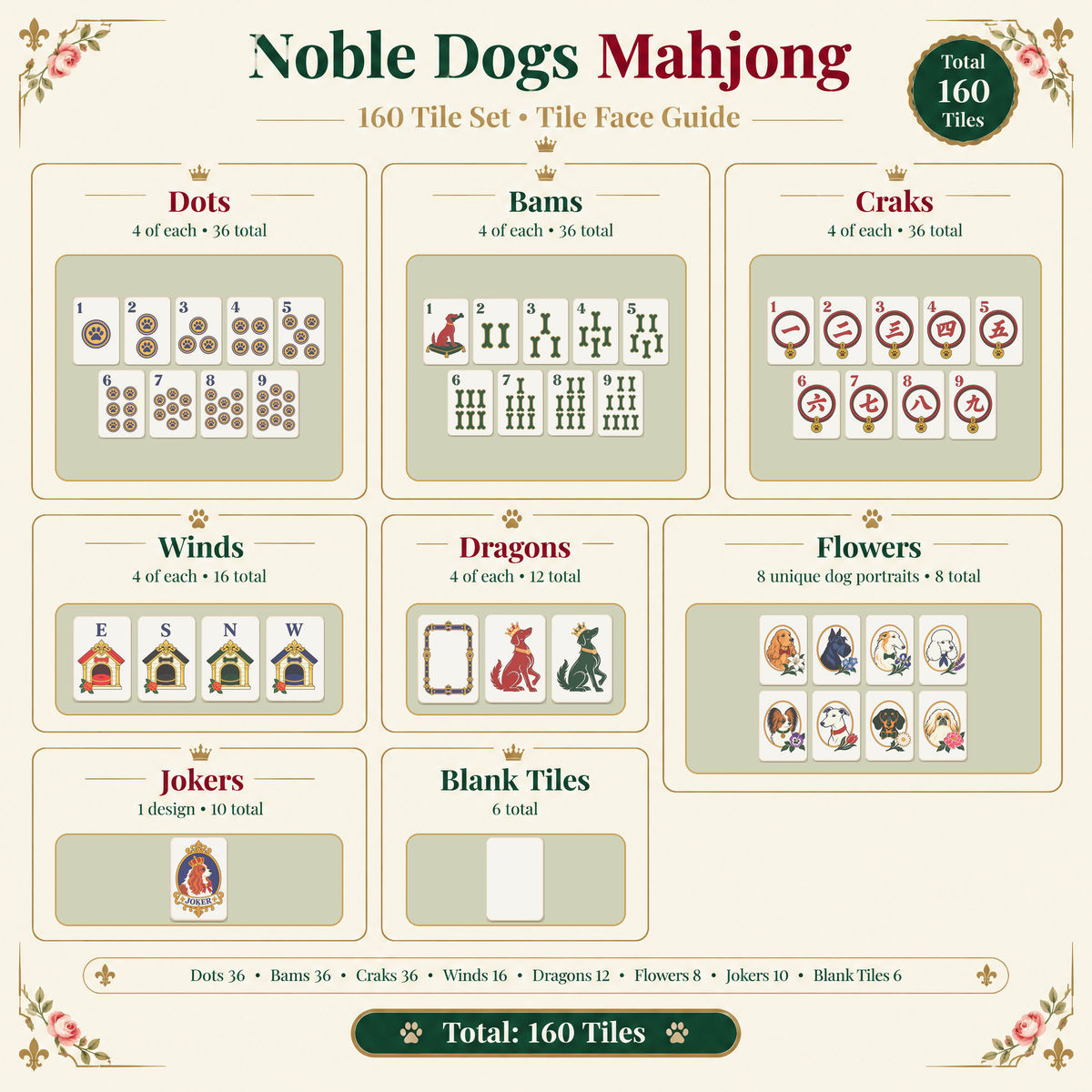
Hangzhou mahjong is a Chinese regional game popular in Zhejiang Province that uses 108 basic tiles (Bams, Craks, Dots numbered 1–9 in four copies each, plus Winds and Dragons) played by four players. Unlike American mahjong, Hangzhou permits chows (sequences: 1-2-3, 7-8-9, etc.) alongside pungs (three identical tiles) and kongs (four identical), drawn and discarded one tile per turn until someone completes a hand of four melds plus a pair. Scoring varies by hand type—sequences and simple tiles score lower than honor-heavy hands or all-pung hands—and rounds typically last 15–30 minutes per hand. The game requires no National Mah Jongg League card and has no jokers in traditional play. Hangzhou mahjong emphasizes reading discard patterns and speed; beginners should master basic melds before attempting advanced hands. For American players switching to Hangzhou, the biggest shift is learning to call and play sequences openly, which American mahjong forbids entirely.
What tiles does Hangzhou mahjong use?
Hangzhou mahjong plays with 108 base tiles: three suits (Bams, Craks, Dots) numbered 1–9 in four copies each (36 per suit), four Winds (North, East, South, West), and three Dragons (Red, Green, White). No jokers or flowers are standard. The 1 Bam typically depicts a bird; the White Dragon is sometimes called "Soap." Players draw from a wall of stacked tiles and discard face-up into a center pool each turn, keeping 13 tiles in hand plus one drawn tile before discarding.

How do melds differ from American mahjong?
American mahjong only allows exposed pungs (three identical), kongs (four identical), and higher groups—never sequences. Hangzhou mahjong permits both pungs and chows (meld sequences like 4-5-6 Bams). You can call and expose any chow or pung openly on your turn; jokers are not used. A completed hand consists of four melds (each pung, kong, or chow) plus one pair. This openness makes Hangzhou faster and more interactive—you can see opponents' strategy forming and respond. American players unfamiliar with sequences often take a few hands to retrain their eye; chows are always three consecutive tiles in one suit only.
What are the basic winning conditions?
In Hangzhou, you win (called "meld hand" or 胡) when you hold exactly four melds plus a pair. You can win on your own turn after drawing (self-draw win, worth bonus points) or by claiming an opponent's discard immediately (discard win). Some schools recognize a closed hand win (no exposed melds before declaring) as premium. Beginner games often use simpler scoring: any meld-plus-pair wins one base point, self-draw doubles it. Advanced play applies multipliers for honor tiles (Winds, Dragons) or patterns like all-sequences or all-same-suit. Unlike American mahjong (where hands come from an annual card), Hangzhou has no fixed hand list—any four melds plus a pair is valid. This freedom makes it easier to learn but requires sharper reading of board flow.
How does scoring and settlement work?
Hangzhou scoring is typically point-based rather than hand-value based. A simple meld-and-pair hand wins one base unit (or point) from the player whose tile was claimed, or from all three players if you self-draw. Winning with honor melds (all Winds, all Dragons, or mixed) multiplies the base: for example, a hand with two Dragon pungs and a Wind pung might be worth 2–3 base units. Some regional rules add bonuses for no-discard wins (pure self-drawn) or all-chow hands. At the end of a round (usually 4 hands, one per seating position), players settle: the one with the highest point total collects the difference from each other player. Cash amounts are set before play begins—common minimums are ¥0.50–¥2 per point. American mahjong uses hand values from the card (ranging roughly 300–1000 points) and complex settlement; Hangzhou is more fluid and faster, ideal for social play.
What are the most common errors new players make?
Discarding too early. Many beginners discard a high-risk tile before seeing the discard pool; wait one or two rounds to learn which tiles others need. If three players have already discarded 1 Craks, the fourth likely holds them or will soon discard safely.
Assuming all four tiles of a suit/honor are safe. Even if three copies of a tile are visible, the fourth is dangerous—someone holds it and will discard on their next safe moment, often catching an eager caller mid-wait.
Calling chows from far-away players. In Hangzhou, you can call a discard from any player to complete a meld, but calling from a player not immediately to your left is slower. Focus first on melds using tiles from the player at your right (traditional flow).
Ignoring exposed melds. Once a player exposes a pung or chow, mentally remove those tiles from play. If two players have exposed 6-7-8 Dots, don't wait for a 9 Dot in that position.
Not tracking the discard timeline. Hangzhou is pattern-read heavy—if player A always discards high Craks early and low Bams late, use that rhythm. American players are used to a static card; Hangzhou requires live adaptation.
🀄 Shop best-selling mahjong sets →

Can you move between American and Hangzhou play without confusion?
Many players enjoy both. The main mechanical differences: Hangzhou uses chows and allows jokerless play; American uses jokers, forbids sequences, and relies on a card. If you play both regularly, keep your American set separate—store your best-selling mahjong sets in a clearly labeled mahjong bag or case and use a different case for Hangzhou tiles. We recommend buying a dedicated acrylic set for American play (156 or 160 tiles, which includes extra jokers and spares) to avoid tile loss during transport. For Hangzhou, a simpler 108-tile traditional bone or bamboo set from a specialist supplier (outside Mahstead's range) is authentic, but many groups in North America now use the same acrylic sets, simply ignoring jokers and treating the set as a 108-tile pool. The key: know which ruleset your group plays before arriving.
What's the fastest way to learn Hangzhou mahjong?
Play five "learning hands" with one experienced player teaching. Ask them to play with scoring off first—focus only on calling melds and completing the four-meld-plus-pair structure. Once you can spot chow opportunities (1-2-3, 4-5-6, etc.) and execute a simple win, play one real hand with light stakes. Watch the discard pile religiously; Hangzhou rewards tile-memory more than American play. Attend a local Hangzhou meetup (search community centers, libraries, or Chinese cultural associations near you) and observe one full round before joining. Most groups have a "new player" table. Within 3–4 hours of active play, the rules will feel natural.
Hangzhou vs. American: Quick Comparison
Aspect | Hangzhou | American |
Tiles | 108 base (no jokers standard) | 152 total (8 jokers, 4 blanks, 4 extra jokers) |
Melds allowed | Pungs, kongs, chows | Pungs, kongs, quints, sextets—no chows |
Jokers | Not used (traditional) | Essential; cannot be pair or single |
Hand source | Player-generated; any four melds + pair | Annual National Mah Jongg League card only |
Winning call | Self-draw or claim discard; any valid meld-pair | Match card pattern exactly; self-draw or discard |
Scoring | Points/units settled per round; simpler | Hand-value multipliers (320–1000+) from card |
Learning curve | 2–3 hours to basic play | 4–6 hours to read card confidently |
Social feel | Fast, intense, memory-heavy | Strategic, card-driven, rule-fixed |
🎁 See our most-loved mahjong sets & accessories →
What do you need to host a Hangzhou game at home?
If borrowing a traditional set, ensure all 108 tiles are present and undamaged. If using an American acrylic set as a substitute (many North American players do), you have 152 tiles, which is fine—simply set aside the 8 jokers and extras. You'll need a flat, hard playing surface: a standard dining table, a mahjong mat with a recessed center well (optional but protects tiles and sound), and ideally racks with pushers for each player to organize their hand neatly. Bring a pen and paper for score tracking—most groups tally points on a notepad or use a simple app. A quiet space without distractions helps everyone track the fast discard flow. If you're hosting regularly, a dedicated felt or vinyl mahjong mat protects your furniture and gives the game a professional feel. No dice are needed for Hangzhou (unlike American, which uses dice to determine the wall-break position); deal and break the wall by agreement or highest-suit rotation.
✨ Find your Mahstead set — free US shipping →
What to check before you buy or borrow a set
Tile count & condition. Hangzhou needs 108 tiles minimum. If tiles are chipped, missing, or faded, sorting melds becomes harder. American acrylic sets have 152 tiles + spares, so loss of one or two never stops play.
Suit clarity. Bams, Craks, and Dots must be visually distinct at arm's length. Faded bamboo or jade sets can blur the eye in dim light.
Size & weight. Standard tiles are ~1 inch × ¾ inch × ½ inch. Oversized tiles suit players with vision or dexterity needs; small tiles suit tight tables.
Storage. Check that your set fits the box and closes fully. Tiles rattling loose during transport will shift; a mahjong bag or case with foam dividers or a soft interior protects against tile breakage.
Rack compatibility. Some traditional sets come with wooden racks; acrylic sets often do not. Verify racks are included or compatible before assuming.

FAQ
Is Hangzhou mahjong played in North America, or mainly in China?
Hangzhou mahjong is primarily played in Zhejiang Province and eastern China, but Chinese immigrant communities in North America host regular games—especially in areas with large Mainland populations. You can find groups through community centers, Chinese cultural associations, and online meetup boards; search your city name plus "mahjong meetup" or check local library bulletin boards.
Can I use an American mahjong set for Hangzhou play?
Yes. American sets have 152 tiles; set aside the 8 jokers and extras, and use 108 tiles as normal. Acrylic tiles work fine. The only difference is you'll have excess tiles in the box—no problem.
Do I need to memorize hand patterns for Hangzhou mahjong?
No. Unlike American mahjong (which relies on a card), Hangzhou is open-ended: any four melds plus a pair wins. You only need to recognize chows (consecutive numbers), pungs (three identical), and kongs (four identical)—no memorization required.
How long does a typical Hangzhou game last?
One hand averages 5–20 minutes depending on how quickly tiles flow and whether disputes arise. A full session (4 hands, one seating per player) lasts 30–90 minutes. Experienced players move faster.
What's the biggest rule difference if I switch from American to Hangzhou?
Sequences (chows). American mahjong forbids chows entirely and relies on a card; Hangzhou requires chows, self-generates hands, and has no card. The mental shift from "find the pattern on the card" to "any four melds plus a pair" takes one or two hands to internalize.
Do I lose if I can't complete a hand before the wall runs out?
In most Hangzhou schools, yes—if the wall empties and no one has melded, the round is declared a draw (no payout) and the next player deals. Some advanced variants award a small bonus to the player closest to winning.
Can I play Hangzhou with 3 or 2 players?
Traditional Hangzhou is four-player. Three-player variants exist (using 81–99 tiles and adjusted hand sizes) but are less common and require a house ruleset. For beginners, stick to four-player games with a standard group.


View More
View More
View More
